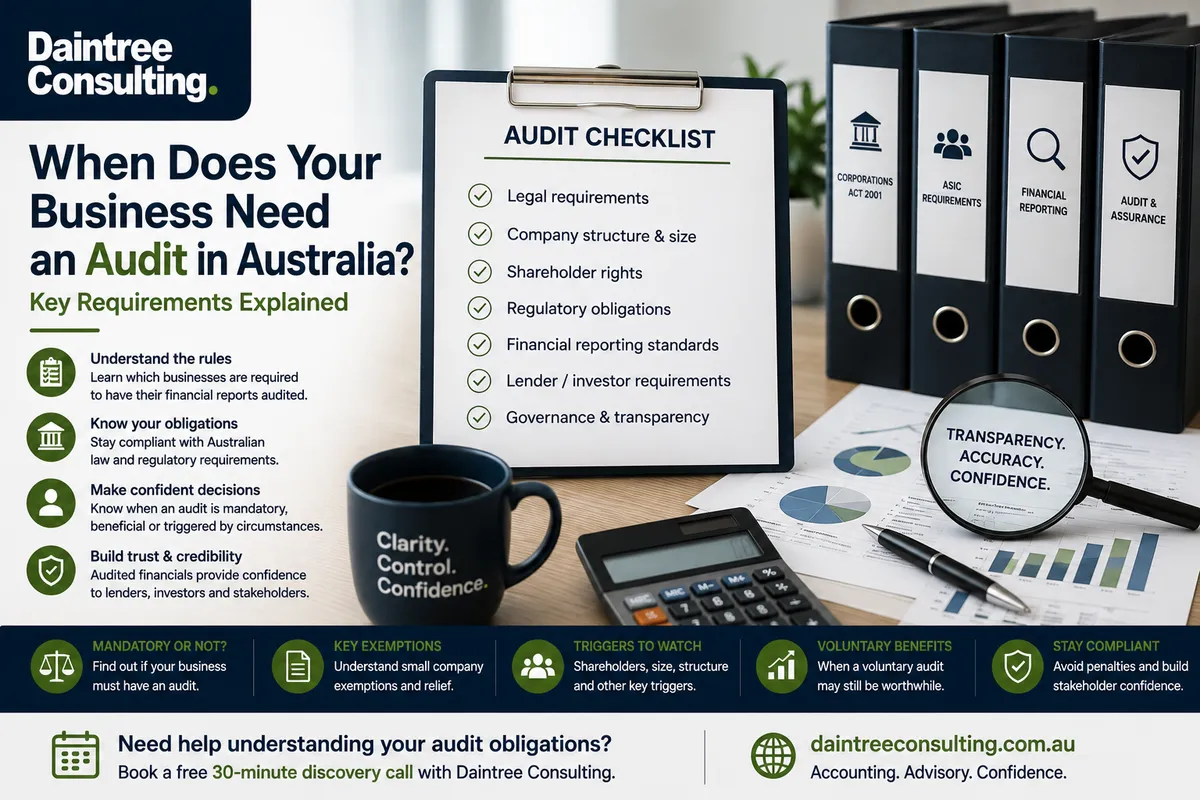
When Does a Business Need an Audit in Australia? Key Requirements
Not every Australian business is required to have its financial statements audited.
For many small businesses, an annual audit is not a mandatory requirement. But as a company becomes larger, changes its structure, raises capital, becomes subject to additional regulation or falls into a specific reporting category, an audit may become compulsory.
Want expert help? Daintree Consulting's audit and assurance services can take this off your plate. Book a free consultation.
So, when does a business need an audit?
The answer depends on the legal structure of the business, its size, ownership, reporting obligations and circumstances.
For example, under the Corporations Act 2001, certain companies and entities must have their financial reports audited, including public companies, disclosing entities, registered schemes and registrable superannuation entities. Large proprietary companies generally also have annual financial reporting and audit obligations, subject to limited relief.
This means you should not assume that your business does or does not need an audit simply because of its revenue.
The correct approach is to look at the business's entity type and specific reporting obligations.
Quick Answer: When Does a Business Need an Audit?
A business may need an audit because:
The law requires its financial report to be audited
It is a large proprietary company
It is a public company or disclosing entity
It is a registered scheme or another regulated entity
It is subject to specific regulatory requirements
Its constitution or governing documents require an audit
A lender, investor, grant provider or other stakeholder requires audited financial statements
Members or shareholders have exercised certain rights
The business voluntarily chooses to obtain independent assurance
The exact requirements depend on the entity.
For Australian companies, ASIC states that certain entities must have their financial reports audited by a registered company auditor.
What Is a Business Audit?
A financial statement audit is an independent examination of a company's financial report.
The auditor obtains evidence and performs procedures to determine whether the financial report has been prepared in accordance with the applicable financial reporting framework and whether it contains material misstatements.
The result is an independent auditor's report.
An audit does not mean that an auditor checks every transaction or guarantees that a business has no fraud or financial problems.
Instead, the audit is designed to provide a high level of assurance about whether the financial report is materially misstated.
For companies required to have an audit under the Corporations Act, the audit must be performed in accordance with the applicable requirements and an auditor's report obtained.
Is an Audit Required for Every Australian Business?
No.
This is one of the most important points for business owners.
A typical small business operating through a small proprietary company will not automatically be required to have its annual financial statements audited simply because it operates a business.
ASIC distinguishes between large and small proprietary companies.
A proprietary company is generally classified as large when it satisfies at least two of the relevant size criteria for the financial year.
For financial years commencing on or after 1 July 2019, those criteria are:
Consolidated revenue of $50 million or more
Consolidated gross assets of $25 million or more
100 or more employees
The thresholds consider the company and entities it controls.
If the company meets at least two of these criteria, it is generally classified as a large proprietary company.
Large proprietary companies generally need to prepare and lodge financial reports, and their accounts must be audited unless applicable relief applies.
When Does a Large Proprietary Company Need an Audit?
For many growing Australian businesses, this is one of the most important areas to understand.
A proprietary company is generally considered large if it satisfies at least two of the applicable size tests.
That means you should not assess your status based only on annual revenue.
For example, a business might have revenue below the revenue threshold but still meet the large-company definition because of its assets and employee numbers.
Conversely, meeting only one of the tests does not automatically make the company large.
ASIC explains that large proprietary companies must prepare and lodge financial reports and that the accounts generally need to be audited unless ASIC relief applies.
Because the calculation can involve controlled entities and consolidated figures, businesses approaching these thresholds should obtain professional advice rather than relying on a simple calculation of their own standalone revenue.
Do Public Companies Need an Audit?
Generally, yes.
Under the Corporations Act, companies other than certain small proprietary companies, as well as registered schemes, registrable superannuation entities and disclosing entities, are within the mandatory audit framework for annual financial reports.
Public companies have specific financial reporting obligations under Chapter 2M of the Corporations Act.
The precise requirements can depend on whether the company is also a disclosing entity or falls within another category.
If you operate a public company, audit and financial reporting obligations should therefore be considered part of the company's ongoing governance process.
What About Small Proprietary Companies?
This is where many business owners become confused.
A small proprietary company does not automatically need an annual audit simply because it is a registered company.
However, there are circumstances where a small proprietary company may still have financial reporting obligations.
ASIC identifies circumstances including:
Shareholders directing the company to prepare financial reports
ASIC directing the company to prepare financial reports
The company having one or more crowd-sourced funding shareholders
The company being controlled by a foreign company
There are also specific exemptions and audit-relief provisions that may apply in some circumstances.
This is why it is risky to say:
"We're a small company, so we don't need an audit."
The correct answer depends on the company's circumstances.
Can Shareholders Require a Small Company to Prepare Financial Reports?
Yes, in certain circumstances.
ASIC explains that members of a small proprietary company with at least 5% of the votes can direct the company to prepare and circulate financial reports to shareholders.
This can create additional financial reporting obligations even where the company would not otherwise have to prepare and lodge annual financial reports.
Whether an audit is also required can depend on the circumstances and the specific direction.
If shareholders are requesting financial information or raising concerns about reporting, directors should obtain appropriate professional advice rather than assuming that the company's normal reporting arrangements are sufficient.
Does Foreign Ownership Change Audit Requirements?
It can.
Foreign-controlled small proprietary companies can have additional financial reporting obligations.
ASIC identifies foreign-controlled small proprietary companies among the entities that may be required to lodge financial reports. There are also specific relief provisions that can apply in certain circumstances.
This means ownership structure matters.
A company that looks like a small Australian business based on its own operations may have different reporting obligations if it is controlled by a foreign company.
The exact circumstances should be reviewed before deciding whether an audit is required.
Do Charities Need an Audit?
Charities operate under a different reporting framework, so business owners and not-for-profit directors should not automatically apply the company rules discussed above.
Under the Australian Charities and Not-for-profits Commission (ACNC) framework:
Small charities generally have no ACNC requirement for their annual financial report to be reviewed or audited, although their governing document may impose additional requirements.
Medium charities generally need their annual financial report to be either reviewed or audited.
Large charities generally need their annual financial report to be audited.
The ACNC also notes that governing documents, grant agreements and other regulators can create additional requirements.
So if your organisation is a charity, you need to consider both the ACNC requirements and any additional obligations that apply to your organisation.
Can a Business Choose to Have an Audit Even If It Isn't Required?
Yes.
An audit does not have to be mandatory to be valuable.
Some businesses voluntarily obtain an independent audit because it provides additional confidence to:
Owners
Directors
Investors
Banks
Potential buyers
Business partners
Grant providers
Other stakeholders
A voluntary audit may also become useful when the business is preparing for a major transaction or significant change.
For example, a business preparing for a sale may want stronger financial reporting and independent assurance before entering discussions with potential buyers.
When a Voluntary Audit May Be Worth Considering
Even when there is no legal requirement, an audit may make commercial sense when:
You are preparing for a business sale
Potential buyers may place greater emphasis on the quality and reliability of financial information.
You are seeking significant finance
A lender or financier may request audited or independently reviewed financial statements as part of its assessment.
You have external investors
Investors may want greater confidence in the financial reporting process.
Your business has become more complex
Multiple entities, locations, revenue streams or significant transactions can increase financial reporting risk.
There are concerns about internal controls
An independent review of financial processes can help identify areas that require improvement.
Ownership is changing
An audit can provide additional confidence when different shareholders or owners have different interests.
The value of an audit in these circumstances is not simply compliance.
It can be about trust, transparency and financial confidence.
Audit vs Review: Are They the Same?
No.
An audit and a review provide different levels of assurance.
An audit involves more extensive procedures and evidence gathering and provides a higher level of assurance.
A review generally involves fewer procedures and provides limited assurance.
The appropriate engagement depends on the circumstances and applicable requirements.
For example, the ACNC allows medium charities to have their annual financial reports either reviewed or audited, while large charities must have them audited.
The distinction is important because a business should not assume that a review is an acceptable substitute where legislation requires an audit.
What Does an Auditor Look At?
Once you know that an audit is required, the next question is usually:
What will the auditor actually examine?
The audit may involve areas such as:
Revenue and sales
Expenses
Bank accounts
Accounts receivable
Accounts payable
Inventory
Fixed assets
Loans and borrowings
Payroll
Tax balances
Equity
Financial statement disclosures
Related-party transactions
Internal controls
Significant estimates and judgements
Supporting documentation
The exact procedures depend on the business, financial statements, risks and audit circumstances.
The auditor's objective is not simply to check whether every number matches a bank statement.
They consider whether there is a risk that the financial report contains a material misstatement and obtain sufficient appropriate audit evidence to support their opinion.
What Happens If Your Business Needs an Audit?
If an audit is required, it is better to prepare throughout the year rather than treating the audit as a year-end event.
A strong process generally includes:
1. Keep financial records current
Your bookkeeping should be maintained throughout the year.
2. Reconcile key accounts
Bank accounts, credit cards, loans and other balance sheet accounts should be regularly reconciled.
3. Maintain supporting documentation
Invoices, contracts, payroll records and other supporting evidence should be organised and accessible.
4. Review unusual transactions
Large, unusual or complex transactions should be identified and documented.
5. Review balance sheet accounts
Don't focus only on the profit and loss statement.
Balance sheet accounts can contain significant errors if they are not reviewed properly.
6. Prepare management schedules
Schedules supporting areas such as fixed assets, receivables, payables and loans can make the audit process more efficient.
7. Communicate with the auditor early
If your business has complex transactions or significant changes, discuss them with the auditor before year-end where appropriate.
How Long Does an Audit Take?
There is no single standard timeframe.
The length of an audit can depend on:
Business size
Number of transactions
Complexity of the entity
Quality of financial records
Number of entities
Internal controls
Availability of supporting documentation
Complexity of accounting estimates
Level of audit risk
How prepared the business is
A well-organised finance function can make the process significantly smoother.
Poorly maintained records can create additional questions, requests and delays.
That is why audit preparation should begin well before the auditor arrives.
What Happens If You Ignore an Audit Requirement?
Failing to meet a mandatory audit or financial reporting obligation can create serious compliance and governance issues.
Depending on the circumstances, the consequences may include:
Regulatory action
Delayed financial reporting
Additional professional costs
Difficulties with lenders or investors
Governance concerns
Potential penalties or other consequences
The exact consequences depend on the entity and the obligation involved.
If you are unsure whether your business is required to have an audit, it is better to clarify the position early rather than discovering the requirement after a reporting deadline has passed.
How Daintree Consulting Can Help
At Daintree Consulting, we help Australian businesses understand and prepare for their financial reporting and audit requirements.
Our support can include:
Financial reporting
Accounting
Bookkeeping
Audit preparation
Management reporting
Internal control reviews
Financial data organisation
Business advisory
Coordination with auditors
The objective is to make sure your financial information is accurate, organised and ready for the level of reporting your business requires.
For businesses approaching the large proprietary company thresholds, changing ownership structures or preparing for significant transactions, early planning can help avoid unnecessary surprises.
How to Know If Your Business Needs an Audit
If you're asking "when does a business need an audit?", start with these questions:
1. What type of entity are we?
Are you a proprietary company, public company, charity, registered scheme or another type of entity?
2. Are we classified as a large proprietary company?
Check the relevant revenue, assets and employee criteria.
3. Are we foreign-controlled?
Ownership and control can affect reporting requirements.
4. Are there shareholders or members with specific rights?
A shareholder direction may create additional reporting obligations.
5. Are we subject to another regulator?
Some industries and entity types have additional requirements.
6. Does our governing document require an audit?
Your constitution, trust deed or other governing document may impose requirements beyond the general rules.
7. Does a lender, investor or other stakeholder require audited accounts?
A commercial requirement can exist even when the law does not require an audit.
8. Are we planning a major transaction?
An audit or other assurance engagement may provide additional confidence during a sale, funding process or ownership change.
Final Takeaway
There is no single rule that says every Australian business must have an audit.
For many small proprietary companies, an annual audit is not automatically required.
However, audit obligations can arise because of the company's size, legal structure, ownership, regulatory status, shareholder directions or other circumstances.
Large proprietary companies, public companies and various regulated entities have specific financial reporting and audit requirements, while charities operate under their own reporting framework.
The important point is:
Don't wait until year-end to find out whether an audit is required.
Understanding your reporting obligations early gives your business more time to prepare accurate records, address control weaknesses and avoid unnecessary delays.
Need Help Determining Whether Your Business Needs an Audit?
If you're unsure whether your business has an audit requirement, the first step is to review its entity structure, size, ownership and reporting obligations.
Daintree Consulting can help you understand your financial reporting position and prepare your business for the next stage of growth.
Book a free 30-minute discovery call to discuss your current reporting structure and identify any areas that may need attention.
Frequently Asked Questions
When does a business need an audit in Australia?
It depends on the entity and its circumstances. Certain companies and regulated entities are required to have financial reports audited, while many small proprietary companies are not automatically subject to an annual audit.
Does every Australian company need an audit?
No. Small proprietary companies are generally not automatically required to have their financial reports audited, although specific circumstances can create reporting and audit obligations.
What size business needs an audit in Australia?
For a proprietary company, being classified as large generally requires meeting at least two of the relevant size criteria: $50 million or more in consolidated revenue, $25 million or more in consolidated gross assets, or 100 or more employees. Other entity types have different requirements.
Does a small proprietary company ever need an audit?
Yes. A small proprietary company can have additional financial reporting obligations because of circumstances such as shareholder directions, ASIC directions, crowd-sourced funding shareholders or foreign control. Specific audit relief provisions may also apply.
Do public companies need to be audited?
Generally, yes. Companies within the mandatory audit provisions of the Corporations Act must have their financial reports audited and obtain an auditor's report.
Do charities need an audit?
Large charities generally need an audit under the ACNC framework. Medium charities generally need either a review or an audit, while small charities generally have no ACNC audit or review requirement unless another requirement applies.
Can a business voluntarily have an audit?
Yes. A business can choose to obtain independent assurance even where an audit is not legally mandatory. This may be useful for funding, investment, business sales, governance or other commercial reasons.
Who can perform a company audit?
Company audits must generally be performed by an appropriately authorised auditor, such as a registered company auditor, an authorised audit company or an eligible audit firm, depending on the circumstances.
How often does a business need an audit?
Where an annual audit is required, it is generally connected to the entity's annual financial reporting cycle. However, the exact reporting and audit obligations depend on the entity and applicable legislation.
What happens if my business is unsure whether an audit is required?
Don't assume. Review the company's structure, size, ownership, reporting obligations and any applicable regulatory or contractual requirements. Professional advice can help determine the correct position before financial reports are prepared or lodged.
Important Publishing Note
Audit and financial reporting requirements can depend on the entity type, company structure, ownership, size, regulatory status and individual circumstances. Australian legislation, ASIC requirements, ACNC requirements and other regulatory obligations can change. This article is provided for general information and should not be treated as legal, accounting or audit advice. Daintree Consulting should verify specific requirements against the applicable legislation and regulator guidance before publication or when updating this article.
For company audit requirements, ASIC and the Corporations Act 2001 should be treated as primary sources. For registered charities, the ACNC should be consulted for the applicable reporting and audit requirements.
Talk to Daintree about your audit
Our ex-Big 4 team gives clear, senior-reviewed advice so you can act with confidence.
Book a free consultation →
Or explore our audit and assurance services.
