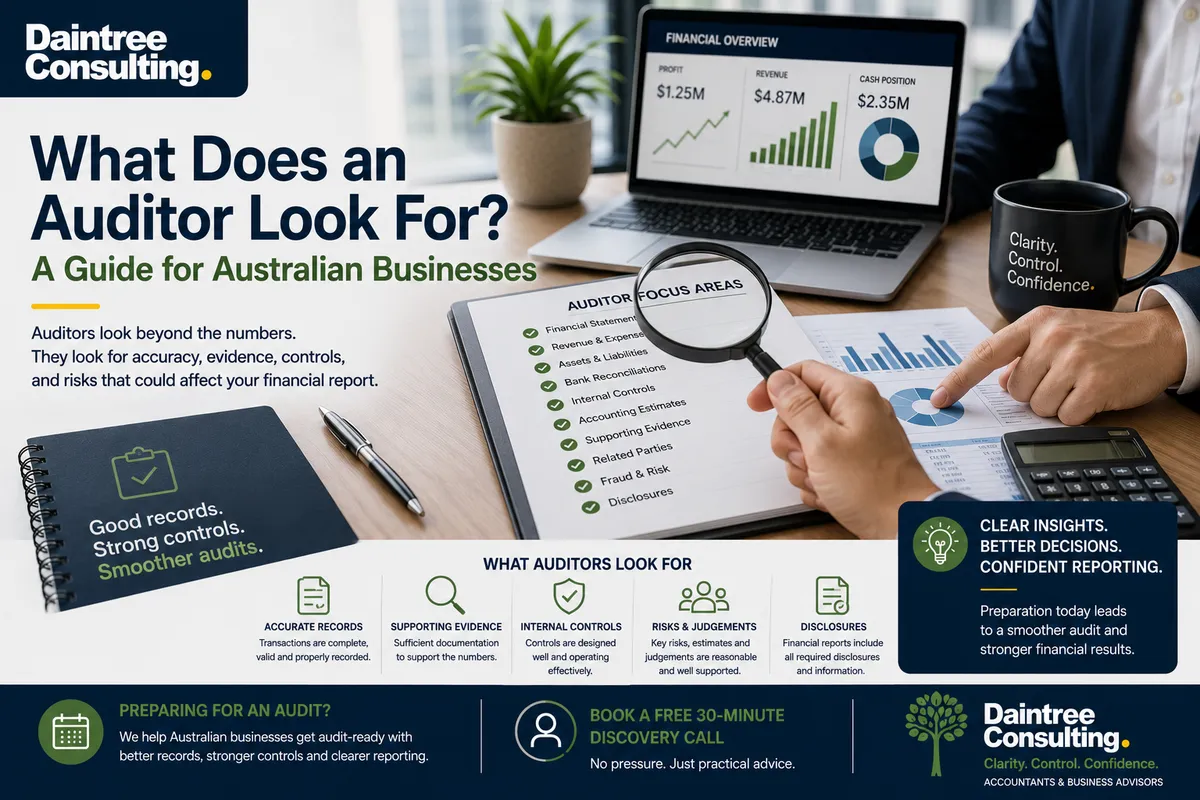
What Does an Auditor Look For? A Guide for Australian Businesses
If your business is preparing for an audit, one of the most common questions is: what does an auditor actually look for?
The answer is broader than simply checking whether the numbers add up.
Want expert help? Daintree Consulting's audit and assurance services can take this off your plate. Book a free consultation.
An auditor looks at the financial information, supporting evidence, accounting treatments, internal controls and business processes that could affect whether the financial report contains a material misstatement. Australian auditing standards require auditors to identify and assess risks of material misstatement arising from both error and fraud, then design procedures to obtain sufficient appropriate audit evidence.
For business owners, this means an audit is not just about having a clean set of accounts. It is about being able to demonstrate where the numbers came from, why they are correct, and what evidence supports them.
This guide explains the main areas an auditor may examine and what Australian businesses can do to prepare.
Quick Answer: What Does an Auditor Look For?
An auditor will generally focus on areas such as:
Financial statements — whether the reported financial information is materially accurate and prepared under the applicable reporting framework.
Supporting records — invoices, contracts, bank statements, reconciliations and other evidence supporting recorded transactions.
Revenue and expenses — whether transactions are genuine, complete, correctly recorded and appropriately classified.
Assets and liabilities — whether balances exist, are valued appropriately and are properly supported.
Internal controls — whether important controls are appropriately designed and implemented.
Accounting estimates and judgements — whether assumptions and estimates are reasonable and adequately supported.
Related-party transactions — whether transactions with related parties are identified, recorded and disclosed appropriately.
Fraud and error risks — whether circumstances exist that could result in material misstatement.
Going concern — where relevant, whether there are circumstances that raise questions about the entity's ability to continue operating.
Financial statement presentation and disclosures — whether required information is appropriately presented and disclosed.
The exact procedures depend on the entity, audit purpose, reporting framework, risks and circumstances. There is no single checklist that applies identically to every Australian business.
What Is an Auditor Actually Trying to Establish?
The auditor's job is not to prove that every single transaction in your business is correct.
Instead, the auditor assesses the risk that the financial report contains a material misstatement and performs procedures designed to obtain sufficient appropriate audit evidence.
Under ASA 315, auditors consider risks at both the overall financial-report level and the level of individual transactions, account balances and disclosures.
This is why auditors may pay particular attention to areas where:
transactions are complex
management judgement is significant
estimates are uncertain
controls are weak
fraud risk is higher
balances are financially significant
unusual transactions have occurred
accounting treatments are difficult to determine
supporting evidence is incomplete
In other words, the auditor's attention is risk-based rather than simply transaction-based.
1. Financial Statements and the Overall Financial Position
One of the first areas an auditor considers is the financial report itself.
Depending on the engagement, this may include:
Profit and loss statement
Balance sheet
Cash-flow information
Changes in equity
Financial statement notes and disclosures
Supporting schedules and reconciliations
The auditor considers whether the financial report has been prepared in accordance with the applicable financial reporting framework and whether it is materially misstated.
For companies subject to the Corporations Act, ASIC explains that auditors have responsibilities relating to whether the financial report complies with accounting standards and gives a true and fair view, as well as whether appropriate financial records have been maintained.
This is why your accounting records need to tell a consistent story.
If the balance sheet says one thing but supporting schedules, bank reconciliations or contracts suggest something different, the auditor will usually investigate further.
2. Revenue and Sales
Revenue is often an important audit area because mistakes in revenue recognition can materially affect reported performance.
An auditor may examine:
Sales invoices
Customer contracts
Receipts
Credit notes
Revenue reconciliations
Cut-off around year-end
Unusual or large transactions
Revenue recognition policies
Deferred or unearned revenue
The auditor may also test whether transactions recorded as revenue actually occurred and whether all relevant revenue has been recorded.
ASIC identifies revenue recognition as an important financial reporting focus area, including whether revenue is recognised consistently with the underlying transactions and applicable performance obligations.
What can cause concern?
Examples include:
Large unexplained movements in revenue
Sales recorded in the wrong accounting period
Inconsistent revenue recognition
Missing contracts
Unusual year-end transactions
Poor reconciliation between sales systems and accounting records
The solution is not to make the numbers "look good." It is to ensure the accounting treatment accurately reflects the underlying transaction.
3. Expenses and Purchases
Auditors may also test expenses to determine whether they are genuine, complete, correctly classified and recorded in the appropriate period.
Supporting evidence may include:
Supplier invoices
Purchase orders
Contracts
Payment records
Expense reports
Credit-card statements
Approval documentation
They may pay particular attention to unusual transactions, significant expenditure or transactions that require judgement.
Businesses should be able to explain significant movements in expenses and provide supporting documentation when requested.
4. Bank Accounts and Reconciliations
Bank balances are fundamental to financial reporting, so auditors commonly examine bank accounts and reconciliations.
You may be asked to provide:
Bank statements
Bank reconciliations
Confirmation information
Details of outstanding transactions
Supporting documentation for unusual payments or receipts
A clean bank reconciliation process makes the audit much easier.
If bank accounts have unreconciled items dating back months, unexplained differences or transactions that cannot be supported, those issues can create additional questions and audit work.
5. Accounts Receivable and Debtors
If your business has outstanding customer balances, the auditor may assess whether those receivables are genuine and recoverable.
This can involve examining:
Aged receivables reports
Customer invoices
Subsequent payments
Credit notes
Disputed balances
Bad-debt provisions
A large debtor balance does not automatically mean there is a problem.
However, if customers have not paid for a long time, the auditor may question whether the balance should remain fully recognised.
6. Accounts Payable and Creditors
Auditors may also examine whether liabilities have been completely recorded.
This is important because businesses can sometimes have obligations that have not yet been entered into the accounting system.
An auditor may examine:
Supplier statements
Outstanding invoices
Payments made after year-end
Expense accruals
Contracts
Purchase commitments
The underlying question is simple:
Are the liabilities reported in the financial statements complete and accurate?
7. Assets and Asset Valuations
Auditors may examine whether assets recorded by the business actually exist and whether their carrying values are appropriate.
Depending on the business, this could involve:
Property
Plant and equipment
Vehicles
Inventory
Intangible assets
Investments
Other significant assets
ASIC identifies asset values as an area requiring particular attention, especially where valuation involves significant judgement or estimation.
The auditor may ask for:
Purchase documentation
Asset registers
Valuation reports
Depreciation calculations
Ownership documents
Evidence of impairment considerations
8. Inventory
For businesses holding stock, inventory can be a significant audit area.
An auditor may consider:
Whether inventory exists
How inventory is counted
Inventory records
Stock movements
Valuation methods
Obsolete or damaged stock
Cut-off around year-end
Poor inventory records can make it difficult to establish whether the financial statements accurately reflect the value of stock held by the business.
9. Payroll and Employee-Related Liabilities
Payroll can also form part of an audit, particularly where employee numbers or payroll costs are significant.
An auditor may examine:
Payroll reports
Employee records
PAYG withholding
Superannuation liabilities
Leave balances
Termination payments
Payroll reconciliations
Related expense and liability accounts
The exact procedures will depend on the engagement and identified risks.
The important point is that payroll information should reconcile with the accounting records and supporting payroll system.
10. Internal Controls
An auditor does not only look at what happened.
They may also consider how transactions are initiated, approved, recorded and reviewed.
Examples of internal controls include:
Separation of financial responsibilities
Approval limits
Bank payment authorisation
User access controls
Review of financial reports
Supplier onboarding procedures
Payroll approval
Reconciliation processes
Management review controls
ASA 315 requires auditors to obtain an understanding of relevant aspects of the entity's system of internal control when assessing risks of material misstatement.
Weak controls do not automatically mean the financial statements are wrong.
However, weak controls can increase the risk of errors or fraud and may influence the auditor's approach.
11. Accounting Estimates and Management Judgement
Some of the most difficult audit areas involve estimates rather than straightforward transactions.
Examples can include:
Asset valuations
Provisions
Impairment
Expected credit losses
Useful lives of assets
Revenue estimates
Other accounting assumptions
ASIC specifically highlights areas involving significant judgement and estimation as important areas for directors, preparers and auditors.
Auditors may therefore ask:
What assumption was used?
Why was that assumption considered reasonable?
What evidence supports it?
Has anything changed since the estimate was prepared?
This is one reason good documentation matters.
12. Related-Party Transactions
Transactions involving owners, directors, shareholders or other related parties may receive additional attention.
Examples might include:
Loans to or from related parties
Payments between related entities
Property transactions
Management fees
Shared expenses
Other transactions involving connected businesses
These transactions can require appropriate accounting treatment and disclosure.
ASA 315 identifies related-party relationships and transactions as an area for specific consideration in risk assessment.
Businesses should maintain clear records explaining the nature and commercial purpose of significant related-party transactions.
13. Fraud and Unusual Transactions
An auditor is not simply looking for accidental mistakes.
Auditing standards require consideration of risks of material misstatement arising from both fraud and error.
This does not mean the auditor assumes management is dishonest.
Professional scepticism means auditors critically assess evidence rather than automatically accepting explanations without appropriate support. ASIC specifically highlights professional scepticism as an important part of audit quality.
Transactions that may attract additional questions can include:
Unusual year-end adjustments
Large manual journals
Significant related-party transactions
Unexpected movements in revenue or expenses
Transactions without adequate supporting documentation
Unusual payments or transfers
The best response is straightforward: maintain accurate records and be prepared to explain significant transactions.
14. Going Concern and Financial Stability
Where relevant, auditors may also consider whether there are circumstances that create uncertainty about an entity's ability to continue operating.
Potential indicators can include:
Persistent losses
Significant cash-flow pressure
Difficulty paying creditors
Loan covenant issues
Dependence on additional funding
Major liabilities falling due
Loss of a significant customer or contract
This does not mean an auditor expects every business to be financially perfect.
The question is whether there are circumstances that require further consideration and appropriate disclosure.
15. Supporting Documentation
One of the most practical answers to "what does an auditor look for?" is evidence.
An auditor needs sufficient appropriate evidence to support the conclusions reached during the audit.
Depending on the business, this can include:
Bank statements
Invoices
Contracts
Reconciliations
Payroll records
Tax records
Asset registers
Loan agreements
Board minutes
Supplier statements
Customer records
Accounting schedules
Valuation documents
Policies and procedures
ASIC also notes that companies need appropriate processes, records and analysis to support information in their financial reports.
A number without supporting evidence can create unnecessary audit questions.
What Auditors Are Not Looking For
There is a common misconception that auditors are trying to find every tiny mistake.
That is not the right way to think about an audit.
An audit is designed around risk and materiality. The auditor's procedures are designed to obtain reasonable assurance that the financial report is free from material misstatement.
This means a minor bookkeeping error does not necessarily have the same significance as a major incorrect revenue recognition policy, unsupported asset valuation or material liability that has been omitted.
The auditor uses professional judgement to determine where additional procedures are necessary.
How Can You Prepare for an Audit?
The best preparation starts well before the auditor arrives.
1. Bring your bookkeeping up to date
Make sure your accounting system is current and reconciled.
2. Reconcile important accounts
Review bank accounts, credit cards, loans, receivables, payables, payroll and other significant balances.
3. Organise supporting evidence
Keep invoices, contracts, statements and other documentation accessible.
4. Review unusual transactions
Identify significant or unusual transactions before the audit and make sure you understand the accounting treatment.
5. Document significant judgements
If management has made an important accounting estimate or judgement, document the reasoning and supporting evidence.
6. Review internal controls
Check who can approve payments, access financial systems, create suppliers and make accounting adjustments.
7. Prepare explanations for major movements
If revenue, expenses, assets or liabilities have changed significantly, be ready to explain why.
8. Respond to information requests promptly
Audit delays often occur because information is scattered across different systems or because management needs significant time to locate supporting evidence.
A structured evidence request process can make the engagement much more efficient.
What Happens If an Auditor Finds a Problem?
Finding an issue does not automatically mean the audit has failed.
The auditor may ask management for:
Additional evidence
Clarification
Supporting documentation
A reconciliation
An accounting adjustment
Additional analysis
An explanation of the underlying transaction
Depending on the issue, management may need to correct the financial statements or provide appropriate disclosure.
The key is to deal with issues early rather than trying to hide or postpone them.
Why Good Record Keeping Makes Audits Easier
A well-organised accounting system gives both management and the auditor greater confidence.
ASIC states that companies must keep financial records that correctly record and explain transactions and financial position and performance, and that enable true and fair financial statements to be prepared and audited.
That means good audit preparation starts with good financial management.
Clean bookkeeping, timely reconciliations, documented controls and organised supporting evidence can reduce unnecessary back-and-forth and make the audit process more efficient.
How Daintree Consulting Can Help You Prepare for an Audit
At Daintree Consulting, audit preparation is designed around the actual requirements of the engagement.
Depending on the circumstances, support may include:
Reviewing financial records before the audit
Identifying missing reconciliations or supporting documentation
Preparing audit schedules
Organising evidence requests
Reviewing internal controls
Helping management respond to auditor queries
Supporting the resolution of accounting issues
Improving financial reporting processes before a formal audit
The objective is not simply to "get through" an audit.
It is to help create a clearer financial reporting process and greater confidence in the records, controls and information supporting the business.
Daintree's audit and assurance service is structured around the applicable purpose, entity and regulatory requirements.
Ready to Prepare for Your Next Audit?
If your business has an upcoming audit and you are unsure what information needs to be prepared, it is better to clarify the requirements early.
A focused conversation can help identify the likely areas of attention, organise the evidence process and determine what support may be appropriate.
Book a free 30-minute discovery call with Daintree Consulting to discuss your audit or assurance requirements.
Frequently Asked Questions
What does an auditor look for in a business?
An auditor generally looks at financial information, supporting evidence, accounting treatments, internal controls and areas where there may be a risk of material misstatement. The exact procedures depend on the engagement and circumstances.
Do auditors check every transaction?
Not necessarily. Audits are risk-based and use professional judgement, sampling and other procedures. The auditor focuses attention on areas where there is a greater risk of material misstatement.
What documents does an auditor usually request?
Depending on the engagement, an auditor may request bank records, reconciliations, invoices, contracts, payroll information, asset registers, loan documents, supporting schedules and other evidence.
Do auditors look at internal controls?
Yes. Auditors consider relevant internal controls as part of understanding the entity and assessing risks of material misstatement.
What happens if an auditor finds an error?
The auditor will generally investigate the issue and may request additional evidence or an adjustment. The effect depends on the nature and significance of the error.
Can a business prepare for an audit?
Yes. Keeping the books current, reconciling accounts, organising supporting evidence and documenting significant accounting judgements can make the audit process more efficient.
Does every Australian business need an audit?
No. Audit requirements depend on the type of entity, applicable legislation, reporting obligations and other circumstances. ASIC notes that certain entities must have their financial reports audited, while some proprietary companies may qualify for audit relief.
Does Daintree Consulting provide audit and assurance support?
Daintree Consulting provides audit and assurance services where the engagement is appropriate and the applicable requirements and independence considerations are satisfied.
Important Publishing Note
Audit requirements can vary depending on the entity type, purpose of the engagement, applicable legislation, reporting framework and specific circumstances. This article provides general educational information and should not be treated as legal, accounting or audit advice for a particular business.
For an actual audit requirement, businesses should confirm the applicable requirements with their auditor or appropriately qualified professional before relying on specific conclusions.
