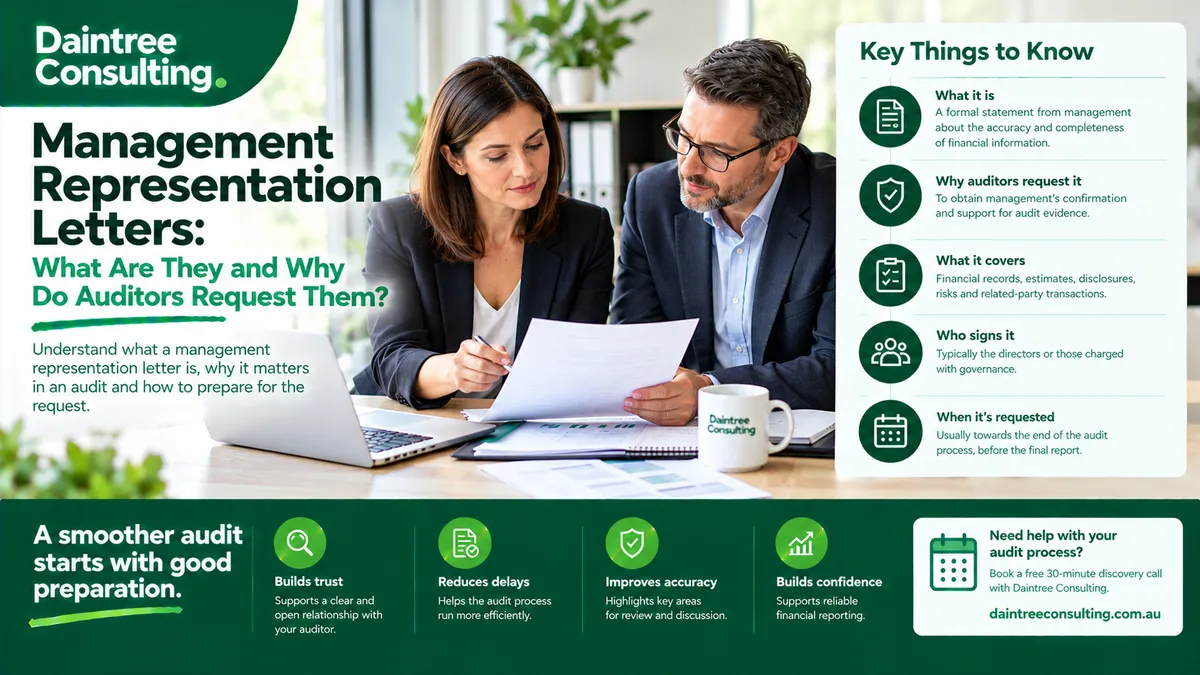
Management Representation Letter Audit: What to Know
When an auditor asks management to sign a management representation letter, it can seem like a formality at the end of an audit.
It is not.
Want expert help? Daintree Consulting's audit and assurance services can take this off your plate. Book a free consultation.
A management representation letter is an important part of the audit process. It gives management an opportunity to formally confirm certain matters to the auditor, including its responsibilities for preparing the financial report and providing relevant information.
Under Australian Auditing Standard ASA 580 Written Representations, written representations are audit evidence. However, they are not a substitute for other audit procedures or sufficient appropriate audit evidence on their own.
For Australian businesses going through an audit, understanding what a management representation letter is, what it normally covers and why an auditor requests one can make the final stages of the audit much clearer.
Quick answer: What is a management representation letter in an audit?
A management representation letter is a written statement from management to the auditor confirming certain matters relevant to the financial report and the audit.
Under ASA 580, the auditor is required to obtain written representations from management with appropriate responsibility for the financial report and knowledge of the relevant matters. The letter normally confirms that management has fulfilled specified responsibilities, including responsibility for preparing the financial report and providing the auditor with relevant information and access.
The letter can also cover other matters where the auditor considers written representation necessary or where another Australian Auditing Standard requires it.
Importantly, the representation letter does not prove that the financial statements are correct by itself. The auditor must still obtain and evaluate other evidence.
What is the purpose of a management representation letter?
An audit involves the auditor obtaining evidence from a range of sources.
That evidence may include:
Accounting records
Bank statements and reconciliations
Invoices and contracts
Board and management minutes
External confirmations
Supporting schedules
Calculations and estimates
Internal control evidence
Discussions with management and employees
Other relevant documentation
Management representations form another part of this evidence.
The purpose is not simply to get management to "sign off" on the accounts.
The written representation provides formal confirmation from the people responsible for the financial report about matters that are relevant to the auditor's work.
ASA 580 explains that written representations are necessary information for the auditor, but they cannot replace other audit evidence.
This distinction is important.
If management says that all liabilities have been disclosed, for example, the auditor does not simply accept the statement without further consideration. The auditor still performs appropriate procedures to obtain sufficient appropriate audit evidence.
Why do auditors request management representation letters?
There are several reasons.
1. To confirm management's responsibility for the financial report
One of the fundamental purposes of the representation letter is to confirm management's responsibility for preparing the financial report in accordance with the applicable financial reporting framework and relevant statutory requirements.
ASA 580 specifically requires the auditor to request written representation that management has fulfilled this responsibility.
This reinforces an important distinction:
Management prepares the financial report. The auditor independently examines it and forms an audit opinion.
The auditor is not taking responsibility for preparing the financial statements simply because an audit is being performed.
2. To confirm that relevant information has been provided
The auditor needs access to the information necessary to perform the audit.
ASA 580 requires written representation that management has provided the auditor with all relevant information and access as agreed in the audit engagement terms. It also requires representation that all transactions have been recorded and reflected in the financial report.
This matters because an auditor's conclusion depends on the information available to them.
If management has information about a transaction, liability, legal matter or other issue that has not been disclosed to the auditor, the auditor may not have the complete picture.
The representation letter therefore provides a formal confirmation concerning the completeness of information provided.
3. To support other audit evidence
Auditors sometimes need management's written confirmation about particular matters that involve judgement, estimates, intentions or other information.
For example, written representations may be relevant to matters involving:
Accounting policies
Management's intentions
Liabilities and contingent liabilities
Asset ownership or control
Restrictions or encumbrances over assets
Certain disclosures
Compliance matters affecting the financial report
Information about internal control deficiencies
Specific financial statement assertions
ASA 580 allows auditors to request additional written representations where they consider them necessary to support other audit evidence or where another Australian Auditing Standard requires them.
However, the written representation remains only one component of the evidence.
What does a management representation letter usually contain?
The exact content depends on the entity, audit and circumstances.
There is no single representation letter that is appropriate for every Australian business.
The required representations generally include management's confirmation that it has fulfilled its responsibilities relating to:
Preparation of the financial report
Management confirms that it has fulfilled its responsibility for preparing the financial report in accordance with the applicable financial reporting framework and relevant statutory reporting requirements.
Information provided to the auditor
Management confirms that it has provided relevant information and access as agreed in the audit engagement.
Completeness of transactions
Management confirms that transactions have been recorded and reflected in the financial report.
Other matters relevant to the audit
Depending on the circumstances, the auditor may request additional representations relating to particular accounting treatments, estimates, disclosures, legal matters, commitments, related matters or other audit issues.
The letter should reflect the actual circumstances of the engagement rather than being treated as a generic administrative document.
Who signs a management representation letter?
The auditor requests written representations from management with appropriate responsibility for the financial report and knowledge of the matters concerned.
Depending on the organisation, this may involve senior management such as the chief executive officer and chief financial officer, or equivalent people where those titles are not used.
The appropriate signatories can vary depending on:
The entity's governance structure
The responsibilities assigned to management
The applicable law or regulation
Who has knowledge of the relevant matters
The nature of the audit
ASA 580 recognises that management may make enquiries of other people within the organisation who have specialised knowledge before making certain representations.
For example, management may need to obtain information from legal, finance, operational or technical personnel before confirming a particular matter.
When is the management representation letter signed?
The timing is important.
Under ASA 580, the date of the written representations should be as near as practicable to, but not after, the date of the auditor's report. The representations cover the financial report and periods referred to in the auditor's report.
This makes sense because the auditor's work is concerned with the financial report and relevant matters up to the point at which the audit report is issued.
A representation signed substantially earlier may not reflect information that has become known during the final stages of the audit.
Management should therefore expect the representation letter to be part of the audit completion process, rather than something that is necessarily signed at the beginning.
Is a management representation letter the same as an audit sign-off?
No.
This is one of the most important points for business owners and directors to understand.
Signing the representation letter does not mean management is independently verifying every figure in the financial statements.
It also does not mean the auditor can rely exclusively on management's statements.
ASA 580 expressly states that written representations do not provide sufficient appropriate audit evidence on their own about the matters to which they relate.
Think of the audit evidence as a broader body of information.
Management's representation might confirm a particular matter, while the auditor may also examine:
Supporting documents
Accounting records
External evidence
Subsequent transactions
Contracts
Reconciliations
Calculations
Internal controls
Other information obtained during the audit
The auditor evaluates the evidence as a whole.
Can an auditor rely on a management representation?
Yes, but not in isolation.
Written representations are recognised as audit evidence under ASA 580. At the same time, the Standard makes clear that they are not sufficient appropriate audit evidence by themselves.
This means an auditor should not simply accept a management statement where other evidence is necessary.
For example, management may represent that a particular receivable is recoverable.
The auditor may still need to consider evidence such as:
Subsequent cash receipts
Customer correspondence
Aged receivables
Credit information
Historical collection patterns
Other relevant evidence
If the evidence supports management's representation, it forms part of the auditor's overall assessment.
If the evidence conflicts with the representation, the auditor needs to investigate.
What happens if the representation letter conflicts with the audit evidence?
This is an important issue.
If a written representation is inconsistent with other audit evidence, the auditor is required to perform audit procedures to try to resolve the matter.
If the issue remains unresolved, the auditor must reconsider the reliability of the representations and the broader audit evidence.
For management, this means a representation letter should not be treated as a document to sign without careful consideration.
Before signing, management should make sure it has a reasonable basis for the statements being made.
That may require discussing questions with:
The finance team
External accountants
Internal advisers
Lawyers
Operational managers
Other people with relevant knowledge
Management may need to make appropriate enquiries before it can confidently provide the requested representations.
What if management refuses to sign the representation letter?
This is potentially serious.
If management does not provide requested written representations, the auditor must discuss the matter with management, reconsider the implications for management's integrity and the reliability of audit evidence, and take appropriate action.
For the core representations concerning management's responsibilities, ASA 580 states that the auditor is required to disclaim an opinion if management does not provide the required written representations or if the auditor concludes that there is sufficient doubt about their reliability.
This does not mean every disagreement about wording automatically results in a disclaimer.
The circumstances matter.
If management has concerns about a representation, the better approach is to discuss the issue with the auditor promptly rather than simply refusing to sign.
There may be a factual misunderstanding, an unresolved accounting issue or a matter requiring additional evidence.
What should management do before signing?
A representation letter deserves careful attention.
Before signing, management should make sure it understands what it is confirming.
A practical review can include the following.
1. Read the entire letter
Do not treat the document as routine paperwork.
Management should understand each representation being made.
2. Check the financial statements
Confirm that the latest version of the financial report being audited is the version management understands and is responsible for.
3. Review significant transactions
Consider whether major transactions during the year have been properly identified, recorded and disclosed where necessary.
4. Consider known liabilities and commitments
Management should consider whether relevant liabilities, commitments, contingencies or other matters have been appropriately communicated to the auditor.
5. Check that information requested by the auditor has been provided
If the audit team has requested documents, schedules or explanations, make sure the relevant information has been supplied.
6. Consider events occurring near year-end and after year-end
Management should communicate relevant matters that may affect the financial report or the audit.
7. Ask questions before signing
If management does not understand a representation, it should ask the auditor or its accounting adviser for clarification.
The goal is not simply to get the letter signed.
The goal is to ensure the representations are accurate and properly informed.
Why good accounting records make the process easier
A management representation letter sits at the end of a much broader financial reporting and audit process.
If financial records are incomplete or reconciliations have not been performed, management may find it harder to confidently confirm the completeness and accuracy of information provided to the auditor.
Strong accounting processes can help management approach the audit with greater confidence.
Useful preparation may include:
Completing bank and balance-sheet reconciliations
Reviewing aged receivables and payables
Reconciling key control accounts
Reviewing significant transactions
Organising supporting documentation
Reviewing unusual movements in the accounts
Documenting significant accounting judgements
Preparing schedules requested by the auditor
Identifying unresolved accounting issues early
This is consistent with the broader audit preparation process: auditors need sufficient appropriate evidence to support their conclusions, rather than relying simply on management explanations. Daintree's recent guidance on audit evidence similarly emphasises the importance of organised records and supporting documentation.
Common mistakes businesses make with representation letters
Treating the letter as a formality
A representation letter contains formal statements from management.
Signing without understanding the statements can create unnecessary problems.
Assuming the letter replaces audit evidence
It does not.
Written representations support the audit evidence but do not replace appropriate audit procedures.
Waiting until the last minute
If management discovers an issue while reviewing the letter, there may be little time left before the intended audit report date.
Discussing potential issues earlier is generally more practical.
Assuming the auditor is responsible for the financial statements
Management remains responsible for preparing the financial report.
The auditor's role is independent and involves obtaining evidence and forming an opinion based on that evidence.
Signing despite unresolved concerns
If management believes a statement in the letter is inaccurate, it should raise the issue.
The right response is to investigate and resolve the matter, not simply sign because the audit is nearing completion.
How a management representation letter fits into the wider audit
It helps to view the letter as one part of the audit evidence process.
A simplified audit process might look like this:
Financial records → Audit procedures → Supporting evidence → Management discussions → Written representations → Evaluation of evidence → Audit conclusion
The representation letter comes into play as the audit approaches completion, but it does not operate independently from the work already performed.
This is why management should not be surprised when an auditor asks for written confirmation of matters that have already been discussed throughout the audit.
The written representation formalises particular matters and responsibilities that are relevant to the auditor's conclusion.
Management representation letter vs auditor's report
These two documents serve very different purposes.
Management representation letter
The representation letter is provided by management to the auditor.
It confirms specified matters and responsibilities.
Auditor's report
The auditor's report is issued by the auditor and communicates the auditor's independent opinion or conclusion on the financial report, subject to the applicable auditing requirements.
The two documents should not be confused.
The representation letter does not replace the auditor's report, and signing the letter does not determine what audit opinion the auditor will issue.
How Daintree Consulting can help with audit preparation
A management representation letter is easier to deal with when the underlying financial information is organised and management understands its responsibilities.
Daintree Consulting's Audit & Assurance service includes audit preparation and readiness support, financial-statement audit support where applicable, internal-control and process reviews, and assistance with organising the information and evidence required for assurance engagements.
Daintree can also support the financial foundations that sit behind an audit, including reconciled accounting records, management reporting and financial oversight.
The objective is not to replace the independent auditor.
Instead, appropriate preparation can help management:
Understand what information needs to be available
Identify gaps in financial records
Resolve issues earlier
Organise supporting documentation
Respond more clearly to audit requests
Approach the final stages of the audit with greater confidence
Daintree's approach is built around understanding the business, clarifying the financial and reporting position, agreeing the appropriate scope and then moving forward with practical support.
Frequently asked questions
What is a management representation letter in an audit?
A management representation letter is a written statement from management to the auditor confirming specified matters relevant to the financial report and audit. Under ASA 580, written representations are a form of audit evidence but do not replace other audit procedures.
Is a management representation letter mandatory?
For audits conducted under ASA 580, the auditor is required to request specified written representations from management concerning its responsibilities and the information provided to the auditor. Additional representations may also be required or requested depending on the audit.
Who signs a management representation letter?
It is generally signed by members of management with appropriate responsibility for the financial report and knowledge of the relevant matters. The appropriate signatories depend on the entity's structure and circumstances.
When is the management representation letter signed?
The written representations should be dated as near as practicable to, but not after, the date of the auditor's report.
Can a management representation letter replace audit evidence?
No. Written representations are audit evidence, but they are not sufficient appropriate audit evidence on their own about the matters they cover.
What happens if management will not sign?
The auditor must discuss the matter with management and assess the implications for the reliability of representations and audit evidence. For the core representations required under ASA 580, failure to provide them can result in the auditor being required to disclaim an opinion.
Final takeaway
A management representation letter is a formal part of the audit evidence process, not simply an administrative document to sign at the end of an audit.
It allows management to confirm important responsibilities and matters relevant to the financial report, while giving the auditor additional evidence to consider when completing the audit.
But the distinction is crucial: a representation letter does not replace independent audit procedures or other audit evidence.
For management, the best approach is to review the letter carefully, make the necessary enquiries, communicate any unresolved matters promptly and ensure the underlying financial records and supporting information are properly organised.
If your business has an upcoming audit and you want help getting the financial records, supporting schedules and audit information organised before the auditor starts, Daintree Consulting can help.
Book a free 30-minute discovery call. The conversation can focus on where your audit preparation currently stands and what practical steps may help you move forward — without pressure or obligation.
Talk to Daintree about your audit
Our ex-Big 4 team gives clear, senior-reviewed advice so you can act with confidence.
Book a free consultation →
Or explore our audit and assurance services.
