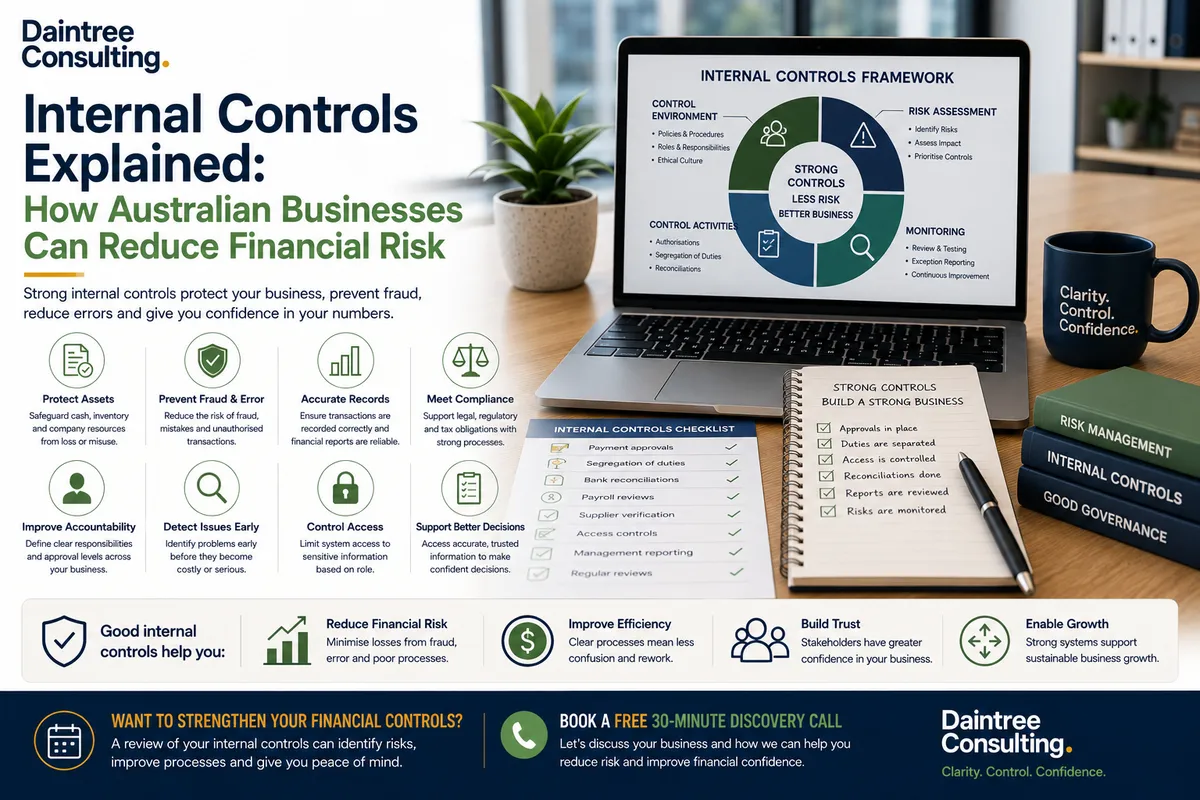
Internal Controls Explained: How Australian Businesses Can Reduce Financial Risk
Running a business involves risk every day.
A payment can be made to the wrong supplier. An invoice can be missed. An employee can have more system access than they need. A bank reconciliation can be left incomplete. A customer balance can remain overdue for months without anyone noticing.
Want expert help? Daintree Consulting's audit and assurance services can take this off your plate. Book a free consultation.
None of these problems necessarily mean someone has done something wrong.
Often, they happen because the business does not have clear processes for who can approve, who can access, who can review and who is accountable.
That is where internal controls come in.
Internal controls are the policies, processes, checks and responsibilities a business uses to protect its money, information, assets and reporting.
For Australian businesses, effective internal controls can help reduce financial errors, fraud risk, compliance problems and operational weaknesses while giving owners and directors greater confidence in the information they use to make decisions.
Importantly, internal controls do not have to mean creating a complicated corporate bureaucracy.
For a small or medium-sized business, the right controls should be proportionate to the size, complexity and risks of the business.
Quick Answer: What Are Internal Controls?
Internal controls are processes and safeguards designed to help a business:
Protect cash and other assets
Reduce the risk of fraud and error
Keep financial records accurate
Ensure transactions are properly authorised
Identify problems early
Maintain appropriate access to financial systems
Support reliable financial reporting
Meet relevant legal and regulatory obligations
Improve accountability across the business
Examples include:
Requiring approval before significant payments are made
Separating payment preparation from payment approval
Reconciling bank accounts regularly
Restricting access to accounting software
Reviewing payroll before processing
Conducting regular stock counts
Reviewing unusual transactions
Maintaining documented financial procedures
Having management review financial reports regularly
The objective is not to eliminate every possible risk.
It is to create a system where important risks are identified, controlled and detected early.
Why Do Internal Controls Matter?
As a business grows, owners naturally become less involved in every transaction.
When there are only a few employees, the owner may personally approve invoices, review bank transactions and know exactly what is happening.
That becomes difficult when the business has:
More employees
Higher transaction volumes
Multiple bank accounts
More suppliers
Larger payroll
Multiple locations
Several entities
External finance providers
More complex accounting systems
The business starts relying on processes rather than personal oversight.
Without appropriate controls, that creates opportunities for mistakes and potentially deliberate misuse.
Strong internal controls help replace informal oversight with repeatable processes and accountability.
ASIC notes that internal audit can contribute to improving the design and operation of an organisation's financial and non-financial control environment, risk processes and governance.
Internal Controls Are Not Just About Fraud
Fraud prevention is one reason businesses establish controls, but it is not the only reason.
A good control environment also helps prevent ordinary mistakes.
For example, imagine a business pays hundreds of supplier invoices every month.
Without a review process, an invoice could be:
Paid twice
Paid to the wrong bank account
Paid without proper approval
Recorded against the wrong expense category
Processed for an incorrect amount
These may be simple administrative errors, but they can distort financial reporting and create unnecessary cash-flow problems.
Internal controls are therefore about both prevention and detection.
8 Important Internal Controls Every Australian Business Should Consider
1. Payment Approval Controls
Businesses should establish clear rules around who can approve payments.
For example, the business may require:
One level of approval for routine expenses
Additional approval for larger payments
Director approval for significant transactions
Supporting documentation before payment
Independent review of unusual payments
The exact thresholds should reflect the size and nature of the business.
The key principle is simple:
The person making a payment should not necessarily have unlimited authority to approve that payment.
2. Separation of Duties
One of the most effective internal controls is separating important financial responsibilities.
For example, where practical:
One person prepares a payment
Another person approves it
Another person reconciles the bank account
This creates a system of checks and balances.
Small businesses may not have enough employees to completely separate every function.
That does not mean controls are impossible.
Instead, the owner or director can provide additional review where full segregation is not practical.
For example, an owner might personally review bank transactions and monthly reconciliations.
3. Bank Reconciliations
Bank reconciliation is one of the simplest and most important financial controls.
The accounting records should be regularly compared with the actual bank transactions.
This can identify:
Missing transactions
Duplicate entries
Unusual payments
Unpresented transactions
Incorrect accounting entries
Potential unauthorised activity
A reconciliation is much more valuable when it is performed consistently rather than only when year-end accounts are being prepared.
For growing businesses, regular reconciliation should be part of the normal finance process.
4. Payroll Controls
Payroll deserves particular attention because it involves recurring payments, employee information and employment-related obligations.
Useful payroll controls may include:
Approval of new employees
Approval of changes to employee pay rates
Review of timesheets
Review of overtime and allowances
Approval of leave
Review of payroll before payment
Reconciliation of payroll records
Review of superannuation obligations
Appropriate access to employee information
Payroll changes should not be made casually.
A clear process can reduce the risk of incorrect payments and unauthorised changes.
5. Accounts Receivable Controls
Getting paid is just as important as making payments.
Businesses should have processes for:
Issuing invoices promptly
Recording customer payments
Reconciling outstanding balances
Reviewing overdue accounts
Following up debts
Approving credit terms
Reviewing unusual customer adjustments
A growing debtor balance can become a significant cash-flow problem even when revenue looks strong.
Regular accounts receivable reporting gives management an opportunity to identify the problem before it becomes serious.
6. Supplier and Accounts Payable Controls
Supplier information should also be controlled carefully.
Businesses can establish processes around:
Creating new suppliers
Changing supplier bank details
Approving invoices
Matching invoices with supporting documentation
Reviewing duplicate invoices
Approving supplier payments
Reviewing unusual or high-value transactions
Changes to supplier bank details deserve particular attention.
A simple verification process can help reduce the risk of payments being redirected to an incorrect account.
7. Accounting System Access Controls
Your accounting software contains sensitive financial information.
Not everyone needs access to everything.
Businesses should consider:
Who has administrator access
Who can create or modify suppliers
Who can approve transactions
Who can process payroll
Who can access bank feeds
Who can modify accounting records
Who can view sensitive employee information
Access should generally reflect the person's role.
When an employee leaves, their system access should also be reviewed and removed where appropriate.
This is a simple control that businesses sometimes overlook.
8. Management Review
Controls are not effective simply because a policy exists.
Someone needs to review whether the process is actually working.
Regular management review might include:
Profit and loss reports
Balance sheet movements
Cash-flow reports
Aged receivables
Aged payables
Payroll reports
Bank reconciliations
Unusual transactions
Budget versus actual performance
Key financial ratios or KPIs
The purpose is not to scrutinise every transaction.
It is to identify unusual activity, trends and exceptions that require attention.
Preventive Controls vs Detective Controls
A useful way to think about internal controls is to separate them into two broad categories.
Preventive controls
These are designed to stop a problem before it happens.
Examples include:
Payment approval limits
Restricted system access
Segregation of duties
Purchase approval processes
Supplier verification
Detective controls
These are designed to identify a problem after it occurs.
Examples include:
Bank reconciliations
Management reviews
Exception reports
Internal audits
Stock counts
Review of unusual transactions
A strong control environment often uses both.
You do not want to rely entirely on preventing every mistake.
You also want processes that help you discover problems quickly when prevention fails.
What Happens When Internal Controls Are Weak?
Weak controls can create financial and operational problems that are not immediately obvious.
For example:
Financial reporting becomes less reliable
If transactions are not reviewed properly, management reports may contain errors.
Fraud becomes harder to detect
When one person controls too many stages of a transaction, inappropriate activity can remain hidden for longer.
Cash flow becomes less predictable
Missed invoices, duplicate payments and poor debtor management can all affect available cash.
Compliance risk increases
Poor processes can contribute to errors in areas such as payroll, taxation and financial reporting.
Management loses confidence in the numbers
When owners constantly have to question whether reports are accurate, decision-making becomes slower.
The cost of weak controls is therefore not limited to the value of a particular error.
It can also affect management confidence, time and decision-making quality.
How to Build Internal Controls in a Small Business
You do not need a large internal audit department to start improving controls.
A practical approach is to begin with your highest-risk financial processes.
Step 1: Identify the risks
Ask:
Where does money enter the business?
Where does money leave?
Who can approve payments?
Who can change supplier details?
Who controls payroll?
Who has accounting system access?
Where could an error occur?
Where could fraud occur?
Which processes depend on one person?
Step 2: Identify the existing controls
Document what already happens.
You may discover that the business already has useful controls but they are informal or inconsistent.
Step 3: Identify gaps
Look for situations where:
One person controls too many steps
Approvals are unclear
Reviews do not happen regularly
System access is excessive
Documentation is missing
Reconciliations are delayed
Step 4: Prioritise
Do not try to fix everything at once.
Focus first on areas with the greatest potential financial or operational impact.
Step 5: Document the process
A control is much easier to maintain when people understand:
What needs to happen
Who is responsible
When it should happen
Who reviews it
What happens when something goes wrong
Step 6: Review regularly
Businesses change.
A process that worked when you had five employees may not be sufficient when you have 30.
Internal controls should evolve with the business.
How Often Should Internal Controls Be Reviewed?
There is no universal review schedule that applies to every Australian business.
The appropriate frequency depends on factors such as:
Business size
Transaction volume
Industry
Number of employees
Financial complexity
Regulatory environment
Number of entities
Existing risk exposure
Recent changes to systems or processes
A small business may conduct formal control reviews periodically while maintaining regular operational checks such as bank reconciliations and management reporting.
Larger or more highly regulated organisations may require more formal risk-management and internal-audit arrangements.
For example, APRA-regulated institutions are subject to specific risk-management requirements, including frameworks covering material risks and the effectiveness of controls.
Those requirements should not be assumed to apply to every Australian SME.
For most businesses, the appropriate approach is proportionate to the organisation's actual risk, size and complexity.
Internal Controls and Audit Readiness
Good internal controls can also make an audit or assurance engagement more efficient.
When processes are documented and evidence is readily available, it becomes easier to demonstrate:
Who approved transactions
How reconciliations were performed
How financial information was reviewed
Who has system access
How key processes operate
How exceptions are identified and resolved
Daintree Consulting's Audit & Assurance service specifically includes internal-control and process reviews, alongside audit preparation and readiness support where applicable.
The objective is not simply to "pass an audit."
A well-designed control environment should help management have greater confidence in the business throughout the year.
Signs Your Business May Need an Internal Controls Review
Consider reviewing your internal controls if:
The business has grown significantly
You have recently hired finance staff
Financial responsibilities have moved between employees
You have introduced new accounting software
You have multiple entities or locations
Payment volumes have increased substantially
There have been unexplained financial discrepancies
Bank reconciliations are frequently delayed
One employee controls most financial processes
Management does not have confidence in financial reports
You are preparing for an audit
A board, funder, investor or other stakeholder requires stronger assurance
The business has experienced fraud or suspected fraud
You are preparing for a major transaction or period of growth
These are often signals that informal processes need to become more structured.
Internal Controls Should Support the Business — Not Slow It Down
A common concern is that stronger controls will create unnecessary bureaucracy.
Poorly designed controls can certainly slow a business down.
But good controls should make important processes clearer and more predictable.
For example, instead of employees asking:
"Who needs to approve this?"
the process should already tell them.
Instead of discovering a bank discrepancy months later, regular reconciliation should identify it quickly.
Instead of relying on one employee's memory, the business should have a documented process.
The goal is not more paperwork.
The goal is better control with less uncertainty.
Why Internal Controls Matter as Your Business Grows
The bigger the business becomes, the harder it is for the owner to personally monitor everything.
That is a normal part of growth.
The solution is not to remain involved in every transaction indefinitely.
It is to build systems that allow the business to operate with appropriate accountability.
Internal controls help create that structure.
They provide a framework for deciding:
Who can do what?
Who approves it?
Who reviews it?
What evidence is retained?
What happens if something looks unusual?
When these questions have clear answers, financial management becomes less dependent on individual memory and more dependent on reliable processes.
How Daintree Consulting Can Help With Internal Controls
Daintree Consulting provides audit and assurance support that can include internal-control and process reviews, depending on the engagement and applicable requirements.
The focus is practical: understanding the organisation's processes, identifying areas of risk, assessing controls and communicating findings clearly.
Daintree's broader accounting, bookkeeping, compliance and advisory capabilities can also provide context around the financial processes supporting those controls.
For businesses preparing for an audit, experiencing growth or wanting greater confidence in their financial processes, an internal-controls review can be a practical starting point.
Ready to Strengthen Your Business's Financial Controls?
You do not need to wait for an audit, financial problem or suspected fraud before reviewing your internal controls.
A focused review can help identify where processes are working well, where risks exist and where relatively simple changes could improve accountability.
Book a free 30-minute discovery call with Daintree Consulting.
We can discuss your current processes, the areas creating the most concern and whether an internal-control or assurance review is appropriate.
Frequently Asked Questions
What are internal controls?
Internal controls are policies, procedures, processes and checks designed to help a business protect assets, reduce financial risk, maintain accurate records and improve accountability.
What are examples of internal controls?
Examples include payment approvals, segregation of duties, bank reconciliations, restricted system access, payroll reviews, supplier verification and regular management review of financial reports.
Are internal controls only for large businesses?
No. Small businesses can benefit from basic internal controls. The controls should be proportionate to the business's size, complexity and risk.
Do internal controls prevent fraud?
They can reduce opportunities for fraud and make unusual activity easier to detect, but no control system can guarantee that fraud will never occur.
What is segregation of duties?
Segregation of duties means separating important responsibilities so that one person does not control every stage of a financial transaction. Where a small business cannot fully separate duties, additional owner or management review can provide another layer of oversight.
How often should internal controls be reviewed?
The appropriate frequency depends on the business and its risks. Controls should also be reviewed when there are significant changes to employees, systems, structure, transaction volumes or business operations.
Are internal controls required by law in Australia?
Requirements depend on the type of entity, industry, legislation and regulatory environment. Certain regulated organisations have specific risk-management and control requirements. Businesses should obtain professional advice where a specific legal or regulatory obligation applies.
Can internal controls help with an audit?
Yes. Clear controls and documented processes can make it easier to demonstrate how transactions are authorised, recorded, reviewed and supported. They can also help identify weaknesses before a formal audit or assurance engagement.
Does Daintree Consulting review internal controls?
Daintree's Audit & Assurance service includes internal-control and process reviews where appropriate to the engagement, along with audit preparation and readiness support.
