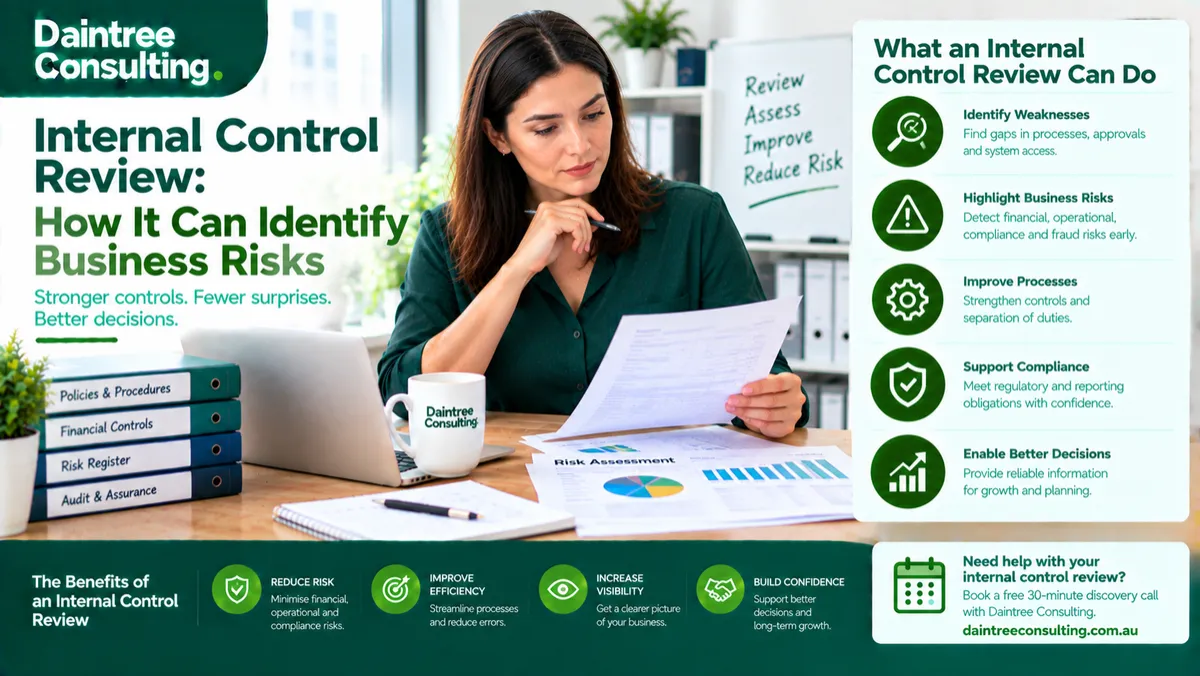
How Internal Control Reviews Can Help Identify Business Risks
A business can have good people, reliable software and strong financial results — and still have weaknesses in the way work is controlled.
A payment may be approved by the wrong person. A customer refund may not be independently checked. Payroll changes may be made without proper review. Important financial information may rely on one employee who knows how everything works but has no documented backup process.
Want expert help? Daintree Consulting's audit and assurance services can take this off your plate. Book a free consultation.
These issues can remain invisible until something goes wrong.
An internal control review can help Australian businesses identify weaknesses in their processes before they develop into larger financial, operational, compliance or governance problems.
Rather than simply asking whether a business has policies in place, an internal control review looks at how controls actually operate. It can examine who is responsible, how transactions are authorised, how information is checked, where risks exist and whether the controls in place are appropriate for the business.
For growing businesses, this can be particularly useful because processes that worked when a business was smaller may become less effective as transaction volumes, employees, customers and financial complexity increase.
Quick answer: What is an internal control review?
An internal control review is a structured assessment of the policies, procedures and controls a business uses to manage risk and protect its financial and operational processes.
The review may consider areas such as:
Financial approvals
Bank and account reconciliations
Accounts payable and receivable
Payroll processes
Access to accounting systems
Revenue and customer transactions
Inventory and assets
Financial reporting
Segregation of duties
Management approvals
Documentation and record keeping
Compliance processes
IT and system access
Fraud and error prevention
The purpose is not necessarily to find that something has gone wrong. Instead, it is to identify where a process could fail, where responsibilities are unclear or where existing controls may not be working as intended.
ASIC notes that internal audit can contribute to governance by reviewing and making suggestions about an organisation's financial and non-financial control environment, risk identification and monitoring processes, and governance processes.
Why internal controls matter to business risk
Business risk is broader than financial loss.
Australian businesses can face risks relating to economic conditions, regulation, technology, cyber security, legal issues, staffing, customers, suppliers and other operational factors. Business.gov.au recommends identifying, analysing, evaluating and treating risks rather than waiting for problems to occur.
Internal controls form part of how a business manages many of these risks.
For example, consider a business where one employee can:
Create a new supplier,
Approve the supplier invoice,
Enter the payment into the accounting system, and
Release the payment.
The business may trust the employee completely. However, the process itself creates a concentration of responsibility.
A control review could identify the lack of separation between these activities and recommend a more appropriate approval process.
The same principle applies to many areas of a business.
The question is not simply:
“Do we trust our employees?”
It is:
“Have we designed our processes so that errors, inappropriate transactions and other risks can be identified before they cause significant damage?”
That distinction is important.
What can an internal control review identify?
An internal control review can uncover different types of weaknesses depending on the business and the scope of the review.
1. Lack of segregation of duties
Segregation of duties means separating important responsibilities so that one person does not have excessive control over a transaction or process.
For example, different people may be responsible for:
Creating suppliers
Approving purchases
Processing payments
Reconciling bank accounts
Reviewing financial reports
Small businesses may not always have enough employees to completely separate every responsibility.
That does not mean controls are impossible. Alternative controls may be appropriate, such as additional management review or regular independent reconciliations.
A review can help identify where duties are concentrated and whether compensating controls are needed.
2. Weak approval processes
A business may technically have an approval process but not enforce it consistently.
For example, the documented policy might require management approval for purchases above a particular amount, while employees regularly make purchases without documented approval.
An internal control review can compare the intended process with what actually happens.
That distinction can reveal a significant gap between control design and control operation.
3. Inadequate reconciliations
Reconciliations are an important way to identify discrepancies.
Businesses may reconcile:
Bank accounts
Credit cards
Payroll accounts
Accounts receivable
Accounts payable
Inventory
Clearing accounts
Balance-sheet accounts
If reconciliations are incomplete, delayed or not independently reviewed, errors can remain in the accounting records.
ASIC states that companies have obligations to maintain financial records that correctly record and explain transactions and financial position and performance, and that appropriate controls and processes form part of maintaining complete and accurate records.
An internal control review can therefore look beyond whether a reconciliation exists and consider whether it is performed consistently, reviewed appropriately and followed up when differences arise.
4. Excessive system access
Accounting and business systems often contain sensitive financial information.
A control review may examine:
Who has administrator access
Who can create or modify suppliers
Who can change customer records
Who can approve payments
Who can process payroll
Who can modify accounting data
Whether former employees still have access
Whether access levels match employees' responsibilities
Access should generally reflect what a person needs to perform their role.
As businesses grow, system permissions can become outdated unless someone regularly reviews them.
5. Poor documentation
A process that exists only in someone's memory can become a business risk.
This is particularly common when one employee has been responsible for a process for several years.
If that person leaves, takes extended leave or changes roles, the business may discover that nobody else knows exactly how the process works.
An internal control review can identify processes that need:
Documented procedures
Defined responsibilities
Approval requirements
Backup arrangements
Review points
Escalation procedures
Business.gov.au notes that clear policies, procedures and processes can help clarify responsibility, support consistent decisions, meet legal and regulatory requirements and keep a business operating during disruption.
Internal control reviews can reveal risks that financial reports do not show
Financial statements can tell you what happened financially.
They do not necessarily explain why something happened or whether the process behind the numbers is reliable.
For example, a business might report strong revenue growth while having:
Weak customer credit controls
Increasing overdue accounts
Unapproved discounts
Inconsistent revenue recognition processes
Poor debtor follow-up
Inadequate cash controls
The financial statements may initially look healthy.
A control review can investigate the processes behind those numbers and identify weaknesses that management reporting alone may not reveal.
This is one reason internal controls should be considered alongside financial reporting rather than as a completely separate issue.
7 business risks an internal control review can help identify
The specific risks will depend on the organisation, but an internal control review may highlight issues such as:
1. Financial reporting risk
Errors in accounting records can affect management reports, financial statements, tax information and business decisions.
Controls can help reduce the likelihood that material errors remain unidentified.
2. Fraud risk
Controls cannot eliminate fraud risk, but appropriately designed processes can make inappropriate activity more difficult and increase the likelihood that unusual transactions are detected.
3. Cash-flow risk
Weak controls over invoicing, collections, payments or cash management can contribute to avoidable cash-flow pressure.
4. Compliance risk
A business may have obligations relating to taxation, payroll, financial reporting, industry regulation or other requirements.
Weak processes can make compliance harder to manage consistently.
5. Operational risk
A business can become dependent on undocumented processes, individual employees or manual workarounds.
These weaknesses can create disruption when circumstances change.
6. Technology and access risk
Inappropriate system access, weak user controls or outdated permissions can increase exposure to unauthorised changes or information access.
7. Governance risk
Management may not receive sufficiently reliable information to understand what is happening within the business.
That can make it harder to identify emerging problems and make timely decisions.
ASIC describes risk identification and management as core responsibilities of directors, including the identification and management of emerging risks.
What does an internal control review actually involve?
The process will depend on the size, structure and objectives of the business.
A practical review may follow several stages.
Step 1: Understand the business
Before testing controls, it is important to understand how the business operates.
This can include reviewing:
Business structure
Key revenue streams
Major expenses
Financial systems
Staffing structure
Approval responsibilities
Critical suppliers
Customer processes
Reporting requirements
Existing policies and procedures
A control that is appropriate for a small professional services firm may not be appropriate for a larger organisation with multiple locations and a larger finance team.
Step 2: Identify key processes
The review can focus on processes where weaknesses could have a meaningful impact.
For example:
Purchasing → supplier setup → invoice approval → payment → reconciliation
Or:
Sale → invoice → receipt of payment → bank reconciliation → reporting
Mapping these processes helps show where controls exist and where gaps may occur.
Step 3: Identify risks
The next question is:
What could go wrong?
For each process, consider potential risks such as:
Incorrect transactions
Unauthorised transactions
Duplicate payments
Missed revenue
Incorrect payroll
Data changes
Fraud
Delayed reconciliations
Incomplete records
Compliance failures
Business.gov.au recommends analysing risks based on factors including likelihood and potential consequences before deciding how they should be treated.
Step 4: Review existing controls
Once the risks are identified, examine what controls are currently in place.
These could include:
Management approvals
System permissions
Reconciliations
Review procedures
Dual authorisation
Exception reports
Supporting documentation
Physical controls
Independent checks
The review should consider whether the control is appropriately designed and whether it is actually being performed.
Step 5: Test the process
A policy document alone does not prove that a control works.
Depending on the scope, testing might involve reviewing transactions, approvals, reconciliations, access permissions, supporting documentation or evidence of management review.
This can reveal whether the process works consistently in practice.
Step 6: Report findings
The final output should make the findings understandable and actionable.
A useful internal control review should help management understand:
What the issue is
Why it matters
What risk it creates
How significant the issue may be
What improvement could be made
Who should take responsibility
Whether follow-up is required
The goal should be practical improvement rather than a report that simply identifies problems.
What are signs your business may need an internal control review?
You do not necessarily need to wait for a major incident.
An internal control review may be worth considering when:
Your business has grown quickly
Processes that worked with five employees may not work effectively with 30.
Growth can introduce new approval levels, systems, locations and responsibilities.
You have changed accounting or business systems
A new accounting platform, payroll system, CRM or payment system can change how information moves through the business.
Controls should be considered as part of that transition.
One person controls too much of the finance process
This can be common in smaller businesses.
If one person handles bookkeeping, payments, reconciliations and reporting, management may benefit from an independent review of the control environment.
You have experienced unexplained errors
Repeated discrepancies, unusual adjustments, duplicate payments or unexplained account movements may indicate a process weakness.
Your financial reporting is regularly delayed
If management cannot obtain reliable financial information on time, the problem may not simply be the reporting process.
There may be weaknesses in the underlying records, reconciliations or review procedures.
You are preparing for an audit
A control review can help identify areas that may require attention before an external audit or assurance engagement.
It does not replace an audit, but it can help management prepare.
Responsibilities are unclear
If employees are unsure who can approve, review or authorise particular transactions, the business may have an avoidable control gap.
Your business has become more complex
Expansion, new entities, new investors, additional funding, acquisitions or multiple operating locations can all change the risk profile of a business.
Internal control review vs external audit
An internal control review and an external audit are not the same thing.
An external audit has a specific purpose, scope and reporting framework. Depending on the entity and circumstances, an audit may involve obtaining evidence to support an opinion on financial statements.
An internal control review is generally more focused on understanding and improving the business's processes and control environment.
A business may conduct a control review:
Before an audit
Between audit cycles
During a period of growth
After implementing new systems
Following a significant organisational change
As part of broader risk management
When management wants greater visibility over financial processes
The two can complement one another, but an internal control review should not be described as a substitute for an audit where an audit is required.
How internal control reviews support better business decisions
Internal controls are often discussed in terms of preventing errors and reducing risk.
There is another important benefit: better information.
Business owners and leadership teams make decisions based on information.
If the information is incomplete, delayed or unreliable, the quality of those decisions can be affected.
For example, management may decide to:
Hire additional employees
Expand into another location
Purchase equipment
Increase marketing expenditure
Seek external funding
Change pricing
Acquire another business
Those decisions rely on financial and operational information.
Stronger controls can provide greater confidence that the underlying information has been processed, reviewed and reconciled appropriately.
That does not guarantee that a decision will be successful. It simply gives management a stronger information base from which to make the decision.
What happens after an internal control review?
Finding a control weakness is only the beginning.
The business should decide what happens next.
For each significant finding, consider:
What is the underlying risk?
How significant could the impact be?
How frequently could the issue occur?
Is the current control adequate?
What improvement is practical?
Who owns the action?
When should it be completed?
How will management know the improvement is working?
Some weaknesses may require immediate attention.
Others may be lower priority and can be addressed as part of a broader process improvement plan.
The important point is to connect findings with actions.
How often should you conduct an internal control review?
There is no single review frequency that suits every business.
The appropriate approach depends on factors such as:
Business size
Industry
Transaction volume
Organisational complexity
Regulatory environment
Number of employees
Financial risk
System changes
Growth
Previous control findings
A business may also benefit from targeted reviews after significant changes rather than relying only on a fixed timetable.
For example, controls could be reviewed after:
Implementing new accounting software
Changing payroll systems
Expanding into a new location
Acquiring another business
Changing senior finance staff
Introducing new payment processes
Experiencing a significant error
Preparing for an audit or assurance engagement
Risk management should not be treated as a one-off exercise. Business.gov.au recommends regularly reviewing risk management approaches and updating them as circumstances change.
Internal controls should grow with your business
One of the biggest mistakes businesses can make is assuming that controls are something you establish once and then leave unchanged.
A business changes.
Employees change. Systems change. Customers change. Transaction volumes change. Regulations change. The financial risks facing the organisation can also change.
A control that was appropriate two years ago may no longer be sufficient today.
This is particularly important for businesses experiencing growth.
As the organisation becomes more complex, management may need clearer approval structures, stronger reporting, better documentation and greater separation of responsibilities.
An internal control review can provide a structured way to identify where those improvements are needed.
How Daintree Consulting can help
Internal controls sit at the intersection of accounting, financial reporting, risk management and business operations.
Daintree Consulting provides audit and assurance support designed around the purpose, entity and applicable requirements of the engagement.
This can include internal-control and process reviews, audit preparation and readiness, financial-statement audit support where applicable, and clear findings and recommended actions.
Daintree can also help businesses connect control findings with broader financial and business considerations, including management reporting, cash flow, performance monitoring and business advisory.
If your business has grown, changed systems, experienced recurring financial issues or simply wants a clearer understanding of where its internal processes may be exposed, an internal control review can be a useful starting point.
Book a free 30-minute discovery call with Daintree Consulting to discuss your business, its current processes and where a review may add value.
Frequently Asked Questions
What is an internal control review?
An internal control review is an assessment of the policies, procedures and controls a business uses to manage financial, operational, compliance and governance risks. It can identify weaknesses, gaps and opportunities to improve processes.
Can an internal control review detect fraud?
An internal control review can identify control weaknesses that may increase exposure to fraud or make unusual activity harder to detect. However, a control review is not automatically a fraud investigation and should not be presented as a guarantee that fraud will be detected.
Is an internal control review the same as an audit?
No. An internal control review and an external audit have different purposes and scopes. A control review generally focuses on understanding and improving processes and controls, while an audit has a defined assurance purpose and reporting requirements.
Should small businesses review their internal controls?
Small businesses can also benefit from reviewing controls, particularly when one person performs several financial functions. The appropriate level of control should reflect the size, complexity and risks of the business.
When should a business conduct an internal control review?
A review may be useful when a business is growing, changing systems, restructuring responsibilities, preparing for an audit, experiencing recurring errors or becoming more financially complex.
What areas can an internal control review cover?
Depending on the scope, a review can cover financial approvals, purchasing, payments, payroll, reconciliations, revenue, system access, reporting, documentation, segregation of duties and other business processes.
What happens if an internal control weakness is identified?
Management can assess the significance of the weakness, determine the underlying risk, assign responsibility and implement an appropriate improvement. Follow-up can then confirm whether the revised control is operating effectively.
Final takeaway
An internal control problem does not have to become a financial loss, compliance issue or operational disruption before management takes action.
An internal control review gives businesses an opportunity to look at how important processes actually work, identify weaknesses and strengthen controls before problems become more difficult to manage.
For Australian businesses, effective risk management is not simply about reacting when something goes wrong. It involves identifying risks, understanding their potential impact and putting practical measures in place to manage them.
As your business grows, your controls should grow with it.
Need help reviewing your business's internal controls? Book a free 30-minute discovery call with Daintree Consulting.
Talk to Daintree about your audit
Our ex-Big 4 team gives clear, senior-reviewed advice so you can act with confidence.
Book a free consultation →
Or explore our audit and assurance services.
