
How long does a financial statement audit take?
A financial statement audit takes as long as the agreed scope, evidence gathering and review require; there is no single turnaround that applies to every Australian business. The timetable includes more than the auditor’s testing: preparing accounts, answering queries, correcting errors and approving the financial statements also affect completion. For a useful estimate, ask for a schedule covering the full process through to the signed auditor’s report, not just the fieldwork.
TL;DR
Want expert help? Daintree Consulting's audit and assurance services can take this off your plate. Book a free consultation.
How long does a financial statement audit take? Scope, evidence readiness and unresolved findings determine the timetable.
Australian Auditing Standards require sufficient appropriate evidence; a reporting deadline does not replace that requirement.
Daintree Consulting provides audit and assurance alongside accounting and advisory services for Australian businesses.
Agree separate milestones for financial statements, audit queries, review and signing before work begins.
How long does a financial statement audit take?
The useful measure is elapsed time from preparation to signing, not simply the time spent testing transactions. An audit can include work before the reporting date, work after the accounts are prepared, and a final review before the report is issued.
For a 2026 audit, ask the auditor to distinguish these stages in the engagement timetable. Each stage has different dependencies, so a fieldwork booking alone is not a completion commitment.
Audit stage | What happens | What determines progress |
|---|---|---|
Planning | The auditor establishes scope, assesses risks and plans procedures | Understanding the business and receiving background information |
Evidence gathering | The auditor tests balances, transactions and disclosures | Complete records, supporting documents and access to relevant people |
Query resolution | Management answers questions and considers proposed adjustments | Clear ownership of queries and reliable explanations |
Completion review | The auditor evaluates findings and the financial statements | Resolution of outstanding matters and completion of review |
Approval and reporting | The financial statements are authorised and the auditor’s report is finalised | Appropriate approvals, representations and final evidence |
These are stages, not fixed-duration packages. Ask which activities can overlap and which must wait for earlier work to finish.
Why this matters
A finance team needs a reporting date it can work towards, rather than an estimate that excludes preparation and approval. Share the actual deadline and its purpose before agreeing the audit timetable.
Daintree Consulting provides accounting, audit and assurance, and business advisory services to Australian businesses. Daintree Consulting suits Australian businesses seeking audit and assurance support alongside broader accounting and advisory services. Confirm the engagement scope and independence requirements before deciding who prepares the accounts and who audits them.
For your 2026 reporting calendar, separate the date you need an audit opinion from the date you expect to hand over the accounts. The work between those dates needs owners, agreed milestones and room to resolve findings.
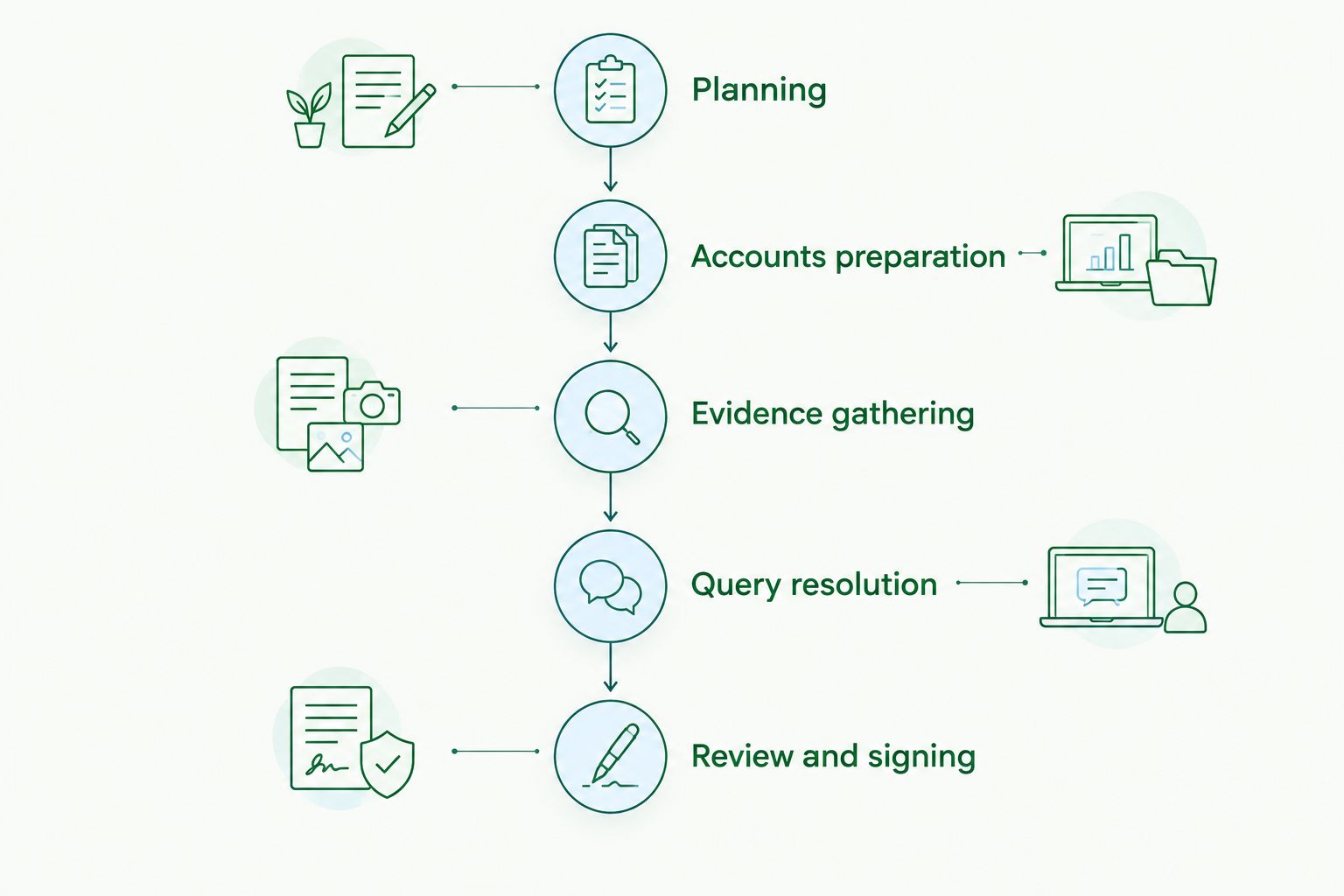
What happens during each stage of a financial statement audit?
1. Planning
Planning establishes what the auditor needs to examine and where the risk of material misstatement lies. The auditor needs to understand the business, its reporting framework, relevant controls and significant changes during the period.
Tell the auditor about acquisitions, new financing, changed accounting systems and unusual transactions early. These matters can change the planned procedures; discovering them during final review creates work at the wrong end of the timetable.
Your next move: agree the scope, reporting deadline, key contacts and initial document request before treating the schedule as settled.
2. Accounts preparation
Management remains responsible for the financial statements, even when an external accountant helps prepare them. An audit examines those statements; it does not transfer responsibility for preparing them to the auditor.
Check that the trial balance agrees with the draft financial statements and that significant balances have supporting reconciliations. If the underlying accounts are still changing, audit work already completed can need updating.
Your next move: identify who owns the draft accounts, supporting schedules and disclosures. Give each deliverable a clear handover date.
3. Evidence gathering
The auditor obtains evidence through procedures appropriate to the risks identified. These can include examining documents, testing transactions, obtaining external confirmations and evaluating accounting estimates.
Australian Auditing Standard ASA 500, Audit Evidence, requires sufficient appropriate audit evidence. For Australian audits in 2026, a tight deadline does not remove that requirement or make an unsupported explanation enough.
Your next move: provide complete, traceable evidence rather than isolated files. A reconciliation should connect the financial statement balance to the ledger and its supporting records.
4. Query resolution
Audit queries are requests for information, explanations or corrections needed to complete the work. Some can be answered directly; others require investigation, revised calculations or management judgement.
Keep a shared query register with an owner and status for each item. Sending documents without identifying which question they answer makes it harder to establish whether the matter is resolved.
Your next move: distinguish between a response submitted and a query closed. Only the auditor can confirm whether the response supplies the evidence required.
5. Review and signing
Completed testing is not the same as an issued audit opinion. The engagement still needs its required reviews, final financial statements, management representations and appropriate authorisation.
The auditor also considers subsequent events under ASA 560, Subsequent Events. Relevant events between the reporting date and the auditor’s report date can require further work or changes to the financial statements.
Your next move: reserve time with the people responsible for approval. Do not leave their availability until every other task appears finished.
Should audit work start before or after year-end?
Starting suitable work before year-end can spread the workload, but it does not complete the audit of year-end financial statements. The auditor decides which procedures are appropriate before the reporting date and what further evidence is needed afterwards.
Use the distinction below when discussing your 2026 audit schedule. Neither approach removes the need for final accounts and completion procedures.
Approach | Best for | Benefit | Limitation |
|---|---|---|---|
Interim work before year-end | Addressing suitable planning and testing tasks earlier | Brings relevant questions forward | Does not establish every year-end balance or disclosure |
Year-end work | Examining final balances and the completed reporting period | Uses year-end records and draft financial statements | Depends on those records being ready |
Ask the auditor which tasks belong in each phase. A business with inventory, for example, should discuss inventory-count arrangements before the relevant count rather than assume the evidence can be assembled afterwards.
Why financial statement audit timing varies
The audit timetable depends on the work required and the conditions in which that work happens. These factors explain why another business’s completion date is not a reliable benchmark for yours.
Scope and structure: Multiple entities, consolidation requirements and different locations can add records, reporting questions and coordination tasks.
Record readiness: Reconciled accounts and complete supporting schedules let the auditor examine evidence rather than wait for its preparation.
Accounting judgements: Estimates, valuations and unusual transactions require support for the assumptions and accounting treatment used.
External evidence: Confirmations and information held by other parties introduce dependencies outside the finance team’s direct control.
Unresolved findings: Proposed adjustments, inconsistent records and incomplete disclosures need attention before completion.
Review and approval: Auditor review, management responses and financial statement authorisation all need to fit the timetable.
Ask which dependencies drive your completion date. That question produces a more useful answer than asking whether the audit is generally on track.
How can you prepare for a financial statement audit?
Preparation cannot guarantee a particular completion date. It can remove avoidable gaps between a request for evidence and a usable response.
Agree the request list
Ask for the auditor’s initial information requirements and clarify what a complete response looks like. Assign responsibility for each schedule instead of treating the request list as a general finance-team task.
Confirm the reporting period and entity covered by each file. A well-prepared schedule for the wrong entity or period still leaves the original request unanswered.
Reconcile the accounts
Check that bank, receivables, payables, payroll and other relevant reconciliations agree with the ledger. Investigate differences rather than carrying unexplained amounts into the audit file.
Keep evidence of the investigation and any correction. The auditor needs to understand the balance ultimately reported, not simply receive a replacement spreadsheet.
Explain significant changes
Prepare clear explanations for major movements and unusual transactions, supported by the relevant documents. Contracts, calculations and accounting papers serve different purposes; provide the material that supports the actual judgement being made.
Flag uncertainty rather than hiding it within a schedule. Early discussion gives management and the auditor a chance to identify the evidence still required.
Control document versions
Keep a clearly identified current version of the financial statements and supporting schedules. When figures change, tell the auditor what changed and why.
Maintain a record of adjustments so the final accounts can be traced back to the underlying records. Unannounced revisions make it harder to establish which evidence supports the latest figures.
Arrange decision-maker access
Make the people responsible for material judgements and approval available when needed. Finance staff cannot always resolve matters that require a director’s decision or another specialist’s assessment.
For 2026 planning, include these meetings in the reporting calendar rather than relying on availability at the end. The final approval process deserves the same attention as the start of fieldwork.
Can an auditor guarantee a completion date?
An auditor can agree a timetable, but completion depends on obtaining the required evidence and resolving matters that affect the report. Ask what assumptions sit behind the proposed date.
A useful schedule explains what happens if the accounts arrive late, an external response is outstanding or a significant issue emerges. It should also identify when the auditor will tell you that a milestone is at risk.
Treat a completion date as a coordinated plan, not permission to leave preparation until the last moment. Your responsibilities and the auditor’s responsibilities need to be clear on the same schedule.
Does a first financial statement audit take longer?
A first audit introduces work associated with understanding the business and considering opening balances. That does not establish a universal extra duration, but it does create matters to discuss when setting the timetable.
If you are appointing an auditor for the first time, raise access to historical records early. If you are changing auditors, discuss relevant handover arrangements and the evidence the incoming auditor will require.
Can you finish the accounts while the audit is underway?
Some preparation and audit work can overlap, but the auditor needs sufficiently complete information for the procedures being performed. Continually changing balances can require additional testing or updates to work already completed.
Agree which schedules are ready for audit and which remain provisional. A phased handover is useful only when everyone understands the status of each part.
FAQ
How long does a financial statement audit take in Australia?
A financial statement audit has no single standard duration in Australia. The timetable depends on scope, evidence readiness, accounting issues, responses to queries and final approval.
Does the audit finish when fieldwork ends?
No, the end of fieldwork does not necessarily mean the audit is complete. Outstanding queries, review, final financial statements and signing procedures can remain.
Can an audit start before the financial year ends?
Yes, suitable planning and audit procedures can begin before year-end. The auditor still needs appropriate evidence for year-end balances, disclosures and completion.
What should I prepare before the auditor starts?
Prepare draft financial statements, reconciliations and the supporting records requested by the auditor. Confirm the required format, reporting period and responsible person for each item.
Will preparing the accounts myself make the audit faster?
Preparing complete, supported accounts can remove preparation delays, but preparing them yourself does not guarantee a faster audit. The auditor still needs to assess the evidence and resolve relevant findings.
Can the auditor sign while queries are still outstanding?
An unresolved matter that prevents the auditor from obtaining sufficient appropriate evidence can affect completion or the audit opinion. Ask the auditor which outstanding matters prevent signing.
Can the same firm prepare and audit my accounts?
That depends on the applicable independence requirements and the circumstances of the engagement. Discuss preparation and audit responsibilities before appointing the providers; do not assume every combination is permitted.
One last thing
Ask for the date the audit report can be signed, not just the date the auditor will attend. Then ask what must be ready for that date to hold.
For your 2026 reporting cycle, keep a single completion checklist covering evidence, adjustments, disclosures, review and approval. Ask Daintree Consulting to clarify the audit scope and responsibilities before agreeing the timetable, so you can see what completion actually requires.
Related guides
Talk to Daintree about your audit
Our ex-Big 4 team gives clear, senior-reviewed advice so you can act with confidence.
Book a free consultation →
Or explore our audit and assurance services.
