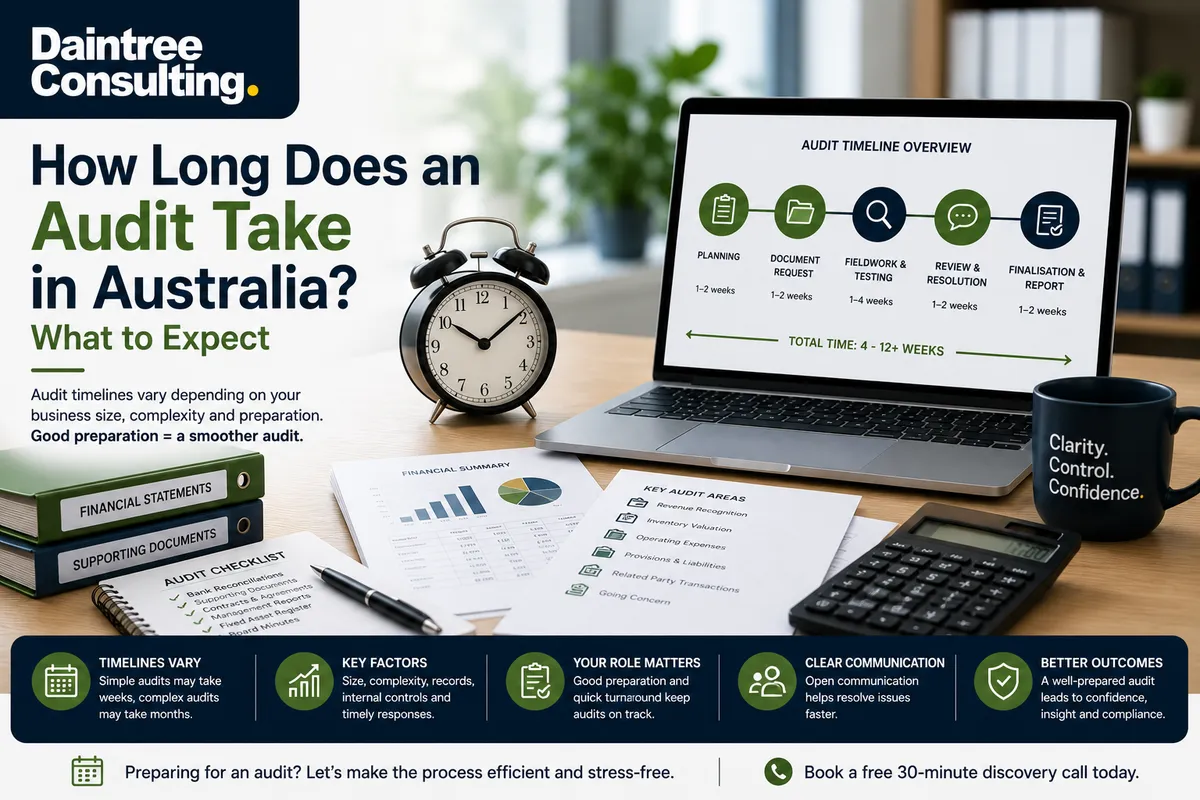
How Long Does a Business Audit Take in Australia? What to Expect
How Long Does a Business Audit Take in Australia?
One of the first questions business owners ask when an audit is approaching is simple:
“How long does an audit take?”
Want expert help? Daintree Consulting's audit and assurance services can take this off your plate. Book a free consultation.
The honest answer is that there is no single timeline that applies to every Australian business.
A straightforward audit with well-organised records and responsive management can move relatively efficiently. A larger or more complex engagement may take considerably longer, particularly where there are multiple entities, complicated transactions, significant estimates, weak internal controls or missing supporting evidence.
The audit itself is also only one part of the overall process.
Before testing begins, the auditor needs to understand the business, determine the scope and risks, and request appropriate evidence. During the audit, questions may need to be answered and additional documentation supplied. The final stage involves resolving outstanding matters and completing the auditor's report.
For companies subject to the Corporations Act, the specific financial reporting and audit obligations depend on the entity and its circumstances. ASIC notes that certain entities must have their financial reports audited by a registered company auditor, while some proprietary companies may qualify for audit relief.
So rather than asking only “How long does an audit take?”, a better question is:
“What factors determine how long our audit will take, and what can we do to keep it moving?”
Quick Answer: How Long Does an Audit Take?
There is no universal Australian audit duration.
As a practical planning guide, a relatively straightforward small-business audit may take several days to a few weeks of active audit work, while larger, more complex or higher-risk audits can take several weeks or longer from planning through completion.
The total calendar time can be longer than the auditor's actual testing time because it may include:
Preparing the financial statements
Initial audit planning
Providing requested documents
Responding to auditor questions
Performing audit testing
Resolving outstanding issues
Reviewing adjustments
Finalising the audit report
Meeting the entity's reporting or lodgement deadline
These are planning ranges rather than guaranteed turnaround times. The actual timeline should be agreed with the auditor based on the engagement, entity, reporting requirements, risk and availability of evidence.
What Determines How Long an Audit Takes?
Several factors can significantly affect the audit timeline.
The most important are usually:
The size of the business
The complexity of the organisation
The quality of the accounting records
How quickly evidence is provided
The number and complexity of transactions
The strength of internal controls
The level of audit risk
Whether significant accounting estimates or judgements are involved
Whether multiple entities are being audited
How quickly outstanding questions are resolved
This is why comparing two businesses and assuming their audits should take the same amount of time can be misleading.
1. The Size of Your Business
Generally, a larger organisation creates more information for the auditor to understand and test.
A small business with:
One entity
A straightforward accounting system
Limited employees
Simple revenue streams
Few major assets
Clean reconciliations
may have a relatively contained audit.
A larger business may have:
Multiple locations
Multiple entities
Larger transaction volumes
More employees
More complex contracts
Inventory
Loans and financing arrangements
Significant assets
Related-party transactions
That additional complexity can increase the amount of planning, evidence gathering and testing required.
ASIC describes financial statement audits as a process in which auditors need sufficient appropriate audit evidence to support their conclusions.
2. The Complexity of Your Business
Revenue alone does not determine audit complexity.
Two businesses with similar revenue can have very different audit requirements.
For example, a professional services business with straightforward transactions may be easier to audit than a business with:
Complex contracts
Construction projects
Inventory
Foreign currency transactions
Multiple subsidiaries
Significant estimates
Long-term customer arrangements
Complicated financing
The more judgement involved in preparing the financial statements, the more work may be required to understand and test the relevant accounting treatments.
ASIC's financial reporting guidance highlights areas such as asset values, provisions, revenue from contracts with customers, capitalised expenditure, expected credit losses, estimates and post-balance-date events as areas requiring particular attention.
3. The Quality of Your Accounting Records
This is one of the biggest factors businesses can actually control.
If your books are accurate and up to date, the auditor can spend more time performing the required audit procedures rather than waiting for records to be corrected.
Problems can arise when:
Bank accounts have not been reconciled
Balance-sheet accounts contain unexplained balances
Debtors and creditors are inaccurate
Payroll records do not agree with the general ledger
Fixed-asset registers are incomplete
GST or tax accounts contain unreconciled amounts
Supporting documents cannot be located
Intercompany balances do not agree
Poor records do not necessarily mean an audit cannot proceed.
They can, however, create additional questions, follow-up work and delays.
ASIC states that auditors consider whether an entity has kept financial records sufficient to enable financial reports to be prepared and audited.
4. How Quickly You Provide the Requested Evidence
An audit is not simply the auditor working independently.
The business has an important role in providing information and responding to requests.
An auditor may request:
Bank statements
Bank reconciliations
Sales reports
Invoices
Contracts
Payroll records
Loan statements
Fixed-asset registers
Inventory information
Debtor and creditor reports
Board minutes
Tax records
Supporting documentation for significant transactions
If the requested evidence is available quickly, the audit can generally progress more smoothly.
If documents are missing or responses take days or weeks, the overall timetable can stretch.
A useful approach is to nominate someone internally to coordinate audit requests rather than allowing requests to move between several people without clear ownership.
5. The Strength of Your Internal Controls
Internal controls can also influence the audit process.
Auditors need to understand relevant systems and controls and determine how they affect the audit approach.
Examples of controls include:
Approval processes
Segregation of duties
Payment authorisation
Bank reconciliation reviews
Access controls
Payroll approvals
Expense approval procedures
Inventory controls
Financial reporting reviews
Weak controls do not automatically mean an audit will fail.
However, they can affect the auditor's risk assessment and the nature or extent of audit procedures required.
That can increase the amount of work involved.
6. The Number of Transactions
Transaction volume can make a major difference.
A business processing hundreds or thousands of transactions each month may require a different audit approach from a business with a relatively small number of high-value transactions.
The auditor may consider:
Transaction volume
Materiality
Risk
Control effectiveness
Account balances
Unusual transactions
Significant movements
The audit approach is therefore not simply based on counting every transaction.
It is designed around the risks and evidence relevant to the financial report.
7. Significant Estimates and Judgements
Some financial statements contain areas where management has to make estimates or apply significant judgement.
Examples can include:
Asset valuations
Provisions
Expected credit losses
Revenue recognition
Impairment assessments
Useful lives of assets
Complex contractual arrangements
These areas can require additional documentation and discussion.
ASIC specifically identifies accounting estimates and management judgements as areas where appropriate analysis, conclusions and supporting documentation are important.
If an auditor needs additional evidence or specialist input, the timeline can extend.
8. Multiple Entities or Locations
A business operating through several entities can have a more complicated audit process.
The auditor may need to consider:
Separate financial statements
Intercompany transactions
Intercompany balances
Consolidation
Related-party transactions
Different accounting systems
Multiple locations
Group-level controls
The more moving parts involved, the more coordination may be required.
What Happens During a Business Audit?
Understanding the process makes the timeline easier to manage.
A typical financial statement audit can be thought of in several stages.
Stage 1: Planning
The auditor first needs to understand the engagement and the entity.
This can involve considering:
The purpose of the audit
The reporting framework
The business and industry
Significant transactions
Financial reporting risks
Internal controls
Materiality
Timing
Evidence requirements
Good planning helps determine where audit attention should be focused.
Stage 2: Information and Evidence Request
The auditor provides a request list covering the information needed for the engagement.
The exact list will vary.
The business may need to provide financial records, reconciliations, contracts, supporting schedules and other documentation.
This is one reason audit preparation matters so much.
The sooner the information is complete and organised, the easier it is to keep the engagement moving.
Stage 3: Audit Testing
The auditor then performs the agreed audit procedures.
Depending on the engagement, this can include testing areas such as:
Revenue
Expenses
Cash
Receivables
Payables
Payroll
Inventory
Fixed assets
Loans
Equity
Tax balances
Significant transactions
The auditor is seeking sufficient appropriate evidence to support the conclusions reached.
ASIC's audit-quality guidance emphasises the importance of sufficient appropriate audit evidence and compliance with applicable auditing standards.
Stage 4: Questions and Follow-Up
It is normal for auditors to ask questions during an audit.
For example:
“Can you provide the agreement supporting this transaction?”
“Why did this balance change significantly compared with last year?”
“Can you provide the reconciliation supporting this account?”
“What is the basis for this accounting estimate?”
These questions are not necessarily signs that something has gone wrong.
They are a normal part of gathering evidence and understanding the financial information.
The faster the business can provide clear answers and supporting evidence, the less likely the audit is to stall.
Stage 5: Resolving Outstanding Matters
Before the audit can be completed, outstanding issues need to be addressed.
These might include:
Missing documentation
Proposed adjustments
Unresolved reconciliations
Accounting treatment questions
Disclosure issues
Subsequent events
Management representations
The number and complexity of outstanding matters can have a significant effect on the completion date.
Stage 6: Finalisation and Audit Report
Once the required procedures have been completed and outstanding matters resolved, the auditor finalises the engagement and issues the appropriate report.
For entities required to lodge financial reports with ASIC, reporting deadlines also matter.
ASIC states that disclosing entities, registered schemes and registrable superannuation entities generally have three months after year-end to lodge their complete financial reports, while other entities generally have four months, subject to the applicable requirements.
This is why audit planning should start well before the final reporting deadline.
Why Some Audits Take Longer Than Expected
An audit can take longer when unexpected issues arise.
Common causes include:
Missing records
The auditor cannot complete testing until the required evidence is available.
Unreconciled accounts
The business needs to investigate and correct unexplained differences.
Significant accounting issues
A transaction may require additional analysis or professional judgement.
Poor internal controls
The auditor may need to perform additional procedures because controls cannot be relied upon as expected.
Delayed responses
Questions remain open because the relevant employee or director has not provided the required information.
Late financial statements
If the financial statements are not finalised, the audit cannot progress to completion in the normal way.
Unexpected transactions
A major acquisition, disposal, restructuring or unusual transaction can require additional audit attention.
How Can You Make an Audit Faster?
You cannot—and should not—try to rush an audit simply to finish sooner.
The objective is a properly performed audit supported by sufficient appropriate evidence.
But you can make the process more efficient.
Start early
Do not wait until the audit deadline is approaching before reviewing your records.
Reconcile your accounts
Make sure bank accounts, loans, payroll, GST and other important balance-sheet accounts are reconciled.
Prepare supporting documentation
Keep contracts, invoices, agreements and other evidence organised and accessible.
Review unusual transactions
Identify major or unusual transactions before the auditor asks about them.
Assign an audit contact
Give the auditor a clear point of contact within the organisation.
Respond quickly
Create an internal process for tracking and closing audit requests.
Review prior-year issues
If the previous audit identified problems, make sure they have been addressed before the next audit.
Finalise financial statements early
The earlier reliable financial statements are available, the more effectively the audit timetable can be planned.
When Should You Start Preparing for an Audit?
Ideally, audit preparation should not begin one week before the auditor arrives.
A better approach is to maintain audit readiness throughout the year.
This means:
Keeping bookkeeping current
Performing regular reconciliations
Maintaining supporting documentation
Reviewing unusual transactions
Maintaining clear approval processes
Keeping financial records organised
Tracking previous audit findings
Preparing important schedules throughout the year
When the audit arrives, you are then organising and validating information rather than trying to recreate it from scratch.
Does a Longer Audit Mean Something Is Wrong?
Not necessarily.
Audit duration is not a simple measure of business performance or audit quality.
A larger or more complex organisation can naturally require more audit work.
Similarly, an audit may take longer because the business has unusual transactions, complex accounting estimates or additional reporting requirements.
What matters is whether the auditor has sufficient appropriate evidence to support the audit conclusion.
ASIC's guidance makes clear that audit quality involves the substance of the audit work and whether sufficient appropriate evidence supports the auditor's conclusions.
Audit Timeline: What Business Owners Should Think About
Instead of focusing only on the number of days, think about the audit as a complete timeline:
Preparation → Planning → Evidence collection → Testing → Questions → Resolution → Finalisation → Reporting
The earlier you start each stage, the less pressure there is near the deadline.
A business that is audit-ready can generally respond more efficiently than one that starts gathering information only after the auditor's first request.
How Daintree Consulting Can Help You Prepare for an Audit
Daintree Consulting provides audit and assurance support designed around the applicable purpose, entity and regulatory requirements.
Support can include:
Audit preparation and readiness
Organising financial records
Preparing evidence
Reconciliations
Supporting schedules
Internal-control reviews
Coordination of audit requests
Clarifying outstanding items
Practical communication of findings and required actions
The objective is not to interfere with the auditor's independent role.
It is to help the business approach the engagement with better organisation, clearer records and fewer avoidable delays.
Ready for an Upcoming Audit?
If your audit deadline is approaching and you are unsure whether your records are ready, it is better to identify gaps early.
A focused review can help you understand:
What information is missing
Which reconciliations need attention
Where supporting evidence may be weak
Whether internal controls need improvement
Who should own audit requests
What needs to happen before the auditor starts
Book a free 30-minute discovery call with Daintree Consulting to discuss your upcoming audit or assurance requirement and identify a practical next step.
Frequently Asked Questions
How long does an audit take?
There is no standard duration. A relatively straightforward audit may involve several days to a few weeks of active work, while larger or more complex engagements can take several weeks or longer. The overall calendar time also depends on preparation, evidence availability and how quickly outstanding matters are resolved.
What makes an audit take longer?
Complexity, poor-quality records, missing evidence, high transaction volumes, multiple entities, weak controls, significant accounting estimates and delayed responses can all increase the audit timeline.
Can I make my audit finish faster?
You should not compromise the audit process simply to reduce the timeline. However, you can improve efficiency by preparing records early, completing reconciliations, organising supporting evidence and responding promptly to audit requests.
Does every Australian business need an audit?
No. Audit requirements depend on the entity, its structure, size, regulatory circumstances and applicable legislation. ASIC states that certain entities must have audited financial reports, while some proprietary companies may qualify for audit relief.
When should I start preparing for an audit?
Ideally, preparation should be ongoing throughout the financial year. At a minimum, begin reviewing records, reconciliations, supporting evidence and prior audit issues well before the auditor's planned start date.
What documents does an auditor usually request?
The exact request depends on the engagement. Common evidence can include financial statements, reconciliations, bank records, invoices, contracts, payroll records, loan documentation, fixed-asset records, board minutes and supporting schedules.
Can an audit be completed remotely?
Many audit activities can be coordinated digitally, but the practical arrangements depend on the engagement, the evidence required and the auditor's processes.
What happens if the audit is not finished before the reporting deadline?
The consequences depend on the entity and applicable reporting requirements. Businesses subject to financial reporting and lodgement obligations should plan the audit timetable around the applicable statutory deadline rather than assuming the audit can simply be completed afterward.
Important Publishing Note
Audit timelines, reporting obligations, audit requirements and applicable deadlines can vary depending on the entity, its structure, size, regulatory requirements, reporting framework and individual circumstances. The timeframes discussed in this article are general planning guidance only and are not a guarantee of how long a particular audit will take. Businesses should confirm their specific audit and financial reporting obligations with their auditor or appropriate professional adviser.
Talk to Daintree about your audit
Our ex-Big 4 team gives clear, senior-reviewed advice so you can act with confidence.
Book a free consultation →
Or explore our audit and assurance services.
