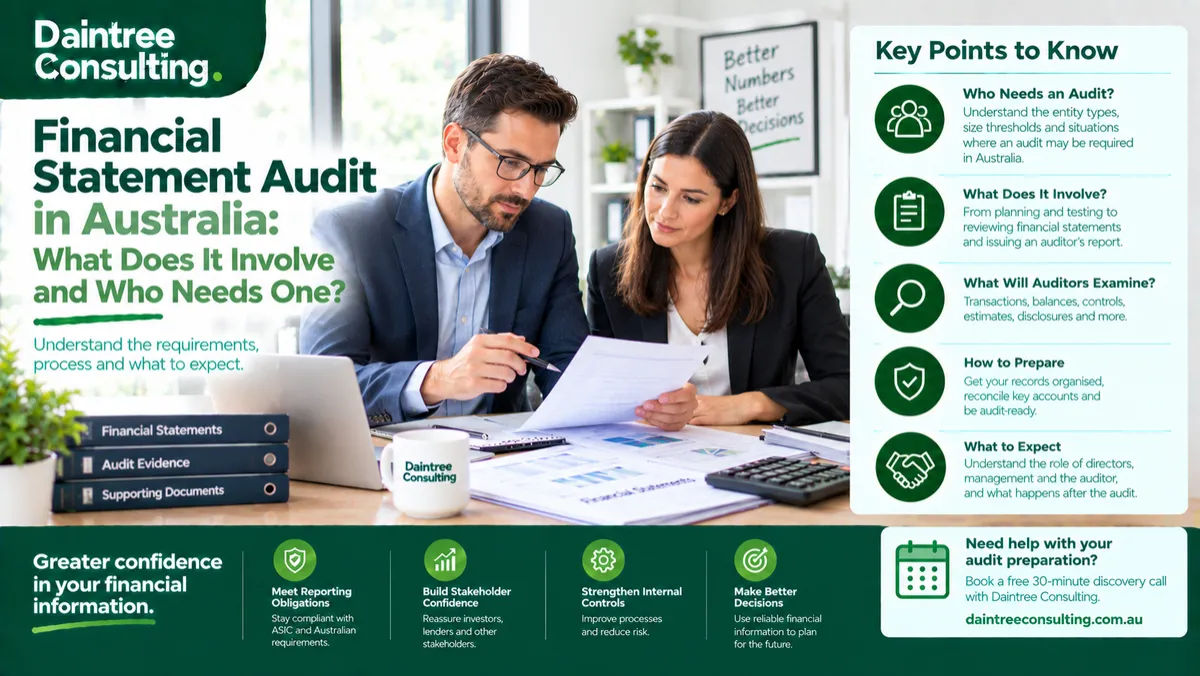
Financial Statement Audit in Australia: What Does It Involve and Who Needs One?
A financial statement audit is more than checking whether the numbers in a set of accounts add up.
For many Australian businesses and organisations, an audit is a statutory requirement. For others, an audit may be undertaken because shareholders, lenders, investors, grant providers or other stakeholders need greater confidence in the financial information.
Want expert help? Daintree Consulting's audit and assurance services can take this off your plate. Book a free consultation.
The important question is not simply “Do we need an audit?” It is also “What does a financial statement audit actually involve, and what should we do to prepare?”
In this guide, we explain how a financial statement audit works in Australia, which types of entities may need one, what an auditor examines, what management and directors are responsible for, and how businesses can make the process more organised.
Quick answer
A financial statement audit in Australia is an independent examination of an entity's financial report and supporting evidence. The auditor performs procedures to obtain sufficient appropriate audit evidence and then forms an opinion on whether the financial report is prepared in accordance with the applicable financial reporting framework.
Certain Australian entities are required to have their financial reports audited, including public companies, disclosing entities, registered schemes and generally large proprietary companies, subject to applicable exemptions and relief.
A large proprietary company is generally one that satisfies at least two of these criteria:
Consolidated revenue of $50 million or more
Consolidated gross assets of $25 million or more
100 or more employees
These thresholds apply for financial years commencing on or after 1 July 2019. There are exceptions and audit-relief provisions, so businesses should confirm their specific obligations rather than relying on the thresholds alone.
What is a financial statement audit?
A financial statement audit is an independent examination of an entity's financial report.
The purpose is to allow an independent auditor to obtain evidence and form an opinion about whether the financial report is prepared, in all material respects, in accordance with the applicable financial reporting framework.
Under Australian Auditing Standard ASA 700, the auditor's responsibilities include forming an opinion on the financial report and reporting that opinion in an independent auditor's report.
An audit is therefore different from simply having an accountant prepare financial statements.
An accountant may prepare, reconcile and analyse the financial information. An auditor performs an independent audit in accordance with the applicable auditing standards and obtains evidence to support the audit opinion.
That independence is an important part of the process.
Who needs a financial statement audit in Australia?
Not every Australian business automatically needs an annual financial statement audit.
The requirement depends on factors including the entity type, size, reporting obligations, legislation and whether an applicable exemption or relief applies.
ASIC states that certain entities must have their annual financial reports audited by a registered company auditor. These include companies other than small proprietary companies, registered schemes and disclosing entities. Proprietary companies may also be subject to specific audit-relief provisions.
Large proprietary companies
Large proprietary companies generally have annual financial reporting and audit obligations.
For financial years commencing on or after 1 July 2019, a proprietary company is classified as large if it satisfies at least two of the following:
$50 million or more in consolidated revenue
$25 million or more in consolidated gross assets
100 or more employees
The thresholds are applied using the relevant consolidated information for the company and entities it controls.
Large proprietary companies generally need to prepare and lodge financial reports with ASIC, and their accounts must generally be audited unless an applicable relief provision applies.
Public companies
Public companies generally have financial reporting and audit obligations under the Corporations Act.
The specific requirements depend on the company's circumstances and reporting category, but a public company should not assume that the audit requirement can be avoided simply because it is privately managed or has relatively straightforward operations.
Disclosing entities
Disclosing entities are subject to enhanced financial reporting requirements.
ASIC states that a disclosing entity must have its annual financial report audited and must also have its interim financial report reviewed.
Other entities
Other organisations can also have audit requirements depending on their structure, legislation, funding arrangements or regulatory obligations.
For example, registered schemes and certain companies limited by guarantee can have financial reporting and audit requirements.
This is why determining whether an audit is required should start with the entity's legal and reporting status rather than simply its annual turnover.
Can a small proprietary company need an audit?
Yes.
Being classified as a small proprietary company does not automatically mean that an audit is never required.
ASIC notes that some small proprietary companies may still need to prepare financial reports, including circumstances where shareholders or ASIC direct the company to do so, or where particular ownership or funding circumstances apply.
There are also specific audit-relief provisions that may apply to some proprietary companies.
ASIC's Regulatory Guide 115 explains audit relief available to certain proprietary companies, while ASIC's more recent reporting guidance sets out additional circumstances in which financial reporting or audit relief may apply.
The key point is simple:
Do not assume that being a small business means you do not need an audit.
Your company's ownership structure, reporting obligations, shareholder requirements and other circumstances may affect the answer.
What does a financial statement audit involve?
An audit normally involves much more than reviewing the final profit and loss statement.
The auditor needs to understand the business, identify areas where material misstatement could occur, assess relevant risks and perform procedures designed to obtain appropriate audit evidence.
The exact audit approach will depend on the entity and the circumstances.
Common areas include:
1. Understanding the business
The auditor needs to understand the entity's activities, structure, financial reporting environment and relevant controls.
This can include considering:
The nature of the business
Revenue streams
Major expenses
Financing arrangements
Significant assets and liabilities
Related-party relationships
Accounting systems
Internal controls
Significant transactions
Areas involving management judgement
This understanding helps the auditor determine where audit attention is required.
2. Reviewing financial statements
The auditor examines the financial report and considers whether the reported information is consistent with the applicable reporting framework.
Financial reports can include:
Statement of financial position
Statement of comprehensive income
Statement of changes in equity
Statement of cash flows
Notes to the financial statements
Directors' declaration
Directors' report
Auditor's report
ASIC identifies these as components of financial reporting for relevant entities.
3. Testing financial information
Auditors generally do not check every transaction individually.
Instead, they use audit procedures designed to obtain sufficient appropriate evidence.
Depending on the circumstances, this can involve testing selected transactions, balances and supporting documentation.
Examples can include examining:
Sales invoices
Supplier invoices
Bank statements
Loan agreements
Payroll records
Asset registers
Inventory records
Investment documentation
Receivables
Payables
Tax balances
Journal entries
The nature and extent of testing depends on the audit risks and the circumstances of the engagement.
4. Assessing internal controls
Auditors may consider the design and operation of relevant internal controls.
This can include controls around:
Payments
Revenue recognition
Bank reconciliations
Payroll
Access to accounting systems
Financial approvals
Journal entries
Asset management
Segregation of duties
Weak controls do not automatically mean that the financial statements are materially misstated.
However, control weaknesses can affect the auditor's risk assessment and may result in additional audit procedures.
5. Obtaining external evidence
Depending on the circumstances, auditors may seek evidence from parties outside the business.
Examples may include:
Bank confirmations
Customer receivable confirmations
Supplier information
Legal correspondence
Loan confirmations
Investment statements
External evidence can provide additional support for particular balances or transactions.
6. Reviewing estimates and judgement
Some financial statement items cannot be measured simply by looking at a bank statement.
Examples can include:
Asset valuations
Provisions
Impairment assessments
Depreciation
Expected credit losses
Tax-related balances
Fair value measurements
Where accounting estimates involve significant judgement, auditors may perform additional procedures to assess whether the amounts and related disclosures are reasonable under the applicable reporting framework.
What does an auditor look for?
A financial statement audit is concerned with whether the financial report contains material misstatements.
That means the auditor is not simply looking for every minor bookkeeping error.
Instead, the audit focuses on information that could reasonably influence the decisions of users of the financial report.
Potential areas of attention can include:
Unusual transactions
Large or unexpected movements in balances
Revenue recognition
Significant expenses
Related-party transactions
Asset valuations
Liabilities and provisions
Going-concern considerations
Accounting estimates
Missing or inadequate disclosures
Errors in financial statement presentation
Weaknesses affecting relevant financial reporting controls
The specific audit procedures depend on the entity and the auditor's assessment of risk.
What is the auditor's report?
At the end of the audit, the auditor issues an auditor's report containing the audit opinion and other required information.
The opinion addresses whether the financial report is prepared, in all material respects, in accordance with the applicable financial reporting framework.
The auditor's report is therefore an important part of the completed financial report.
It provides users with an independent auditor's opinion rather than management's own assessment of the financial statements.
An audit opinion should not be confused with a guarantee that the business is financially successful or that every error has been identified.
An audit provides reasonable assurance within the scope of the audit. It is not designed to guarantee the future performance of a business or eliminate all risk.
What are directors and management responsible for?
One of the most important points for business owners is that an auditor does not take responsibility for preparing the company's financial report.
Management and directors retain important responsibilities.
ASIC states that directors have responsibilities relating to maintaining proper books and records, understanding the financial report and providing auditors with the information they require.
This means directors and management need to:
Maintain appropriate financial records
Provide complete and accurate information
Explain significant transactions
Make appropriate accounting judgements
Prepare the financial report
Respond to auditor questions
Provide supporting documentation
Address identified issues
Meet applicable reporting obligations
The auditor's independence is also fundamental to the audit process. ASIC provides specific guidance concerning auditor independence and audit quality.
How should a business prepare for a financial statement audit?
Good audit preparation starts well before the auditor arrives.
A business can make the process more efficient by keeping its financial records organised throughout the year.
Reconcile key accounts
Bank accounts, credit cards, loans, receivables and payables should be reconciled regularly.
Unreconciled balances can make it harder to explain movements during the audit.
Review the balance sheet
Do not focus only on the profit and loss statement.
Review balance-sheet accounts and make sure significant balances can be supported by appropriate documentation.
Organise supporting documents
Create a clear audit file containing relevant documentation.
This may include:
Bank statements
Loan documents
Asset registers
Investment statements
Major contracts
Tax records
Payroll records
Reconciliation files
Significant transaction documentation
Board or management records where relevant
Identify unusual transactions
If there were major acquisitions, disposals, loans, restructures, related-party transactions or other unusual events during the year, identify them early.
The auditor is likely to ask questions about significant or unusual movements.
Review accounting policies
Make sure accounting policies are documented and consistently applied.
Where the business has complex transactions or significant estimates, consider the accounting treatment before the audit begins.
Resolve known issues
If management already knows that an account contains errors or unexplained balances, waiting until the audit begins can create unnecessary delays.
Addressing known issues before fieldwork can make the process considerably smoother.
How long does a financial statement audit take?
There is no single timeframe that applies to every Australian business.
The duration depends on factors such as:
Size of the organisation
Complexity of transactions
Number of entities
Quality of financial records
Internal control environment
Availability of supporting documents
Number of significant estimates
Audit scope
Responsiveness of management
Complexity of the reporting requirements
A well-organised business with reconciled records and a prepared audit file can generally make the information-gathering process easier.
By contrast, incomplete records, unexplained balances and late responses can extend the process.
What happens if an auditor finds an issue?
Finding an issue does not automatically mean that the business has failed its audit.
The auditor may raise questions, request additional evidence, propose adjustments or identify control issues.
Management may then need to:
Understand the issue.
Provide additional evidence.
Correct an error where appropriate.
Explain the accounting treatment.
Improve a process or control.
Consider whether the issue affects the financial report or disclosures.
The outcome depends on the nature and significance of the matter.
Some findings may relate to straightforward accounting corrections. Others may indicate broader control or reporting issues that require more attention.
Audit vs review: are they the same?
No.
An audit and a review are different types of engagement.
A financial statement audit involves procedures designed to obtain sufficient appropriate audit evidence to support an audit opinion.
A review generally involves more limited procedures and provides a lower level of assurance than an audit.
ASIC specifically distinguishes between audits and reviews in its financial reporting guidance.
The appropriate engagement depends on the entity's legal requirements and the purpose for which the financial information is being prepared.
Is a financial statement audit useful if it is not legally required?
An audit can sometimes be undertaken voluntarily, depending on the circumstances.
For example, an organisation may want greater independent confidence in its financial reporting when dealing with:
Investors
Lenders
Shareholders
Potential purchasers
Grant providers
Business partners
Parent companies
Other stakeholders
However, the value and scope of a voluntary audit should be considered in the context of the organisation's objectives and reporting needs.
It is not simply a matter of obtaining an audit because a business is growing.
When should you get professional audit preparation support?
Audit preparation can become more difficult when the accounting function is already under pressure.
Professional support may be useful when:
Your business has complex financial transactions
The company is approaching the large proprietary company thresholds
You have multiple entities
Your accounting records need significant cleanup
You have experienced rapid growth
There are substantial balance-sheet accounts to reconcile
Management needs better monthly reporting
You are preparing for your first audit
Previous audits identified recurring issues
Your finance team has limited capacity
The role of accounting support is not to replace the independent auditor.
Instead, it can help management maintain accurate records, prepare supporting schedules, reconcile accounts and respond to information requests more efficiently.
How Daintree Consulting can help
Preparing for an audit starts with having reliable financial information.
Daintree Consulting provides accounting and audit & assurance support for Australian businesses that need clearer financial records, stronger reporting processes and a more organised approach to financial requirements.
Support can include areas such as:
Financial reporting
Account reconciliations
Management reporting
Audit preparation and readiness
Internal-control and process reviews
Supporting documentation
Financial statement audit support where applicable
Coordination around audit information requests
Daintree's Audit & Assurance service is designed around the applicable purpose, entity and regulatory requirements, with a focus on clear findings and practical next steps.
If you are approaching an audit or are unsure what your business needs to prepare, you can book a free 30-minute discovery call with Daintree Consulting.
Frequently asked questions
Does every Australian business need a financial statement audit?
No. Audit requirements depend on the entity type, size, reporting obligations and applicable legislation. Certain entities must be audited, while some proprietary companies may qualify for audit relief.
What is the financial statement audit threshold in Australia?
For financial years commencing on or after 1 July 2019, a proprietary company is generally considered large if it satisfies at least two of $50 million or more in consolidated revenue, $25 million or more in consolidated gross assets, and 100 or more employees. Other reporting and audit rules can apply, so the thresholds should not be considered in isolation.
Does a small proprietary company need an audit?
Not necessarily. However, some small proprietary companies can have financial reporting or audit obligations depending on their circumstances, including certain foreign-controlled companies and companies subject to shareholder or ASIC directions. Specific audit relief may also apply in some situations.
What documents does an auditor need?
The exact information request depends on the audit. Common documents can include financial statements, general ledger information, bank statements, reconciliations, invoices, contracts, loan documents, asset records, payroll information and supporting evidence for significant transactions.
Does an audit check every transaction?
Usually, an audit does not involve checking every transaction individually. Auditors design procedures based on assessed risks and the requirements of the applicable auditing standards.
What happens after the audit?
The auditor completes the required procedures, evaluates the audit evidence and forms an audit opinion. The auditor's report is then included with the financial report where required.
Final takeaway
A financial statement audit in Australia is an independent examination of an entity's financial report and supporting evidence.
For some organisations, an audit is a legal requirement. For others, it may be undertaken to provide stakeholders with greater confidence in the financial information.
For business owners and directors, the most useful approach is to understand the requirements early, keep financial records organised, reconcile key accounts regularly and prepare supporting documentation throughout the year.
If your business is approaching an audit, preparing its first financial statement audit or reviewing its internal financial processes, getting the accounting records organised before the audit begins can make the process much more manageable.
Need help preparing for a financial statement audit? Book a free 30-minute discovery call with Daintree Consulting.
Talk to Daintree about your audit
Our ex-Big 4 team gives clear, senior-reviewed advice so you can act with confidence.
Book a free consultation →
Or explore our audit and assurance services.
