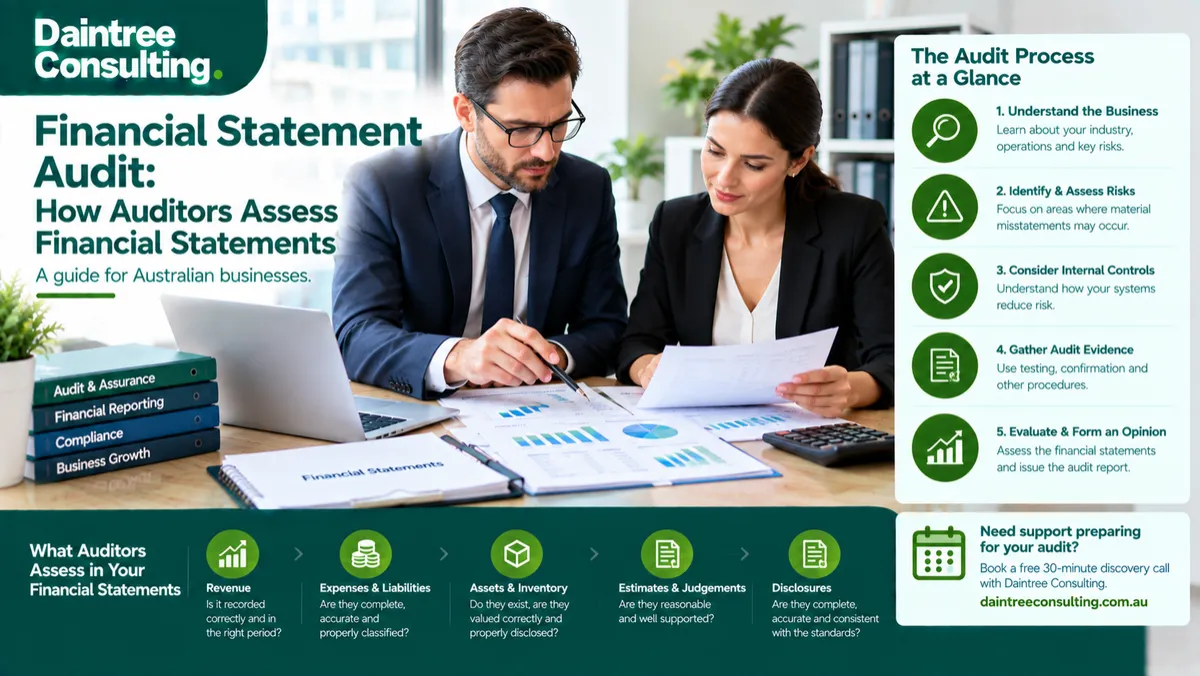
How Do Auditors Assess Financial Statements? A Guide for Australian Businesses
When a business goes through a financial statement audit, one of the most common questions from management is:
“What exactly is the auditor looking for?”
Want expert help? Daintree Consulting's audit and assurance services can take this off your plate. Book a free consultation.
An audit is more than checking whether the numbers in a financial report add up.
Auditors assess whether there is a risk that the financial statements contain a material misstatement and design audit procedures to obtain sufficient appropriate evidence to support their opinion.
Under Australian Auditing Standards, auditors identify and assess risks of material misstatement, consider the entity and its internal controls, and design audit procedures that respond to those risks.
That means the auditor's approach is not simply:
“Check every transaction.”
Instead, auditors use professional judgement to determine where errors or other misstatements could matter most and what evidence is needed to reach reasonable assurance.
For Australian businesses, understanding this process can make an audit much easier to prepare for.
It can also help management understand why auditors ask particular questions, request particular documents and spend more time on some areas of the financial statements than others.
Quick answer: How do auditors assess financial statements?
During a financial statement audit, auditors generally:
Understand the business and its environment.
Understand the applicable financial reporting framework.
Consider relevant internal controls.
Identify and assess risks of material misstatement.
Consider materiality.
Determine the appropriate audit procedures.
Obtain and evaluate audit evidence.
Test selected transactions, balances and disclosures.
Assess accounting estimates and significant judgements.
Consider whether the financial statements are appropriately presented and disclosed.
Evaluate identified misstatements.
Form an audit opinion based on the evidence obtained.
The exact procedures vary depending on the business, financial reporting framework, risks, industry, transactions and other circumstances.
What is a financial statement audit?
A financial statement audit is an independent examination of financial information designed to provide reasonable assurance that the financial report is free from material misstatement and prepared in accordance with the applicable financial reporting framework.
For entities subject to the Corporations Act financial reporting requirements, the auditor's role includes forming an opinion on whether the financial report complies with accounting standards and gives a true and fair view, as well as considering other matters required by law.
The audit does not mean the auditor guarantees that every number is correct.
ASIC explains that an audit is not intended to provide absolute assurance that there are no material misstatements. Reasonable assurance represents a high level of assurance, but it is not 100% certainty.
This distinction is important.
An audit is designed to provide reasonable assurance based on appropriate audit procedures and evidence.
Step 1: The auditor gets to know the business
Before testing individual financial statement balances, the auditor needs to understand the entity.
This can include understanding:
What the business does
How it generates revenue
Its industry
Its organisational structure
Key suppliers and customers
Major contracts
Financing arrangements
Accounting systems
Internal processes
Relevant regulations
Significant transactions
Changes during the reporting period
The objective is not simply to learn about the business.
Understanding the business helps the auditor identify areas where material misstatements could occur.
ASA 315 requires auditors to identify and assess risks of material misstatement through understanding the entity, its environment and relevant aspects of its internal control.
Why does this matter?
Imagine two businesses both report $10 million in revenue.
One operates a straightforward retail model with relatively simple transactions.
The other has long-term contracts, complex revenue arrangements and significant estimates.
The financial statements may contain similar headline figures, but the audit risks can be very different.
That is why an auditor does not apply exactly the same procedures to every business.
Step 2: The auditor identifies areas of risk
The next major part of the process is identifying where a financial statement could potentially be materially misstated.
A misstatement may result from:
Error
Incorrect accounting treatment
Inappropriate assumptions
Incomplete records
Incorrect classification
Incorrect valuation
Inadequate disclosure
Fraud
ASA 315 requires auditors to identify and assess risks of material misstatement at both the financial-report level and the assertion level.
This risk assessment influences the rest of the audit.
Higher-risk areas generally require more persuasive audit evidence and more focused procedures. ASA 330 requires the nature, timing and extent of further audit procedures to respond to assessed risks.
Step 3: The auditor considers materiality
Auditors do not treat every error as equally significant.
Materiality is an important concept in a financial statement audit.
In simple terms, a matter is material when its omission, misstatement or obscuring could reasonably be expected to influence decisions made by users of the financial report.
Materiality is considered when planning the audit, assessing risks and evaluating identified misstatements.
This does not mean smaller errors are automatically ignored.
A series of individually smaller errors can become significant when considered together.
Qualitative factors can also matter.
For example, a relatively small amount may still be important if it relates to:
A regulatory requirement
A related-party transaction
Management remuneration
A covenant
A sensitive disclosure
A transaction affecting a key performance measure
Materiality is therefore not simply a single dollar threshold applied mechanically to every audit issue.
Step 4: The auditor considers internal controls
Auditors also consider relevant internal controls.
Internal controls are the processes and safeguards a business uses to reduce the risk of errors, fraud or inappropriate transactions.
Examples include:
Approval procedures
Segregation of duties
Bank reconciliations
Payment controls
Access controls
Review procedures
Payroll approvals
Inventory controls
Financial reporting reviews
User permissions within accounting systems
ASA 315 requires auditors to obtain an understanding of the entity's system of internal control relevant to the audit and to consider the control environment and other components of internal control.
Does the auditor test every control?
No.
The nature and extent of control-related audit work depend on the circumstances and the auditor's risk assessment.
In some audits, the auditor may test whether particular controls are operating effectively.
In other situations, the auditor may place greater emphasis on substantive procedures.
The approach depends on the risks and the audit strategy.
Step 5: The auditor tests the financial information
Once the risks have been assessed, the auditor designs procedures to obtain evidence.
Audit procedures can include:
Inspecting documents
Recalculating amounts
Reperforming processes
Analysing trends
Comparing information
Confirming balances externally
Observing processes
Inspecting assets
Testing transactions
Reviewing contracts
Examining subsequent events
ASA 500 explains that audit evidence is information used by the auditor in reaching conclusions on which the audit opinion is based. The evidence can come from accounting records as well as other internal and external sources.
The auditor evaluates whether the evidence is sufficient and appropriate.
What does “sufficient and appropriate audit evidence” mean?
These two concepts are related but different.
Sufficiency
Sufficiency refers broadly to the quantity of audit evidence.
Higher assessed risk may require more evidence.
Appropriateness
Appropriateness relates to the quality of evidence, including its relevance and reliability.
More evidence does not necessarily compensate for poor-quality evidence.
ASA 500 explains that the quantity of evidence needed is affected by assessed risk, while the quality of evidence depends on its relevance and reliability.
This is one reason auditors may ask for original documents, independent confirmations or information from external sources rather than relying solely on internally generated explanations.
What financial statement areas do auditors commonly assess?
The exact focus varies by business, but auditors may pay particular attention to areas such as:
Revenue
Auditors may assess whether revenue has been:
Recorded in the correct period
Properly supported
Correctly recognised
Appropriately classified
Properly disclosed
Revenue can involve significant audit attention because errors in timing, classification or recognition can affect reported performance.
Expenses and liabilities
Auditors may examine whether expenses and liabilities have been:
Completely recorded
Correctly classified
Recorded in the correct period
Properly supported
Appropriately disclosed
They may also consider whether liabilities existing at year-end have been omitted or understated.
Accounts receivable
For trade receivables, auditors may consider:
Whether balances exist
Whether amounts are recoverable
Whether balances are correctly recorded
Whether credit losses have been appropriately considered
Whether subsequent receipts support the balances
Depending on the circumstances, auditors may use external confirmations, subsequent cash receipts and other procedures as evidence.
Inventory
Inventory can involve several audit considerations.
These may include:
Existence
Completeness
Valuation
Condition
Cut-off
Obsolescence
Stock counts
Physical observation can be an important part of inventory auditing where appropriate.
The auditor may also examine how the business calculates inventory values and whether the accounting treatment is consistent with the applicable reporting framework.
Property, plant and equipment
For significant fixed assets, auditors may consider:
Whether the asset exists
Whether the business controls it
Whether it is correctly recorded
Whether its carrying value is appropriate
Depreciation
Useful lives
Impairment indicators
Capital expenditure classification
ASIC identifies asset values and other estimates as areas where financial reporting can involve significant judgement and estimation.
Loans and borrowings
Borrowings can involve several audit considerations, including:
Whether the liability exists
The amount outstanding
Interest
Repayment terms
Security arrangements
Classification
Related disclosures
Compliance with relevant requirements
Loan agreements and other finance documents may therefore form part of the audit evidence.
Payroll and employee-related balances
Auditors may examine payroll-related balances and transactions, including:
Wages
Superannuation
Leave provisions
Payroll liabilities
Employee benefits
Payroll tax where relevant
They may compare payroll records with accounting records and examine supporting documentation.
Tax balances
Tax-related balances can also require audit attention.
Depending on the business and reporting framework, this may involve areas such as:
Income tax
GST
Deferred tax
PAYG-related balances
Tax provisions
Tax liabilities
The audit treatment depends on the financial reporting framework and circumstances of the entity.
Accounting estimates and judgement
Some of the most challenging areas of a financial statement audit involve estimates.
Examples can include:
Asset valuations
Impairment
Provisions
Expected credit losses
Useful lives
Revenue estimates
Contingent liabilities
Other forward-looking assumptions
These areas can require significant management judgement.
ASIC specifically highlights areas involving significant judgement and estimation as areas where auditors should apply professional scepticism.
What does professional scepticism mean?
It means the auditor does not simply accept management's explanation without appropriate consideration of the evidence.
ASIC describes professional scepticism as involving a questioning mindset and critical assessment of audit evidence and management's judgements.
That does not mean the auditor assumes management is wrong.
It means the auditor evaluates the evidence objectively.
Auditors also consider financial statement disclosures
An audit is not only about the numbers in the main statements.
Financial reports include notes and other disclosures.
ASIC notes that financial reports generally include financial statements, notes, relevant declarations and reports, including the auditor's report.
Auditors therefore consider whether required disclosures are appropriate and consistent with the underlying financial information.
This can include disclosures relating to:
Accounting policies
Significant judgements
Estimates
Commitments
Related parties
Financial instruments
Contingencies
Events after reporting date
Other matters required by the applicable reporting framework
A number can be correct while the accompanying disclosure is inadequate.
What happens if the auditor finds an error?
Finding an error does not automatically mean the financial statements will receive a modified audit opinion.
The auditor evaluates the nature and significance of the issue.
They may consider:
The amount involved
Whether the issue is isolated or widespread
Whether it affects a key disclosure
Whether similar errors exist elsewhere
Whether management can correct it
Whether the issue is material individually or collectively
Auditors also evaluate identified misstatements in accordance with the applicable auditing standards.
Where appropriate, management may be asked to make an adjustment to the financial statements.
This is one reason businesses should not view audit queries as simply requests for paperwork.
An audit query can identify an accounting treatment or process that needs further consideration.
Why auditors ask for so many documents
A common frustration during an audit is receiving a long request list.
From management's perspective, some requests may seem excessive.
But the auditor needs evidence to support the conclusions that underpin the audit opinion.
Evidence may include:
Invoices
Contracts
Bank statements
Bank reconciliations
Customer confirmations
Supplier statements
Loan agreements
Asset registers
Payroll reports
Inventory records
Board minutes
Accounting schedules
Tax records
Valuation reports
Management calculations
ASA 500 makes clear that audit evidence can come from the entity's accounting records and other internal and external sources.
The specific evidence requested will depend on the risk and the financial statement area being audited.
Why does an auditor ask the same question more than once?
Auditors may ask management to explain an issue and then request supporting evidence.
This is not necessarily because they distrust the business.
An explanation is not always sufficient audit evidence.
For example, management might explain that a receivable is expected to be collected.
The auditor may then ask for:
Subsequent payment evidence
Customer correspondence
Aged receivables
Credit assessments
Other supporting information
The auditor needs evidence that supports the conclusion, not simply an assertion.
What happens after the testing?
Once the auditor has performed the planned procedures and evaluated the evidence, they consider whether they have obtained sufficient appropriate audit evidence to support their conclusions.
ASA 330 requires auditors to evaluate whether sufficient appropriate audit evidence has been obtained and whether the financial statement presentation and disclosures are adequate.
The auditor then considers the overall financial report and the implications of identified matters before forming the audit opinion.
What does the auditor's opinion tell you?
The audit opinion communicates the auditor's conclusion about the financial report under the applicable reporting framework.
For an unmodified opinion, the auditor has concluded, in the circumstances of the audit, that the financial report is prepared in accordance with the applicable framework and is not materially misstated.
A modified opinion can arise when the auditor identifies matters that affect the opinion under the applicable auditing standards.
The exact wording and implications depend on the circumstances.
This is why the audit report should be read alongside the financial statements and notes rather than viewed as a standalone approval stamp.
Is a financial statement audit a guarantee that the accounts are correct?
No.
This is an important distinction.
An audit provides reasonable assurance, not absolute assurance.
ASIC specifically notes that audits are not intended to provide absolute assurance that there are no material misstatements.
Audits also have inherent limitations.
For example, auditors generally use sampling and professional judgement rather than checking every individual transaction.
The objective is to reduce audit risk to an acceptably low level, not eliminate all possibility of error.
What can businesses do to make a financial statement audit easier?
A business cannot eliminate every audit question.
But it can make the process more organised.
Start with the fundamentals.
Keep reconciliations up to date
Make sure key accounts are reconciled regularly.
This can include:
Bank accounts
Credit cards
Loans
Accounts receivable
Accounts payable
Payroll
GST accounts
Intercompany balances
Maintain supporting documentation
Keep contracts, invoices, statements and other relevant evidence organised.
Maintain a fixed asset register
Make sure additions, disposals and depreciation are appropriately recorded.
Review unusual transactions
Large or unusual transactions should be identified and reviewed before the audit begins.
Document significant accounting judgements
Where management has made a significant estimate or accounting judgement, maintain documentation explaining the basis for the treatment.
ASIC highlights the importance of documenting the basis and circumstances of judgements relating to accounting estimates and forward-looking information.
Review the financial statements before the audit
Do not assume that the auditor will identify every issue.
Management remains responsible for preparing the financial report.
ASIC states that directors are primarily responsible for the quality of the financial report and should ensure that appropriate processes, records and analysis support it.
Management remains responsible for the financial statements
One of the most important things to understand about an audit is that the auditor does not prepare the company's financial statements for management.
The responsibility for preparing and presenting financial statements remains with management and those charged with governance.
ASIC explains that directors have responsibilities relating to financial reporting, including ensuring records are complete and accurate and that appropriate controls and processes are in place.
The auditor provides an independent opinion based on the evidence obtained.
This distinction matters.
Management prepares the financial report.
The auditor independently assesses it and forms an opinion.
Who needs a financial statement audit in Australia?
Not every Australian business is automatically required to have its financial statements audited.
Audit and financial reporting requirements depend on the type of entity, its circumstances and applicable legislation.
ASIC states that entities required to lodge financial reports can include disclosing entities, public companies, large proprietary companies and some small proprietary companies.
Certain other entities also have specific reporting requirements.
Some entities may qualify for relief in particular circumstances.
Businesses should therefore confirm their specific obligations rather than assuming that size alone determines whether an audit is required.
Financial statement audit vs financial statement preparation
These are two different processes.
Financial statement preparation
This involves preparing the financial statements in accordance with the applicable accounting framework.
Financial statement audit
This involves an independent auditor obtaining evidence and forming an opinion on the financial report.
A business can therefore have accurate bookkeeping and well-prepared financial statements while still going through an audit process.
The audit provides an additional level of independent assurance.
How Daintree can help businesses prepare for an audit
An efficient audit usually starts well before the auditor arrives.
Daintree Consulting can support Australian businesses with audit preparation and the financial information required for an efficient audit process.
Support may include:
Financial statement preparation support
Account reconciliations
Audit schedules
Supporting documentation
Balance-sheet review
Financial reporting
Audit-ready records
Coordination with the audit process
Identification of potential issues before the audit
Clear responses to auditor information requests
The objective is not to interfere with the auditor's independence.
It is to help management ensure the financial information and supporting records are organised, complete and ready for the audit.
Need help preparing for a financial statement audit?
Daintree Consulting provides accounting and Audit & Assurance support for Australian businesses that need greater confidence in their financial records and reporting.
If your business has an upcoming audit, or you want to understand whether your financial records are ready, book a free 30-minute discovery call with Daintree Consulting.
Frequently Asked Questions
What does an auditor look for in financial statements?
Auditors look for risks of material misstatement and obtain evidence to assess whether the financial statements are appropriately prepared under the applicable reporting framework.
Areas reviewed can include revenue, expenses, assets, liabilities, cash, inventory, estimates, disclosures and internal controls.
Do auditors check every transaction?
Usually, no.
Auditors use risk assessment, professional judgement, sampling and other procedures to obtain sufficient appropriate evidence. The nature and extent of testing depend on the assessed risks and circumstances of the audit.
What is material misstatement?
A material misstatement is an error, omission or other misstatement that could reasonably be expected to influence decisions made by users of the financial report.
Materiality is considered when auditors plan and perform their work and evaluate identified misstatements.
What is audit evidence?
Audit evidence is information used by the auditor to reach conclusions on which the audit opinion is based.
It can include accounting records, contracts, invoices, confirmations, calculations, external information and other relevant evidence.
Why do auditors examine internal controls?
Understanding relevant internal controls helps auditors identify and assess risks of material misstatement and determine appropriate audit procedures.
Can an auditor change the financial statements?
Management is responsible for preparing the financial statements.
If an auditor identifies an issue, they may discuss it with management and request an adjustment where appropriate. The auditor then evaluates the financial report based on the applicable auditing standards and evidence obtained.
Does an audit guarantee that there are no errors?
No.
An audit provides reasonable assurance, not absolute assurance, that the financial report is free from material misstatement.
What documents should I prepare for a financial statement audit?
The exact list depends on the business and audit scope, but common requests can include bank reconciliations, general ledger information, invoices, contracts, asset registers, loan documents, payroll information, receivables and payables reports, inventory records and supporting schedules.
Does every Australian business need an audit?
No.
Audit requirements depend on the entity type and applicable legal and reporting requirements. Some entities are required to have financial reports audited, while certain entities may qualify for relief in particular circumstances.
How can I prepare my business for a financial statement audit?
Start by ensuring the accounts are reconciled, supporting documents are organised, significant transactions are reviewed, financial statements are checked and significant accounting judgements are documented.
It is also useful to resolve known issues before the audit begins rather than waiting for the auditor to identify them.
Talk to Daintree about your audit
Our ex-Big 4 team gives clear, senior-reviewed advice so you can act with confidence.
Book a free consultation →
Or explore our audit and assurance services.
