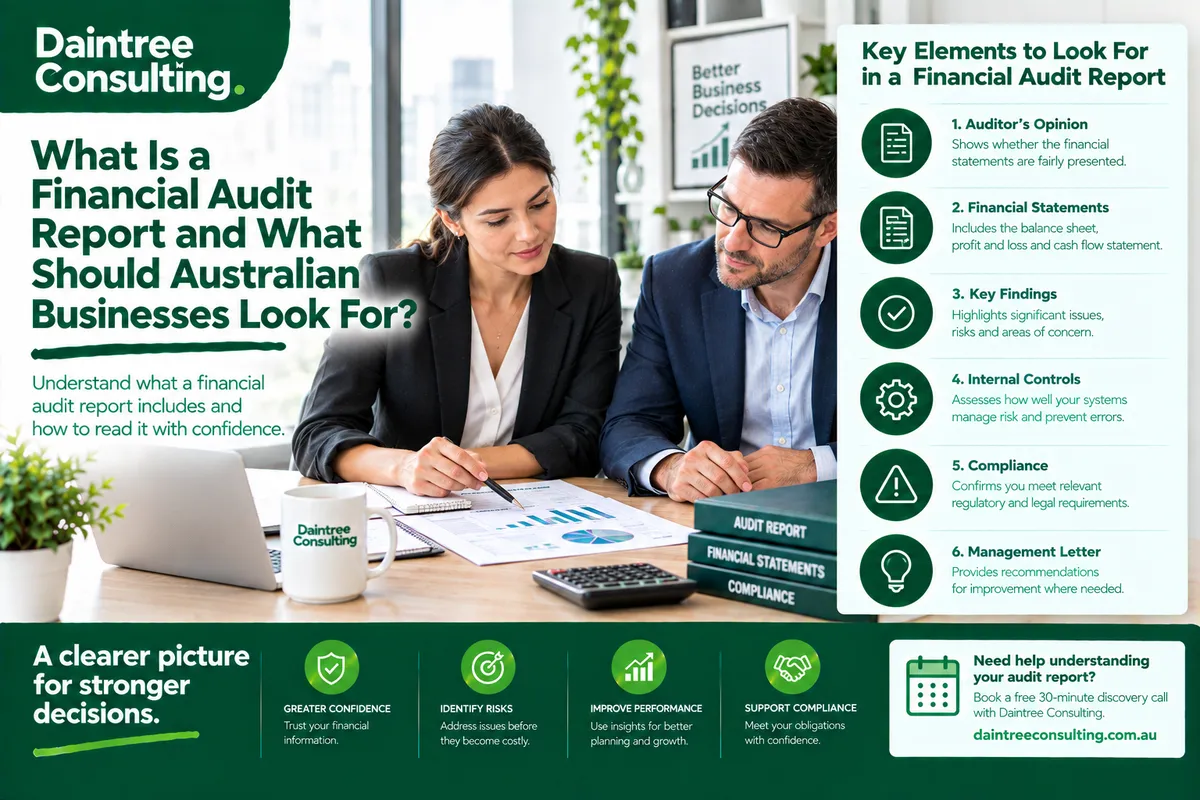
What Is a Financial Audit Report and What Should Australian Businesses Look For?
A financial audit report is one of the most important documents produced at the end of a financial statement audit.
But for many Australian business owners and directors, the auditor's report can be difficult to interpret.
Want expert help? Daintree Consulting's audit and assurance services can take this off your plate. Book a free consultation.
It may contain terms such as unmodified opinion, qualified opinion, Basis for Qualified Opinion, Key Audit Matters, Emphasis of Matter and going concern.
What do these terms actually mean?
More importantly, what should a business owner look at first when reviewing an audit report?
In Australia, an auditor's report communicates the auditor's independent opinion on the financial report following an audit. The auditor considers whether the financial report has been prepared, in all material respects, in accordance with the applicable financial reporting framework and whether sufficient appropriate audit evidence has been obtained to support the opinion.
The report therefore should not be treated simply as a certificate saying that every number in the accounts is correct.
It is the auditor's formal communication about the financial report based on the audit performed.
For businesses and directors, understanding how to read a financial audit report in Australia can make it easier to identify important issues, understand the auditor's conclusion and follow up on matters that require attention.
Quick answer: What is a financial audit report?
A financial audit report is the independent auditor's report issued after completing an audit of a financial report.
The report communicates the auditor's opinion about whether the financial report has been prepared in accordance with the applicable financial reporting framework and, where relevant, whether it gives a true and fair view.
The exact format depends on the entity, reporting framework and circumstances of the audit.
Under ASA 700, the auditor's report includes an opinion section and other required information explaining the basis for the auditor's conclusion and the respective responsibilities of management and the auditor.
A report may also contain additional sections where relevant, such as Key Audit Matters, an Emphasis of Matter or Other Matter paragraph, or a section explaining the basis for a modified opinion.
The important point is that the auditor's report needs to be read together with the financial report, rather than in isolation.
What does a financial audit report actually tell you?
The primary purpose of an auditor's report is to communicate the auditor's opinion following an audit.
ASIC describes the auditor's report as an independent opinion intended to help users understand whether the applicable financial reporting framework has been applied and whether the financial report is free from material misstatement and gives a true and fair view where applicable.
The auditor's report therefore provides a conclusion based on the audit evidence obtained.
It does not mean:
Every transaction was checked
Every accounting estimate is certain
There is no possibility of fraud
The business will remain profitable
The business will have sufficient cash in the future
Management decisions are necessarily good
The company is guaranteed to be financially healthy
An audit provides reasonable assurance rather than absolute assurance.
That distinction is important when interpreting the report.
What is included in an Australian financial report?
Before looking specifically at the auditor's report, it helps to understand the broader financial report.
ASIC explains that a financial report generally includes:
Statement of financial position
Statement of profit or loss and other comprehensive income
Statement of changes in equity
Statement of cash flows
Notes to the financial statements
Directors' declaration
Directors' report
Auditor's report
The financial statements and notes provide the underlying financial information.
The auditor's report provides the auditor's independent opinion on that financial report.
This means the auditor's report should not be viewed as replacing the financial statements.
It is part of the broader reporting package.
Who is responsible for the financial report?
This is an important distinction for Australian businesses.
The auditor does not prepare the company's financial report for the directors.
Management and those charged with governance remain responsible for preparing and presenting the financial report.
ASIC also makes clear that directors have responsibilities relating to the financial report and should understand and carefully review it.
The external auditor provides an independent opinion after conducting the audit.
In simple terms:
Management prepares the financial report.
The auditor independently audits it and reports an opinion.
This distinction matters because an auditor's report is not a replacement for management's responsibility to ensure that financial information is properly prepared and supported.
The first thing to look for: the auditor's opinion
If you are reviewing a financial audit report, start with the Opinion section.
Under ASA 700, the Opinion section is the first section of the auditor's report.
It identifies the entity whose financial report has been audited and identifies the financial statements and relevant period covered by the audit.
Most importantly, it tells the reader the auditor's conclusion.
For a standard unmodified opinion, the auditor concludes that the financial report is prepared, in all material respects, in accordance with the applicable financial reporting framework.
The wording will depend on the reporting framework and circumstances.
For a business owner, this is the section to read first.
Do not start with the technical detail further down the report before understanding what opinion the auditor has issued.
What is an unmodified audit opinion?
An unmodified opinion is sometimes informally referred to as a "clean" audit opinion.
It means the auditor has concluded that the financial report is prepared, in all material respects, in accordance with the applicable financial reporting framework.
It does not mean the auditor is guaranteeing that every figure is correct.
It also does not mean that there were no audit issues, discussions or recommendations during the audit.
There may still be control deficiencies, management recommendations or areas that received significant audit attention.
The key point is that the auditor has not determined that a modification to the opinion is required under the applicable auditing standards.
What is a modified audit opinion?
A modified opinion means the auditor has determined that the standard unmodified opinion is not appropriate in the circumstances.
Under ASA 705, modified opinions include:
Qualified opinion
Adverse opinion
Disclaimer of opinion
These are not interchangeable.
The nature of the modification and the reasons behind it matter.
This is why a business should never look only at the words "modified opinion" and stop there.
The next step is to read the section explaining why the opinion was modified.
What is a qualified opinion?
A qualified opinion generally means that the auditor has identified a matter that affects the financial report, but the effect is not so pervasive that an adverse opinion or disclaimer is required.
The auditor's report includes a Basis for Qualified Opinion section explaining the reason for the qualification.
The wording depends on the circumstances.
A qualification can arise from a material misstatement or, in some circumstances, an inability to obtain sufficient appropriate audit evidence.
For a business owner, the important questions are:
What caused the qualification?
Which financial statement area is affected?
How significant is the matter?
Does it affect an asset, liability, revenue, expense or disclosure?
Has management considered whether an adjustment is required?
Could the issue affect future reporting periods?
The qualification should therefore be read alongside the relevant financial statement note.
What is an adverse opinion?
An adverse opinion is more serious than a qualified opinion.
It means the auditor concludes that the financial report is materially and pervasively misstated in accordance with the applicable reporting framework.
The auditor's report explains the basis for the adverse opinion.
For management and directors, this should prompt careful consideration of the underlying accounting and reporting issues.
The issue is not simply that the audit report contains an adverse opinion.
The important question is what caused it and what needs to change?
What is a disclaimer of opinion?
A disclaimer of opinion means the auditor does not express an opinion on the financial report because the auditor was unable to obtain sufficient appropriate audit evidence and the possible effects could be both material and pervasive, or because the circumstances require a disclaimer under the applicable standard.
A disclaimer is therefore different from an adverse opinion.
An adverse opinion means the auditor has concluded that the financial report is materially and pervasively misstated.
A disclaimer means the auditor has been unable to obtain sufficient appropriate evidence to form an opinion in the required circumstances.
The Basis for Disclaimer of Opinion section should explain the circumstances.
Read the "Basis" section carefully
One of the most useful parts of an audit report is the section explaining the basis for the auditor's opinion.
For an unmodified opinion, the report generally includes a Basis for Opinion section.
For a modified opinion, the report includes the relevant basis section, such as:
Basis for Qualified Opinion
Basis for Adverse Opinion
Basis for Disclaimer of Opinion
This section helps explain the evidence and circumstances underlying the auditor's conclusion.
For a business owner, this is where the report moves beyond the headline opinion.
If the report contains a qualification or other significant matter, this section deserves close attention.
What does "reasonable assurance" mean?
An audit does not provide absolute certainty.
The auditor's objective is to obtain reasonable assurance that the financial report as a whole is free from material misstatement, whether caused by fraud or error.
This is important because an audit generally involves professional judgement, risk assessment, sampling and other procedures.
The auditor is not necessarily checking every transaction individually.
Instead, the auditor obtains sufficient appropriate audit evidence to support the opinion.
Therefore, an unmodified opinion should not be interpreted as:
"Nothing could possibly be wrong."
It means the auditor has reached the required conclusion based on the audit evidence obtained and the applicable auditing standards.
What should you look for in the financial statements themselves?
Reading the auditor's report is only the beginning.
The next step is to review the financial statements and notes.
Look at areas such as:
Revenue
Consider whether revenue has changed significantly.
Ask:
Is growth consistent with what happened in the business?
Are there major changes from the previous period?
Are there significant contracts or revenue arrangements?
Are unusual movements explained in the notes?
Profitability
Review:
Gross profit
Operating profit
Net profit
Major expense movements
Changes in margins
A business can have strong revenue growth while experiencing declining margins.
Cash flow
Profit and cash are not the same thing.
Review:
Operating cash flow
Investing activities
Financing activities
Cash balances
Borrowings
Major capital expenditure
Cash-flow information can provide important context when assessing the financial position of the business.
Assets and liabilities
Look for significant movements in:
Receivables
Inventory
Property and equipment
Loans
Trade payables
Provisions
Other liabilities
Large changes should be understood rather than simply accepted because the audit opinion is unmodified.
Accounting estimates
Pay particular attention to areas involving significant judgement or estimation.
These may include:
Asset valuations
Impairment
Provisions
Expected credit losses
Useful lives
Fair values
Other significant assumptions
The notes should provide information about significant judgements and estimates where required by the applicable reporting framework.
What are Key Audit Matters?
Some audit reports contain a section called Key Audit Matters, or KAMs.
Key Audit Matters are matters that, in the auditor's professional judgement, were of most significance in the audit of the financial report for the current period.
They are selected from matters communicated with those charged with governance.
Key Audit Matters are particularly relevant for listed entities, although the requirements and circumstances under which they appear should be considered carefully for other entities.
They do not represent separate audit opinions on individual matters.
They are also not a substitute for required financial statement disclosures or a modified audit opinion.
For readers, KAMs can provide useful insight into the areas that required significant auditor attention.
A KAM might relate to an area involving:
Significant management judgement
Complex transactions
Significant estimates
Valuation
Revenue recognition
Acquisitions
Impairment
Other matters requiring significant auditor attention
If a KAM section appears in the report, read it together with the related financial statement note.
Does a Key Audit Matter mean something is wrong?
Not necessarily.
This is a common misunderstanding.
A Key Audit Matter is not automatically a problem, error or qualification.
It identifies a matter that was of most significance in the audit.
A matter may require substantial audit attention because it is complex, highly judgemental or involves significant estimation.
The auditor may still issue an unmodified opinion.
Therefore:
Key Audit Matter does not automatically mean financial statement error.
It means the matter was significant to the audit and is being communicated to users in accordance with the applicable requirements.
What is an Emphasis of Matter paragraph?
An Emphasis of Matter paragraph is used in particular circumstances to draw users' attention to a matter that is appropriately presented or disclosed in the financial report and that, in the auditor's judgement, is fundamental to users' understanding of the financial report.
Importantly, an Emphasis of Matter paragraph does not automatically mean that the auditor has modified the opinion.
ASA 706 requires the auditor to indicate that the opinion is not modified in respect of the matter being emphasised.
For a business owner, this means the paragraph deserves attention, but it should not automatically be interpreted as an adverse audit finding.
Read the referenced financial statement disclosure to understand the issue.
What is an Other Matter paragraph?
An Other Matter paragraph is different.
It relates to a matter that is not presented or disclosed in the financial report but is, in the auditor's judgement, relevant to users' understanding of the audit, the auditor's responsibilities or the auditor's report.
Again, the existence of such a paragraph does not automatically mean that the financial statements are materially misstated.
The significance depends on the specific circumstances and wording.
What should you look for regarding going concern?
Going concern is another important area to understand when reviewing an audit report.
A business can be profitable and still face significant cash-flow pressure.
Auditors consider matters relevant to the entity's ability to continue as a going concern under the applicable auditing requirements.
Where significant uncertainty or other relevant circumstances exist, the financial report and auditor's report may contain specific disclosures or reporting.
For an owner or director, warning signs may include:
Continuing losses
Significant cash-flow pressure
Difficulty meeting financial obligations
Dependence on refinancing
Major debt maturities
Loss of significant customers
Funding uncertainty
Negative working capital
These circumstances should be considered alongside the financial statements, forecasts and relevant disclosures.
The existence of a going-concern-related disclosure should not be interpreted without reading the specific wording and circumstances.
Look at the date of the auditor's report
The date of the auditor's report is also important.
ASA 700 requires the auditor's report to be dated no earlier than the date on which the auditor has obtained sufficient appropriate audit evidence on which to base the opinion and the relevant financial report has been prepared and responsibility has been acknowledged.
The report date therefore tells you when the auditor's opinion was formally issued.
It should not be confused with the financial year-end.
For example, a business might have a financial year ending on 30 June, while the audit report is dated later after the audit work has been completed.
Check the auditor's independence
Auditor independence is fundamental to the credibility of an external audit.
ASIC notes that external auditors provide an independent opinion and that independence requirements apply to auditors.
For Australian companies subject to the relevant Corporations Act requirements, the auditor's independence declaration forms part of the broader reporting framework.
When reviewing an audit report, therefore, the identity and independence of the auditor are relevant.
The purpose of an external audit is not for the auditor to agree with management.
The purpose is to provide an independent opinion based on the audit evidence obtained.
What if the audit report contains a problem?
A problem identified in an audit report should be understood rather than simply filed away.
Management and directors should consider:
What caused the issue?
Is it a one-off matter?
Does it affect other accounts?
Does it indicate a weakness in internal controls?
Does it affect future financial reporting?
Does the accounting treatment need to change?
Is additional disclosure required?
What action should management take?
Who is responsible for addressing it?
The audit report may identify the reporting consequence, but management may need to investigate the underlying business process.
For example, an issue involving revenue recognition may indicate more than an isolated accounting error.
It could point to:
Weak contract review procedures
Inadequate cut-off processes
Poor documentation
Inconsistent accounting treatment
Insufficient review controls
This is where audit findings can become useful for improving the business rather than simply completing a compliance requirement.
How should directors read a financial audit report?
Directors should not rely on the audit report alone.
ASIC states that directors have responsibilities relating to understanding and reviewing the financial report and should question accounting treatments and the adequacy of disclosures where appropriate.
A practical review process could involve:
Step 1: Read the auditor's opinion
Understand whether the opinion is unmodified or modified.
Step 2: Read the basis for the opinion
Look for matters that explain the auditor's conclusion.
Step 3: Check for additional sections
Look for Key Audit Matters, Emphasis of Matter, Other Matter or going-concern-related reporting where applicable.
Step 4: Read the relevant notes
If the auditor refers to a particular financial statement area, read the corresponding note.
Step 5: Compare the current year with the previous year
Look for significant changes in revenue, profitability, assets, liabilities and cash flow.
Step 6: Ask questions
If something does not make sense, investigate it.
Step 7: Follow up on audit findings
Where improvements are recommended, determine who will address them and when.
This approach turns the audit report into a management resource rather than treating it as a document to be filed after the audit.
Financial audit report vs financial statements: What's the difference?
These documents serve different purposes.
Financial statements
Financial statements present information about the business's financial position and performance.
They include information such as:
Assets
Liabilities
Equity
Revenue
Expenses
Profit or loss
Cash flows
Auditor's report
The auditor's report communicates the independent auditor's opinion following the audit.
The auditor considers whether the financial report is prepared in accordance with the applicable framework and whether sufficient appropriate audit evidence has been obtained.
The two should therefore be read together.
The financial statements tell you what the financial report says.
The auditor's report tells you what the independent auditor concluded about that financial report.
What if the audit report is unmodified but the business still has problems?
An unmodified audit opinion does not mean that the business has no operational or commercial problems.
A company can have:
Poor cash-flow management
Weak internal processes
Low margins
Customer concentration
Inefficient operations
Poor forecasting
Management reporting problems
and still receive an unmodified audit opinion if the financial report is not materially misstated under the applicable framework.
The purpose of a financial statement audit is narrower than a complete business health assessment.
This distinction is particularly important for owners who want to use an audit as a broader management review.
An audit provides assurance over the financial reporting objective.
It does not replace commercial analysis, management reporting, business advisory or strategic planning.
What should Australian businesses do after receiving an audit report?
The audit should not necessarily be considered finished once the report has been signed.
Businesses can use the outcome to improve future reporting and processes.
Consider creating an action list covering:
Audit findings
Accounting adjustments
Disclosure improvements
Internal control issues
Documentation gaps
Reconciliation issues
Reporting process improvements
Significant estimates
Areas requiring better supporting evidence
Then assign responsibilities and review progress.
This can reduce the risk of the same issues recurring during the next audit.
It can also make the following year's audit process more efficient.
How Daintree Consulting can help with audit preparation and financial reporting
A successful audit depends on more than the auditor's work.
Management needs reliable financial information, reconciliations, supporting documentation and appropriate reporting processes.
Daintree Consulting can support Australian businesses with financial reporting and audit preparation, including:
Financial statement preparation support
Account reconciliations
Audit schedules
Supporting documentation
Balance-sheet reviews
Financial reporting
Audit-readiness support
Coordination of information requested during the audit
Identification of potential issues before the audit
Clear responses to auditor information requests
Daintree's Audit & Assurance service can also support businesses with applicable audit and assurance engagements, internal-control and process reviews, agreed-upon procedures, grant or funding assurance and audit preparation.
The objective is not to replace the independent auditor.
It is to help management ensure that the underlying financial information and records are organised, complete and ready for independent review.
A financial audit report should be read, not just filed
A financial audit report is more than the final page of an audit.
It communicates an independent conclusion about the financial report and can provide useful information about areas that received significant audit attention.
For Australian businesses, the most useful starting point is to understand the auditor's opinion and then read the supporting sections and relevant financial statement notes.
If the report contains a qualification, emphasis of matter, Key Audit Matter, going-concern-related reporting or other significant information, the specific wording and underlying circumstances matter.
The report should also be considered alongside management's own understanding of the business.
An audit can provide important assurance over financial reporting, but directors and management remain responsible for understanding their financial information and acting on issues that require attention.
If your business has an upcoming audit or you want to improve the quality and organisation of your financial reporting before the next audit, Daintree Consulting can help.
Book a free 30-minute discovery call with Daintree Consulting to discuss your financial reporting, audit preparation and assurance needs.
Talk to Daintree about your audit
Our ex-Big 4 team gives clear, senior-reviewed advice so you can act with confidence.
Book a free consultation →
Or explore our audit and assurance services.
