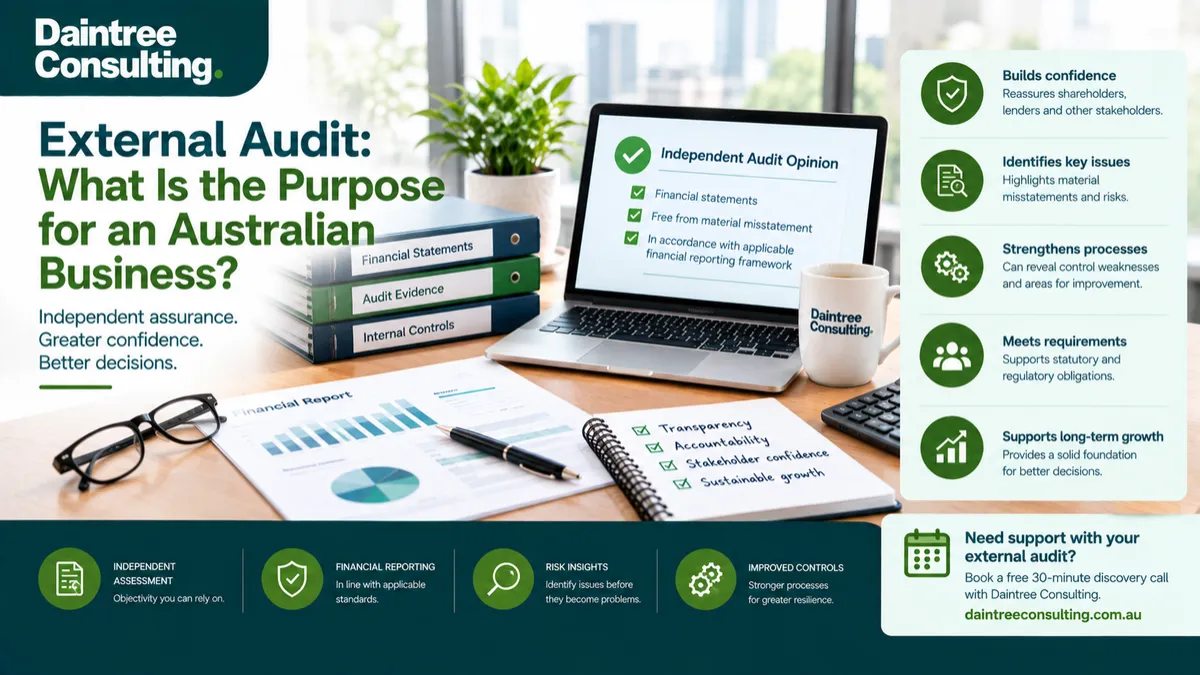
What Is the Purpose of an External Audit for an Australian Business?
An external audit is more than a compliance exercise.
For organisations that are required to have their financial reports audited, an external audit provides an independent assessment of whether the financial report has been prepared in accordance with the applicable financial reporting framework and is free from material misstatement.
Want expert help? Daintree Consulting's audit and assurance services can take this off your plate. Book a free consultation.
That independence is what gives an external audit much of its value.
Business owners, directors, shareholders, lenders and other stakeholders may all rely on financial information when making decisions. An independent auditor provides an additional level of assurance that the financial report has been examined objectively.
In Australia, certain entities are required to have their financial reports audited under the Corporations Act 2001, while other organisations may choose or otherwise need an audit because of their circumstances, agreements, funding arrangements or regulatory requirements. ASIC notes that companies other than small proprietary companies, registered schemes and disclosing entities generally have specific audit requirements, although exemptions and audit relief can apply in some circumstances.
So what is the actual purpose of an external audit?
Let's look at what an audit is designed to achieve, what it means for business owners and directors, and why independent assurance can matter even when an audit is not simply viewed as a legal obligation.
Quick Answer: What Is the Purpose of an External Audit?
The purpose of an external audit is to provide an independent auditor's opinion on whether a financial report has been prepared, in all material respects, in accordance with the applicable financial reporting framework.
An external audit can help:
Increase confidence in financial reports
Provide independent assurance to stakeholders
Identify material misstatements
Assess whether financial information is supported by appropriate evidence
Highlight areas requiring attention
Support transparency and accountability
Help meet statutory or regulatory requirements
Give shareholders and other users greater confidence in reported financial information
Importantly, an external audit does not transfer responsibility for the financial statements from management or directors to the auditor.
ASIC makes this distinction clear: those charged with governance remain responsible for the preparation and presentation of the financial report, while the auditor provides an independent opinion on it.
What Is an External Audit?
An external audit is an independent examination of an organisation's financial report by an external auditor.
The auditor is separate from the management team responsible for preparing the financial information.
During the audit, the auditor obtains and evaluates evidence relating to the financial report and considers whether the information is materially misstated.
This can involve examining areas such as:
Revenue
Expenses
Assets
Liabilities
Bank balances
Receivables
Inventory
Loans
Equity
Accounting estimates
Supporting documentation
Financial statement disclosures
Relevant internal controls and processes
The auditor does not simply check whether every transaction is correct.
An audit is designed around risk, materiality, evidence and professional judgement.
ASIC describes the objective of an audit as enabling the auditor to express an opinion on whether the financial report has been prepared, in all material respects, in accordance with the applicable financial reporting framework.
Why Does Independence Matter?
Independence is one of the defining characteristics of an external audit.
If the person preparing a company's financial report were also responsible for independently verifying that report, there would be an obvious conflict.
An external auditor provides a separate perspective.
Australian auditor independence requirements are legally enforceable and operate under the Corporations Act, professional ethical requirements and auditing standards. ASIC states that auditors must be independent from the entities they audit and must consider conflicts of interest and other threats to independence.
This matters because users of financial information need confidence that the auditor's conclusions have not been influenced by management or other relationships.
Independence is therefore not simply a technical requirement.
It is fundamental to the credibility of the audit opinion.
What Does an External Audit Actually Provide?
An external audit provides reasonable assurance, rather than absolute certainty.
This distinction is important.
An audit does not mean that:
Every transaction has been checked
Every error will necessarily be found
Fraud is impossible
The business will remain financially successful
Management decisions are correct
The business is guaranteed to survive
Instead, the auditor obtains sufficient appropriate evidence to form an opinion about whether the financial report is materially misstated.
ASIC describes audit quality in terms of obtaining reasonable assurance that the financial report as a whole is free from material misstatement.
This is why saying that an audit "guarantees the accounts are correct" would be misleading.
The purpose is to provide a high level of independent assurance within the scope and limitations of an audit.
1. An External Audit Builds Confidence in Financial Reporting
One of the biggest purposes of an external audit is confidence.
A financial report can contain a large amount of information.
Users may want to know:
Can I rely on this information?
Has it been prepared using the appropriate accounting framework?
Are there material errors?
Are important matters appropriately disclosed?
Has an independent professional examined the information?
The auditor's report helps answer these questions.
ASIC describes the auditor's report as a key tool for users of financial reports and says its purpose includes providing an opinion about whether the applicable financial reporting framework has been applied and whether the report is free from material misstatement.
2. An External Audit Supports Shareholder Confidence
Shareholders may not be involved in the day-to-day operation of a company.
They may therefore rely heavily on formal financial reporting to understand the company's:
Financial position
Performance
Cash flows
Assets
Liabilities
Risks
Overall financial direction
An independent audit provides an additional layer of confidence around that reporting.
For larger companies, this can be particularly important because the people running the organisation and the people using the financial information may be separated by significant organisational distance.
The external auditor provides an independent perspective between management and financial-report users.
3. An External Audit Can Support Lenders and Other Stakeholders
Financial information may also be relevant to:
Banks
Finance providers
Investors
Potential investors
Business partners
Regulators
Grant providers
Other stakeholders
For example, a lender assessing a significant financing arrangement may want to understand the company's financial position and performance.
An audited financial report can provide greater confidence in the information being considered.
An audit does not guarantee that a lender will approve finance.
However, independently audited financial information can form an important part of a broader financial information package.
4. An External Audit Helps Identify Material Misstatements
A core purpose of an audit is to identify whether the financial report contains a material misstatement.
A misstatement may arise because of:
An accounting error
Incorrect classification
Unsupported balances
Incorrect assumptions
Inappropriate accounting treatment
Missing disclosures
Fraudulent activity
Not every difference is material.
Auditors use professional judgement and materiality when determining which matters could influence the decisions of users of the financial report.
This means an audit is not simply a hunt for small bookkeeping errors.
It focuses attention on matters that could have a significant effect on the financial information.
5. An External Audit Examines Financial Evidence
An auditor does not simply ask management whether the numbers are correct.
The auditor obtains evidence.
Depending on the circumstances, this can involve:
Reviewing documentation
Examining transactions
Confirming balances
Testing selected items
Assessing accounting estimates
Reviewing reconciliations
Analysing financial information
Examining controls and processes
Comparing information from different sources
Discussing significant transactions with management
The nature and extent of procedures depend on the risks and circumstances of the engagement.
ASIC emphasises the importance of professional scepticism in quality audits, including critically assessing audit evidence and challenging significant accounting estimates and treatments where appropriate.
6. An External Audit Can Highlight Weaknesses
An audit is primarily about the financial report and the auditor's opinion.
However, the audit process can also identify issues in financial processes and controls.
For example, an audit may highlight:
Weak reconciliations
Poor documentation
Inadequate approval processes
Inconsistent accounting procedures
Weak segregation of duties
Unsupported balances
Delayed financial close processes
Incomplete records
Not every control weakness will necessarily result in a modification to the audit opinion.
However, significant findings may be communicated to directors, management or an audit committee depending on the circumstances.
This can provide useful insight into areas that need improvement.
7. An External Audit Supports Accountability
Good financial reporting requires accountability.
Directors and management have responsibilities for the financial report.
The external auditor provides an independent assessment rather than taking over management's responsibilities.
ASIC specifically states that companies must have appropriate processes and records supporting their financial reports and should not simply rely on the independent auditor to produce quality financial information.
This creates an important separation of responsibilities:
Management prepares the financial information.
Directors take responsibility for the financial report.
The external auditor independently examines the report and provides an opinion.
That separation is fundamental to a properly functioning audit process.
8. An External Audit Helps Meet Regulatory Requirements
For some Australian entities, an external audit is not optional.
ASIC states that certain entities must have their financial reports audited by a registered company auditor. This includes companies other than small proprietary companies, registered schemes and disclosing entities, subject to applicable exemptions and relief.
Public companies, for example, generally have specific financial reporting and audit obligations under Chapter 2M of the Corporations Act.
However, the exact requirement depends on the entity and its circumstances.
A business should not assume that its size alone determines whether an audit is required.
The appropriate question is:
What financial reporting and audit obligations apply to this particular entity?
9. An External Audit Can Improve Financial Reporting Discipline
Preparing for an external audit can encourage businesses to maintain stronger financial processes throughout the year.
When management knows financial information needs to be supported, reconciled and documented, there is a greater incentive to establish disciplined processes.
This may include:
Regular account reconciliations
Timely month-end close
Clear documentation
Consistent accounting policies
Better approval controls
Proper record retention
Clear responsibility for financial information
ASIC states that companies must maintain financial records that correctly record and explain transactions and enable true and fair financial statements to be prepared and audited.
The audit itself is not a substitute for these processes.
The business needs to have them in place.
10. An External Audit Can Increase Trust in the Business
Trust can matter commercially.
A company may need to demonstrate financial credibility to:
Investors
Banks
Shareholders
Potential buyers
Business partners
Regulators
Other stakeholders
An independent audit does not eliminate financial risk.
But it can provide an additional layer of confidence around the information being presented.
This can be particularly valuable when significant decisions depend on the financial statements.
What an External Audit Does Not Do
It is just as important to understand what an external audit doesn't do.
An audit does not guarantee business success
A clean audit opinion does not mean the business will be profitable next year.
An audit does not guarantee that fraud does not exist
Auditors consider fraud risk, but an audit cannot guarantee that all fraud will be detected.
An audit does not replace management
Management remains responsible for the financial report.
An audit does not fix the accounting records
The business must maintain appropriate records and prepare the financial report.
An audit does not provide business advice automatically
An auditor may identify issues, but an audit is not the same as an ongoing business advisory engagement.
Understanding these boundaries helps businesses approach the audit process realistically.
What Is the Difference Between an External Audit and an Internal Review?
An external audit and an internal review can have different purposes.
External audit
An external audit is conducted by an independent auditor and is focused on providing an opinion on the financial report.
Internal review
An internal review may focus on areas such as:
Processes
Controls
Operational risks
Efficiency
Compliance
Internal procedures
An internal review can be broader and more management-focused.
A business may benefit from both, particularly when it wants to strengthen processes before an external audit or improve internal controls more generally.
Does Every Australian Business Need an External Audit?
No.
Not every Australian business is automatically required to have an external audit.
Audit requirements depend on factors such as:
Entity type
Financial reporting obligations
Size and circumstances
Regulatory requirements
Whether the entity is a public or proprietary company
Whether the entity is a disclosing entity
Applicable exemptions or audit relief
Industry-specific requirements
Contractual or funding arrangements
ASIC states that generally small proprietary companies do not have to prepare or lodge financial statements with ASIC, subject to particular circumstances, while certain other entities have mandatory audit requirements.
This is why businesses should determine their requirements based on their actual structure and circumstances rather than relying on a general revenue threshold.
What Should Directors Understand About an External Audit?
Directors have an important role in the audit process.
They should understand that the auditor is not responsible for preparing the company's financial report.
Directors and management need to:
Maintain appropriate financial records
Prepare the financial report
Provide information and explanations to the auditor
Identify significant accounting judgements
Address relevant financial reporting issues
Support the audit with appropriate documentation
ASIC states that directors, management and other officers must provide auditors with the information and explanations required for the audit.
A successful audit therefore requires cooperation between management, directors and the auditor while preserving the auditor's independence.
How Can a Business Get More Value From an External Audit?
Although the audit is independent, management can make the process more efficient by improving its own financial processes.
Keep accounts reconciled
Bank, loan, payroll and other important balances should be reviewed regularly.
Maintain supporting documentation
Significant transactions should have appropriate evidence.
Document significant accounting judgements
Complex estimates and accounting treatments should be supported by clear reasoning.
Resolve unusual transactions early
Don't wait until the audit to investigate unexplained balances.
Maintain clear financial reporting processes
Everyone should understand who prepares, reviews and approves financial information.
Communicate early
If management knows about a significant transaction, restructuring, acquisition or accounting issue, it is generally better to discuss it early rather than allowing it to become an unexpected audit issue.
When Can an Audit Become Particularly Valuable?
Even where an audit is required, its value can extend beyond simply satisfying a requirement.
An independent audit can become particularly important when a business is:
Growing significantly
Seeking external funding
Preparing for a transaction
Operating with multiple entities
Managing complex financial arrangements
Experiencing rapid organisational change
Reporting to a large shareholder base
Subject to increased regulatory scrutiny
Improving its governance framework
The more stakeholders depend on the financial information, the more important confidence in that information can become.
How Daintree Consulting Can Support Audit Readiness
An external auditor must remain independent, so a business should be careful about separating accounting, advisory and audit responsibilities appropriately.
Daintree Consulting's Audit & Assurance service focuses on audit and assurance support designed around the applicable purpose, entity and regulatory requirements.
Support can include:
Audit preparation and readiness
Financial statement audit support where applicable
Internal-control and process reviews
Trust-account and compliance audit services where applicable
Grant, funding and agreed-assurance engagements
Clear reporting of findings and required actions
The aim is to help businesses approach assurance work with clearer records, defined responsibilities and better preparation.
Explore Daintree Consulting's Audit & Assurance Services
Frequently Asked Questions
What is the main purpose of an external audit?
The main purpose is to allow an independent auditor to express an opinion on whether the financial report has been prepared, in all material respects, in accordance with the applicable financial reporting framework and whether it is free from material misstatement.
Does an external audit guarantee that financial statements are accurate?
No. An audit provides reasonable assurance, not absolute assurance. Auditors perform procedures designed to obtain sufficient appropriate evidence and form an opinion about material misstatement.
Who is responsible for preparing the financial statements?
Management and those charged with governance remain responsible for preparing and presenting the financial report. The auditor independently examines the report and provides an audit opinion.
Does every Australian company need an external audit?
No. Audit requirements depend on the entity and its circumstances. Certain companies and other entities have mandatory audit requirements, while some proprietary companies may qualify for exemptions or audit relief.
Why does auditor independence matter?
Independence helps ensure the auditor can form an objective opinion without inappropriate influence from the entity being audited. Australian auditor independence requirements are legally enforceable.
Can an external audit identify internal control problems?
An audit may identify control deficiencies or other issues during the engagement, although the primary purpose of a financial statement audit is to provide an opinion on the financial report rather than conduct a comprehensive internal-control review.
Is an external audit the same as an internal audit?
No. An external financial statement audit primarily provides an independent opinion on financial reporting. An internal audit or internal review can have a broader focus on controls, risks, processes and operations.
The Bottom Line
An external audit is ultimately about independent confidence in financial reporting.
For organisations subject to audit requirements, it provides an independent opinion that helps shareholders, directors, lenders, regulators and other users understand the reliability of the financial report.
But an audit is not simply about ticking a compliance box.
A well-managed audit process can encourage better financial reporting discipline, highlight areas requiring attention and give stakeholders greater confidence in the information they rely on.
At the same time, businesses should remember that responsibility for preparing appropriate financial information remains with management and those charged with governance. The auditor's independence is what makes the external assurance valuable.
If your business is preparing for an audit, reviewing its financial controls or needs support getting its records and processes ready, professional audit-readiness assistance can help make the process clearer and more efficient.
Book a free 30-minute discovery call with Daintree Consulting to discuss your Audit & Assurance requirements.
Talk to Daintree about your audit
Our ex-Big 4 team gives clear, senior-reviewed advice so you can act with confidence.
Book a free consultation →
Or explore our audit and assurance services.
