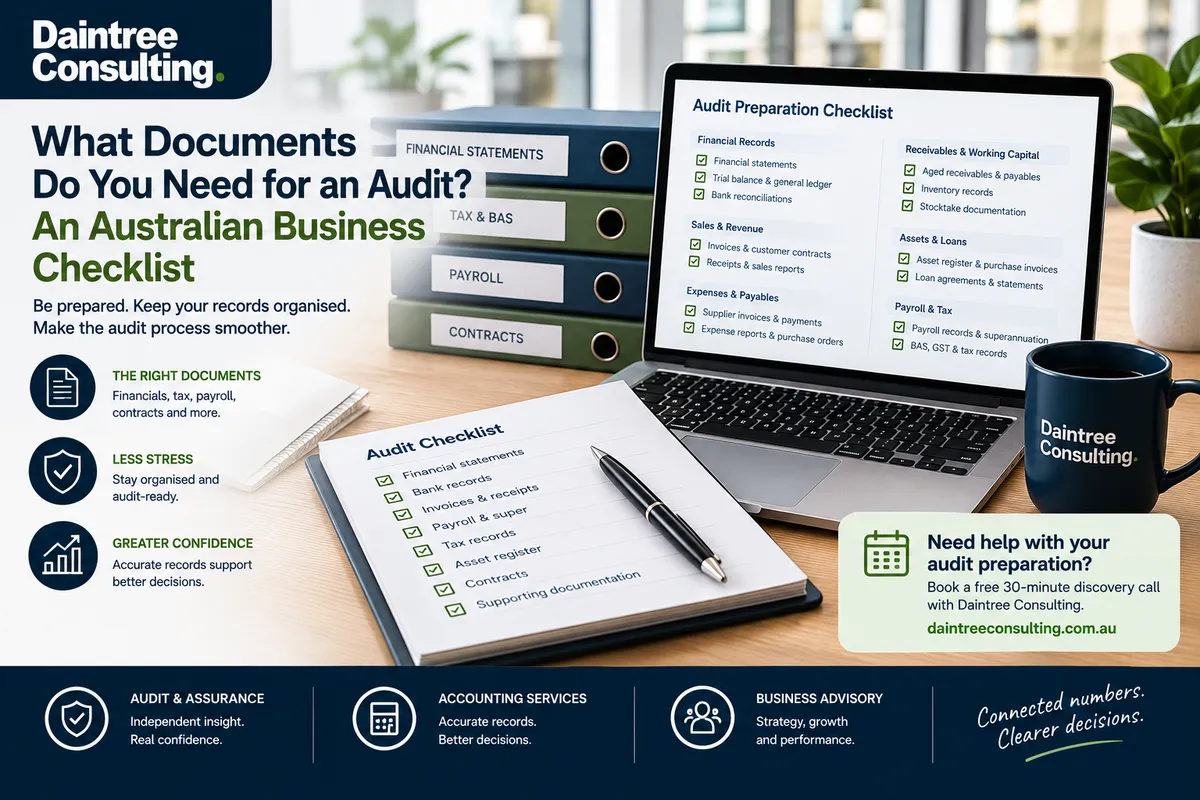
Documents Needed for an Audit: Australian Business Checklist
If your business is preparing for an audit, one of the first questions is usually: what documents do you need for an audit?
The answer depends on the type of audit, your business structure, the financial reporting framework that applies to you, and the areas your auditor needs to test. There is no single document pack that works for every Australian business.
Want expert help? Daintree Consulting's audit and assurance services can take this off your plate. Book a free consultation.
However, most financial audits require a combination of accounting records, financial statements, supporting transaction evidence, banking information, tax records, payroll information, asset records, contracts and documentation supporting significant accounting judgements.
The key is not simply collecting as many documents as possible. It is making sure the records are complete, accurate, organised and capable of supporting the figures and disclosures in the financial report.
ASIC states that companies must keep financial records that correctly record and explain transactions and the company's financial position and performance, and that enable financial statements to be prepared and audited. Companies generally need to retain financial records for at least seven years.
This checklist explains the documents needed for an audit in Australia, what auditors commonly request, why each category matters and how to prepare before the audit starts.
Quick Answer: What Documents Are Needed for an Audit?
For a typical Australian financial statement audit, your auditor may request:
Final or draft financial statements
General ledger and trial balance
Bank statements and bank reconciliations
Accounts receivable records
Accounts payable records
Sales invoices and supporting documentation
Supplier invoices and expense records
Payroll and superannuation records
GST, BAS and tax records
Fixed asset registers and supporting invoices
Loan agreements and finance statements
Inventory records and stocktake documentation
Contracts and major agreements
Related-party transaction records
Shareholder and equity records
Board and management meeting minutes
Documentation supporting significant estimates and judgements
Evidence supporting provisions and liabilities
Legal correspondence where relevant
Details of subsequent events
Prior-year financial statements and audit information
Internal policies and controls documentation where relevant
Your auditor may also request confirmations or information directly from banks, customers, suppliers, lawyers or other external parties.
Under Australian Auditing Standard ASA 500, audit evidence can come from accounting records and other internal or external sources. The auditor's objective is to obtain sufficient appropriate audit evidence to support their conclusions and audit opinion.
1. Financial Statements
Your financial statements are usually one of the most important starting points for the audit.
Depending on your circumstances, these may include:
Statement of financial position
Statement of profit or loss and other comprehensive income
Statement of cash flows
Statement of changes in equity
Notes to the financial statements
Directors' declaration
Directors' report, where applicable
Other required disclosures
ASIC notes that financial reports generally include financial statements, notes, relevant directors' declarations and reports, and the auditor's report. The exact requirements depend on the entity and reporting obligations.
The auditor will use the financial statements to identify significant balances, transactions, disclosures and accounting judgements that require audit evidence.
Before the audit
Make sure the financial statements are based on a finalised or substantially finalised trial balance.
If the financial statements are still changing significantly when the audit begins, the audit process can become less efficient because the auditor may need to repeat testing.
2. Trial Balance and General Ledger
The trial balance and general ledger provide the underlying accounting structure behind the financial statements.
Your auditor may request:
Final trial balance
General ledger
Chart of accounts
Journal entries
Manual journals
Year-end adjustments
Suspense account details
Intercompany journals
Significant or unusual transactions
These records allow the auditor to trace amounts from the financial statements back into the accounting system and underlying transactions.
A clean general ledger can make audit preparation substantially easier.
If your business has numerous unexplained journal entries, old suspense balances or unreconciled accounts, these may become areas requiring additional investigation.
3. Bank Statements and Bank Reconciliations
Bank records are another core part of an audit document checklist.
You may need to provide:
Bank statements
Bank reconciliation reports
Bank account listings
Term deposit statements
Investment account statements
Credit card statements
Foreign currency account statements
Evidence supporting significant reconciling items
Your auditor may compare accounting records with external bank information and investigate differences.
It is particularly important that bank reconciliations are completed at year-end and that outstanding items are supported.
For example, an old unreconciled payment should not simply remain on the reconciliation without an explanation.
4. Accounts Receivable Records
If your business sells on credit, auditors will generally need evidence supporting accounts receivable.
This may include:
Aged receivables report
Customer statements
Sales invoices
Credit notes
Receipts after year-end
Bad debt information
Debtor correspondence
Evidence supporting significant outstanding balances
The auditor may be assessing whether receivables actually exist and whether they are recoverable.
This is one reason post-year-end receipts can be useful audit evidence. If a customer pays an outstanding invoice shortly after year-end, that payment may provide evidence relevant to the balance that existed at year-end.
The auditor will determine what evidence is appropriate based on the circumstances.
5. Accounts Payable and Supplier Records
Your audit document checklist should also include information supporting amounts owed to suppliers.
Common requests include:
Aged payables report
Supplier statements
Supplier invoices
Credit notes
Payments made after year-end
Unpaid invoices
Accrued expenses
Major supplier contracts
Auditors may also pay particular attention to transactions occurring immediately before and after year-end.
This can help identify whether expenses and liabilities have been recorded in the correct accounting period.
6. Sales and Revenue Documentation
Revenue is often an important audit area.
Depending on the business, your auditor may request:
Sales reports
Sales invoices
Customer contracts
Point-of-sale reports
Online sales reports
Subscription records
Revenue reconciliations
Credit notes
Refund records
Receipts
Revenue recognition calculations
The specific evidence will depend on how your business earns revenue.
For example, a business selling straightforward products may have a relatively simple sales process, while a business providing long-term contracts or subscription services may require more detailed documentation supporting how and when revenue is recognised.
7. Expenses and Supplier Invoices
Your auditor may select expenses from the accounting records and request supporting documentation.
Keep accessible:
Supplier invoices
Receipts
Expense reports
Purchase orders
Contracts
Payment records
Supporting approvals
Reconciliations
This is where good bookkeeping processes can make a major difference.
If every transaction is properly coded, reconciled and supported, responding to audit queries is generally much easier than trying to reconstruct the evidence months later.
8. Payroll and Superannuation Records
Businesses with employees should expect payroll information to form part of the audit evidence where relevant.
Documents may include:
Payroll reports
Employee expense records
PAYG withholding records
Superannuation records
Payroll reconciliations
Leave balances
Employment agreements
Bonus or commission calculations
Termination payments
Payroll tax records where applicable
The auditor may reconcile payroll expenses to the general ledger and investigate significant movements or unusual balances.
Where employee entitlements are material, supporting calculations and documentation may also be required.
9. BAS, GST and Tax Records
Tax records can help support the financial information being audited.
Depending on your circumstances, this may include:
BAS records
GST reconciliations
Income tax returns
Tax provision calculations
PAYG records
FBT records
Tax correspondence
ATO statements
Tax payment records
Supporting calculations for significant tax balances
The exact tax documentation required will depend on your entity and the audit areas identified.
Don't assume that because a tax return has already been lodged, the auditor will not require supporting information. The audit and tax compliance processes have different purposes.
10. Fixed Asset Records
If your business owns property, vehicles, equipment, machinery or other significant assets, prepare:
Fixed asset register
Purchase invoices
Disposal documentation
Depreciation calculations
Asset financing documents
Capital expenditure reports
Sale agreements
Evidence of ownership
Impairment assessments where relevant
ASIC specifically identifies asset registers, financial statements and supporting financial records among the types of records companies commonly maintain.
For significant assets, the auditor may need evidence addressing existence, ownership, valuation and accounting treatment.
11. Loans and Financing Documents
If your business has loans or other financing arrangements, gather:
Loan agreements
Finance contracts
Bank statements
Repayment schedules
Interest statements
Security documents
Covenant calculations
Refinancing documentation
Director or shareholder loan records
Loan balances may need to be reconciled to external statements.
Your auditor may also need to understand whether amounts are correctly classified and whether relevant terms or commitments require disclosure.
12. Inventory Records
Businesses holding inventory should prepare:
Inventory listing
Stocktake results
Stocktake instructions
Inventory valuation calculations
Inventory movement reports
Obsolete or damaged stock assessments
Supplier invoices
Inventory purchase records
Work-in-progress calculations, where relevant
Inventory can require more than simply providing a year-end stock report.
The auditor may need evidence concerning the existence and condition of inventory, how it has been counted and how its value has been determined.
13. Contracts and Major Agreements
Don't limit your audit preparation to accounting reports.
Important contracts can provide evidence about financial obligations, revenue arrangements, commitments and other matters.
Consider providing relevant:
Customer contracts
Supplier agreements
Lease agreements
Property agreements
Loan contracts
Employment agreements
Insurance policies
Partnership or shareholder agreements
Major service agreements
Acquisition or sale agreements
Your auditor may specifically request contracts where a transaction or balance involves significant terms or judgement.
14. Board Minutes and Management Records
Corporate records can be important audit evidence, particularly for significant transactions and decisions.
Depending on the circumstances, auditors may request:
Board meeting minutes
Shareholder resolutions
Management meeting records
Written resolutions
Investment decisions
Acquisition decisions
Financing decisions
Dividend declarations
Restructuring documentation
These records can help the auditor understand transactions and events affecting the financial statements.
They can also provide evidence about commitments, disputes, related-party transactions and events occurring around year-end.
15. Related-Party Transactions
If your business has transactions involving directors, shareholders, related entities or other related parties, make sure the auditor knows about them.
Prepare information covering:
Director loans
Shareholder loans
Intercompany transactions
Related-party sales
Related-party purchases
Management fees
Shared expenses
Property arrangements
Guarantees
Other transactions outside ordinary commercial arrangements
Don't assume a transaction is irrelevant because it has already been recorded in the accounting system.
Related-party information can be important for financial statement disclosures and audit procedures.
16. Documentation Supporting Estimates and Judgements
This is one of the areas businesses sometimes underestimate.
Auditors may need supporting documentation for significant accounting estimates and judgements.
Examples include:
Bad debt provisions
Asset impairment calculations
Useful life assumptions
Inventory provisions
Employee entitlement calculations
Provisions
Valuations
Revenue recognition judgements
Deferred tax calculations
Going concern assessments
Forecasts used in financial reporting
ASIC specifically highlights the importance of documenting how accounting policies have been determined, particularly where significant estimation uncertainty and judgement are involved.
A number in the financial statements is much easier to audit when management can clearly explain how it was calculated, what assumptions were used and what evidence supports those assumptions.
17. Legal and Contingent Liability Information
Your auditor may need information about matters that could affect the financial statements but are not necessarily obvious from the accounting records.
This could include:
Current legal disputes
Potential claims
Insurance claims
Regulatory matters
Guarantees
Letters of demand
Significant disputes with customers or suppliers
Legal correspondence
If something significant has happened, tell the auditor rather than deciding yourself that it is not relevant.
The auditor needs enough information to determine whether additional procedures or financial statement disclosures may be necessary.
18. Subsequent Events
The audit doesn't necessarily stop at the last day of the financial year.
Auditors may need information about significant events occurring after year-end.
Examples include:
Major customer losses
Business acquisitions
Asset sales
Significant financing changes
Major legal developments
Material damage or loss
Restructuring
Significant changes in trading conditions
This information can help determine whether events after reporting date require adjustment or disclosure.
19. Prior-Year Audit Information
If your business has been audited before, have the previous audit information available.
This may include:
Prior-year financial statements
Previous auditor's report
Management letter
Previous audit adjustments
Unresolved audit matters
Prior-year working-paper requests provided to management
Opening balance information
This can help the current audit team understand previous issues and identify areas that may require follow-up.
The Documents Needed for an Audit Depend on What the Auditor Is Testing
One important point is often misunderstood:
Your auditor does not necessarily need every business document before the audit begins.
Auditing is an evidence-based process.
Australian Auditing Standard ASA 500 explains that audit evidence can include accounting records and information from other internal and external sources. The auditor designs procedures to obtain sufficient appropriate evidence to support reasonable conclusions.
So, your initial audit request list may be followed by additional questions.
For example, an auditor might select a particular transaction and then ask for:
The invoice
The customer or supplier contract
Proof of payment
Correspondence
Approval documentation
Supporting calculations
This does not necessarily mean something is wrong.
It is part of the auditor obtaining appropriate evidence.
How to Prepare Your Documents Before the Audit
Good audit preparation is less about creating a giant folder and more about creating a logical evidence trail.
Step 1: Finalise your bookkeeping
Complete bank reconciliations, accounts receivable, accounts payable, payroll and other key reconciliations.
Step 2: Review the trial balance
Look for:
Unusual balances
Suspense accounts
Old unreconciled items
Unexpected movements
Negative balances
Large manual journals
Step 3: Prepare supporting schedules
Create clear schedules for significant balances such as:
Fixed assets
Loans
Provisions
Receivables
Payables
Inventory
Employee entitlements
Step 4: Gather significant contracts
Don't wait for the auditor to discover an important contract in a later query.
Step 5: Document significant judgements
If management has made a significant accounting judgement, document the reasoning and supporting evidence.
Step 6: Identify unusual transactions
Flag acquisitions, disposals, restructures, related-party transactions, major loans and other significant events.
Step 7: Organise electronic records
ASIC confirms that financial records can be electronic, provided the business can produce hard copies within a reasonable timeframe when required.
A well-organised digital folder structure can make responding to audit requests much faster.
A Simple Audit Document Checklist for Australian Businesses
Before the auditor starts, ask yourself whether you have access to:
Financial reporting
Final trial balance
General ledger
Financial statements
Supporting schedules
Banking
Bank statements
Bank reconciliations
Loan statements
Credit card records
Revenue
Sales reports
Invoices
Customer contracts
Receipts
Expenses
Supplier invoices
Expense reports
Payment records
Major contracts
Assets
Fixed asset register
Asset invoices
Disposal records
Depreciation calculations
Working capital
Aged receivables
Aged payables
Inventory records
Stocktake information
Employees
Payroll reports
PAYG records
Superannuation records
Leave and entitlement calculations
Tax
BAS records
GST reconciliations
Income tax information
Relevant ATO correspondence
Corporate
Board minutes
Shareholder records
Related-party information
Significant agreements
Judgements and risks
Provisions
Valuations
Impairment assessments
Legal matters
Going concern information
Significant accounting judgements
Subsequent events
Not every business will need every item. Your auditor should provide an audit request list tailored to the engagement.
What Happens If You Don't Have a Document?
Don't manufacture one.
If a requested document is unavailable, tell the auditor and explain why.
Depending on the circumstances, alternative evidence may be available. The appropriate response will depend on what the auditor is trying to establish and the reliability of the alternative evidence.
Australian auditing standards recognise that audit evidence can come from different sources, with reliability depending on factors such as independence and how the information was generated and maintained.
The worst approach is usually to ignore the request or provide an explanation that cannot be supported.
Early communication gives your accountant, finance team and auditor more options to resolve the issue.
How Good Accounting Processes Make Audits Easier
Audit preparation starts well before the auditor arrives.
If your accounting records are regularly reconciled, supporting documents are retained, significant transactions are documented and management reporting is reviewed throughout the year, the year-end audit is less likely to become a scramble.
ASIC also makes clear that directors and management remain responsible for maintaining appropriate records and supporting financial reporting. A business should not rely on the external auditor to create the evidence needed to support its own financial report.
This is where good accounting processes become more than a compliance exercise.
Reliable records can give management better visibility throughout the year while also creating a stronger foundation for audit, tax, reporting and decision-making.
Need Help Preparing for an Audit?
If you're approaching an audit and aren't sure whether your financial records are ready, getting organised before the audit begins can save time and reduce unnecessary back-and-forth.
Daintree Consulting can support Australian businesses with accounting, financial reporting and audit preparation, helping create clearer financial records and reporting processes before important compliance or assurance work begins.
The goal isn't simply to hand an auditor a folder of documents.
It's to make sure your financial information is accurate, supported, explainable and ready for review.
Need help getting your business audit-ready? Book a free 30-minute discovery call with Daintree Consulting to discuss your situation and the support you need.
Frequently Asked Questions
What documents are needed for an audit?
Common documents include financial statements, trial balance, general ledger, bank records, reconciliations, invoices, receivables and payables reports, payroll records, tax records, asset registers, contracts, loan documents, inventory records and documentation supporting significant accounting judgements.
The exact requirements depend on the audit.
Do auditors need every invoice?
Not necessarily. Auditors generally select transactions and balances for testing based on their audit procedures and risk assessment. They may request specific invoices or supporting documents rather than every transaction.
Do auditors need bank statements?
Bank statements and bank reconciliations are commonly requested as evidence supporting cash balances and transactions. The auditor may also seek external confirmation or other evidence depending on the engagement.
How far back do audit documents need to go?
The period covered by the audit generally relates to the financial reporting period being audited, but auditors may also need prior-year information, opening balances or historical documents relevant to the audit.
Separate record-retention requirements may also apply. ASIC states that companies generally need to keep financial records for at least seven years.
Can accounting records be electronic?
Yes. ASIC states that company financial records can be electronic, provided the business can produce hard copies within a reasonable timeframe if requested.
What if my business cannot find a document the auditor requested?
Tell the auditor as soon as possible. Depending on the circumstances, alternative evidence may be available. Do not create or alter documentation simply to satisfy an audit request.
Does the auditor prepare my financial records?
No. Management remains responsible for the financial report and maintaining appropriate books and records. The auditor's role is to independently obtain evidence and form an opinion in accordance with the applicable auditing requirements.
Final Takeaway
Knowing the documents needed for an audit is useful, but audit readiness is about more than collecting paperwork at year-end.
The strongest preparation starts with reliable bookkeeping, reconciled accounts, organised supporting evidence, documented judgements and clear financial reporting throughout the year.
If your business is facing an upcoming audit, start by asking:
Can we trace the important numbers in our financial statements back to reliable supporting evidence?
If the answer is yes, you're already in a much stronger position.
Important Note
Audit requirements and the documents requested can vary depending on the entity, financial reporting obligations, audit scope and individual circumstances. This article is general information and should not be treated as a complete audit request list or professional advice. For publication, Daintree Consulting should confirm its current audit and accounting procedures and ensure any references to regulatory requirements remain current. ASIC and the applicable Australian auditing standards should be checked where specific compliance requirements apply.
Primary commercial intent: attract Australian businesses searching for documents needed for an audit and convert readers who need help preparing their financial records into Audit & Assurance / Accounting enquiries.
Talk to Daintree about your audit
Our ex-Big 4 team gives clear, senior-reviewed advice so you can act with confidence.
Book a free consultation →
Or explore our audit and assurance services.
