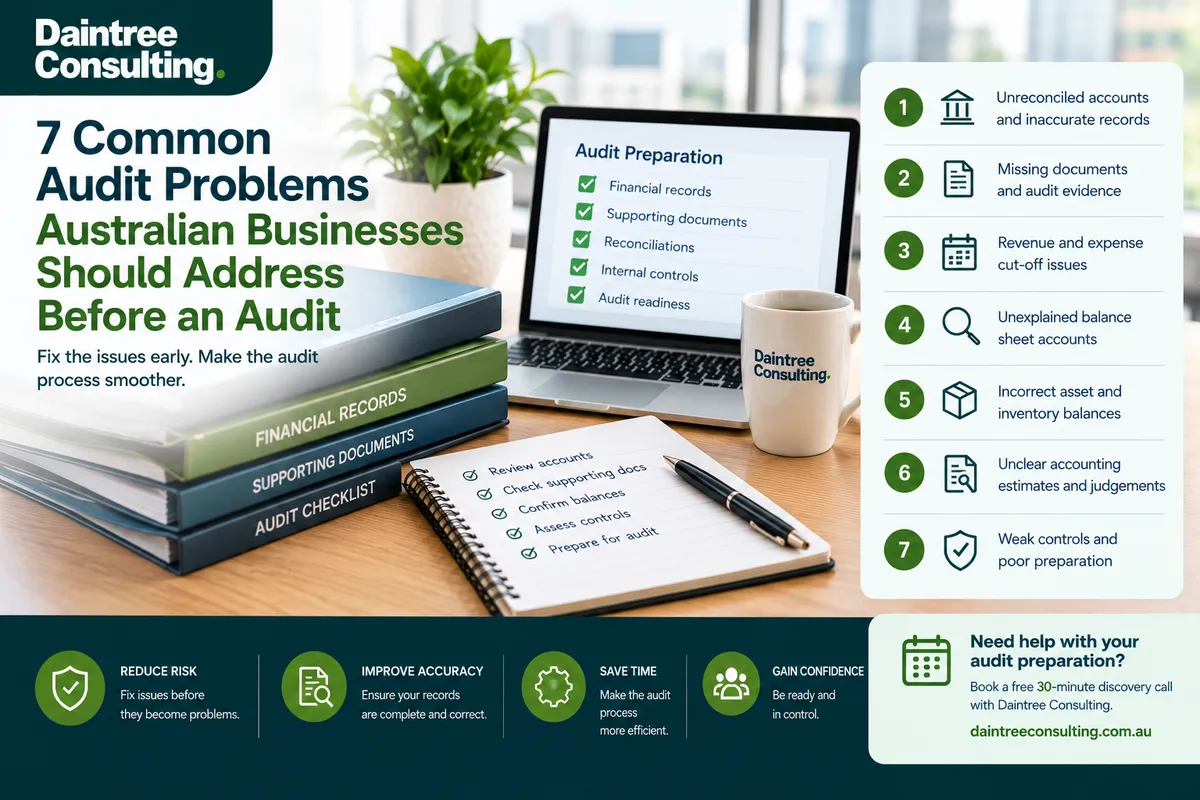
7 Common Audit Problems Australian Businesses Should Address Before an Audit
An audit can be stressful when financial records are incomplete, supporting documents are scattered or management is trying to answer questions at the last minute.
But many audit problems are not actually caused by the audit itself.
Want expert help? Daintree Consulting's audit and assurance services can take this off your plate. Book a free consultation.
They start much earlier—with incomplete reconciliations, unclear accounting treatments, missing evidence, weak processes or financial information that has not been properly reviewed before the auditor arrives.
For Australian businesses, preparing properly can make the audit process more efficient and give management greater confidence in the financial information being reviewed. ASIC notes that companies are responsible for maintaining financial records that correctly record and explain transactions and enable true and fair financial statements to be prepared and audited.
So, what are the most common audit problems businesses should address before an audit?
Here are seven worth checking.
Quick Answer: What Are the Most Common Audit Problems?
The most common audit problems Australian businesses should address before an audit include:
Unreconciled accounts and inaccurate financial records
Missing supporting documents and audit evidence
Revenue and expense cut-off problems
Unexplained balance sheet accounts
Incorrect or poorly supported asset and inventory balances
Unclear accounting estimates and judgements
Weak internal controls and poor audit preparation
These problems do not necessarily mean a business has done something wrong.
Often, they indicate that the financial reporting process has not kept pace with the complexity of the business.
The earlier these issues are identified, the more time management has to investigate, correct and document them.
1. Unreconciled Accounts and Inaccurate Financial Records
One of the biggest audit problems is also one of the most basic:
The accounts do not reconcile.
A business may have transactions recorded in its accounting system, but that does not automatically mean the underlying balances are correct.
Common examples include:
Bank accounts that have not been reconciled
Credit cards with unexplained balances
Old debtor balances
Supplier accounts containing duplicates
Payroll clearing accounts that do not clear
GST accounts that do not agree with supporting records
Suspense accounts with old transactions
Intercompany balances that do not match
Fixed asset registers that are out of date
These issues can create unnecessary audit questions.
For example, if the general ledger shows $250,000 in accounts receivable but the supporting debtor records do not reconcile to that figure, the auditor may need additional information to understand the difference.
That can take time.
What to do before the audit
Review your key balance sheet accounts before the audit begins.
At a minimum, consider whether you can explain:
What the balance represents
How it was calculated
What supporting documentation exists
Whether it reconciles to an external or subsidiary record
Whether any old or unusual items need investigation
The objective is simple:
Every significant balance should have a clear explanation.
ASIC expects companies to maintain records that enable financial statements to be prepared and audited.
2. Missing Supporting Documents and Audit Evidence
An auditor cannot simply accept that a transaction is correct because it appears in the accounting system.
They may need evidence to support balances and transactions.
Depending on the business and audit scope, this may include:
Invoices
Contracts
Bank statements
Loan agreements
Lease documents
Payroll records
Tax records
Asset purchase documents
Customer agreements
Supplier statements
Board or management documentation
Investment statements
Reconciliation schedules
One common mistake is assuming that the auditor will be able to find everything themselves.
That can create unnecessary delays.
ASIC specifically states that companies should produce quality financial information on a timely basis and support it with appropriate analysis and documentation for the independent audit.
The problem with scattered records
Imagine your auditor asks for evidence supporting a major expense.
The invoice is in an email.
The contract is in a shared drive.
The payment is in the bank account.
The approval is in a messaging platform.
And nobody is sure where the original agreement is stored.
The transaction may be legitimate, but proving it can become unnecessarily difficult.
Better approach
Create an organised audit evidence folder before the audit starts.
Group documentation logically by area, such as:
Cash
Revenue
Receivables
Inventory
Fixed assets
Expenses
Payroll
Loans
Tax
Equity
Related parties
This makes it easier for both management and the auditor.
3. Revenue and Expense Cut-Off Problems
Timing is another common source of audit questions.
The issue is usually whether revenue or expenses have been recorded in the correct reporting period.
For example:
A business receives an invoice in July for services relating to June.
Or a customer is invoiced in June for work that will not actually be delivered until July.
Or a large customer payment is received around year-end and management is unsure which period it relates to.
These situations can create cut-off questions.
The issue becomes particularly important around year-end because financial statements need to reflect the appropriate reporting period.
Common warning signs
Look more closely at transactions occurring immediately before and after year-end, particularly:
Large sales
Large expenses
Unusual invoices
Credit notes
Customer receipts
Supplier invoices
Prepayments
Accrued expenses
Do not assume that unusual year-end transactions are wrong.
Instead, make sure you understand them and have the documentation to support the accounting treatment.
ASIC's current financial reporting guidance highlights revenue recognition and other areas involving judgement as areas requiring appropriate attention and documentation.
4. Unexplained Balance Sheet Accounts
A balance sheet can contain accounts that have been carried forward for years without anyone properly reviewing them.
That is a problem.
Examples include:
Old loans
Suspense accounts
Accrued expenses
Prepayments
Deposits
Other receivables
Other payables
Employee-related balances
Tax accounts
Intercompany accounts
Sometimes the balance is correct.
Sometimes it is not.
The real problem is when nobody can explain it.
An auditor may ask:
"What is this balance?"
If the answer is:
"I'm not sure—it has always been there."
you have found an area that should probably be investigated before the audit.
A useful pre-audit test
For every significant balance sheet account, ask:
What is this?
Why is this amount outstanding?
What supports it?
When will it be cleared?
Does it still belong in the accounts?
This simple exercise can identify problems before the auditor does.
5. Incorrect or Poorly Supported Asset and Inventory Balances
Assets often require more than simply confirming that a number exists in the accounting system.
For example, a business may need to consider:
Whether an asset still exists
Whether it is owned by the business
Whether the recorded value remains appropriate
Whether depreciation has been calculated correctly
Whether disposals have been removed
Whether capital expenditure has been correctly classified
Whether inventory records are accurate
Whether obsolete or damaged inventory requires consideration
Inventory can be particularly challenging because the accounting records may need to be supported by physical stock information and appropriate valuation processes.
Similarly, large capital expenditure may require documentation explaining what was purchased, why it was capitalised and how it is being accounted for.
ASIC identifies areas such as asset values, impairment, capitalisation of expenditure and other estimates among areas where financial reporting may require significant judgement and attention.
Before the audit
Review your fixed asset register and inventory records.
Look for:
Assets that have been disposed of but remain on the register
Old assets with unclear status
Large recent capital purchases
Missing invoices
Unusual movements
Inventory discrepancies
Slow-moving or obsolete stock
Unexplained valuation changes
The goal is to ensure the records tell the same story as the underlying business.
6. Unclear Accounting Estimates and Judgements
Some of the most difficult audit discussions involve areas where there is no simple answer.
Financial reporting often requires management to make estimates or judgements.
Examples can include:
Asset impairment
Provisions
Expected credit losses
Revenue recognition
Useful lives of assets
Inventory valuation
Contract-related estimates
Going-concern considerations
Other significant accounting estimates
These areas can attract additional attention because management needs to be able to explain the reasoning behind its treatment.
ASIC says financial reporting processes should be supported by appropriate analysis and documentation, particularly in complex areas involving estimates and judgement.
Don't wait until the auditor asks
If a significant accounting judgement is likely to be discussed during the audit, prepare the supporting explanation beforehand.
Document:
What the issue is
What accounting treatment was selected
Why it was selected
What assumptions were used
What evidence supports those assumptions
What alternatives were considered, where relevant
This does not mean creating unnecessary paperwork for every transaction.
It means documenting significant decisions that could materially affect the financial statements.
7. Weak Internal Controls and Poor Audit Preparation
Sometimes the problem is not one particular transaction.
It is the process.
For example:
One person can create suppliers and approve payments
Bank reconciliations are performed irregularly
Financial reports are not reviewed consistently
Journal entries have limited supporting documentation
Payroll changes are not independently reviewed
Access to accounting systems is not appropriately managed
Key approvals happen informally
Important processes depend entirely on one employee
These weaknesses may not automatically mean financial statements are incorrect.
But they can increase financial and operational risk and lead to additional questions during an audit or assurance engagement.
Daintree's Audit & Assurance service specifically includes internal-control and process reviews as well as audit preparation and readiness support.
The key question
Ask:
"If the person responsible for this process was away tomorrow, could someone else understand what happened and verify it?"
If the answer is no, you may have a process weakness worth addressing.
Why Audit Problems Often Start Before the Audit
A common misconception is that the auditor creates the work.
In reality, many audit issues are created by the underlying financial reporting process.
ASIC states that companies should have appropriate processes and records supporting their financial reports rather than relying on the independent auditor to resolve those issues.
This is an important distinction.
The auditor's role is to independently assess the financial report within the scope of the engagement.
Management remains responsible for preparing the financial information and providing the information, explanations and assistance required for the audit.
That means audit preparation is a management responsibility, not something that should be outsourced entirely to the auditor.
A Practical Pre-Audit Checklist
Before your next audit, work through the following areas.
Financial records
Are bank accounts reconciled?
Are credit cards reconciled?
Are major balance sheet accounts reviewed?
Are old balances investigated?
Are suspense accounts cleared or explained?
Do subsidiary records agree with the general ledger?
Revenue
Are sales recorded in the correct period?
Are significant contracts documented?
Are unusual transactions explained?
Are credit notes properly supported?
Expenses
Are major expenses supported by invoices or contracts?
Have outstanding expenses been considered?
Are prepayments and accruals reasonable?
Are unusual transactions documented?
Assets
Is the fixed asset register up to date?
Have disposals been removed?
Are major additions supported?
Are depreciation calculations reviewed?
Are impairment considerations documented where relevant?
Inventory
Do inventory records reconcile?
Have discrepancies been investigated?
Is obsolete or damaged stock identified?
Are valuation processes documented?
Judgements and estimates
Are significant accounting judgements documented?
Are key assumptions supported?
Can management explain unusual estimates?
Has management considered relevant changes in circumstances?
Internal controls
Are key reconciliations reviewed?
Are important approvals documented?
Are payment controls working?
Are accounting-system access rights appropriate?
Are financial reports reviewed by the appropriate people?
How Early Should You Start Preparing for an Audit?
There is no universal preparation period that applies to every business.
The appropriate timing depends on:
The size of the organisation
The complexity of the accounts
The type of audit
The quality of existing records
The number of entities involved
The availability of supporting evidence
The number of significant accounting judgements
Previous audit findings
However, waiting until the auditor sends the first request list is rarely the ideal strategy.
A better approach is to treat audit readiness as part of the year-round financial reporting process.
Regular reconciliations, organised records and documented controls make the eventual audit much easier.
Daintree's current audit and assurance process starts by confirming the purpose, criteria, scope and independence requirements before establishing an evidence request and timetable.
What If You Find a Problem Before the Audit?
Finding a problem before the audit is not necessarily bad news.
In many cases, it is much better to discover an issue internally than to have it identified for the first time during the audit.
The appropriate response depends on the issue.
You may need to:
Investigate the cause.
Determine whether the accounting treatment is appropriate.
Correct an error where necessary.
Reconcile the affected account.
Obtain missing supporting evidence.
Document the relevant judgement.
Strengthen the process that allowed the problem to occur.
Discuss significant matters with the appropriate accounting or audit professionals.
The objective should not be to make problems disappear before the auditor sees them.
It should be to ensure the financial reporting is accurate, supportable and properly documented.
Don't Confuse Audit Preparation With "Passing" an Audit
A good audit preparation process is not about trying to hide weaknesses.
It is about understanding them.
If a process is weak, fixing it before the audit is valuable.
If a balance is incorrect, correcting it is valuable.
If a significant accounting judgement needs documentation, preparing that documentation is valuable.
The purpose is to improve the quality of the financial information and make the audit process more efficient.
ASIC emphasises that quality financial reporting depends on timely, well-supported information and appropriate attention to areas involving significant judgement.
How Daintree Consulting Can Help With Audit Preparation
Daintree Consulting provides audit and assurance support designed around the applicable purpose, entity and regulatory requirements.
Its current service scope includes:
Financial-statement audit support where applicable
Audit preparation and readiness
Internal-control and process reviews
Trust-account and compliance audit services where applicable
Grant, funding and agreed assurance engagements
Clear reporting of findings and required actions
Daintree's process focuses on clarifying the audit or assurance requirement, establishing the evidence request and timetable, resolving questions and communicating practical next steps.
This can be particularly useful when:
An audit deadline is approaching
Records are spread across multiple systems
Previous audits identified recurring issues
Management wants to strengthen controls
The business is preparing for a new audit
The board, funder or regulator requires independent assurance
Importantly, audit and accounting roles need to be structured appropriately because auditor independence requirements apply. ASIC states that auditors must remain independent from the entity they audit.
Final Thoughts: Fix the Process Before the Audit Starts
The easiest audit is not necessarily the one with the fewest questions.
It is the one where the financial records, supporting evidence, processes and management explanations are organised enough for the auditor to perform their work efficiently.
The seven common audit problems to look for are:
Unreconciled accounts
Missing supporting evidence
Revenue and expense cut-off issues
Unexplained balance sheet balances
Poorly supported assets or inventory
Undocumented accounting judgements
Weak controls and poor preparation
You do not need to wait until the auditor arrives to start addressing them.
A structured pre-audit review can identify gaps early, give management time to investigate them and create a more organised process for everyone involved.
If your next audit is approaching and you are not confident that your records, controls and supporting evidence are ready, getting an independent review early may be worthwhile.
Need Help Preparing for an Audit?
Daintree Consulting provides Audit & Assurance support for Australian businesses that need greater confidence in their records, controls and reporting.
Explore Daintree's Audit & Assurance Services
You can also start with a focused 30-minute discovery call to discuss the audit requirement, timing, records and appropriate next step.
Book a Free 30-Minute Discovery Call
Frequently Asked Questions
What are the most common audit problems?
Common audit problems include unreconciled accounts, missing supporting documents, incorrect transaction cut-off, unexplained balance sheet balances, poorly supported assets or inventory, undocumented accounting judgements and weaknesses in internal controls.
How can I prepare my business for an audit?
Start by reconciling key accounts, reviewing balance sheet items, organising supporting evidence, checking revenue and expense cut-off, reviewing assets and inventory, documenting significant judgements and testing important internal controls.
What documents do auditors usually need?
The exact evidence depends on the audit and entity, but may include financial statements, bank records, reconciliations, invoices, contracts, asset records, payroll information, loan documents, tax records and other supporting evidence relevant to the audit scope.
Can an audit problem be fixed before the audit?
Yes. Identifying an issue before the audit gives management an opportunity to investigate it, determine the appropriate treatment, make corrections where necessary and document the outcome.
Does an auditor fix errors in the accounts?
Management is responsible for the financial report. An auditor independently assesses the financial report and obtains evidence to support their audit opinion; businesses should not rely on the auditor to prepare or fix their underlying financial records.
How long does audit preparation take?
There is no single timeframe. Preparation depends on the size and complexity of the business, the type of audit, the quality of the records and the availability of supporting evidence. Starting earlier generally provides more time to investigate and resolve issues.
Can an accountant help prepare for an audit?
Yes. Accounting and finance professionals can assist with reconciliations, financial reporting, supporting documentation and audit-readiness work. However, the engagement needs to be structured appropriately where auditor independence requirements apply.
Talk to Daintree about your audit
Our ex-Big 4 team gives clear, senior-reviewed advice so you can act with confidence.
Book a free consultation →
Or explore our audit and assurance services.
