
Can a not-for-profit be audited by an external accountant?
Yes, an Australian not-for-profit can be audited by an external accountant, provided the accountant is independent and meets the qualifications required for that organisation’s audit. Being external is not enough: your legal structure, regulator, governing rules and funding agreements determine whether you need an audit, who can perform it and what the report must cover.
TL;DR
Want expert help? Daintree Consulting's audit and assurance services can take this off your plate. Book a free consultation.
Can a not for profit be audited by an external accountant? Yes, when independence and auditor qualification requirements are met.
ACNC reporting requirements depend on charity size; not every not-for-profit is an ACNC-registered charity.
An audit provides reasonable assurance; a review provides limited assurance and does not replace a required audit.
Check your regulator, constitution and funding agreements before appointing an external accountant.
Can a not-for-profit be audited by an external accountant?
Yes—but appoint an eligible, independent auditor, not simply an accountant who works outside your organisation. An external accountant can prepare accounts, provide advice or perform an assurance engagement. Those are different responsibilities, and accepting one does not automatically establish eligibility for another.
Daintree Consulting is best for Australian organisations seeking accounting and advisory support alongside audit and assurance services. For a not-for-profit audit, establish the required qualifications, scope and independence before making an appointment.
Engagement | What it provides | Best for | Main limitation |
|---|---|---|---|
Financial statement audit | Reasonable assurance and an audit opinion on the financial report | Organisations required to obtain an audit, or choosing that assurance level | Does not guarantee accuracy or detect every fraud |
Financial statement review | Limited assurance, generally using enquiries and analytical procedures | Organisations whose reporting obligations permit a review | Cannot replace an audit where an audit is required |
Accounts preparation | Financial statements prepared from the organisation’s records | Organisations needing help preparing their financial report | Does not provide independent audit or review assurance |
Why this matters
An accountant’s involvement does not tell your committee what assurance it has received. Prepared accounts, reviewed accounts and audited accounts are not interchangeable, even when the documents look similar.
For your 2026 reporting, start with the obligation rather than the provider. Commissioning a review when your funding agreement requires an audit leaves the requirement unmet. Commissioning an audit without checking the required scope can also leave a separate funding acquittal unfinished.
The practical question is: what must your organisation submit, to whom, and who is eligible to sign it? Answer that before requesting proposals.
ACNC-registered charities: requirements depend on annual revenue
For ACNC reporting in 2026, the standard charity size thresholds are based on annual revenue. They do not apply automatically to every Australian not-for-profit, because not every not-for-profit is registered with the Australian Charities and Not-for-profits Commission.
The ACNC’s published charity size and financial reporting guidance sets out the following general requirements. Specific exemptions, including those for eligible basic religious charities, require separate consideration.
ACNC charity size | Annual revenue | General ACNC financial reporting requirement |
|---|---|---|
Small | Less than $500,000 in annual revenue | No annual financial report required by the ACNC |
Medium | $500,000 to less than $3 million in annual revenue | Submit an annual financial report that is reviewed or audited |
Large | $3 million or more in annual revenue | Submit an audited annual financial report |
These are regulatory revenue thresholds, not audit fees. Use revenue, rather than your bank balance or the amount of a single grant, when checking the applicable size category.
Small charities: less than $500,000 in annual revenue
A small registered charity generally does not need to submit an annual financial report to the ACNC. That does not remove its record-keeping obligations or settle every other reporting requirement.
Your constitution or grant agreement can still require an audit. Check those documents before concluding that a small charity does not need one.
Medium charities: $500,000 to less than $3 million in annual revenue
A medium registered charity generally has a choice between an audit and a review for its ACNC annual financial report. A review provides less assurance than an audit, but satisfies the general ACNC requirement for this category.
That choice disappears if another applicable requirement demands an audit. Read the funding agreement and governing rules alongside the ACNC requirement, rather than treating them as separate decisions.
Large charities: $3 million or more in annual revenue
A large registered charity generally needs an audited annual financial report for ACNC reporting. A review does not meet that audit requirement.
Confirm that the proposed auditor meets the ACNC’s eligibility requirements. Do not assume that professional accounting membership alone authorises someone to sign a large charity’s statutory audit report.
Not ACNC-registered? Start with your legal structure
A not-for-profit’s tax treatment, charitable purpose and legal structure are different questions. Describing your organisation as a community group or not-for-profit does not identify its audit rules.
An incorporated association needs to check the applicable state or territory legislation and regulator guidance. A company needs to check the requirements applying to its company type, including any relevant exemptions or reporting arrangements.
Your governing document can impose obligations beyond the statutory minimum. Funding agreements can also require audited financial statements, an audited acquittal or another specified assurance report.
For a 2026 appointment, give the proposed accountant your legal entity details and the actual reporting clauses. A general description of your activities is not enough to establish the engagement.
Who is qualified to audit a not-for-profit?
The required qualification depends on the rules governing the audit. There is no single rule allowing every qualified accountant to audit every Australian not-for-profit.
For ACNC purposes, an audit must be performed by a registered company auditor, an audit firm or an authorised audit company. ACNC review eligibility is broader and includes specified members of recognised professional accounting bodies who meet the relevant requirements.
For other not-for-profits, check the applicable legislation and any additional conditions in the organisation’s rules or funding agreement. Where registered company auditor status is required, verify the individual’s registration through ASIC’s published register.
Ask the proposed provider:
Who will sign the report, and in what capacity?
Which qualification or registration makes that person eligible?
Which reporting obligation does the engagement address?
Does the engagement include any separate grant acquittal?
What independence issues need to be assessed?
A clear answer names the requirement and the responsible signatory. A general statement that the firm handles not-for-profit accounts does not establish either.
Can the same accountant prepare the accounts and audit them?
Using an accountant to prepare financial statements can help your organisation produce an orderly financial report. Asking that accountant to audit the same work creates a self-review threat that needs assessment under the applicable independence requirements.
Do not assume that separate engagement letters or different staff automatically resolve an independence problem. Whether both services are permissible depends on the circumstances and the relevant professional and legal requirements.
Your governing body remains responsible for the financial report and the organisation’s decisions. An accountant’s assistance does not transfer that responsibility to the provider.
Tell the proposed auditor who performs bookkeeping, prepares financial statements, approves journals and makes accounting decisions. Disclose those arrangements before work begins, not when the report is ready for signature.
Why not-for-profit audit requirements vary
The need for an audit, and the form it takes, depends on several overlapping requirements:
Legal structure: Incorporated associations, companies and other entities operate under different reporting rules.
Charity registration: ACNC registration brings its own reporting framework, subject to applicable exemptions.
Annual revenue: ACNC charity size determines the general financial reporting and assurance requirement.
Governing rules: Your constitution or trust deed can require an audit beyond the regulatory minimum.
Funding agreements: A grant can require a specific acquittal or assurance report.
Engagement scope: An audit of the annual financial report is not automatically an audit of every grant or operational process.
The right scope follows the documents that bind your organisation. Another organisation’s audit arrangements are not a reliable substitute, even when its activities resemble yours.
How do you appoint an external accountant for the audit?
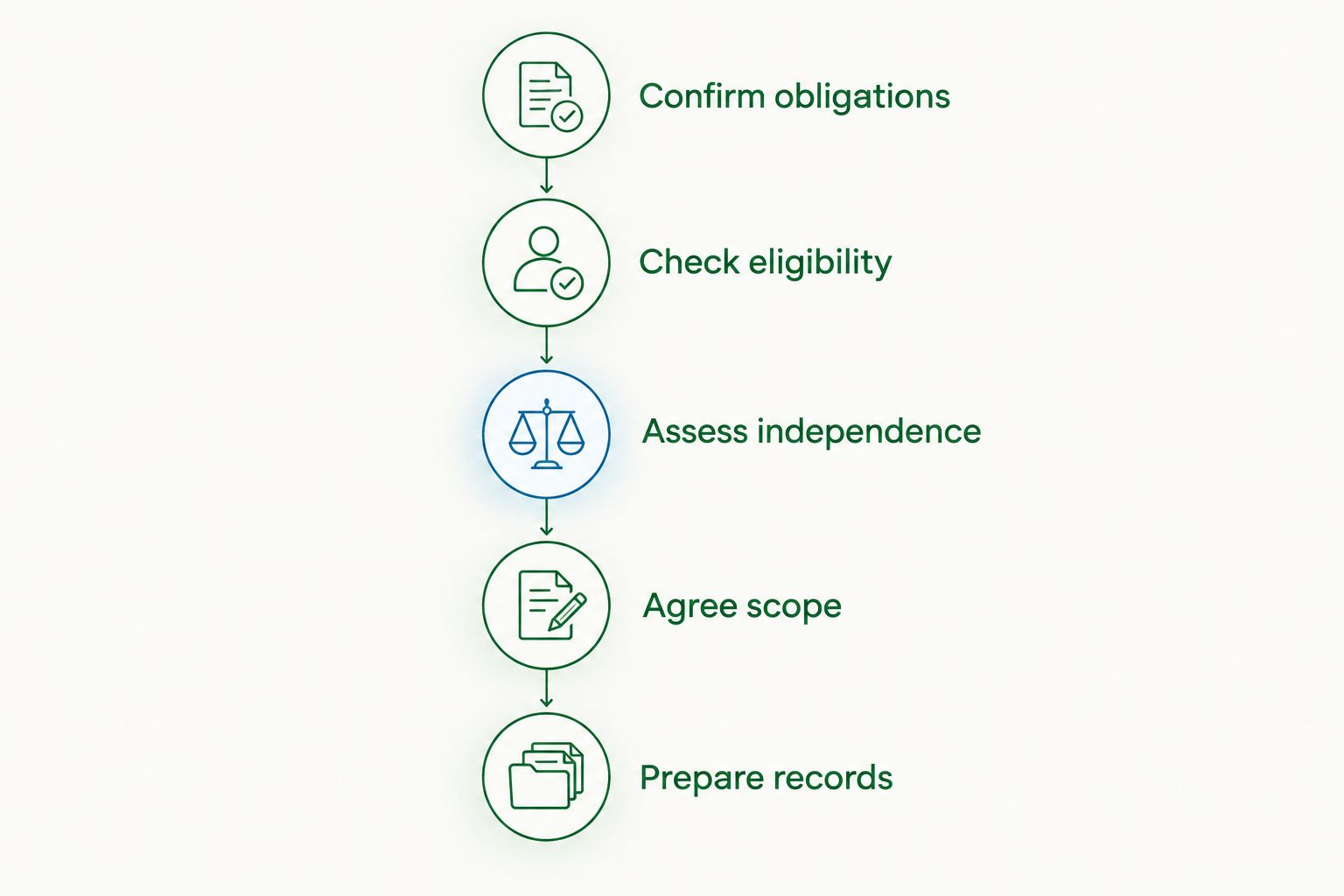
Use a documented appointment process so your committee understands what it is approving. For your 2026 audit, settle these steps before agreeing to the engagement.
01. Confirm obligations
List the regulator, governing rules and funding agreements that require reporting. Record the reporting period, required assurance level, deadline and intended recipient for each obligation.
Distinguish an annual financial statement audit from a grant acquittal. They can require different reports, even when they use some of the same underlying records.
02. Check eligibility
Confirm who will sign and whether that person or entity meets the relevant requirements. Check any required registration rather than relying only on a professional title.
Ask about relevant not-for-profit audit experience without treating experience as a replacement for statutory eligibility. Both questions matter, but they answer different concerns.
03. Assess independence
Disclose existing accounting, bookkeeping and advisory relationships. Include personal or governance connections that the proposed auditor needs to assess.
Ask the auditor to explain how independence requirements apply to your circumstances. Resolve any issue before the appointment proceeds.
04. Agree scope
Obtain an engagement letter identifying the entity, reporting period, financial reporting framework and expected report. Confirm what your organisation must prepare and what sits outside the engagement.
Make responsibility for separate funding reports explicit. Silence in the engagement letter is not confirmation that an acquittal is included.
05. Prepare records
Agree on the records and explanations the auditor needs. Allocate an internal contact who can answer questions and obtain supporting documents.
Your 2026 audit file should connect the financial statements to underlying records, including reconciliations, grant agreements, payroll records and relevant committee minutes. Ask for the auditor’s preparation list early.
Does an audit guarantee that no fraud has occurred?
An audit provides reasonable assurance, not a guarantee that every fraud or error will be found. The auditor assesses whether the financial report is free from material misstatement under the applicable auditing framework.
If your committee suspects fraud, disclose that concern explicitly. A financial statement audit and a targeted fraud investigation have different objectives and scopes.
Can a review replace an audit for a not-for-profit?
A review can replace an audit only where the applicable requirements allow it. Medium ACNC-registered charities generally have that choice, but a constitution, funding agreement or other obligation can still require an audit.
FAQ
Can any external accountant audit our not-for-profit?
No. The external accountant must meet the eligibility and independence requirements applying to your organisation and the particular audit. Confirm the signatory and applicable requirements before appointment.
Does every Australian not-for-profit need an annual audit?
No. Audit requirements depend on legal structure, charity registration, size, governing rules and funding agreements. Being a not-for-profit does not create one universal audit requirement.
Does a small charity need an audit for the ACNC?
A small charity with less than $500,000 in annual revenue generally does not need to submit an annual financial report to the ACNC. Other obligations, including a constitution or grant agreement, can still require an audit.
Is an accountant’s prepared financial report the same as an audit?
No. Preparing a financial report does not provide independent audit assurance. An audit is a separate engagement with its own requirements and auditor’s report.
Can our bookkeeper also be our auditor?
Do not assume your bookkeeper can also audit the financial report. The proposed auditor must meet the relevant qualification requirements and assess independence, including self-review threats arising from bookkeeping work.
Will an annual audit cover our grant acquittals?
Not automatically. An annual financial statement audit does not necessarily satisfy a grant-specific assurance requirement. Give the auditor the funding agreement and confirm whether a separate report is needed.
What should we ask Daintree Consulting before arranging an audit?
Ask who would sign the report, which eligibility requirements apply and how independence would be assessed. Provide your governing rules and funding agreements so the required scope can be established.
One last thing
Before approving your 2026 engagement, put the required report beside the proposed engagement letter. Check that the entity, reporting period, assurance level and recipient match.
An auditor’s appointment is not the same as meeting your reporting obligation. The signed report must address the requirement your organisation actually has.
Related guides
Talk to Daintree about your audit
Our ex-Big 4 team gives clear, senior-reviewed advice so you can act with confidence.
Book a free consultation →
Or explore our audit and assurance services.
