Audit vs Assurance: What's the Difference? | Daintree Consulting
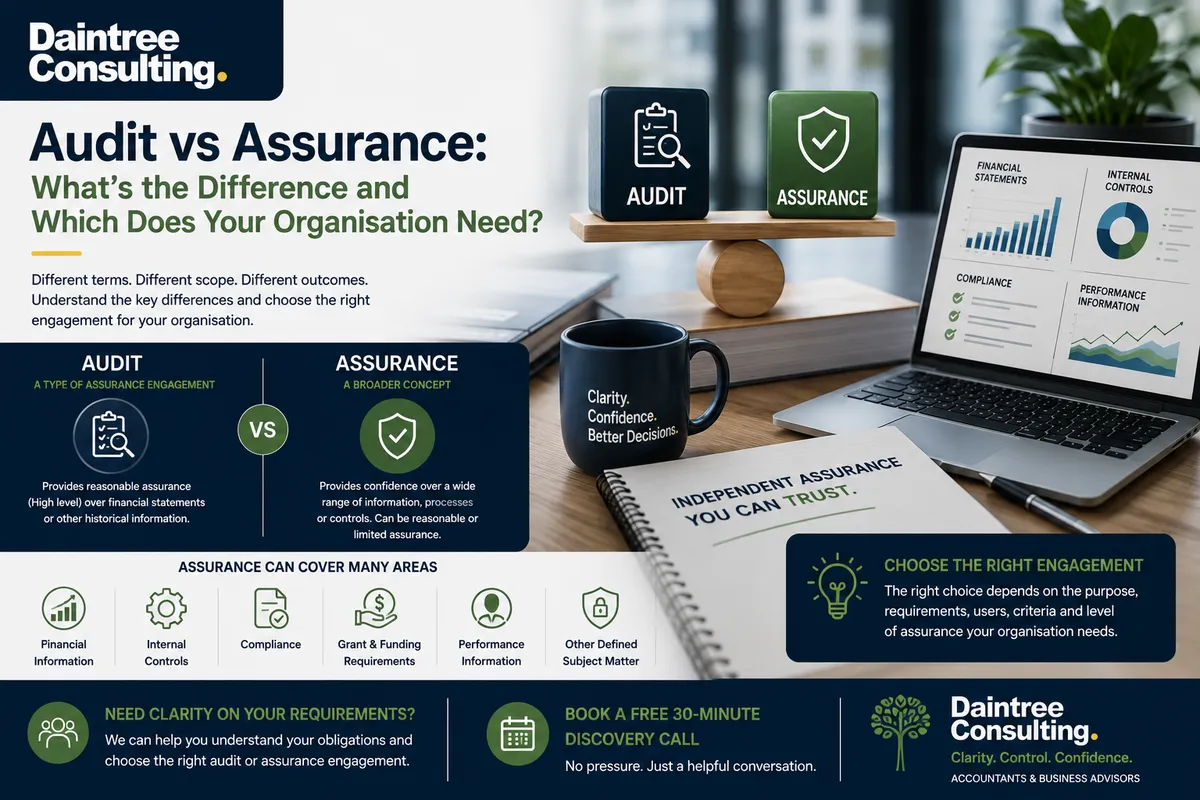
An audit is a specific type of assurance engagement. Assurance is the broader concept of providing users with greater confidence about information, processes, controls or other subject matter by evaluating it against appropriate criteria.
In simple terms:
Want expert help? Daintree Consulting's audit and assurance services can take this off your plate. Book a free consultation.
Audit = a defined assurance engagement, commonly involving a financial report.
Assurance = the broader category of engagements designed to increase confidence in information or processes.
An audit generally involves more extensive evidence-gathering procedures and provides reasonable assurance, which is a high level of assurance but not an absolute guarantee. Other assurance engagements may provide reasonable or limited assurance depending on their purpose and scope.
For Australian organisations, the right approach depends on why the engagement is required, what is being assessed, who needs the conclusion, the applicable criteria, and any regulatory or independence requirements.
That is why choosing between "audit" and "assurance" is not simply a matter of picking the cheaper option.
What Is an Audit?
An audit is a structured examination designed to provide an independent opinion or conclusion on defined information.
One of the most familiar examples is a financial statement audit.
In a financial statement audit, the auditor obtains evidence and assesses whether the financial report has been prepared in accordance with the applicable financial reporting framework and is free from material misstatement.
ASIC describes a financial statement audit as a detailed process that provides a high level of assurance to users of financial reports.
An audit may involve procedures such as:
Examining financial records
Testing transactions
Assessing accounting estimates
Reviewing supporting documentation
Confirming selected balances
Assessing relevant internal controls
Performing analytical procedures
Investigating unusual transactions or balances
Evaluating whether sufficient appropriate audit evidence has been obtained
The exact procedures depend on the engagement, the entity, the reporting framework and the auditor's assessment of risk.
Importantly, an audit does not mean that every transaction is checked.
Auditors work using risk assessment, materiality and sampling, among other professional considerations.
What Is Assurance?
Assurance is broader than an audit.
An assurance engagement is designed to increase the confidence of intended users in information or another defined subject matter by obtaining sufficient appropriate evidence and expressing a conclusion.
Australian assurance standards distinguish between reasonable assurance and limited assurance engagements.
Assurance can potentially relate to areas such as:
Financial information
Internal controls
Compliance
Performance
Sustainability information
Grant or funding requirements
Trust-account requirements
Other defined subject matter
The engagement must have a clear purpose, scope, subject matter and criteria.
This is important because "assurance" does not mean simply checking whether a business is operating properly.
The practitioner needs to understand what is being assessed and what criteria are being used to assess it.
Audit vs Assurance: The Key Difference
The easiest way to understand the relationship is:
Assurance is the broader category. Audit is one specific form of assurance.
A financial statement audit is generally a reasonable assurance engagement over historical financial information.
Other assurance engagements may have a different subject matter or provide limited assurance.
The level of work required can therefore vary significantly.
For example, a reasonable assurance engagement generally involves more extensive procedures than a limited assurance engagement. AUASB guidance explains that limited assurance engagements involve procedures that are less extensive in nature, timing and extent than those ordinarily performed for reasonable assurance.
What Is Reasonable Assurance?
Reasonable assurance is a high level of assurance, but it is not absolute assurance.
The practitioner obtains sufficient appropriate evidence to reduce engagement risk to an acceptably low level and then expresses a conclusion based on that evidence.
This may involve a combination of:
Inspection
Observation
Confirmation
Recalculation
Reperformance
Analytical procedures
Enquiries
Testing of relevant controls
Examination of supporting evidence
The exact procedures depend on the nature and risks of the engagement.
For a financial statement audit, the auditor's objective is not to guarantee that the financial statements contain no errors whatsoever.
Instead, the auditor provides an opinion about whether the financial statements are free from material misstatement, in accordance with the applicable reporting framework.
What Is Limited Assurance?
Limited assurance provides a lower level of assurance than reasonable assurance.
That does not mean the engagement has no value.
It means the nature, timing and extent of procedures are generally less extensive than those required for reasonable assurance.
A limited assurance engagement may place greater emphasis on procedures such as:
Enquiries
Analytical procedures
Reviewing documentation
Understanding processes
Targeted testing
The conclusion is also expressed differently from a reasonable assurance opinion.
This distinction matters when an organisation is deciding what level of independent confidence its stakeholders actually require.
Why Does the Difference Matter?
Understanding the difference between audit and assurance can prevent organisations from commissioning the wrong type of engagement.
For example, an organisation may need:
A statutory financial statement audit
An internal-control review
A grant or funding assurance engagement
A compliance-related assurance engagement
Audit preparation support
A defined agreed-upon procedures engagement
Another form of independent review
These are not interchangeable.
The appropriate engagement depends on the underlying requirement.
If a regulator, funder, board, investor or other stakeholder specifically requires an audit, a general review may not satisfy that requirement.
Likewise, if an organisation needs independent confidence over a particular process or control environment, a full financial statement audit may be unnecessarily broad.
The first question should therefore be:
What exactly are we required to demonstrate, and to whom?
When Does an Organisation Need an Audit?
Not every Australian business or organisation automatically requires the same type of audit.
Audit requirements can depend on the entity's legal structure, size, industry, regulatory environment, reporting obligations and other circumstances.
For example, certain companies and other regulated entities have specific financial reporting and audit requirements.
ASIC provides guidance on which entities may be required to have financial reports audited and on auditor appointment requirements.
This means an organisation should not rely on a generic online checklist to determine whether an audit is legally required.
Instead, confirm the applicable requirement for the specific entity and reporting period.
When Might Assurance Be More Appropriate?
An assurance engagement may be appropriate where an organisation needs independent confidence over a particular area but does not necessarily require a full financial statement audit.
Examples can include:
Internal controls
Management or a board may want greater confidence that important financial or operational controls are appropriately designed and operating as intended.
Grant or funding requirements
A funder may require independent assurance over specified information, expenditure or compliance criteria.
Compliance requirements
Certain organisations may need independent assessment against particular compliance criteria.
Trust-account requirements
Specific trust-account or regulatory environments can create audit or assurance obligations.
Performance or other defined information
An organisation may require independent confidence over information other than its financial statements.
The scope should always be clearly defined before work begins.
Audit vs Assurance: Which One Does Your Organisation Need?
Start with these questions.
1. Is the engagement legally or contractually required?
If a regulator, legislation, funding agreement, constitution, board or other stakeholder requires an audit, identify the exact requirement before deciding what work to commission.
2. What information needs to be assessed?
Is the requirement about:
Financial statements?
Internal controls?
Compliance?
Grant expenditure?
Trust accounts?
Performance?
Another defined subject matter?
The answer will help determine the appropriate engagement.
3. Who will use the result?
Consider whether the intended users are:
Directors
Shareholders
A board
A regulator
A government department
A funder
Investors
Members
Management
Different stakeholders can have different information needs.
4. What level of assurance is required?
Does the requirement call for reasonable assurance, limited assurance or another form of engagement?
Do not assume that a limited assurance engagement will satisfy a requirement for an audit.
5. Are there independence requirements?
Independence can be critical in audit and assurance work.
An organisation should establish whether the proposed practitioner can accept the engagement and whether any independence or conflict considerations apply.
Daintree specifically notes that audit and assurance engagements are subject to the agreed scope, applicable professional standards and independence requirements.
Audit Preparation: What Should Your Organisation Have Ready?
Whether you are preparing for an audit or another assurance engagement, good preparation can make the process significantly more efficient.
Start by gathering the records and evidence relevant to the agreed scope.
Depending on the engagement, this could include:
Financial statements
General ledger
Bank reconciliations
Bank statements
Accounts receivable records
Accounts payable records
Payroll records
Tax and BAS information
Fixed-asset registers
Loan documentation
Major contracts
Board minutes
Policies and procedures
Internal-control documentation
Grant agreements
Supporting evidence for significant transactions
The exact evidence required will depend on the engagement.
Daintree's Audit & Assurance service describes an engagement process built around confirming the purpose and scope, issuing an evidence request and timetable, performing agreed testing, resolving questions and reporting findings.
Why Internal Controls Matter
Audit and assurance work often intersects with an organisation's internal controls.
Internal controls can help organisations:
Protect assets
Reduce the risk of error
Detect unusual transactions
Maintain accurate records
Support reliable reporting
Separate incompatible responsibilities
Strengthen accountability
Reduce financial and operational risk
ASIC also highlights the importance of appropriate accounting policies, controls and processes in maintaining complete and accurate financial records.
Strong controls do not eliminate risk.
They create a more structured environment for identifying, managing and responding to risk.
What Happens During an Audit or Assurance Engagement?
While every engagement is different, the process commonly follows a structured sequence.
1. Define the purpose
First, establish why the engagement is being performed.
2. Confirm the scope
Identify what information, processes, controls or criteria are included.
3. Identify evidence requirements
The practitioner provides an appropriate request list and timetable.
4. Assess risks
The practitioner considers areas where there may be a higher risk of material misstatement, non-compliance or control deficiencies, depending on the engagement.
5. Perform testing
The agreed procedures are performed and evidence is evaluated.
6. Resolve questions
Management may be asked to provide additional documentation or explanations.
7. Form the conclusion or opinion
The practitioner evaluates the evidence and prepares the applicable report.
8. Communicate findings
Where relevant, findings, control observations or required actions are discussed with management or those charged with governance.
The result should be clear enough for the intended users to understand what was examined, what criteria applied and what conclusion was reached.
Common Mistakes Organisations Make Before an Audit
Poor preparation can create unnecessary delays.
Some of the most common issues include:
Waiting until the last minute
Starting evidence collection only when the auditor arrives creates unnecessary pressure.
Incomplete reconciliations
Unreconciled bank, payroll, receivable or payable balances can create additional questions.
Poor documentation
A transaction may be correct but difficult to verify if supporting evidence cannot be located.
Weak ownership
If nobody knows who is responsible for responding to evidence requests, the process slows down.
Outdated policies
Policies that no longer reflect how the organisation actually operates can create control concerns.
Disconnected systems
When records are spread across multiple systems, gathering evidence becomes more difficult.
Treating the audit as purely administrative
An audit can highlight weaknesses in reporting, controls and processes that management should understand.
Preparation should therefore be about more than simply "getting through the audit."
Can an Auditor Help Fix Issues Found During an Audit?
This depends on the circumstances and the applicable independence requirements.
An auditor must consider whether providing certain remediation or other services would create independence or other professional concerns.
For that reason, organisations should not assume that the same practitioner can both design controls and independently audit those controls without restriction.
Daintree notes that remediation support may be available where it does not conflict with independence or other professional requirements.
Where independence is relevant, the scope and responsibilities should be agreed carefully before work begins.
How Daintree Consulting Approaches Audit & Assurance
Daintree Consulting provides audit and assurance support designed around the purpose, entity and applicable requirements of the engagement.
Its published service scope includes:
Financial-statement audit support where applicable
Trust-account and compliance audit services where applicable
Internal-control and process reviews
Grant, funding or agreed assurance engagements
Audit preparation and readiness support
Clear reporting of findings and required actions
The process is designed to create a defined scope, clear evidence requirements, efficient coordination and practical communication of findings.
Daintree also states that availability depends on the entity, purpose, applicable registrations and independence requirements, with engagement fit confirmed before acceptance.
Audit vs Assurance: The Simple Way to Think About It
If you remember only one thing from this article, remember this:
An audit is a specific type of assurance engagement. Assurance is the broader concept.
An audit may be appropriate when legislation, regulation, governance requirements or another stakeholder specifically requires an audit.
A different assurance engagement may be more appropriate when the organisation needs independent confidence over a defined area such as controls, compliance, funding information or another subject matter.
The right answer depends on the purpose, scope, criteria, intended users and applicable requirements.
Ready to Clarify Your Audit or Assurance Requirement?
If you are unsure whether your organisation needs an audit, an assurance engagement, an internal-control review or preparation support, it is worth clarifying the requirement before the deadline approaches.
Daintree Consulting can discuss the purpose of the engagement, the information involved, the expected timing and the appropriate next step.
Book a free 30-minute discovery call to discuss your organisation's audit or assurance requirement.
Book a free discovery call with Daintree Consulting
Frequently Asked Questions
Is an audit the same as assurance?
No. An audit is a specific type of assurance engagement. Assurance is a broader category that can include different types of engagements and levels of assurance.
Is an audit a form of assurance?
Yes. A financial statement audit is commonly a reasonable assurance engagement over historical financial information.
What is the difference between reasonable and limited assurance?
Reasonable assurance provides a higher level of assurance and generally involves more extensive evidence-gathering procedures. Limited assurance involves less extensive procedures and provides a lower level of assurance.
Does every Australian business need an audit?
No. Audit requirements depend on the entity, applicable legislation, regulatory requirements and other circumstances. Organisations should confirm their specific obligations rather than assume that every business has the same requirement. ASIC provides guidance on financial reporting and audit obligations for relevant entities.
Can assurance cover internal controls?
Yes. Depending on the engagement, assurance work can address defined subject matter such as controls, compliance or other information, provided the engagement is appropriately scoped and the relevant criteria are established.
What should I prepare before an audit?
Start by confirming the audit scope and evidence requirements. Then organise relevant financial records, reconciliations, contracts, policies, supporting documentation and other evidence requested for the engagement.
Can an audit be completed remotely?
Many stages can be completed using secure digital collaboration, depending on the engagement and evidence required. Daintree states that remote completion of many stages may be possible depending on the circumstances.
Does Daintree provide audit and assurance services?
Daintree provides audit and assurance support across areas including financial-statement audit support where applicable, trust-account and compliance audit services, internal-control reviews, grant and funding assurance, agreed assurance engagements and audit preparation. Engagement availability depends on the applicable requirements, registrations and independence considerations.
Important Publishing Note
Audit and assurance requirements can vary depending on the entity, purpose, applicable legislation, regulatory requirements, engagement scope and independence considerations. This article provides general information only and should not be relied upon as a determination that a particular organisation is required to undertake an audit or a specific assurance engagement. Organisations should confirm the applicable requirement for their circumstances and obtain appropriate professional advice where necessary.
This note is worthwhile for this article because audit obligations and assurance requirements are not identical for every Australian organisation. Daintree's own published information also states that audit and assurance activities are subject to the exact engagement scope, applicable professional standards and independence requirements
