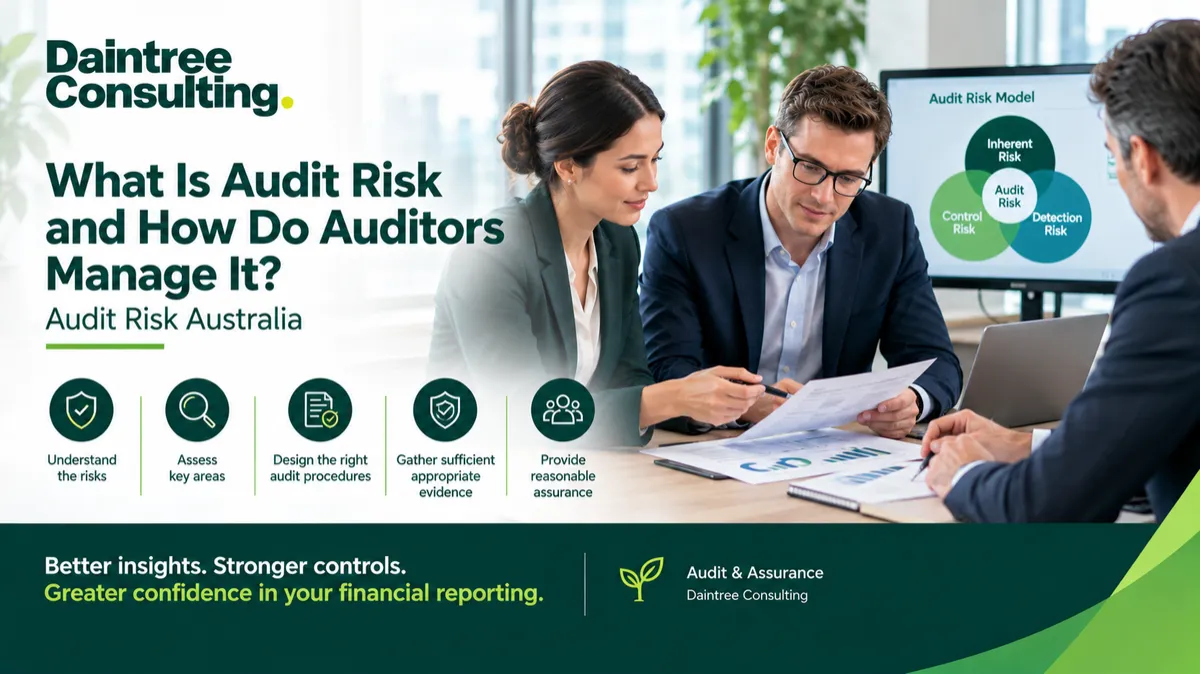
Audit Risk Australia: How Auditors Manage Risk
An audit is designed to provide confidence in financial reporting, but no audit can eliminate risk completely.
For Australian businesses, audit risk is a technical concept that sits at the centre of how an audit is planned and performed. Auditors need to identify where a financial report could contain a material misstatement, assess the risks involved and design appropriate audit procedures to respond to those risks.
Want expert help? Daintree Consulting's audit and assurance services can take this off your plate. Book a free consultation.
Under Australian Auditing Standards, audit risk is a function of the risks of material misstatement and detection risk. Auditors aim to reduce audit risk to an acceptably low level by obtaining sufficient appropriate audit evidence. Standards Portal
Understanding audit risk can also help business owners and management understand why auditors ask particular questions, request supporting documents and examine certain transactions in greater detail.
Quick Answer: What Is Audit Risk?
Audit risk is the risk that an auditor expresses an inappropriate opinion when the financial report is materially misstated.
Australian Auditing Standards explain that audit risk is made up of:
Risk of material misstatement
Inherent risk
Control risk
Detection risk
Auditors manage these risks through activities such as:
Understanding the business and its environment
Assessing internal controls
Identifying areas where material misstatements could occur
Assessing risks of fraud and error
Designing appropriate audit procedures
Testing transactions, balances and controls where appropriate
Obtaining sufficient appropriate audit evidence
Applying professional judgement and professional scepticism
Revising procedures when new information changes the risk assessment
The objective is not to achieve absolute certainty. An audit provides reasonable assurance, which is a high level of assurance but not an absolute guarantee. Standards Portal
Why Does Audit Risk Matter?
Financial statements contain information that may influence decisions made by owners, directors, investors, lenders, regulators and other stakeholders.
If those financial statements contain a material misstatement and the auditor fails to identify it, the resulting audit opinion could be inappropriate.
This is why auditors cannot simply check whether the accounting records "look right".
They need to consider:
Where errors could occur
Where fraud could occur
Which balances are more susceptible to misstatement
Whether internal controls are designed appropriately
Whether controls are operating effectively where the auditor plans to rely on them
Whether accounting estimates involve significant judgement
Whether the evidence obtained actually supports the conclusions reached
ASIC's guidance on audit quality also emphasises the importance of identifying and addressing audit risks, applying professional scepticism and appropriately challenging significant accounting estimates and treatments. ASIC
The Audit Risk Model
A useful way to understand audit risk in Australia is through the audit risk model.
At a high level:
Audit Risk = Risk of Material Misstatement × Detection Risk
The risk of material misstatement has two components:
Inherent risk
Control risk
This means auditors consider both the possibility that a material misstatement could exist and the possibility that their audit procedures might fail to detect it. Standards Portal
Let's look at each component.
1. What Is Inherent Risk?
Inherent risk is the susceptibility of an assertion about a transaction, account balance or disclosure to a material misstatement before considering related controls.
In simple terms:
How likely is something to be wrong because of the nature of the transaction, balance or business circumstances?
Some areas naturally involve more judgement or complexity than others.
For example, a business may have significant:
Complex revenue arrangements
Inventory valuation
Asset valuations
Provisions
Accounting estimates
Related-party transactions
Foreign currency transactions
Complex contracts
An auditor may therefore determine that certain areas have higher inherent risk.
The important point is that inherent risk exists before considering whether the business has controls in place to address it. Standards Portal
2. What Is Control Risk?
Control risk is the risk that a material misstatement will not be prevented, detected or corrected on a timely basis by the entity's internal controls.
For example, imagine a business has a process where:
An employee enters supplier invoices.
A manager approves payments.
Bank payments are reconciled independently.
These controls may reduce the likelihood that certain errors or inappropriate payments remain undetected.
However, controls can fail.
A control may:
Not exist
Be poorly designed
Not be followed
Be overridden
Be performed inconsistently
Be performed by someone without appropriate authority
Fail to identify an error
This is why auditors need to understand the entity's system of internal control when assessing risk.
ASA 315 requires auditors to obtain an understanding of the entity and its environment and its system of internal control as part of identifying and assessing risks of material misstatement. Standards Portal
3. What Is Detection Risk?
Detection risk is the risk that the audit procedures performed by the auditor will fail to detect a material misstatement that exists.
This is different from inherent and control risk.
Inherent and control risks relate to the business and its financial reporting environment.
Detection risk relates to the possibility that the auditor's procedures do not identify a material misstatement.
For example, an auditor may test a sample of transactions.
If the sample does not reveal an existing material error, there is a possibility that the error remains undetected.
Auditors therefore design their procedures based on their assessment of the risks involved.
Where assessed risks are higher, the auditor may need to perform more appropriate or persuasive procedures.
How Do Auditors Assess Risk?
Risk assessment is one of the fundamental parts of an audit.
Under ASA 315, auditors perform risk assessment procedures to obtain an appropriate basis for identifying and assessing risks of material misstatement due to fraud or error. Standards Portal
This can involve understanding:
The business
Auditors need to understand what the organisation does, how it makes money and what financial reporting issues may arise from its operations.
The industry
Industry conditions can affect financial reporting risks.
The business model
Different business models create different risks.
A construction business, professional services firm and retailer may have very different areas requiring audit attention.
Internal controls
Auditors consider relevant controls and how they operate.
Accounting policies
The accounting framework and policies used by the business need to be understood.
Financial performance
Unexpected changes, unusual trends or significant fluctuations can indicate areas that require further investigation.
Significant transactions
Large, unusual or complex transactions may receive additional attention.
Fraud risks
Auditors must consider the possibility of material misstatement resulting from fraud as well as error.
Why Professional Scepticism Matters
Auditors are not expected to automatically accept every explanation or document provided by management.
Australian Auditing Standards require auditors to exercise professional scepticism when planning and performing an audit. Standards Portal
Professional scepticism involves maintaining a questioning mindset and being alert to circumstances that could indicate possible misstatement due to fraud or error.
For example, if revenue suddenly increases significantly near the end of the reporting period, an auditor may want to understand:
Why did revenue increase?
Were the underlying sales genuine?
When were goods or services provided?
Are the transactions recorded in the correct period?
Are there unusual contractual terms?
Is there evidence supporting the transactions?
This does not mean the auditor assumes something is wrong.
It means the auditor considers whether the available evidence adequately supports the financial reporting treatment.
How Auditors Respond to Identified Risks
Once risks have been identified and assessed, auditors design procedures to address those risks.
Depending on the circumstances, procedures may include:
Inspecting documents
Observing processes
Confirming information with external parties
Reperforming calculations
Performing analytical procedures
Testing transactions
Testing account balances
Testing controls where appropriate
Examining supporting evidence
Reviewing subsequent events
Assessing accounting estimates
The procedures need to be appropriate to the risks identified.
Risk assessment procedures alone are not sufficient audit evidence for the audit opinion. ASA 315 specifically distinguishes risk assessment procedures from the further audit procedures required to respond to assessed risks. Standards Portal
What Is a Significant Audit Risk?
Not every identified risk has the same level of importance.
Some risks may require particular attention because of their likelihood, potential magnitude or other characteristics.
ASA 315 defines a significant risk as an identified risk of material misstatement that, in the auditor's judgement, requires special audit consideration. Standards Portal
Examples could include areas involving:
Significant management judgement
Complex transactions
Significant estimates
Unusual transactions
Fraud risk
Major changes in accounting treatment
The specific risks will depend on the circumstances of each audit.
How Internal Controls Can Affect Audit Risk
Strong internal controls can help reduce the risk that financial information contains material errors or that errors remain undetected.
Examples include:
Segregation of duties
Authorisation procedures
Bank reconciliations
Review of journal entries
Access controls
Approval limits
Inventory controls
Independent review
Regular financial reporting
Reconciliation of subsidiary records to the general ledger
However, having a control documented does not automatically mean it is effective.
Auditors may need to understand whether controls are properly designed and, where relevant to the audit approach, test whether they are operating effectively. ASA 315 includes specific requirements concerning the assessment of control risk when auditors plan to test the operating effectiveness of controls. Standards Portal
What Happens When Audit Risk Is Higher?
A higher assessed risk does not necessarily mean the financial statements are wrong.
It means the auditor believes there is a greater possibility of material misstatement and therefore needs to respond appropriately.
The response may involve:
More detailed testing
Additional supporting evidence
Larger or more targeted samples
Greater use of substantive procedures
More experienced audit team members
Additional review
Greater focus on particular transactions or balances
Increased professional scepticism
The nature and extent of the response depend on the specific risk.
A Simple Example of Audit Risk
Imagine an Australian business has a large amount of inventory.
There may be an inherent risk because inventory can become obsolete, damaged or incorrectly valued.
The business has controls requiring regular inventory counts and management review.
The auditor therefore considers the control risk associated with those processes.
The auditor may then perform procedures such as:
Attending an inventory count
Testing inventory records
Checking selected items
Reviewing valuation information
Examining supporting purchase documentation
Considering obsolete or slow-moving stock
These procedures are designed to reduce detection risk to an appropriate level.
The example demonstrates an important principle:
Auditors do not use the same procedures for every account or transaction.
The audit approach should respond to the risks identified.
What Can Businesses Do to Make an Audit More Effective?
Management cannot eliminate audit risk.
That is the auditor's responsibility to assess and respond to.
However, businesses can make the audit process more efficient by maintaining reliable records, appropriate controls and supporting evidence.
Before an audit, management should consider whether:
Bank accounts have been reconciled
The general ledger is up to date
Balance sheet accounts have been reviewed
Significant transactions have supporting documentation
Major contracts are available
Fixed asset records are accurate
Accounts receivable have been reviewed
Accounts payable are complete
Inventory records are reliable
Tax and compliance records are available
Internal controls are documented where appropriate
Management can explain significant changes in financial performance
Good preparation does not remove audit risk, but it can make it easier for auditors to obtain the evidence they need.
Audit Risk vs Business Risk
These terms are sometimes confused.
Business risk relates to events or circumstances that could affect an organisation's ability to achieve its objectives.
Audit risk is a specific technical concept relating to the risk of an inappropriate audit opinion when the financial report is materially misstated.
Australian Auditing Standards make this distinction clear. Audit risk is not simply the general business risk faced by the audit firm or the organisation being audited. Standards Portal
This distinction is important because an organisation can have significant business risks that do not necessarily translate directly into audit risks.
Why Audit Risk Matters to Australian Businesses
Understanding audit risk can help management have more productive conversations with its auditors.
Instead of viewing audit requests as a list of administrative tasks, management can understand the underlying question:
What financial reporting risk is the auditor trying to address?
That can make it easier to provide:
The right evidence
Clear explanations
Relevant documentation
Access to appropriate personnel
Information about unusual transactions
Details about significant estimates and judgements
It can also highlight opportunities to strengthen internal controls and financial reporting processes.
Why Daintree Consulting for Audit & Assurance?
Daintree Consulting provides audit and assurance support designed around the purpose, entity and applicable requirements of the engagement.
Its Audit & Assurance service can support areas including:
Financial-statement audit support where applicable
Trust-account and compliance audit services where applicable
Internal-control and process reviews
Grant, funding or agreed assurance engagements
Audit preparation and readiness support
Reporting of findings and required actions Daintree Consulting
For businesses preparing for an audit, having financial records, reconciliations, controls and supporting evidence organised can make the process clearer and more efficient.
Daintree takes a structured approach to defining the scope, preparing evidence requests, performing the agreed work and communicating findings and practical next steps. Daintree Consulting
Final Takeaway
Audit risk is the risk that an auditor expresses an inappropriate opinion when a financial report contains a material misstatement.
In Australia, auditors manage audit risk through a structured process of:
Understanding the business → Assessing risk → Designing audit procedures → Gathering evidence → Evaluating results → Forming an opinion
The key components of the audit risk model are:
Inherent risk
Control risk
Detection risk
Auditors cannot provide absolute assurance, but they are required to obtain sufficient appropriate audit evidence to reduce audit risk to an acceptably low level and provide reasonable assurance. Standards Portal
For businesses, understanding the process can make audits less mysterious and highlight the importance of accurate records, effective controls and well-supported financial reporting.
Frequently Asked Questions
What is audit risk in Australia?
Audit risk is the risk that an auditor expresses an inappropriate opinion when the financial report is materially misstated. Australian Auditing Standards describe audit risk as a function of the risks of material misstatement and detection risk. Standards Portal
What are the three types of audit risk?
The audit risk model considers inherent risk, control risk and detection risk. Inherent and control risk make up the risks of material misstatement, while detection risk relates to the possibility that audit procedures fail to detect a material misstatement.
Can auditors eliminate audit risk?
No. Audits provide reasonable assurance rather than absolute assurance. Auditors seek to reduce audit risk to an acceptably low level through appropriate risk assessment, audit procedures and sufficient appropriate audit evidence. Standards Portal
What is the difference between inherent risk and control risk?
Inherent risk concerns the susceptibility of an assertion to material misstatement before considering controls. Control risk concerns the possibility that the entity's controls will fail to prevent, detect or correct a material misstatement on a timely basis. Standards Portal
How can a business prepare for audit risk?
Businesses can support an efficient audit by maintaining accurate financial records, completing reconciliations, retaining supporting evidence, documenting appropriate controls and being prepared to explain significant transactions, estimates and changes in financial performance.
Talk to Daintree about your audit
Our ex-Big 4 team gives clear, senior-reviewed advice so you can act with confidence.
Book a free consultation →
Or explore our audit and assurance services.
