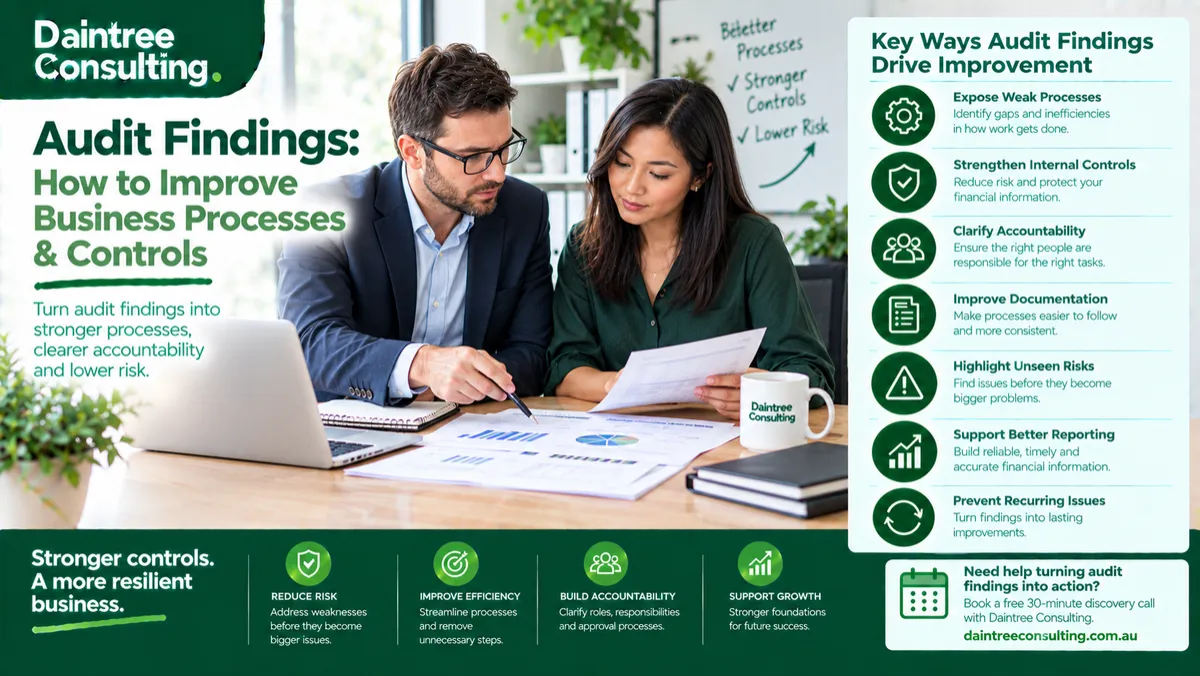
Audit Findings: How to Improve Business Processes & Controls
An audit is not only about determining whether financial information is fairly presented. The process can also highlight weaknesses in the way a business records transactions, manages approvals, reconciles accounts, protects information and monitors financial activity.
That is where audit findings can become useful beyond the audit itself.
Want expert help? Daintree Consulting's audit and assurance services can take this off your plate. Book a free consultation.
When findings are properly understood and followed up, they can help management identify gaps in processes and controls, clarify responsibilities and reduce the likelihood of the same issues occurring again.
For Australian businesses, this is particularly relevant where an audit identifies deficiencies in internal control. Under ASA 265, auditors are required to communicate certain internal control deficiencies to management and those charged with governance, based on their professional judgement and the significance of the deficiencies identified.
The important point is that an audit finding should not simply become another item on a report that gets filed away.
It can be a starting point for improving how the business operates.
What Are Audit Findings?
Audit findings are matters identified during an audit that require attention, discussion or follow-up.
The nature of a finding depends on the type and purpose of the engagement. In a financial statement audit, for example, the auditor may identify matters relating to accounting records, financial reporting, internal controls, supporting documentation or processes relevant to the audit.
An audit finding does not automatically mean that a business has done something seriously wrong.
Some findings may identify relatively minor process weaknesses. Others may point to deficiencies that could increase the risk of errors, misstatements, fraud or reporting problems.
ASA 265 defines a deficiency in internal control as a situation where a control is missing or is designed, implemented or operated in a way that cannot prevent, or detect and correct, financial-reporting misstatements on a timely basis. A significant deficiency is one that, in the auditor's professional judgement, is important enough to merit the attention of those charged with governance.
This distinction matters.
Businesses should consider not only what the finding says, but also why the issue occurred and what needs to change.
Why Audit Findings Matter for Business Processes
A financial result can sometimes show that something went wrong without explaining exactly why.
For example, a reconciliation difference may appear in the accounts. An audit may then identify that reconciliations are not being completed consistently, supporting documentation is incomplete or review responsibilities are unclear.
The accounting issue is only part of the problem.
The underlying process may be the bigger issue.
Audit findings can help management move from:
“We need to fix this error.”
to:
“What part of our process allowed this error to happen, and how can we reduce the chance of it happening again?”
That shift can lead to more useful improvements.
1. Audit Findings Can Expose Weak Processes
Many business processes evolve over time.
A business may start with a simple process where the owner approves payments, checks invoices and reviews the bank account personally. As the business grows, more employees become involved, transaction volumes increase and responsibilities are divided across different people or systems.
The original process may no longer be sufficient.
An audit can bring attention to gaps such as:
unclear approval responsibilities
incomplete supporting documentation
inconsistent reconciliations
inadequate review procedures
poor segregation of duties
manual processes that are prone to error
outdated procedures
inconsistent record keeping
controls that exist on paper but are not consistently followed
These findings can provide a useful signal that a process needs to be redesigned rather than simply corrected once.
2. Findings Can Help Strengthen Internal Controls
Internal controls are the processes and procedures a business uses to help manage risks and maintain reliable financial information.
Controls can be preventative or detective.
A preventative control may require approval before a payment is made. A detective control may involve reviewing a bank reconciliation to identify unusual or incorrect transactions.
Controls can also be manual, automated or a combination of both. ASA 265 recognises that controls can operate individually or together to prevent, or detect and correct, misstatements.
When an audit identifies a control deficiency, management can consider whether the control should be:
redesigned
documented more clearly
automated
assigned to a different person
reviewed more frequently
supported by additional evidence
separated from another responsibility
monitored through management reporting
The appropriate response depends on the nature and significance of the finding.
3. Audit Findings Can Clarify Accountability
A process can look reasonable on paper but still fail because nobody clearly owns it.
For example, a business may expect monthly reconciliations to be completed, but the responsibility may not be formally assigned. One employee assumes another person is doing it, while management assumes it is already complete.
An audit finding can highlight the gap.
Management can then establish:
who performs the task
who reviews it
when it must be completed
what evidence should be retained
who is responsible for resolving exceptions
when unresolved issues should be escalated
Clear accountability can make controls much more effective.
A control is difficult to rely on if responsibility for operating it is unclear.
4. Findings Can Improve Documentation
Good processes are easier to follow when they are documented.
Documentation might include procedures, approval requirements, reconciliation checklists, financial close processes, delegations of authority or evidence of management review.
An audit finding involving missing or inconsistent documentation can therefore be an opportunity to make the process more repeatable.
This becomes increasingly important as businesses grow.
A process that relies heavily on one person's memory may work when a business is small. It becomes more vulnerable when employees change, responsibilities are transferred or transaction volumes increase.
Better documentation can help reduce that dependency.
5. Findings Can Highlight Risks That Management Has Overlooked
Business owners and managers are often close to their day-to-day operations.
That knowledge is valuable, but it can also make certain weaknesses difficult to see.
An audit provides an additional perspective based on the scope and procedures of the engagement.
A finding may draw attention to an area management has not previously considered significant.
For example, an audit might identify weaknesses involving:
access to accounting systems
payment approvals
customer balances
supplier records
inventory records
journal entries
financial reporting procedures
reconciliations
review controls
supporting documentation
The finding itself is only the starting point.
Management then needs to consider the potential consequence and whether the underlying risk is adequately controlled.
6. Audit Findings Can Improve Financial Reporting Processes
Reliable financial reporting depends on more than having accounting software.
Businesses need processes that ensure transactions are recorded accurately, accounts are reconciled, adjustments are reviewed and financial information is prepared consistently.
An audit finding may therefore reveal that a financial reporting process needs greater structure.
For example, management may respond by introducing a more formal month-end process covering:
bank reconciliations
accounts receivable
accounts payable
payroll
inventory where relevant
fixed assets
accruals and prepayments
balance-sheet reconciliations
unusual transactions
management review
supporting documentation
A stronger month-end process can improve the quality and timeliness of financial information throughout the year, not just during the audit.
7. Findings Can Help Prevent Recurring Problems
One of the most important questions after receiving an audit finding is:
Has this happened before?
If the same issue appears year after year, correcting the immediate problem may not be enough.
Management should consider whether the root cause remains.
For example, if supporting documentation is repeatedly missing, the issue may not simply be that employees forgot to attach documents. The underlying process may lack a clear requirement, review point or system workflow.
Similarly, if reconciliations are repeatedly late, the problem may involve insufficient resources, unclear ownership, inadequate review or a process that is too manual.
ASA 265 notes that previously communicated significant deficiencies may need to be communicated again if remedial action has not been taken.
That makes follow-up an important part of the process.
8. Audit Findings Can Support Better Risk Management
A useful audit finding should be considered in the context of business risk.
Management can ask:
What happened?
Why did it happen?
What risk does it create?
How often could the issue occur?
What could the financial or operational consequence be?
Which control should address the risk?
Who owns the corrective action?
How will management know the issue has been resolved?
This approach turns a finding into a practical risk-management exercise.
It also helps management distinguish between fixing a symptom and addressing the underlying weakness.
What Should a Business Do After Receiving Audit Findings?
Receiving audit findings is only the beginning.
A practical response process can include the following steps.
Step 1: Understand the finding
Start by making sure management understands exactly what the auditor identified.
Avoid jumping immediately into a solution.
Clarify the issue, the affected process, the relevant control and the potential effect.
Step 2: Identify the root cause
Ask why the issue occurred.
Was the procedure unclear?
Was the control missing?
Was the control not operating consistently?
Was responsibility unclear?
Was the process too manual?
Was the business relying on outdated information?
The root cause will influence the appropriate response.
Step 3: Assess the risk
Not every finding requires the same response.
Management should consider the nature of the issue, its potential effect, how frequently it could occur and whether other controls already reduce the risk.
For significant deficiencies identified during an audit, ASA 265 requires written communication to those charged with governance and communication to management at an appropriate level of responsibility.
Step 4: Assign responsibility
Every agreed action should have an owner.
Without clear accountability, corrective actions can remain unresolved.
The responsible person should understand what needs to change and when the action should be completed.
Step 5: Improve the process or control
The response should address the underlying weakness.
That could mean changing an approval process, adding a review step, improving documentation, separating responsibilities, automating part of the workflow or introducing a regular management review.
Step 6: Test whether the change works
Implementing a new procedure does not automatically mean the problem has been solved.
Management should determine how the new process will be monitored.
For example, if a business introduces monthly reconciliations, it could track whether they are completed on time, reviewed and supported by appropriate documentation.
The goal is not simply to close an action item.
The goal is to establish a process that works consistently.
Common Mistakes When Responding to Audit Findings
Businesses can sometimes focus too heavily on closing findings quickly rather than improving the underlying process.
Common mistakes include:
Fixing the individual error but not the process
Correcting one incorrect transaction does not necessarily address the control weakness that allowed it to occur.
Treating every finding as equally urgent
Findings should be considered based on their nature, significance and potential consequences.
Assigning actions without clear ownership
An action without an accountable owner can easily remain unresolved.
Introducing controls that are too complicated
A control that is unnecessarily complex may be difficult to operate consistently.
Controls should be proportionate to the risks they are designed to address.
Assuming software will solve the problem
Technology can support stronger controls, but software does not automatically create a good process.
The business still needs appropriate responsibilities, review procedures and oversight.
Failing to follow up
A finding should not disappear simply because the audit has finished.
Management should track agreed actions and assess whether changes have actually been implemented.
How to Turn Audit Findings Into Continuous Improvement
The most useful approach is to treat audit findings as information that can improve the business.
Rather than viewing each finding as an isolated problem, management can look for patterns.
Are several findings related to the same process?
Are issues repeatedly occurring around month-end?
Are similar problems appearing across different departments?
Are manual processes creating unnecessary risk?
Are controls documented but not consistently followed?
Are managers receiving the information they need to identify problems early?
These questions can reveal broader opportunities for improvement.
A business might use its audit findings to strengthen its financial close process, improve approval controls, formalise reconciliations, clarify responsibilities or introduce more consistent management reporting.
Over time, this can create a stronger control environment.
When Should You Review Business Processes and Controls?
An audit is one opportunity to review controls, but businesses do not need to wait for the next audit to identify weaknesses.
A review may be useful when:
the business is growing rapidly
transaction volumes have increased
new employees are taking on financial responsibilities
accounting systems have changed
the business has introduced new products or services
there has been a change in ownership or management
financial reporting requirements have changed
recurring errors are appearing
previous audit findings remain unresolved
management does not have confidence in the accuracy or timeliness of financial information
Regular internal control reviews can help management identify weaknesses before they become larger operational or financial problems.
Audit Findings vs Audit Recommendations
It is also useful to distinguish between a finding and a recommendation.
An audit finding describes an issue identified during the engagement.
Depending on the engagement and reporting requirements, the auditor may also communicate potential remedial actions, management's responses or other relevant information. ASA 265 allows written communications about significant deficiencies to include suggestions for remedial action and management's actual or proposed responses.
However, management remains responsible for deciding how the business responds.
The appropriate solution will depend on the business's circumstances, risk tolerance, resources and objectives.
The auditor's role and the responsibilities of management should not be confused.
How Daintree Consulting Can Help
Audit findings can provide valuable information, but turning those findings into practical improvements may require broader financial and process work.
Daintree Consulting works with Australian businesses on Audit & Assurance, including audit preparation, internal-control and process reviews, and clear findings and actions where applicable.
Support can also extend into accounting processes, management reporting and financial oversight, helping businesses create more reliable financial information and clearer responsibilities.
If your business has received audit findings and you want to understand what they mean for your processes and controls, a structured review can help identify the practical next steps.
Book a free 30-minute discovery call with Daintree Consulting to discuss your situation and determine what support may be appropriate.
Frequently Asked Questions
Are audit findings always a sign that a business has serious problems?
No. The significance of an audit finding depends on the nature of the issue, the relevant risks and the auditor's professional judgement. Some findings may identify relatively minor weaknesses, while others may represent significant deficiencies requiring greater attention.
Can audit findings improve business processes?
Yes. Findings can identify weaknesses in processes, controls, documentation, responsibilities and financial reporting. Management can use this information to assess root causes and determine appropriate improvements.
What is a control deficiency?
Under ASA 265, a deficiency in internal control exists where a control is missing or is designed, implemented or operated in a way that cannot prevent, or detect and correct, financial-reporting misstatements on a timely basis.
Who is responsible for fixing audit findings?
Management and those charged with governance are responsible for evaluating and responding to identified issues. The appropriate responsibility will depend on the nature of the finding and the organisation's governance structure.
Should audit findings be reviewed after the audit?
Yes. Follow-up is important to determine whether agreed actions have been implemented and whether the underlying weakness has actually been addressed.
Final Takeaway
Audit findings can be more than a list of problems to resolve.
They can show where business processes, financial reporting procedures and internal controls may need greater structure or oversight.
The most valuable response is not simply to correct the immediate issue.
It is to understand why the issue occurred, assess the underlying risk, improve the relevant process, assign clear responsibility and monitor whether the change works.
For Australian businesses, this can turn the findings from an audit into a practical source of business improvement.
A stronger control environment can support more reliable financial information, clearer accountability and better visibility over the processes that underpin the business.
Talk to Daintree about your audit
Our ex-Big 4 team gives clear, senior-reviewed advice so you can act with confidence.
Book a free consultation →
Or explore our audit and assurance services.
