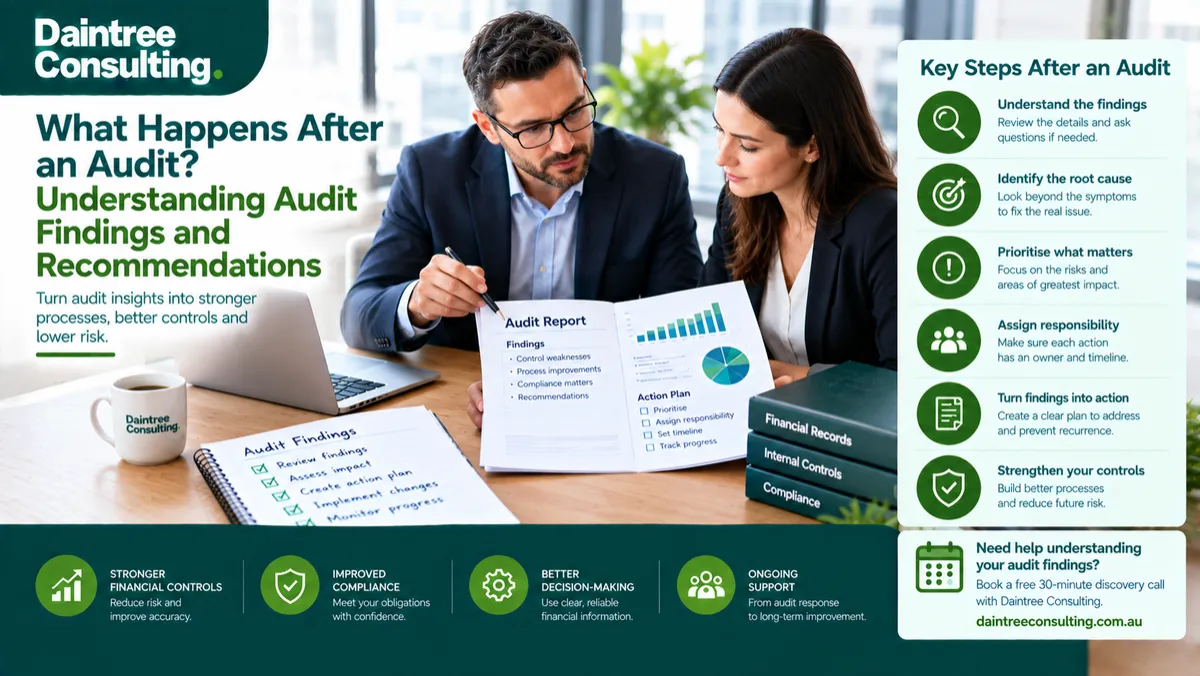
What Happens After an Audit? Understanding Audit Findings and Recommendations
An audit does not necessarily end when the auditor finishes testing your records.
For many Australian businesses and organisations, the more important work begins when the audit findings and recommendations are communicated.
Want expert help? Daintree Consulting's audit and assurance services can take this off your plate. Book a free consultation.
An audit can identify weaknesses in financial processes, internal controls, documentation, reconciliations, governance or compliance. Some findings may be relatively minor and straightforward to address. Others can point to broader issues that require management attention.
The key is understanding what the findings actually mean and deciding what needs to happen next.
Rather than treating an audit report as something to file away until next year, management can use the findings as a practical roadmap for improving financial processes and reducing avoidable risk.
Quick Answer: What Happens After an Audit?
After an audit, the auditor communicates relevant findings, issues or recommendations to management and, where appropriate, those charged with governance.
Management then needs to understand the issues identified, assess their significance, determine appropriate actions and establish responsibility and timing for addressing them.
The exact process depends on the type and scope of the audit.
Some findings may require immediate attention, while others may be suitable for longer-term process improvements.
The important question is not simply “Did we pass the audit?”
It is:
“What did the audit tell us about our financial records, controls and processes, and what should we do about it?”
What Are Audit Findings?
Audit findings are issues, observations, weaknesses or matters identified during an audit that may require management's attention.
The terminology used can vary depending on the type of audit, the engagement and the auditor.
A finding might relate to:
Missing supporting documentation
Reconciliation issues
Weak internal controls
Inconsistent approval processes
Inadequate record keeping
Unusual or unexplained transactions
Errors in financial information
Segregation-of-duties concerns
Incomplete processes
Compliance-related matters
Information that was not available when requested
Not every finding represents a major failure.
Some findings may have a relatively low level of financial or operational impact but still indicate that a process could be improved.
Others may be more significant because they could affect the reliability of financial information, expose the organisation to risk or indicate that an important control is not operating as intended.
This is why findings need to be understood in context rather than treated as a simple list of problems.
Audit Findings Are Not All the Same
One of the first steps after receiving audit findings is to understand their relative importance.
Depending on the engagement, findings may be described using terms such as:
Observation
Recommendation
Control deficiency
Significant deficiency
Material issue
Non-compliance
Corrective action
The terminology and reporting approach will depend on the audit.
A business should therefore avoid assuming that every finding has the same level of urgency.
A useful post-audit review should consider:
What was identified?
Understand the specific issue rather than relying on a broad description.
Why does it matter?
Consider the potential financial, operational, compliance or governance consequences.
How significant is it?
Determine whether it requires immediate action or can be addressed through a planned improvement.
What caused it?
The underlying cause may be more important than the individual error.
What should change?
Identify the practical action required to reduce the likelihood of the issue recurring.
Why Audit Recommendations Matter
An audit recommendation should not simply be viewed as criticism.
In many cases, it provides an opportunity to strengthen the way the business operates.
For example, an auditor might identify that supporting documentation for certain expenses is inconsistent.
The immediate issue may be missing documents.
But the underlying problem could be that:
Staff are unclear about documentation requirements
Approval procedures are inconsistent
Responsibilities have not been clearly assigned
Records are stored across different systems
There is no regular review process
Simply asking employees to “keep better records” may not solve the underlying problem.
A better response could involve introducing a clearer expense policy, approval workflow and document-storage process.
The recommendation therefore becomes an opportunity to improve the broader control environment.
What Should Management Do After Receiving Audit Findings?
A structured response can make the post-audit process much more effective.
1. Read the Findings Carefully
Start by understanding exactly what the auditor identified.
Avoid jumping straight into solutions.
For each finding, consider:
What happened?
Which process was affected?
What evidence supported the finding?
Was the issue isolated or recurring?
What risk does it create?
Is management's understanding consistent with the auditor's observation?
If anything is unclear, ask for clarification.
A good response starts with a shared understanding of the issue.
2. Separate Symptoms From Root Causes
An audit finding may identify a visible problem without necessarily identifying every reason it occurred.
For example, an account reconciliation may contain unexplained differences.
The immediate issue is the unreconciled balance.
But the root cause could be:
Incomplete bookkeeping
Incorrect transaction coding
Delayed reconciliations
Lack of review
Poor documentation
A system configuration issue
Insufficient staff training
Addressing only the visible symptom may allow the problem to return.
Root-cause analysis can therefore be an important part of the post-audit response.
3. Prioritise the Findings
Not every finding needs to be addressed in exactly the same way or at the same time.
Management should consider factors such as:
Potential financial impact
Compliance implications
Risk to financial reporting
Frequency of the issue
Likelihood of recurrence
Operational consequences
Governance implications
Effort required to resolve the issue
This can help management distinguish between immediate priorities and longer-term improvements.
For example, a control weakness that could result in significant financial errors should generally receive more attention than a minor administrative inconsistency.
The appropriate priority will depend on the circumstances and the nature of the audit.
4. Assign Responsibility
A recommendation without an owner can easily become an unresolved action item.
For each significant finding, identify who is responsible for addressing it.
Depending on the business, this might involve:
Business owners
Directors
Finance managers
Accountants
Bookkeepers
Payroll staff
Operations managers
IT personnel
External advisers
Responsibility should be clear.
It should also be understood that management remains responsible for decisions and implementation, even when external professionals are involved in providing support.
5. Create an Action Plan
Once the findings have been prioritised, turn them into specific actions.
A useful action plan should answer:
What needs to change?
Who is responsible?
What needs to happen first?
When should it be completed?
How will management know the issue has been resolved?
For example, instead of:
Improve financial controls.
A stronger action might be:
Introduce a documented approval process for expenditure above an agreed threshold, assign approval responsibilities and review compliance monthly.
The second approach creates a much clearer path from finding to action.
6. Fix the Process, Not Just the Individual Error
One of the most important lessons from audit findings is that correcting one transaction may not be enough.
Imagine an auditor identifies several transactions that were incorrectly coded.
Management could correct those transactions and consider the matter closed.
But if the process that caused the errors remains unchanged, similar issues may appear again.
The better question is:
Why did the error happen in the first place?
Potential improvements might include:
Clearer accounting procedures
Better account coding guidance
Regular reconciliations
Management review
Approval controls
Staff training
Improved document retention
Defined responsibilities
Better accounting-system configuration
This turns the audit from a compliance exercise into an opportunity for process improvement.
7. Review Internal Controls
Audit findings frequently highlight weaknesses in internal controls.
Internal controls are the policies, procedures and checks used to help a business manage financial and operational risks.
Examples include:
Segregation of duties
Approval controls
Bank reconciliations
Payment authorisation
User access controls
Expense approvals
Financial review procedures
Inventory controls
Payroll review
Management reporting
If an audit identifies a control weakness, management should consider whether the issue is isolated or reflects a broader weakness.
For example, if one person can create a supplier, approve an invoice and release a payment without independent review, the issue may extend beyond one transaction.
The appropriate control environment depends on the size and complexity of the organisation.
Smaller businesses may not be able to separate every responsibility between different employees, but compensating review controls may still be possible.
What Happens to Audit Findings in the Next Audit?
Previous audit findings can become an important part of future audit preparation.
If an auditor identifies an issue in one period, management may need to demonstrate what has been done to address it.
This means businesses should retain appropriate evidence of corrective actions.
Depending on the finding, this could include:
Updated policies
Revised procedures
Reconciliation records
Approval documentation
Training records
System changes
Management review evidence
Updated control documentation
Supporting correspondence
The objective is not to create paperwork for its own sake.
It is to provide evidence that the underlying issue has actually been addressed.
Why Recurring Audit Findings Are a Warning Sign
A finding that appears repeatedly deserves particular attention.
If the same issue is identified year after year, it may indicate that previous corrective action did not address the root cause.
For example:
Year 1:
Supporting documentation is incomplete.
Management response:
Staff are reminded to retain documents.
Year 2:
Supporting documentation remains inconsistent.
This suggests that the reminder did not solve the underlying process problem.
A more effective response might involve changing the workflow itself.
Recurring findings can therefore provide valuable information about whether management's previous corrective actions have actually worked.
Audit Findings Can Reveal Broader Business Risks
Although an audit may focus on a defined scope, its findings can sometimes highlight issues beyond the original problem.
For example, recurring reconciliation problems might indicate broader weaknesses in the finance function.
Inconsistent financial reporting could suggest that management does not have a reliable month-end close process.
Weak payment controls could highlight broader governance concerns.
Incomplete documentation might indicate that responsibilities have not been clearly defined.
This is why management should consider whether a finding is an isolated event or evidence of a wider process issue.
How Better Financial Records Can Reduce Future Findings
Reliable accounting records provide the foundation for effective financial management and audit preparation.
Businesses can reduce avoidable issues by establishing consistent processes around:
Bank reconciliations
Balance-sheet reconciliations
Accounts receivable
Accounts payable
Payroll records
Fixed assets
GST and tax-related records
Supporting documentation
Journal entries
Month-end close
Management review
The objective is not to prepare the business only when an audit is approaching.
Financial records should be maintained consistently throughout the year.
This can make audit preparation more straightforward and give management better information for day-to-day decisions.
When Should You Bring in External Support?
Some audit findings are relatively straightforward.
Others can expose weaknesses that management does not have the time, expertise or internal resources to address.
External accounting or advisory support may be useful when:
Findings keep recurring
Financial reconciliations are not consistently completed
Internal controls need to be redesigned
Management reporting is unreliable
The finance team is stretched
The business has experienced significant growth
The organisation has undergone structural changes
There are complex financial processes to review
Management needs an independent perspective
The appropriate support depends on the nature of the findings.
For some businesses, accounting support may address the underlying records.
For others, business advisory or outsourced CFO support may be more appropriate where the issues involve broader financial processes, reporting, controls or management decision-making.
How an Outsourced CFO Can Help After an Audit
An outsourced CFO can play a useful role when audit findings point to broader financial management issues.
Rather than simply correcting individual errors, an outsourced CFO can help management look at the underlying finance function.
This can include:
Financial reporting
Reviewing whether management receives accurate and timely financial information.
Cash flow management
Assessing whether cash flow forecasting and working capital processes need improvement.
Internal controls
Helping identify practical improvements to financial processes and control procedures.
Management reporting
Reviewing whether financial reports provide the information leadership needs to make decisions.
Finance processes
Assessing month-end procedures, reconciliations, responsibilities and reporting workflows.
Action planning
Helping management translate audit recommendations into practical finance improvements.
This does not replace the auditor.
The auditor's role is distinct from management's responsibility to operate the business and address identified issues.
Instead, CFO support can help management respond effectively to the findings.
How to Prepare for the Next Audit
Once the findings have been addressed, do not wait until the next audit is approaching to review progress.
Instead, build the improvements into the normal finance process.
Useful practices can include:
Regular account reconciliations
Monthly management reviews
Documented approval procedures
Clear financial responsibilities
Consistent record keeping
Periodic internal-control reviews
Tracking outstanding audit actions
Maintaining evidence of corrective actions
Reviewing recurring issues
Escalating significant problems early
This creates a continuous improvement cycle:
Audit → Findings → Root-cause analysis → Corrective action → Monitoring → Improved processes
That is far more valuable than treating the audit as an annual event.
Audit Findings Should Be a Starting Point, Not the End
An audit provides more than an opinion or a formal report.
It can give management an external perspective on the quality of financial information, controls and processes within the scope of the engagement.
The real value comes from what happens afterwards.
Businesses that carefully assess their audit findings can identify weaknesses, strengthen controls, improve financial processes and reduce the likelihood of similar issues recurring.
The goal is not to create a business where nothing ever goes wrong.
The goal is to create financial processes that identify issues earlier, provide reliable information and make it easier for management to respond.
If your business has recently completed an audit and needs help understanding the financial or process implications of the findings, Daintree Consulting can provide practical accounting, advisory and finance support.
Book a free 30-minute discovery call to discuss your audit findings and determine what support may be appropriate for your business.
Frequently Asked Questions
What are audit findings?
Audit findings are issues, observations, weaknesses or other matters identified during an audit that may require management attention. They can relate to financial records, internal controls, documentation, processes or compliance, depending on the audit scope.
What happens after audit findings are identified?
Management should understand the findings, assess their significance, identify root causes, prioritise corrective actions, assign responsibility and monitor progress. The exact process depends on the nature of the audit and findings.
Are all audit findings serious?
No. Findings can vary considerably in significance. Some may be relatively minor process observations, while others may indicate more significant weaknesses or risks. The appropriate response depends on the circumstances.
How should a business respond to an audit recommendation?
A business should first understand the underlying issue and then determine an appropriate corrective action. The response should ideally address the root cause rather than simply correcting an individual error.
Why do audit findings keep recurring?
Recurring findings can indicate that previous corrective actions did not address the underlying cause. They may also suggest that the relevant process, control or responsibility needs to be redesigned.
Can an accountant help with audit findings?
An accountant may be able to help address financial-record issues, reconciliations and accounting processes. More complex findings may require additional business advisory, internal-control or CFO-level support depending on the issue.
Can an outsourced CFO help after an audit?
Yes. An outsourced CFO can help management assess broader financial issues identified during an audit, improve reporting and forecasting, review finance processes and support the implementation of practical improvements.
Does fixing an audit finding guarantee there will be no issues next year?
No. Businesses operate in changing environments, and new issues can arise. The purpose of corrective action is to reduce identified risks and strengthen relevant processes, not to guarantee a particular future audit outcome.
Talk to Daintree about your audit
Our ex-Big 4 team gives clear, senior-reviewed advice so you can act with confidence.
Book a free consultation →
Or explore our audit and assurance services.
