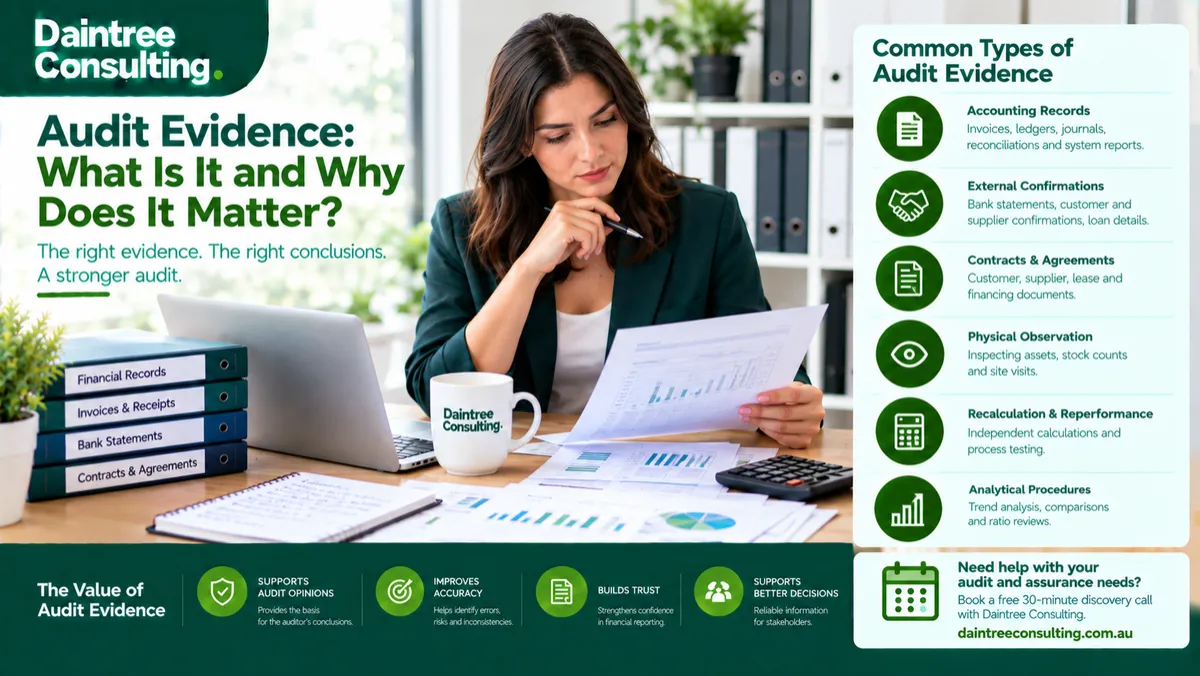
Audit Evidence: What Is It and Why Does It Matter?
An audit opinion is not based simply on whether a company's financial statements look reasonable.
Auditors need evidence.
Want expert help? Daintree Consulting's audit and assurance services can take this off your plate. Book a free consultation.
They examine financial records, supporting documents, transactions, balances, controls and information from other sources to reach conclusions about the financial report.
This is known as audit evidence.
Under Australian Auditing Standard ASA 500, audit evidence is information used by the auditor when reaching conclusions on which the audit opinion is based. It can include information contained in the accounting records as well as information obtained from other sources.
For Australian businesses, understanding audit evidence can make the audit process easier to prepare for.
It also explains why an auditor may ask for what can sometimes feel like a large amount of supporting information.
The purpose is not simply to collect documents.
The auditor needs sufficient and appropriate evidence to support the conclusions reached during the audit.
Quick answer: What is audit evidence?
Audit evidence is information that an auditor uses to support conclusions about a financial report and ultimately form the basis for an audit opinion.
It can include:
invoices
bank statements
contracts
accounting records
general ledgers
reconciliations
payroll records
inventory information
loan agreements
confirmations from third parties
calculations
supporting schedules
physical observations
management information
external information
evidence obtained through audit procedures.
ASA 500 distinguishes between two important concepts:
Sufficiency refers to the quantity of audit evidence.
Appropriateness refers to its quality, including its relevance and reliability.
Both matter.
A large amount of low-quality evidence does not necessarily compensate for a lack of reliable evidence.
Why Does Audit Evidence Matter?
An auditor's conclusion needs to be supported by evidence.
ASA 500 requires auditors to design and perform audit procedures to obtain sufficient appropriate audit evidence that enables them to draw reasonable conclusions on which to base their audit opinion.
This is important because financial statements contain information that users may rely on when making decisions.
Auditors therefore need to obtain evidence that supports their assessment of whether the financial report is materially misstated.
For businesses, this means an audit is not simply a review of the final financial statements.
The auditor may need to understand:
where figures came from
whether transactions occurred
whether balances are supported
whether accounting treatments are appropriate
whether estimates are reasonable
whether information is complete
whether disclosures are supported.
The evidence helps the auditor move from a reported number to a supported conclusion.
What Counts as Audit Evidence?
There is no single type of document that qualifies as audit evidence.
Evidence can come from different sources and can be obtained through different audit procedures.
ASA 500 specifically recognises both information contained in accounting records and information obtained from other sources.
Examples include:
Accounting records
These may include:
general ledger
subsidiary ledgers
journals
invoices
receipts
electronic payment records
bank records
reconciliations
spreadsheets
accounting system reports.
These records form an important part of the evidence available to the auditor.
Contracts and agreements
Contracts can help support information relating to:
revenue
leases
financing
supplier arrangements
major customer relationships
commitments
acquisitions.
For example, an auditor may inspect a contract to understand the terms of a significant transaction.
External confirmations
An auditor may obtain information directly from an external party.
Examples could include confirmations relating to:
bank balances
loans
customer receivables
supplier balances
legal matters.
Information obtained directly from an independent external source can be particularly useful when testing relevant financial statement assertions.
ASA 500 notes that the reliability of evidence can be increased when it comes from independent sources outside the entity.
Physical observation
Some audit evidence is obtained by observing something directly.
For example, an auditor may observe an inventory count or inspect an asset.
Observation can provide useful evidence about whether a process or condition exists at a particular point in time.
However, observation alone does not necessarily establish every fact about the item being observed.
Recalculation
An auditor may independently recalculate an amount to assess whether the mathematical calculation is accurate.
This could involve:
interest calculations
depreciation
payroll-related calculations
provisions
revenue calculations
other financial computations.
Reperformance
An auditor may independently perform a procedure that was originally carried out by the business.
This can help assess whether the process or control operates as expected.
Analytical procedures
Auditors may analyse relationships, trends and unexpected movements.
For example, they may compare:
current-year revenue with prior-year revenue
gross margins across periods
expense trends
debtor balances
inventory movements
financial results against expectations.
An unusual movement does not automatically mean there is an error.
It may, however, indicate an area that needs further investigation.
What Makes Audit Evidence Good Quality?
Not all evidence has the same level of reliability.
The auditor considers whether information is relevant and reliable for the particular audit procedure and conclusion.
ASA 500 defines appropriateness as the measure of the quality of audit evidence, including its relevance and reliability.
Several factors can influence reliability.
Source
Evidence obtained from an independent external source may provide stronger support than information generated internally, depending on the circumstances.
For example, an external bank confirmation may provide different evidence from an internal spreadsheet showing the same balance.
Directness
Evidence obtained directly by the auditor can be more reliable than information obtained indirectly.
For example, directly observing a control being performed can provide different evidence from simply asking an employee whether the control operates.
Documentation
Documentary evidence can provide stronger support than an unsupported verbal explanation, although the circumstances and controls over the information still matter.
ASA 500 notes that documentary evidence can be more reliable than oral evidence and that original information may provide different reliability considerations from copies or transformed records.
Internal controls
Information generated internally may be more reliable when the controls surrounding its preparation and maintenance are effective.
This is one reason auditors may examine internal controls when assessing the reliability of information used during an audit.
What Is the Difference Between Sufficient and Appropriate Audit Evidence?
These terms are closely related but have different meanings.
Sufficiency = quantity
Sufficiency concerns how much evidence is needed.
The amount required depends partly on the assessed risk of material misstatement and the quality of the evidence obtained.
Higher assessed risk may mean that more evidence is needed.
Appropriateness = quality
Appropriateness concerns whether the evidence is relevant and reliable enough for the auditor's purpose.
The two concepts work together.
ASA 500 explains that sufficiency and appropriateness are interrelated and that obtaining more evidence does not necessarily compensate for poor-quality evidence.
This is an important distinction for businesses.
Providing 100 documents is not necessarily better than providing 20 well-supported documents if the 20 provide the evidence the auditor actually needs.
The objective is appropriate audit evidence, not simply a large volume of paperwork.
How Do Auditors Obtain Audit Evidence?
Auditors use different procedures depending on the risks and the matters being tested.
ASA 500 identifies procedures including:
inspection
observation
confirmation
recalculation
reperformance
analytical procedures
enquiry.
These procedures may be used individually or in combination.
For example, an auditor testing revenue might:
Review the accounting records.
Inspect selected sales invoices.
Examine relevant contracts.
Check supporting delivery information.
Test subsequent cash receipts.
Perform analytical procedures.
Investigate unusual transactions.
The exact procedures will depend on the engagement, assessed risks and circumstances.
Common Types of Audit Evidence by Financial Area
Different financial statement areas require different forms of evidence.
Revenue
Evidence may include:
sales invoices
customer contracts
delivery records
customer correspondence
receipts
credit notes
subsequent cash receipts.
The auditor may be interested in whether revenue occurred, was recorded in the correct period and is appropriately accounted for.
Accounts receivable
Evidence may include:
aged receivables reports
customer invoices
customer confirmations
subsequent receipts
credit notes
correspondence concerning disputed balances.
The auditor may also consider whether receivables are recoverable.
Inventory
Evidence may include:
inventory listings
stocktake records
purchase invoices
sales information
inventory movement reports
valuation calculations.
Physical observation may also form part of the audit procedures around inventory.
Property, plant and equipment
Evidence may include:
purchase invoices
asset registers
financing agreements
depreciation calculations
disposal documentation
physical inspection.
Loans and borrowings
Evidence could include:
loan agreements
lender statements
repayment schedules
interest calculations
bank confirmations.
Payroll
Evidence may include:
payroll reports
employee records
employment agreements
payment records
superannuation information
payroll reconciliations.
Tax balances
Depending on the engagement, auditors may examine:
tax calculations
lodged returns
correspondence
payment records
reconciliations
supporting schedules.
Provisions and estimates
Evidence may be more complex when financial statement amounts involve management judgement.
The auditor may examine:
underlying calculations
assumptions
supporting data
historical outcomes
external information
subsequent events.
The objective is not necessarily to find one document that proves the estimate is correct.
The auditor may need to evaluate the reasonableness of the information and assumptions supporting it.
Why Do Auditors Ask for Supporting Documents?
A common question from business owners is:
“If the transaction is already in our accounting software, why does the auditor need the invoice or supporting document?”
The accounting system records the transaction.
But the auditor may need evidence to test whether the recorded information is supported.
For example, an accounting system might show a $50,000 expense.
The auditor may want to understand:
what the expense relates to
whether it actually occurred
whether it belongs to the business
whether it is recorded in the correct period
whether the amount is accurate
whether it has been appropriately classified.
The supporting documentation helps the auditor perform those procedures.
This is why strong record-keeping can make an audit process more efficient.
What Happens If Audit Evidence Is Missing?
Missing evidence does not automatically mean that the financial statements are incorrect.
However, it can make it more difficult for the auditor to reach a conclusion.
If evidence is unavailable, the auditor may need to perform alternative procedures or obtain evidence from another source.
For example, if an original document is unavailable, the auditor may consider whether other reliable information can support the relevant conclusion.
If sufficient appropriate evidence cannot be obtained, the matter can become more significant.
ASA 330 addresses the auditor's evaluation of whether sufficient appropriate audit evidence has been obtained, and Australian regulatory materials emphasise the importance of evidence supporting audit conclusions.
For a business, this is another reason to maintain organised financial records throughout the year rather than trying to reconstruct documentation immediately before an audit.
Does More Audit Evidence Always Mean a Better Audit?
Not necessarily.
The goal is not to collect as much information as possible.
The auditor needs evidence that is relevant and reliable and sufficient for the risks and conclusions involved.
For example, repeating the same low-quality information many times does not necessarily provide the same value as obtaining a reliable independent source.
ASA 500 specifically explains that the quantity of evidence required is affected by risk and the quality of evidence, and that more evidence does not necessarily compensate for poor quality.
This is why audit evidence should be considered in terms of quality, relevance and quantity together.
What Can Businesses Do to Make Audit Evidence Easier to Provide?
Businesses cannot control exactly what an auditor will request.
However, they can make the underlying records easier to understand and support.
Keep accounting records up to date
Regular bookkeeping and reconciliations reduce the risk of having to reconstruct transactions later.
Maintain supporting documentation
Keep invoices, contracts, statements, agreements and other relevant documents in an organised system.
Reconcile accounts regularly
Bank, receivables, payables, loans, payroll and other relevant accounts should be reviewed regularly.
This can make unusual balances easier to identify.
Document significant judgements
Where management has made an important accounting judgement or estimate, keep records explaining the assumptions and supporting information.
Keep contracts accessible
Important customer, supplier, lease, financing and other agreements should be easy to locate.
Investigate unusual transactions
Large or unusual transactions are more likely to require additional explanation or evidence.
Having the supporting documentation ready can make the process more efficient.
How Good Record-Keeping Supports Audit Evidence
Good record-keeping is not the same thing as audit evidence, but it provides an important foundation for the evidence available to the auditor.
A well-organised business may be able to quickly provide:
reconciliations
invoices
contracts
bank records
payroll reports
asset registers
loan statements
inventory information
management schedules
supporting calculations.
This can reduce unnecessary delays and help the auditor understand the financial information more efficiently.
ASIC's audit surveillance work specifically focuses on whether sufficient appropriate audit evidence supports auditors' conclusions, reinforcing the importance of evidence quality in the audit process.
Audit Evidence and Professional Scepticism
Audit evidence also connects with professional scepticism.
An auditor does not simply accept every explanation or document at face value.
Where information appears inconsistent, incomplete or unreliable, the auditor may need to investigate further.
ASA 500 requires auditors to consider relevance and reliability and to respond when evidence from different sources is inconsistent or there are doubts about reliability.
For businesses, this means an auditor may ask follow-up questions even when documentation has already been provided.
That is a normal part of evaluating evidence.
A question from the auditor does not necessarily mean that something is wrong.
It may simply mean the auditor needs additional evidence to reach a reasonable conclusion.
Audit Evidence vs Audit Documentation
These terms are related but should not be confused.
Audit evidence is the information used by the auditor to reach conclusions.
Audit documentation is the record of the audit work performed, evidence obtained and conclusions reached.
The evidence supports the auditor's conclusions.
The audit documentation records how the auditor performed the work and reached those conclusions.
This distinction matters because an auditor needs to be able to demonstrate the basis for significant decisions and conclusions.
ASIC has stated that its audit file reviews focus on whether sufficient appropriate audit evidence is present to support conclusions on key decisions and significant judgements.
Why Audit Evidence Matters to Australian Businesses
For businesses undergoing an audit, understanding audit evidence can change the way you approach audit preparation.
Instead of thinking:
“What documents will the auditor ask us for?”
it can be more useful to think:
“What information supports the important figures, balances, transactions and judgements in our financial statements?”
That mindset encourages better preparation.
It also connects audit readiness with everyday accounting processes.
Accurate bookkeeping, regular reconciliations, organised documentation and clear explanations of significant transactions can all make it easier to respond to audit requests.
How Daintree Consulting Can Help With Audit Preparation
Daintree Consulting provides Audit & Assurance support for Australian businesses and organisations that need stronger preparation around their financial records, reporting and audit processes.
Depending on the engagement, support may include:
audit preparation and readiness
financial statement preparation support
reconciliation review
supporting schedule preparation
internal-control and process reviews
coordination of information for auditors
identifying potential documentation gaps
helping management respond to audit requests.
The objective is not to replace the independent auditor.
It is to help the business organise its financial information and supporting records so that the audit process can be more structured and manageable.
If your business is preparing for an audit and you are unsure whether your records and supporting evidence are ready, book a free 30-minute discovery call with Daintree Consulting to discuss your requirements.
Frequently Asked Questions About Audit Evidence
What is audit evidence?
Audit evidence is information used by an auditor to reach conclusions that support the audit opinion. It can come from accounting records and other internal or external sources.
What are examples of audit evidence?
Examples include invoices, contracts, bank statements, reconciliations, accounting records, confirmations, calculations, inventory records, payroll information and evidence obtained through inspection, observation or analytical procedures.
What is sufficient audit evidence?
Sufficient audit evidence refers to the quantity of evidence needed for the auditor to reach reasonable conclusions. The amount required depends on factors including assessed risk and the quality of the evidence.
What is appropriate audit evidence?
Appropriate audit evidence refers to the quality of evidence, particularly its relevance and reliability for the auditor's purpose.
Is audit evidence the same as supporting documents?
Not exactly. Supporting documents can form part of audit evidence, but audit evidence can also include information obtained through procedures such as observation, confirmation, recalculation, reperformance and analytical procedures.
What happens if an auditor cannot obtain enough evidence?
The auditor may perform additional or alternative procedures. If sufficient appropriate audit evidence still cannot be obtained for a material matter, this can affect the auditor's ability to reach an appropriate conclusion and may have implications for the audit report.
Can accounting records be used as audit evidence?
Yes. ASA 500 specifically recognises information contained in accounting records as audit evidence, although the auditor must consider whether the information is relevant and reliable for the purpose of the audit.
Does an auditor need external evidence?
Not necessarily for every audit matter. The appropriate evidence depends on the circumstances, risks and audit procedures. External information can be particularly useful where it provides relevant and reliable independent support.
Final Takeaway
Audit evidence is the foundation supporting an auditor's conclusions.
It is more than a collection of invoices and bank statements.
Audit evidence can come from accounting records, contracts, confirmations, calculations, observations, analytical procedures and other sources. The auditor considers both the quantity and quality of the evidence, with sufficiency relating to quantity and appropriateness relating to relevance and reliability.
For businesses, the practical lesson is straightforward:
Keep accurate records, reconcile accounts regularly, retain supporting documentation and be prepared to explain significant transactions and judgements.
Good audit preparation starts well before the auditor arrives.
When the underlying financial information is organised and supported, management is generally in a better position to respond to audit requests and help the audit progress efficiently.
Important Publishing Note: Audit requirements and procedures depend on the entity, reporting framework, engagement circumstances and applicable Australian Auditing Standards. The current AUASB standards list identifies ASA 500 as the applicable standard for Audit Evidence with an operative date commencing 15 December 2022. This article provides general information only and should not be treated as audit, accounting, legal or other professional advice. The scope and independence requirements of each audit engagement should be confirmed with the appointed auditor.
Talk to Daintree about your audit
Our ex-Big 4 team gives clear, senior-reviewed advice so you can act with confidence.
Book a free consultation →
Or explore our audit and assurance services.
