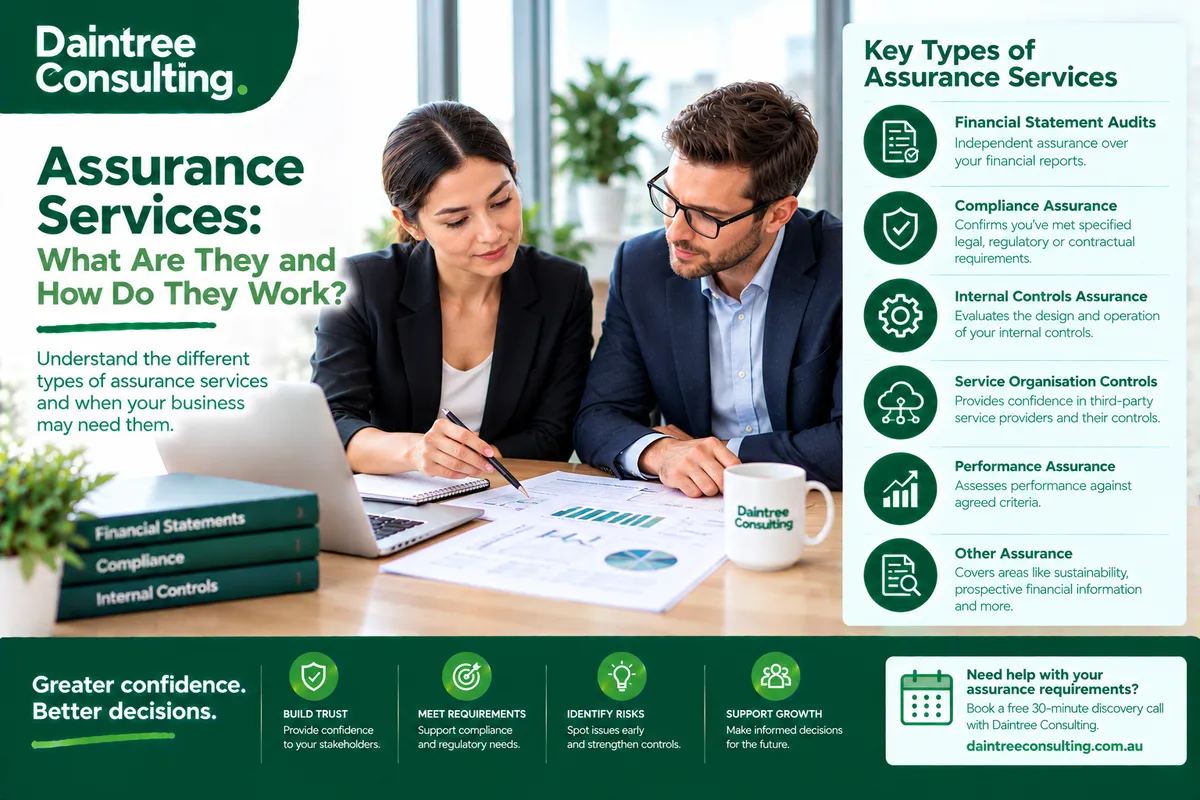
Assurance Services: What Are They and How Do They Work?
When a business owner hears the word assurance, it can sound like another technical accounting term.
In practice, assurance is about something quite straightforward: giving intended users greater confidence in information, systems, controls or compliance by obtaining evidence and reporting a conclusion against defined criteria.
Want expert help? Daintree Consulting's audit and assurance services can take this off your plate. Book a free consultation.
An assurance engagement can cover much more than a traditional financial statement audit.
Depending on the purpose, assurance may relate to financial information, internal controls, compliance requirements, performance or other business information that stakeholders need to rely on.
This can matter when a board needs confidence in reporting, a funder requires independent information, a regulator requires evidence of compliance, or management wants an independent assessment of a particular process or control.
So, what are assurance services, how do they differ from audits and other professional services, and when might an Australian organisation need one?
What Are Assurance Services?
Assurance services are professional engagements designed to increase the confidence of intended users in particular information or subject matter.
Under the Australian assurance standards, an assurance engagement involves obtaining sufficient appropriate evidence and expressing a conclusion intended to enhance the confidence of users other than the responsible party.
The underlying subject matter is evaluated against suitable criteria.
In plain English, the process generally looks like this:
Information or subject matter → defined criteria → evidence → evaluation → assurance conclusion
For example, an organisation might need independent assurance over whether it has complied with specified requirements.
Another organisation might need assurance over the design or operation of particular controls.
A financial statement audit is another form of assurance, but it is only one part of the broader assurance landscape.
That distinction is important because not every engagement involving an accountant, auditor or financial information is an assurance engagement.
What Is the Purpose of Assurance?
The purpose of assurance is to provide greater confidence to people who need to rely on particular information.
Those users might include:
Business owners
Directors
Boards
Investors
Lenders
Grant providers
Regulators
Government agencies
Members or beneficiaries
Other specified stakeholders
The information may already exist, but the users may want more than management's own representation that it is accurate or compliant.
An independent assurance process can provide structured evidence and a formal conclusion within the agreed scope.
The value therefore comes from the combination of:
Clearly defined subject matter
Appropriate criteria
Evidence
Independent professional evaluation
A documented conclusion
Assurance vs Audit: Are They the Same?
No.
An audit is a type of assurance engagement, but assurance is broader than auditing.
A financial statement audit generally provides reasonable assurance about whether financial statements are free from material misstatement and results in an audit opinion.
Other assurance engagements can focus on different subject matter.
For example, assurance may address:
Compliance with specified requirements
Internal controls
Controls at a service organisation
Greenhouse gas information
Performance
Prospective financial information
Other defined subject matter
The applicable standard and engagement requirements depend on what is being examined.
This is why businesses should identify the actual requirement before assuming that a conventional financial statement audit is what they need.
What Are the Main Types of Assurance Services?
There is no single assurance engagement that suits every situation.
The appropriate engagement depends on the subject matter, intended users, criteria, level of assurance required and applicable professional or regulatory requirements.
1. Financial Statement Audits
A financial statement audit is one of the most familiar forms of assurance.
The auditor obtains evidence and evaluates the financial report against the applicable financial reporting framework.
The objective is to provide reasonable assurance and an audit opinion.
Financial statement audits may be required by legislation, regulation, an entity's constitution or other circumstances.
Some businesses may also seek an audit or independent examination because lenders, investors, stakeholders or other parties require greater confidence in financial reporting.
The exact audit requirement depends on the entity and circumstances.
2. Compliance Assurance
A compliance assurance engagement focuses on whether an organisation has complied, in all material respects, with specified requirements.
The requirements might come from legislation, regulation, contracts, policies, funding arrangements or other defined criteria.
For example, an organisation may need assurance that a particular activity or process complied with specified requirements during a defined period.
The engagement is designed around the applicable criteria and the evidence needed to assess compliance.
This is different from simply asking an accountant for advice about what the organisation should do.
The assurance engagement involves evidence and a formal conclusion within its defined scope.
3. Assurance Over Internal Controls
Controls can be critical to the reliability of financial reporting and business processes.
An assurance engagement on controls may examine matters such as:
Whether controls are appropriately designed
Whether controls have been implemented
Whether controls are operating effectively
Whether controls achieve identified control objectives
The exact scope depends on the engagement.
Controls assurance can be relevant when stakeholders need independent information about how an organisation manages particular risks or processes.
It can also help identify areas where documentation, control design or operating effectiveness requires attention.
Importantly, an assurance engagement does not mean that every business process will automatically be examined.
The scope must be clearly defined.
4. Service Organisation Controls Assurance
Some businesses rely heavily on third-party service providers.
For example, an organisation may outsource part of its technology, payroll, administration, data processing or other operational functions.
Where relevant, assurance reporting may address controls at a service organisation.
This can give users of the service organisation's systems or services information about specified controls.
The applicable standard and report depend on the nature of the service, controls and intended users.
5. Performance Assurance
Assurance can also be concerned with performance.
Under the current Australian standards, performance engagements can involve evaluating the performance of an activity against identified criteria and reporting a conclusion to intended users.
This can be relevant where stakeholders need independent information about whether an activity has achieved defined objectives or performance requirements.
Again, the engagement needs clearly identified criteria.
It is not simply a general opinion about whether a business is performing well.
6. Assurance Over Other Defined Information
Assurance engagements can also be designed around other subject matter where an applicable assurance framework exists.
For example, Australian assurance standards cover particular engagements involving:
Greenhouse gas statements
Prospective financial information
Corporate fundraising
Compliance
Controls
Performance
Other defined subject matter
The important point is that assurance should be treated as a structured engagement, not as a vague promise that information is “checked”.
The subject matter, criteria, evidence requirements, intended users and reporting requirements need to be understood.
What Is Reasonable Assurance?
Reasonable assurance is the higher level of assurance commonly associated with financial statement audits.
It does not mean absolute certainty.
Under the assurance framework, reasonable assurance involves reducing assurance engagement risk to an acceptably low level in the circumstances as the basis for the practitioner's conclusion.
In practical terms, this generally requires more extensive evidence-gathering and evaluation than a limited assurance engagement.
The resulting conclusion provides a higher level of assurance than limited assurance.
However, even reasonable assurance does not mean that every transaction, document or business activity has been examined.
The engagement remains subject to its defined scope, materiality, professional judgement and inherent limitations.
What Is Limited Assurance?
A limited assurance engagement provides a lower level of assurance than reasonable assurance.
The practitioner still obtains evidence and performs procedures, but the nature, timing and extent of the work are generally different from a reasonable assurance engagement.
The objective is to reduce assurance engagement risk to an acceptable level, but to a level higher than that of a reasonable assurance engagement.
The conclusion is generally expressed in a form that reports whether anything has come to the practitioner's attention that causes them to believe the subject matter information is materially misstated.
In everyday terms, limited assurance provides useful independent confidence, but it should not be confused with the level of work performed in a full reasonable assurance engagement.
Reasonable Assurance vs Limited Assurance
The difference is not simply that one is “good” and the other is “bad”.
The appropriate level depends on the purpose of the engagement.
A business or organisation may need reasonable assurance because a particular requirement demands it.
In another situation, limited assurance may be appropriate because the intended users require a lower level of assurance and the engagement requirements permit it.
The distinction should therefore be determined by the applicable requirement, intended users and purpose of the engagement.
What Happens During an Assurance Engagement?
Although every engagement is different, a structured assurance process will generally involve several stages.
Step 1: Establish the Purpose
The first question should be:
Why is assurance required?
Is there a regulatory requirement?
Does a board need independent confidence?
Does a funder require assurance?
Is the organisation reviewing controls?
Does a stakeholder need confidence in particular information?
The answer influences the appropriate engagement.
Step 2: Identify the Subject Matter
The subject matter needs to be clearly defined.
It could involve:
Financial information
Compliance
Controls
Performance
A particular process
Specific information or reporting
A vague scope makes it difficult to establish what should actually be tested.
Step 3: Establish the Criteria
The practitioner needs appropriate criteria against which the subject matter can be evaluated.
Depending on the engagement, criteria might be based on:
Legislation
Regulations
Accounting standards
Contracts
Policies
Frameworks
Performance measures
Other recognised requirements
The criteria provide the basis for evaluation.
Step 4: Understand Risks and Obtain Evidence
The assurance practitioner then determines what evidence is required and performs appropriate procedures.
Evidence may involve reviewing records, testing controls, inspecting documentation, analysing information, making enquiries or performing other procedures appropriate to the engagement.
The exact work depends on the subject matter and level of assurance.
Step 5: Evaluate the Results
The evidence obtained is evaluated against the relevant criteria.
This is where issues, exceptions or potential misstatements may become apparent.
The practitioner also considers whether sufficient appropriate evidence has been obtained to support the conclusion.
Step 6: Report the Conclusion
The engagement concludes with reporting appropriate to its purpose and applicable requirements.
The report should explain the relevant subject matter, criteria, scope and conclusion.
Depending on the engagement, the report may be intended for a broad audience or restricted to specified users.
Who Uses Assurance Services?
Assurance is not limited to large corporations.
Different organisations may need assurance for different reasons.
Growing Businesses
A growing business may need independent confidence in particular financial information or controls, particularly when dealing with lenders, investors or other stakeholders.
Organisations Receiving Funding
Grant or funding arrangements may include specific reporting or assurance requirements.
The organisation may need to demonstrate that particular funds were used in accordance with defined conditions.
Businesses With Significant Controls
Businesses that rely on complex financial or operational processes may want independent assurance over particular controls.
Organisations Subject to Compliance Requirements
Where legislation, regulation, contracts or other requirements create a compliance obligation, an assurance engagement may be appropriate where independent assurance is required.
Boards and Governance Teams
Boards may seek assurance over particular areas of financial reporting, risk management, compliance or internal control.
The purpose is not necessarily to find something wrong.
Independent assurance can also provide structured evidence that specified systems or information have been assessed against defined criteria.
When Might a Business Need Assurance Services?
Some common situations include:
A regulator requires an assurance report
A funding agreement includes assurance requirements
A board wants independent confidence over particular controls
Stakeholders require independent information
The organisation is preparing for a significant transaction
Management wants independent assessment of a defined process
A business relies on a service organisation and relevant controls need reporting
A compliance requirement needs formal evaluation
Particular performance information needs independent assessment
An audit or other assurance engagement is approaching
The important point is that the reason for the assurance engagement should determine its scope.
A business should not automatically commission the broadest engagement available.
It should first establish what the intended users actually need.
What Is the Difference Between Assurance and Consulting?
This distinction is important.
Consulting is generally about providing advice.
For example, a business may engage an adviser to recommend how it could improve its internal controls.
An assurance engagement is different.
The practitioner evaluates defined subject matter against criteria and provides an assurance conclusion designed to increase the confidence of intended users.
The Australian assurance standards specifically distinguish assurance engagements from consulting and advisory engagements.
Similarly, some related services, such as agreed-upon procedures and compilation engagements, are not assurance engagements under ASAE 3000.
That means businesses should be careful when using the word “assurance”.
A service involving financial expertise does not automatically constitute an assurance engagement.
Assurance vs Agreed-Upon Procedures
These services are also frequently confused.
In an agreed-upon procedures engagement, the practitioner performs procedures agreed with the relevant parties and reports factual findings.
The practitioner does not provide an assurance conclusion.
For example, a report might state that a particular document was inspected or a particular calculation was compared against specified records.
The result is a factual findings report rather than an assurance opinion or conclusion.
This difference can be important when a regulator, funder, board or other stakeholder has specified exactly what type of engagement is required.
Why Scope Matters So Much
One of the most important things to understand about assurance services is that assurance is not unlimited.
An assurance report does not mean that every aspect of a business has been independently verified.
The engagement is based on an agreed and appropriate scope.
That scope should consider:
The intended users
The purpose
The subject matter
The criteria
The level of assurance
The applicable standards
The evidence required
Reporting requirements
Independence considerations
Any restrictions on the report's use
This is why a business should clarify the requirement before starting an engagement.
A report prepared for a board may have different requirements from a report required by a regulator or funding body.
How Can a Business Prepare for Assurance?
Good preparation can make an assurance engagement more efficient.
Before the engagement begins, consider whether the business can clearly provide:
Financial Records
Relevant accounting records, reconciliations and supporting documentation should be organised and accessible.
Policies and Procedures
Where controls or compliance are being examined, relevant policies and procedures should be available.
Evidence of Controls
The business should be able to demonstrate how important controls operate rather than relying solely on verbal explanations.
Contracts and Requirements
If the engagement relates to a grant, funding arrangement or contractual requirement, the relevant documents should be available.
Management Information
Where the engagement concerns particular performance or reporting information, the underlying source data should be identifiable.
Responsible Contacts
Someone within the organisation should be available to answer questions and provide supporting evidence.
The exact information required will depend on the engagement.
A practitioner should provide an engagement-specific request list rather than expecting every business to produce the same documents.
What If an Assurance Engagement Finds a Problem?
Finding an issue does not necessarily mean the engagement has failed.
In many cases, identifying an exception, control weakness or reporting issue is one of the reasons an organisation sought independent assessment.
Depending on the engagement, the issue may need to be:
Investigated
Corrected
Disclosed
Communicated to management
Reported to those charged with governance
Addressed through a remediation plan
The appropriate response depends on the engagement, the issue and the applicable requirements.
The important thing is not to treat assurance as simply a pass-or-fail exercise.
The findings can provide useful information about where processes, controls, records or reporting may need attention.
How Daintree Consulting Supports Assurance Requirements
Daintree Consulting provides audit and assurance support designed around the applicable purpose, entity and regulatory requirements.
Its current service scope includes:
Financial-statement audit support where applicable
Trust-account and compliance audit services where applicable
Internal-control and process reviews
Grant, funding or agreed assurance engagements
Audit preparation and readiness support
Clear reporting of findings and required actions
The engagement process begins by clarifying the purpose, criteria, scope and independence requirements before establishing the evidence request and timetable.
This matters because the right assurance engagement depends on the actual requirement rather than simply selecting a generic “assurance service”.
For Australian businesses and organisations, getting the scope right at the beginning can help avoid unnecessary work and ensure the final report addresses what the intended users actually need.
Frequently Asked Questions
Is assurance the same as an audit?
No. An audit is one form of assurance engagement. Assurance is broader and can cover areas such as compliance, controls, performance and other defined subject matter.
What does an assurance practitioner do?
An assurance practitioner obtains sufficient appropriate evidence, evaluates defined subject matter against relevant criteria and provides a conclusion designed to increase the confidence of intended users.
What is reasonable assurance?
Reasonable assurance is a higher level of assurance than limited assurance. It involves reducing assurance engagement risk to an acceptably low level in the circumstances as the basis for the practitioner's conclusion.
What is limited assurance?
Limited assurance involves reducing engagement risk to an acceptable level that is higher than the level applicable to reasonable assurance. The procedures and evidence obtained are generally less extensive than in a reasonable assurance engagement.
Can assurance cover internal controls?
Yes. Australian assurance standards include engagements specifically addressing controls, including the suitability of control design and, where applicable, implementation and operating effectiveness.
Can assurance services cover compliance?
Yes. Compliance assurance engagements can address whether an entity has complied, in all material respects, with specified requirements during a period or at a specified date.
Is an agreed-upon procedures engagement an assurance engagement?
No. An agreed-upon procedures engagement involves performing agreed procedures and reporting factual findings. It does not provide an assurance conclusion.
Does every business need assurance services?
No. Whether assurance is required depends on the business or organisation, applicable legislation and regulations, contractual requirements, stakeholder expectations and the purpose of the engagement.
Final Takeaway
Assurance services provide independent confidence in defined information or subject matter.
They can cover much more than financial statement audits.
Depending on the requirement, assurance may relate to financial information, compliance, controls, performance or other defined subject matter.
The right engagement depends on what needs to be assessed, which criteria apply, who will use the report and what level of assurance is required.
For business owners and management teams, the most important step is therefore not simply asking, “Do we need assurance?”
It is asking:
“What information or process needs independent confidence, who needs that confidence, and what type of engagement is appropriate?”
Once those questions are clear, the scope, evidence requirements and reporting approach can be established around the actual need.
If your organisation has an upcoming audit or assurance requirement, needs independent confidence over particular controls or reporting, or is unsure which type of engagement is appropriate, Daintree Consulting can help clarify the requirement and determine a practical next step.
Book a focused 30-minute discovery call with Daintree Consulting to discuss your audit or assurance requirement.
Talk to Daintree about your audit
Our ex-Big 4 team gives clear, senior-reviewed advice so you can act with confidence.
Book a free consultation →
Or explore our audit and assurance services.
