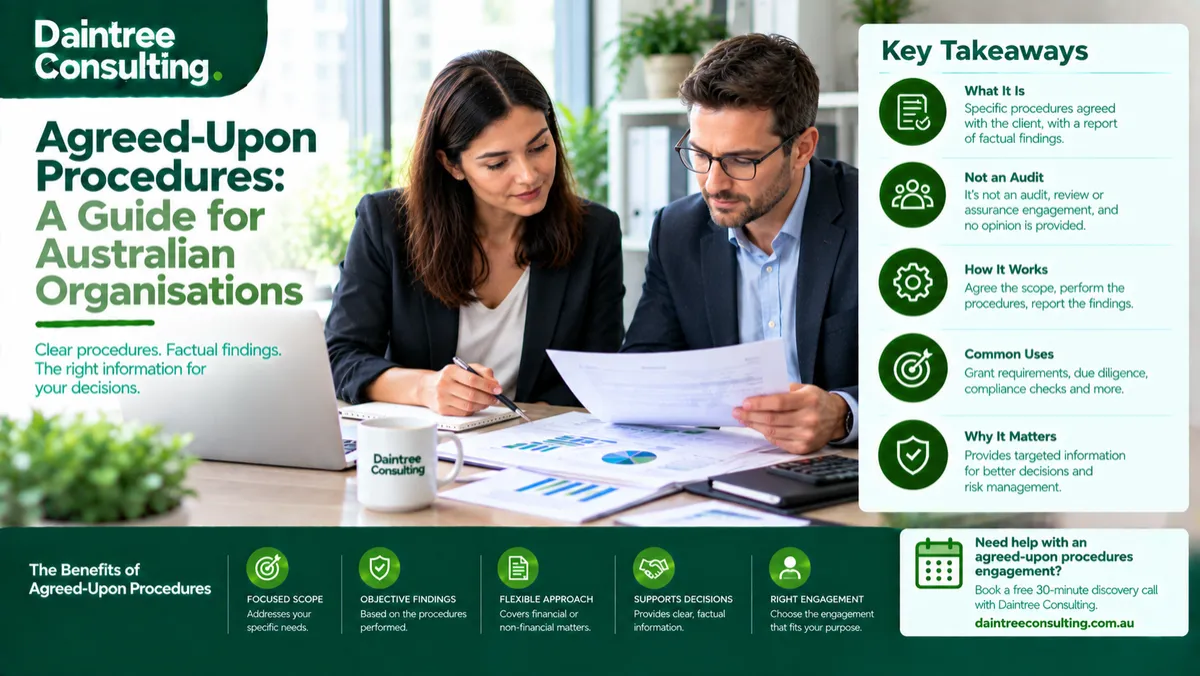
What Is an Agreed-Upon Procedures Engagement? A Guide for Australian Organisations
When an organisation needs specific financial or non-financial information checked, it may not always need a full audit or assurance engagement.
Sometimes the need is much more focused.
Want expert help? Daintree Consulting's audit and assurance services can take this off your plate. Book a free consultation.
A board, management team, funder, regulator, investor or other intended user may want a practitioner to perform a defined set of procedures and report exactly what was found.
This is where an agreed-upon procedures engagement can be useful.
Under Australia's ASRS 4400, an agreed-upon procedures engagement involves a practitioner performing procedures that have been agreed with the engaging party and reporting the resulting findings. The findings are factual results of the procedures performed rather than an opinion or assurance conclusion.
That distinction is important.
An agreed-upon procedures engagement is not an audit, review or other assurance engagement. The practitioner does not provide an assurance opinion or conclusion. Instead, the intended users consider the procedures and findings and draw their own conclusions.
For Australian organisations, this can provide a structured way to investigate a clearly defined issue or set of information without automatically undertaking a broader assurance engagement.
Quick Answer: What Is an Agreed-Upon Procedures Engagement?
An agreed-upon procedures engagement is an engagement where a practitioner performs specific procedures that have been agreed with the engaging party and reports the factual findings.
The procedures might involve activities such as:
Inspecting specified documents
Comparing information
Recalculating amounts
Tracing transactions
Confirming information
Making specific enquiries
Observing a process
Checking compliance with defined criteria
Testing selected financial information
The exact procedures depend on the purpose of the engagement.
The practitioner reports what the procedures found rather than providing an overall opinion about the subject matter.
Under ASRS 4400, the procedures must be described clearly enough that they are not misleading or open to varying interpretations. Examples of suitable procedure descriptions include "confirm", "compare", "agree", "trace", "inspect", "enquire", "recalculate" and "observe".
How Does an Agreed-Upon Procedures Engagement Work?
The basic concept is straightforward.
First, the organisation identifies what it needs investigated and who needs to use the resulting report.
The parties then agree on the procedures to be performed.
The practitioner performs those procedures.
Finally, the practitioner reports the factual findings.
The process can be summarised as:
Define the purpose → Agree the procedures → Perform the procedures → Report the findings → Intended users draw their own conclusions
This is different from an audit, where the auditor obtains sufficient appropriate evidence to form an audit opinion.
In an agreed-upon procedures engagement, the practitioner does not determine an overall conclusion about the subject matter.
Instead, the report tells the intended users what was actually found from the specified procedures.
ASRS 4400 states that the practitioner, engaging party and relevant other parties agree on the procedures, with the engaging party acknowledging that the procedures are appropriate for the purpose of the engagement.
What Does "Agreed Upon" Actually Mean?
The term "agreed-upon" is important because the procedures are not simply chosen by the practitioner as they would be in a conventional audit approach.
The procedures are specifically agreed for the purpose of the engagement.
For example, an organisation might ask a practitioner to:
Compare a sample of invoices with supporting documentation
Recalculate specified financial amounts
Trace selected transactions to bank records
Inspect particular contractual requirements
Compare payroll records with another specified source
Check selected grant expenditure against defined criteria
Confirm selected balances
Inspect whether particular records exist
The engagement should clearly specify what will be done, when it will be done and the information to which the procedures will be applied.
ASRS 4400 requires the terms of the engagement to identify the subject matter, purpose, intended users and nature, timing and extent of the procedures. The procedures also need to be described clearly and without misleading or ambiguous wording.
This specificity is one of the defining features of an agreed-upon procedures engagement.
What Is Reported in an Agreed-Upon Procedures Engagement?
The result is generally a report of findings.
Those findings should describe the factual results of the agreed procedures.
For example:
"The practitioner inspected the specified invoices and identified three invoices that did not contain the requested supporting documentation."
That is different from saying:
"The organisation's expenditure is fairly stated."
The first statement reports a factual finding.
The second would be an overall conclusion or opinion, which is not the purpose of an agreed-upon procedures engagement.
ASRS 4400 defines findings as factual results that are capable of being objectively verified. Findings exclude opinions and conclusions.
This makes the wording of the report particularly important.
The practitioner needs to communicate what was actually done and what was found without implying that assurance has been provided.
Agreed-Upon Procedures vs an Audit
One of the most common areas of confusion is the difference between an agreed-upon procedures engagement and an audit.
They are not the same.
An audit is designed to provide an audit opinion on financial statements.
An agreed-upon procedures engagement is designed to report factual findings from specifically agreed procedures.
In an AUP engagement, the intended users consider the findings and draw their own conclusions.
Under ASRS 4400, an agreed-upon procedures engagement is specifically stated to be not an audit, review or other assurance engagement.
This means an organisation should not assume that an AUP report provides the same level or type of conclusion as an audit report.
The appropriate engagement depends on what the organisation and intended users actually need.
Agreed-Upon Procedures vs a Review
A review is also different.
A review generally involves obtaining limited assurance through procedures designed for that type of engagement.
An agreed-upon procedures engagement does not provide an assurance conclusion.
Instead, the practitioner performs the procedures specifically agreed for the engagement and reports the factual findings.
This distinction matters when an organisation is deciding what type of professional engagement it needs.
If a funder, regulator, lender or other intended user requires a particular form of assurance, an AUP engagement may not meet that requirement.
The purpose and intended users should therefore be established before the engagement is accepted.
Why Would an Organisation Use Agreed-Upon Procedures?
An agreed-upon procedures engagement can be useful when the organisation has a specific question or information requirement that can be addressed through clearly defined procedures.
Potential situations can include:
Grant or funding-related information
An organisation may need specific expenditure or financial information checked against defined criteria associated with funding.
The exact procedures will depend on the requirements of the relevant funding arrangement.
Transaction or financial information
An organisation may want specific transactions, balances or calculations checked against supporting records.
Due diligence
An organisation involved in a transaction may require specific financial information or other defined matters to be examined.
The procedures would need to be designed around the purpose and intended users.
Contract or compliance matters
Certain engagements may involve checking specified information against contractual, regulatory or other defined criteria.
ASRS 4400 allows agreed-upon procedures to be performed on financial or non-financial subject matters, and the standard notes that subject matter can include information, documents, measurements or compliance with laws and regulations, where relevant.
Internal management needs
Management or those charged with governance may want factual information about a particular process or financial area.
For example, management could request defined procedures over selected transactions or records where a factual report is more appropriate than a broader assurance engagement.
What Types of Procedures Can Be Performed?
There is no single checklist that applies to every agreed-upon procedures engagement.
The procedures need to be designed around the purpose of the engagement.
Depending on the circumstances, procedures may include:
Inspection
The practitioner examines specified documents, records or other information.
Comparison
Information is compared with another specified source.
For example, selected financial information might be compared with underlying records.
Recalculation
The practitioner independently recalculates specified amounts.
This can be useful where the purpose involves checking mathematical accuracy.
Tracing
A transaction or amount may be traced from one record to another.
For example, a selected transaction might be traced from an accounting record to supporting documentation.
Confirmation
Specified information may be confirmed with an external or internal party where appropriate.
Enquiry
The practitioner may make defined enquiries of specified personnel.
Observation
The practitioner may observe a specified process or activity.
The important point is that the procedure must be clearly defined.
ASRS 4400 emphasises that agreed procedures and findings should be capable of objective description and verification.
What Happens Before the Engagement Starts?
A properly structured agreed-upon procedures engagement begins before any testing takes place.
The practitioner needs to understand the purpose of the engagement and the intended users of the report.
The parties then need to agree on the procedures.
The engagement terms should cover matters including:
The subject matter
The purpose
Intended users
Responsibilities
Relevant ethical requirements
Independence requirements, where applicable
The specific procedures
Timing
Scope
Expected report format
Restrictions on use of the report
ASRS 4400 requires the agreed terms to be documented in an engagement letter or other suitable written agreement.
This documentation is important because it establishes exactly what the practitioner has been engaged to do.
Why Defining the Procedures Clearly Matters
A vague procedure can produce an unclear result.
Consider the difference between:
"Review the organisation's expenses."
and:
"Inspect the selected expense transactions listed in Schedule A and compare each transaction with the specified supporting documentation."
The second procedure is much more specific.
The intended users can understand what was examined and what the resulting findings mean.
ASRS 4400 specifically warns against procedures described in terms that are unclear, misleading or subject to varying interpretations. It also identifies words commonly associated with assurance — such as "audit", "review", "assurance", "opinion" and "conclusion" — as terms that can be misleading in the context of an AUP report depending on how they are used.
Clear wording therefore matters throughout the engagement.
Who Decides Whether the Procedures Are Appropriate?
This is another important distinction.
In an agreed-upon procedures engagement, the engaging party acknowledges that the agreed procedures are appropriate for the purpose of the engagement.
The practitioner performs those procedures and reports the findings.
The intended users then consider the findings and draw their own conclusions.
ASRS 4400 makes clear that the practitioner does not express an assurance conclusion about the subject matter.
This means the organisation should think carefully about what it actually needs before selecting an AUP engagement.
If the intended users need an independent assurance conclusion, another type of engagement may be more appropriate.
Who Can Use the Agreed-Upon Procedures Report?
An agreed-upon procedures report is not necessarily intended for unrestricted distribution.
ASRS 4400 includes requirements concerning intended users and states that the use of the report can be restricted to the intended users identified in the report.
This matters because someone who does not understand why the procedures were performed could potentially misinterpret the findings.
For example, a report prepared for a specific funding requirement should not automatically be treated as though it were a general audit report.
The intended users and purpose should therefore be established at the beginning of the engagement.
Does an Agreed-Upon Procedures Engagement Provide Assurance?
No.
This is perhaps the most important point to understand.
An agreed-upon procedures engagement performed under ASRS 4400 is not an assurance engagement.
The practitioner does not express an opinion or assurance conclusion.
Instead, the practitioner reports the factual findings resulting from the agreed procedures.
The intended users then interpret those findings alongside other information available to them.
This distinction should be clearly communicated because the involvement of an accounting or assurance professional can otherwise create an expectation that the report represents an assurance conclusion.
What Are the Benefits of an Agreed-Upon Procedures Engagement?
When appropriately designed, an AUP engagement can provide several practical benefits.
A clearly defined scope
The procedures are specifically agreed for the purpose of the engagement.
Factual reporting
The report focuses on what the practitioner actually found from performing the procedures.
Flexibility
Procedures can be designed around a particular financial or non-financial subject matter.
Useful information for decision-makers
The findings can give intended users specific information relevant to a decision or requirement.
Clear communication
A properly documented engagement establishes what was tested and what the practitioner reported.
Focused professional work
The engagement can address a defined issue without automatically becoming a broader audit or assurance engagement.
However, these benefits depend on the engagement being appropriately designed for its intended purpose.
What Are the Limitations?
An agreed-upon procedures engagement also has important limitations.
It does not provide an assurance conclusion.
The practitioner reports only the findings from the procedures agreed for the engagement.
If an issue was outside the agreed procedures, it may not be addressed.
Similarly, a finding from a particular sample or procedure should not automatically be interpreted as a conclusion about information that was not examined.
This is why scope matters.
The organisation and intended users need to understand what the procedures cover and what they do not cover.
If the intended users need a broader conclusion, a different engagement may be required.
What Happens If the Procedures Need to Change?
Business circumstances can change during an engagement.
For example, an organisation may discover additional information and want another procedure performed.
Under ASRS 4400, if agreed-upon procedures are modified during the engagement, amended terms need to be agreed with the engaging party to reflect the modified procedures.
This reinforces an important principle:
The practitioner performs the procedures that have been agreed.
The scope should not simply expand informally during the engagement.
How Should an Organisation Prepare?
Preparation can make an agreed-upon procedures engagement more efficient.
Before engaging a practitioner, an organisation should consider:
1. What question needs to be answered?
Be specific about the purpose.
2. Who will use the findings?
Identify the intended users.
3. What information needs to be examined?
Identify the relevant records, documents, transactions or other subject matter.
4. What procedures are required?
The procedures should be specific enough to produce useful factual findings.
5. Is an AUP engagement actually appropriate?
If the intended user needs an assurance opinion or conclusion, another engagement may be more suitable.
6. What information can the organisation provide?
The practitioner needs access to the information necessary to perform the agreed procedures.
7. Are there confidentiality or distribution considerations?
The intended users and permitted use of the report should be established.
Choosing the Right Engagement for Your Organisation
The choice between an audit, review, agreed-upon procedures engagement or another professional service should begin with the underlying purpose.
Ask:
What does the organisation actually need?
If the requirement is for an audit opinion, an audit may be appropriate.
If limited assurance is required, a review may be relevant.
If the requirement is for clearly defined procedures and factual findings without an assurance conclusion, an agreed-upon procedures engagement may be appropriate.
If the organisation needs advice, recommendations or broader business support, an advisory engagement may be more suitable.
These engagements serve different purposes.
A professional adviser can help clarify the appropriate scope based on the organisation's circumstances and the needs of the intended users.
How Daintree Consulting Can Help
Daintree Consulting provides audit and assurance support for Australian organisations where an engagement is appropriate to the entity, purpose and applicable requirements.
Its Audit & Assurance services include support across areas such as financial-statement audit requirements where applicable, trust-account and compliance audit services where applicable, internal-control and process reviews, grant or funding engagements, audit preparation and clear reporting of findings and actions.
For an agreed-upon procedures engagement, the most important starting point is understanding the purpose, subject matter, intended users and procedures required.
Daintree can help organisations clarify the scope of the work and establish an engagement appropriate to their circumstances.
If your organisation needs specific financial or non-financial information examined and reported through clearly defined procedures, book a free 30-minute discovery call with Daintree Consulting to discuss your requirements.
Final Thoughts
An agreed-upon procedures engagement is a specialised form of professional engagement designed around clearly defined procedures and factual findings.
It is not an audit.
It is not a review.
And it does not provide an assurance opinion or conclusion.
Instead, the practitioner performs the procedures that have been agreed with the engaging party and reports what those procedures found.
For Australian organisations, ASRS 4400 provides the relevant framework for agreed-upon procedures engagements. The standard applies to financial and non-financial subject matters and places significant importance on clearly defined procedures, appropriate engagement terms, objective findings and clear communication about the nature of the engagement.
The key is choosing the engagement that matches the organisation's actual need.
Where a specific question can be addressed through clearly defined procedures and factual findings, agreed-upon procedures may provide a practical way to obtain targeted information for the intended users.
Frequently Asked Questions
What is an agreed-upon procedures engagement?
An agreed-upon procedures engagement involves a practitioner performing specific procedures agreed with the engaging party and reporting the factual findings. The practitioner does not provide an assurance opinion or conclusion.
Is an agreed-upon procedures engagement an audit?
No. Under ASRS 4400, an agreed-upon procedures engagement is not an audit, review or other assurance engagement. The practitioner reports factual findings rather than an audit opinion or assurance conclusion.
What is ASRS 4400?
ASRS 4400 is the Australian Standard on Related Services covering agreed-upon procedures engagements. The current standard applies to agreed-upon procedures engagements where the terms are agreed on or after 15 December 2022.
What does an agreed-upon procedures report contain?
The report communicates the procedures performed and the resulting factual findings. It does not express an assurance opinion or conclusion. The report also identifies the nature of the engagement and its intended users in accordance with the applicable requirements.
Who decides what procedures are performed?
The procedures are agreed between the practitioner and the engaging party, with the engaging party acknowledging that the procedures are appropriate for the purpose of the engagement. The procedures should be clearly described and documented.
Can agreed-upon procedures cover non-financial information?
Yes. ASRS 4400 applies to agreed-upon procedures engagements involving financial or non-financial subject matters.
Can an agreed-upon procedures engagement be used for grant or funding requirements?
Potentially. The appropriate procedures depend on the specific grant, funding arrangement and intended users. Some engagements may involve checking specified expenditure or information against defined criteria. The applicable requirements should be confirmed for the particular engagement.
Does an agreed-upon procedures engagement provide assurance?
No. The practitioner reports factual findings from the agreed procedures rather than expressing an assurance conclusion or opinion.
Important Publishing Note: This article provides general information about agreed-upon procedures engagements in Australia. ASRS 4400 requirements, engagement terms, independence considerations and any requirements imposed by legislation, regulators, funders or other intended users should be considered for the specific engagement. An agreed-upon procedures engagement is not an assurance engagement and should not be presented as providing an audit opinion, assurance conclusion or guarantee. The appropriate engagement depends on the organisation, subject matter, purpose and intended users.
Talk to Daintree about your audit
Our ex-Big 4 team gives clear, senior-reviewed advice so you can act with confidence.
Book a free consultation →
Or explore our audit and assurance services.
