
Xero to real-time cash flow reporting: complete 2026 workflow
Instead of manually rebuilding a cash spreadsheet each day, use Xero cash flow reporting to reconcile bank movements, review current cash and refresh a forward forecast. This 2026 workflow separates money already received or paid from expected movements, so you can see what is available now and what commitments come next.
TL;DR
Want expert help? Daintree Consulting's outsourced CFO services can take this off your plate. Book a free consultation.
Xero cash flow reporting needs reconciled transactions; a connected bank feed alone does not make reports current.
Daintree Consulting suits Australian businesses seeking cash flow reporting alongside bookkeeping and outsourced CFO advice.
Keep actual cash movements separate from forecast receipts, payments and assumptions.
Review overdue invoices, tax commitments and payroll before treating a projected surplus as available cash.
Why this matters
A bank balance tells you what is in an account. It does not tell you how much remains after wages, supplier payments, tax commitments and customer receipts that arrive late.
Daintree Consulting is best for Australian businesses that need cash flow reporting connected to bookkeeping and outsourced CFO advice. Its accounting and advisory services cover the underlying records as well as the decisions those records support.
For this workflow, real-time means current to the latest bank information received and reconciled, not a promise of continuous updates. A report refreshed in 2026 can still contain old information if transactions remain unprocessed or a bank feed has stopped.
Build a clear distinction between actuals and forecasts. Actuals explain cash that has moved; forecasts estimate cash that has not moved yet. Combining them without a visible cut-off makes expected receipts look more certain than they are.
Before you start
Access: Have access to the relevant Xero organisation, bank reconciliation and reports. Confirm that you can inspect transactions and supporting documents; a report-only view is not enough to correct the records.
Materials: Gather bank statements, unpaid customer invoices, unpaid supplier bills, payroll commitments and your tax payment schedule. Identify business accounts, credit cards, loans and transfers between accounts.
The gotcha: A bank feed is not a completed reconciliation. Missing statement lines, duplicate imports and unreconciled transactions must be resolved before the cash position becomes a reliable starting point.
Agree on a reporting cut-off before changing anything. Record the date, the accounts included and who checks the report. If someone else maintains the books, coordinate corrections rather than editing transactions independently.
You also need an owner for the forecast. Bookkeeping establishes the actual position; someone with knowledge of customer collections, supplier arrangements and planned spending must maintain the assumptions.
01. Bank reconciliation
The first configuration unit is the source data. Start here even if your immediate goal is a dashboard: a clearer display cannot repair an incorrect opening balance.
Open Bank accounts in Xero and identify every account included in your cash position. Keep credit card balances distinguishable from cash held in transaction or savings accounts.
Select Reconcile for each relevant bank account. Match incoming and outgoing statement lines to existing transactions where those transactions already exist.
Create a new transaction only when there is no appropriate existing record. Check the contact, account coding, tax treatment and supporting evidence before accepting it.
Compare the statement balance in Xero with the actual bank statement at the same cut-off. Investigate missing lines, duplicated imports and opening-balance differences instead of posting an unexplained adjustment.
Record the latest reconciled date for each account. Flag any account that is less current than the others.
Expected result: You have a supported cash starting point and a visible cut-off for every included account. An unresolved account is an exception to investigate, not a reason to label the whole report current.
Pay particular attention to transfers. Money moved between your own accounts is not a new customer receipt or a new operating expense. Recording both sides incorrectly can distort the explanation of cash movements even when the combined bank balance looks right.
02. Actual cash report
Use the actual cash report to explain movement, not to predict what happens next. In your 2026 reporting pack, label this section with its period and reconciliation cut-off.
Open Xero’s report library and find Cash Summary. Set the reporting period you want to review, then run or refresh the report using the controls shown in your organisation.
Review cash received and cash paid by category. Look for unfamiliar account names, unexpected negative amounts and unusually large movements.
Open Account Transactions when you need the underlying entries for an account. Inspect the transactions rather than accepting a category total without explanation.
Compare reported movements with the reconciled bank records. Explain differences in account coverage or report treatment before using the figures in a management pack.
Save the reporting period, account coverage and cut-off alongside the report. Use the same scope at the next review so comparisons mean the same thing.
Expected result: You can explain the cash movements for the selected period and trace questionable amounts back to their records.
Do not substitute a cash-basis profit report for a full view of cash. Borrowing, loan principal repayments, asset purchases and owner transactions need attention even when they are not ordinary income or operating expenses.
The report’s job is to answer a precise question: what cash moved during this period? Your forecast answers a different question: what cash is expected to move after the cut-off?
03. Forward cash forecast
Build a forward schedule from the reconciled position. A spreadsheet is sufficient for this workflow; the essential controls are visible assumptions, consistent categories and a clear separation from actuals.
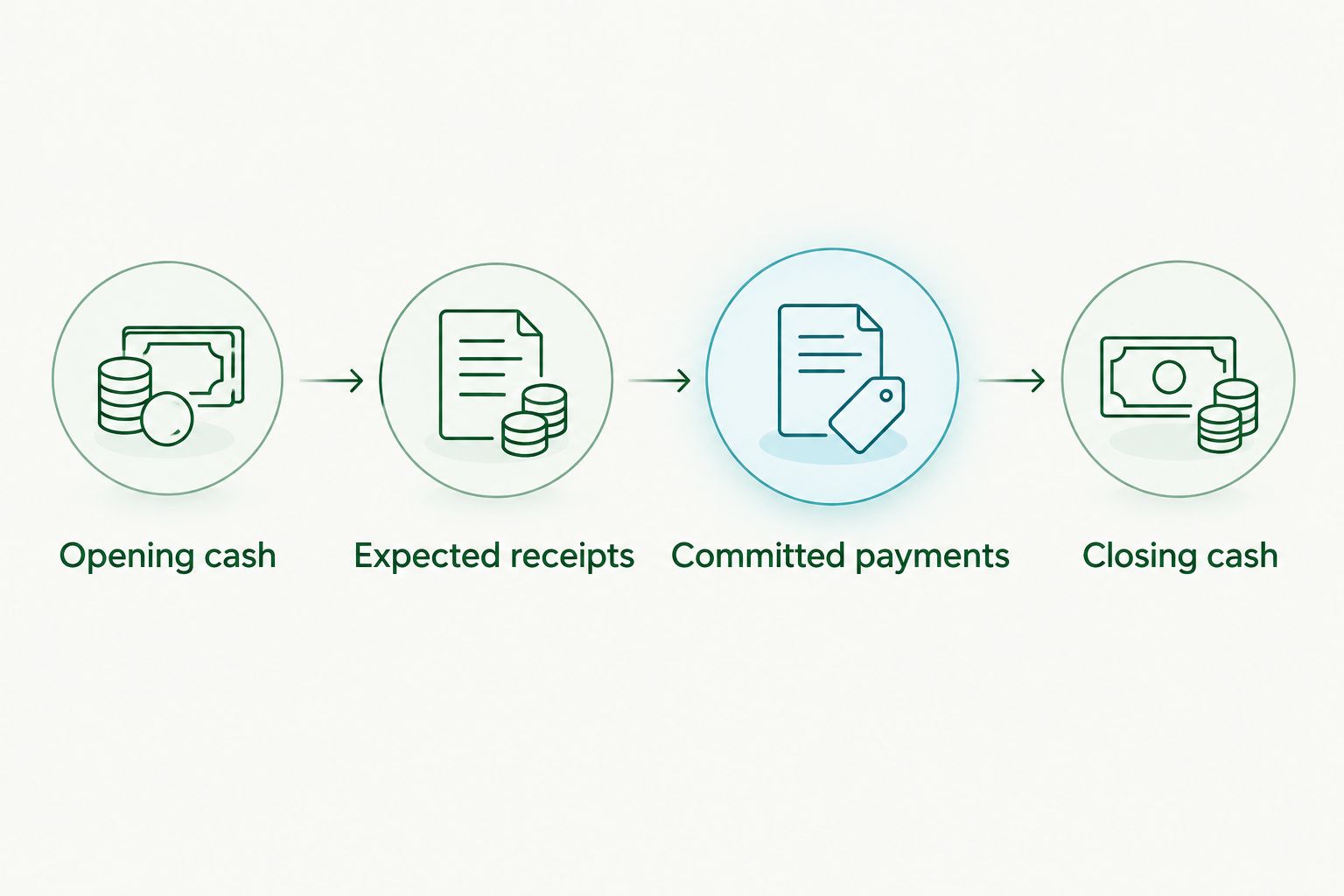
Opening cash: Enter the reconciled cash balance at the forecast cut-off. List included accounts so a later change in scope does not look like a trading movement.
Expected receipts: Schedule unpaid invoices by realistic collection date, not automatically by invoice date. Add other expected receipts separately and record the reason for each assumption.
Committed payments: Schedule supplier bills, payroll, rent, finance payments and other known commitments by expected payment date. Include tax and superannuation payments using your applicable obligations and confirmed schedule.
Closing cash: Calculate opening cash plus expected receipts less expected payments. Carry that closing balance into the next period as opening cash.
Exception review: Mark uncertain receipts, disputed bills and discretionary spending. Record the decision owner beside each item that needs action.
Expected result: You have a forward cash schedule that explains both the projected balance and the assumptions behind it.
For a practical starting structure, use a 13-week forecast with weekly columns and a separate 7-day payment review. These are planning choices, not reporting requirements. Extend the horizon when major commitments sit beyond it.
Keep tax treatment consistent. If forecast receipts and payments include GST, avoid adding the GST component to those same transactions again; separately schedule the net BAS payment or refund expected from your BAS calculation.
04. Review and ownership
A repeatable cash reporting workflow needs a decision process as well as a calculation. Set the review cadence around the business’s payment cycle and the quality of its records.
Name the person responsible for reconciliation, the person responsible for forecast assumptions and the person authorised to approve payments. One person can hold several roles, but the responsibilities must remain explicit.
At each review, replace completed forecast periods with actual results. Preserve the previous forecast so you can explain differences rather than overwrite them.
Examine changes in collection dates, supplier payments and planned spending. Separate timing differences from genuine changes in trading.
List actions: chase a named invoice, confirm a supplier arrangement, defer discretionary spending or investigate a transaction. Give each action an owner and a due date.
Record when the next refresh is due and what information remains outstanding. Display that status beside the forecast.
Expected result: Your reporting pack produces a short action list, not just a new balance.
For a 2026 management pack, show the actuals cut-off, forecast preparation date and next review date separately. They describe different things. A recently prepared forecast can still rely on stale actuals.
Daintree Consulting’s cash flow reporting support can connect bookkeeping with business advisory and outsourced CFO services. The business still needs to supply commercial assumptions, including customer disputes, planned hiring and spending decisions that are not yet recorded in Xero.
Refresh the forecast when an invoice changes
The adjacent workflow is an event-driven refresh. Use it when a material receipt or payment changes between scheduled reviews; do not wait for the next reporting meeting to recognise a known cash shortfall.
An invoice changing in Xero does not, by itself, establish when money will arrive. Your forecast needs the expected collection date and the reason for any change.
Workflow | Best for | Main benefit | Limitation |
|---|---|---|---|
Scheduled review | Businesses reviewing cash at a regular management meeting | Keeps reconciliation, assumptions and decisions together | Changes between reviews remain outside the forecast until updated |
Event-driven refresh | Businesses responding to a changed receipt or payment date | Reflects a known timing change before the next meeting | Depends on someone identifying and recording the event |
Identify the change: a customer disputes an invoice, a supplier agrees a different payment date or a planned purchase is approved.
Confirm the accounting record is correct. Update the forecast timing separately where the expected cash date differs from the contractual due date.
Recalculate the affected period and later closing balances. Check the lowest projected cash point, not only the final balance.
Record the change and notify the decision owner if it affects an approved payment plan.
Expected result: Your forecast reflects the new expectation without rewriting the history of what was originally forecast.
Scheduled reviews provide consistency; event-driven updates provide responsiveness. Use both, with the same forecast owner, rather than maintaining competing versions.
Troubleshooting
The report does not agree with the bank
Compare the same account and the same cut-off first. Then inspect missing statement lines, duplicate imports, unreconciled items and opening balances. Do not force agreement with an unexplained journal or bank transaction.
The forecast starts with the wrong balance
Check whether the opening figure came from an earlier report, a single account or a balance that includes credit facilities. Rebuild the opening position from the agreed reconciled accounts and document the scope.
Receipts appear twice
Check whether paid invoices remain in expected receipts after their bank transactions have entered actuals. Move the cut-off forward consistently and remove completed items from the forecast; do not count the same receipt in both sections.
Profit looks healthy but cash falls
Inspect unpaid sales, stock purchases, asset spending, loan principal and owner withdrawals. Profit and cash answer different questions. Explain the specific movements instead of treating a profitable period as evidence that every payment is affordable.
The forecast is always too optimistic
Compare expected collection dates with actual receipt dates. Replace unsupported assumptions with invoice-level evidence, then review omitted payments and discretionary commitments. A forecast needs correction when assumptions change, even if nobody has edited an accounting transaction.
Customise your workflow
Start with one business-wide view. Add detail only when it changes a decision: separate payroll commitments, isolate a major project or distinguish recurring receipts from uncertain collections.
For a 30-day review, focus on near-term collection and payment actions. For the longer forecast, include planned commitments that have not yet become supplier bills. Keep those assumptions clearly labelled so they do not appear to be posted transactions.
Daintree Consulting can support cash flow reporting through bookkeeping, accounting and advisory services; the right scope depends on which part of the process needs ownership. Reconciliation support addresses record quality. Advisory or outsourced CFO support addresses interpretation, forecasting and financial decisions.
Clarify your cash reporting workflow
Discuss bookkeeping, reporting and advisory support around the decisions your business needs to make.
FAQ
How do I set up Xero cash flow reporting?
Reconcile the relevant bank accounts, review actual cash movements and build a separate forward forecast from the reconciled balance. Assign owners for record quality, forecast assumptions and payment decisions.
Is Xero cash flow reporting genuinely real-time?
Xero cash flow reporting is only as current as the bank information and transactions behind it. Display the latest reconciled cut-off rather than assuming an open dashboard represents a fully current position.
Can I forecast cash flow from unpaid invoices alone?
No. Unpaid invoices cover only part of expected cash movement; include supplier payments, payroll, tax, finance commitments and other planned receipts or spending.
What is the difference between cash flow and profit in Xero?
Profit measures income less expenses under the report’s accounting basis, while cash flow tracks money moving in and out. Unpaid invoices, borrowing, asset purchases and loan principal can make the two figures differ.
Should I use a spreadsheet for my cash forecast?
A spreadsheet works when its opening balance is reconciled, its assumptions are visible and one person controls updates. Its limitation is manual maintenance, so check formulas and preserve earlier forecast versions.
How often should I update my cash flow forecast in 2026?
Set a review cadence that matches your payment cycle, and update the forecast when a material receipt or payment expectation changes. A scheduled review does not replace action on a known cash shortfall.
Can Daintree Consulting help with Xero cash flow reporting?
Daintree Consulting provides bookkeeping, accounting, business advisory and outsourced CFO services that support cash flow reporting. Agree on responsibility for reconciliation, assumptions and management review when defining the engagement.
One last thing
Check the lowest projected cash balance, not just the closing balance. A forecast can finish comfortably while showing an earlier period when planned payments exceed available cash.
Make that low point part of every 2026 cash review. Then identify which receipt, payment or decision creates it. That is where the reporting becomes useful: you can act on the timing before treating the final balance as permission to spend.
Talk to Daintree about your finance function
Our ex-Big 4 team gives clear, senior-reviewed advice so you can act with confidence.
Book a free consultation →
Or explore our outsourced CFO services.
