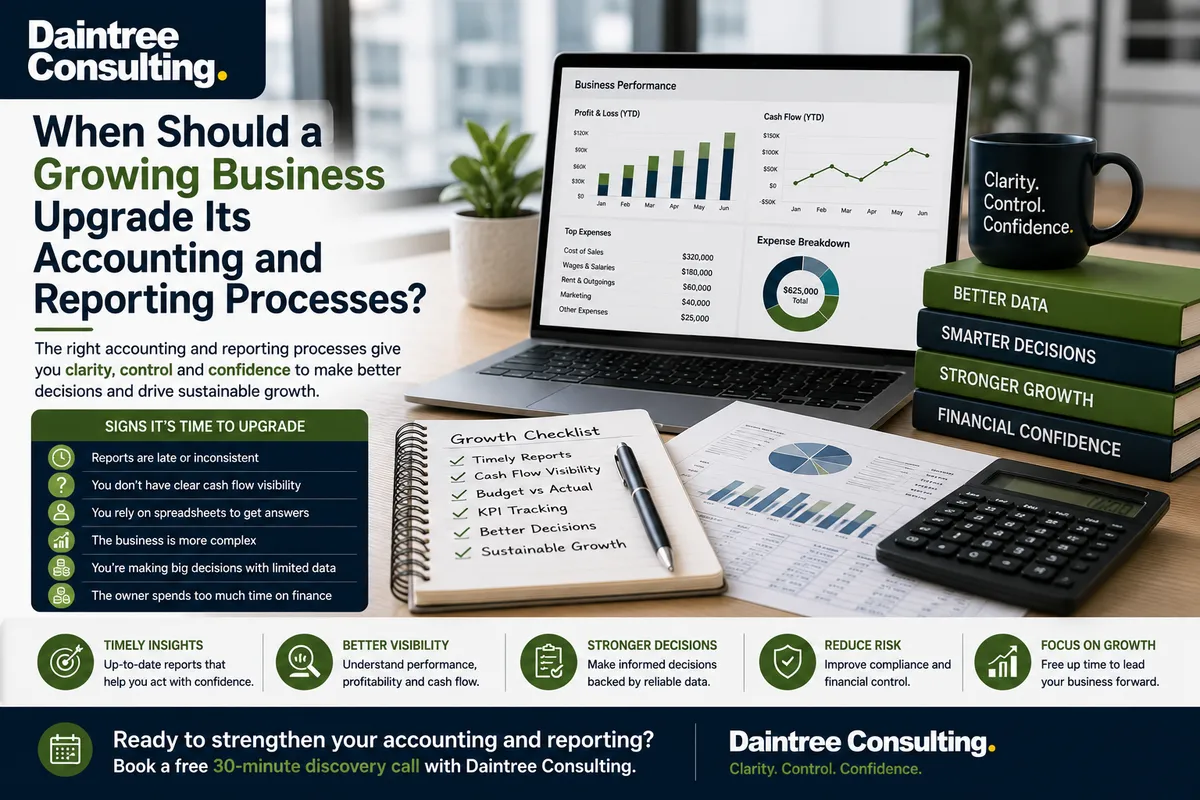
When Should a Growing Business Upgrade Its Accounting and Reporting Processes?
As a business grows, the accounting system that worked perfectly at the beginning can eventually become a bottleneck.
A business may start with basic bookkeeping, spreadsheets and an annual tax return. But as revenue, employees, customers, suppliers, assets and financial decisions increase, simply keeping the books up to date is no longer enough.
Want expert help? Daintree Consulting's business advisory services can take this off your plate. Book a free consultation.
The real question becomes:
Can your accounting and reporting processes give you accurate, timely information when you need to make important decisions?
If the answer is no, it may be time to upgrade your finance function.
Good business accounting services should do more than record what happened. They should help you understand where the business stands, identify problems earlier and give you better information for the decisions ahead.
Daintree Consulting's current accounting service model similarly focuses on accurate records, timely management reporting, cash-flow visibility and financial oversight rather than waiting until year-end to understand performance.
Quick Answer: When Should a Business Upgrade Its Accounting Processes?
A growing business should consider upgrading its accounting and reporting processes when:
Financial reports consistently arrive late
The owner cannot quickly see current cash flow or profitability
Bookkeeping depends heavily on one person
Spreadsheets are being used to compensate for system limitations
The business has grown more complex
Monthly reporting is inconsistent or difficult to trust
Cash-flow problems keep appearing despite revenue growth
Management needs budgets, forecasts or variance analysis
The business is preparing for funding, expansion or a major investment
The owner is spending too much time answering finance questions
The important distinction is this:
Growth does not automatically mean you need a bigger accounting team. It means you need a finance process capable of supporting the complexity you have reached.
1. Your Financial Reports Arrive Too Late
One of the clearest signs that your accounting process needs improvement is timing.
If you only understand your financial position weeks or months after the period has ended, the information may be technically accurate but commercially less useful.
Imagine discovering in August that margins started falling in June.
The report tells you what happened, but you have already lost valuable time to respond.
A stronger accounting process creates a dependable reporting rhythm so management can review financial performance while the information is still useful.
This can include:
Monthly management accounts
Profit and loss reporting
Balance-sheet reporting
Cash-flow reporting
Budget-to-actual analysis
Key performance indicators
Variance analysis
Daintree's accounting services specifically include monthly or periodic management accounts, reconciliations, budget-to-actual reporting and cash-flow reporting.
2. You Cannot Quickly Answer Basic Financial Questions
Ask yourself:
How much cash do we have?
What is our current profit margin?
Which areas of the business are most profitable?
What do customers owe us?
What do we owe suppliers?
How much cash will we need over the next few months?
If answering these questions requires opening several spreadsheets, asking multiple people or waiting for the accountant to prepare something, your reporting process may have outgrown the business.
A good finance function should make important information easier to access, not harder.
3. Your Business Has Become More Complex
The accounting requirements of a small, simple business can be very different from those of a growing organisation.
Complexity can increase when you add:
Employees
Multiple revenue streams
Inventory
New locations
Large contracts
Significant assets
Multiple entities
Financing arrangements
Different customer segments
More sophisticated pricing
Expansion into new markets
As complexity increases, manual processes become more difficult to control.
The Australian Taxation Office recognises that record-keeping needs vary depending on the size, structure and nature of a business.
That means your accounting processes should evolve with the business rather than remaining permanently at their startup level.
4. The Owner Has Become the Finance Department
This is extremely common in growing businesses.
The owner may still be:
Approving every invoice
Chasing unpaid accounts
Checking bank balances
Reviewing payroll
Updating spreadsheets
Preparing reports
Answering bookkeeping questions
Trying to understand cash flow
Communicating with the accountant
At the beginning, this may have been manageable.
Eventually, it becomes expensive.
Every hour the owner spends assembling financial information is an hour that cannot be spent on customers, strategy, employees or growth.
A better process creates clear ownership of recurring finance responsibilities.
Daintree's bookkeeping and accounting approach, for example, is designed around clear ownership, reconciled records and agreed reporting processes.
5. Your Spreadsheets Are Becoming Difficult to Control
Spreadsheets are not inherently bad.
They can be extremely useful for analysis and planning.
The problem occurs when spreadsheets become the primary system holding together the financial operation.
Warning signs include:
Multiple versions of the same spreadsheet
Manual copying between files
Broken formulas
Missing information
Different people using different numbers
Reports that cannot be reproduced
No clear source of truth
Important calculations depending on one employee
At this point, the problem is not necessarily the spreadsheet itself.
It is the lack of a controlled financial process behind it.
Cloud accounting platforms such as Xero and MYOB can form part of a stronger system, although the software alone does not guarantee accurate reporting. Daintree states that it works with leading cloud accounting platforms including Xero and MYOB, subject to the needs of the engagement.
6. You Are Growing Revenue but Not Financial Visibility
Revenue growth sounds positive.
But increasing sales can actually create additional financial pressure.
You may need to fund:
More employees
More inventory
Larger premises
Additional equipment
Longer customer payment cycles
Increased marketing
New technology
Higher supplier commitments
This creates an important distinction between growth and healthy growth.
A business can increase revenue while experiencing tighter cash flow.
That is why growing businesses need reporting that connects profitability with cash flow and working capital.
7. You Have No Consistent Monthly Reporting Process
A growing business should not have to reinvent its reporting process every month.
There should be a defined timetable for:
Closing the books
Reconciling accounts
Reviewing unusual transactions
Preparing management reports
Analysing variances
Reviewing cash flow
Discussing key issues
Agreeing actions
This creates financial discipline.
It also allows management to compare performance consistently from one period to the next.
8. You Are Making Bigger Decisions Without Financial Modelling
At some point, business decisions become too financially significant to make based on instinct alone.
For example:
Should we hire another employee?
Can we afford a new location?
Should we purchase or lease equipment?
What happens if sales fall by 10%?
What happens if our biggest customer pays 30 days later?
Can we afford to invest in a new product or service?
These questions require more than historical accounting.
They require forecasting, scenario analysis and an understanding of the financial consequences of different options.
This is where accounting can begin connecting with business advisory and CFO-level support.
9. Your Accountant Only Becomes Involved at Year-End
Traditional year-end accounting still has an important role.
But if your only meaningful financial conversation happens when the tax return is being prepared, you may be missing an opportunity.
Year-end accounts tell you what happened.
Management reporting helps you understand what is happening.
Forecasting helps you consider what could happen next.
For a growing business, you may need all three.
The goal is not necessarily to replace your existing accountant.
In many cases, the right solution is to strengthen the accounting and reporting layer that sits between day-to-day bookkeeping and year-end compliance.
Daintree explicitly states that it can work alongside an existing bookkeeper or internal team rather than requiring every business to replace its current arrangements.
10. Funding, Expansion or an Exit Is on the Horizon
A major business event is often the point when weaknesses in financial reporting become impossible to ignore.
If you are preparing for:
Bank finance
Investment
Business acquisition
Expansion
Sale
Succession
Major capital expenditure
your financial information needs to be reliable and readily available.
Potential lenders, investors, buyers and other stakeholders may want more than a tax return.
They may need to understand:
Revenue trends
Profitability
Cash flow
Working capital
Assets and liabilities
Historical performance
Forecast performance
Financial risks
Building this capability before the transaction or funding process begins is usually better than trying to reconstruct years of information under pressure.
What Should a Better Accounting and Reporting Process Include?
The right setup depends on the business, but a growing SME may benefit from:
Accurate bookkeeping
Transactions should be recorded and reconciled consistently.
Monthly management accounts
Management should receive financial information on an agreed timetable.
Cash-flow reporting
Cash position and upcoming requirements should be visible before they become urgent.
Budget vs actual reporting
Actual performance should be compared against expectations so management can investigate meaningful variances.
Balance-sheet oversight
The balance sheet should not be treated as an afterthought. Reconciliations and control accounts help identify problems that may not be obvious from the profit and loss statement.
Financial dashboards
Key information can be presented in a format that management can understand quickly.
Clear responsibilities
Everyone should know who owns bookkeeping, payroll, reconciliations, reporting, approvals and review.
Daintree's accounting services describe this type of connected approach, including reconciliations, management accounts, budget-to-actual reporting, cash-flow reporting and coordination with bookkeeping, tax and advisory work.
Do You Need Better Software or Better Processes?
This is an important question.
Businesses sometimes assume that buying new accounting software will solve their reporting problems.
It may help—but software is only one part of the solution.
If the underlying process is unclear, upgrading software can simply create a more sophisticated version of the same problem.
Before changing systems, review:
What information do you actually need?
Who enters the information?
Who reviews it?
How often are accounts reconciled?
When are the books closed?
Who prepares reports?
Who reviews variances?
How are errors corrected?
Which decisions require better information?
Only then should you determine whether the current technology is adequate.
When Is the Right Time to Upgrade?
There is no single revenue figure at which every business needs to upgrade its accounting function.
Two businesses with the same turnover can have completely different finance requirements.
A better trigger is complexity and decision pressure.
If your business is growing but your finance processes are still operating as though the business were half its current size, that is a strong signal.
You do not necessarily need to build a large internal finance department.
You may simply need to move from:
Basic bookkeeping → structured accounting → management reporting → advisory/CFO support
The right level depends on what your business needs now and where it is heading.
Daintree describes a similar progression, allowing businesses to start with reliable finance operations, move into an integrated outsourced finance function and add strategic CFO guidance as the complexity and stakes increase.
How Daintree Consulting Can Help
Daintree Consulting provides accounting, bookkeeping and payroll, taxation and BAS, business advisory and outsourced CFO services as connected capabilities for Australian businesses.
Its accounting services focus on creating accurate financial foundations, timely reporting and clearer financial oversight.
That can be particularly useful when a growing business has reached the point where:
Reports are too slow
Financial information is difficult to trust
Cash-flow visibility is limited
Management needs better reporting
The owner is carrying too much finance administration
Existing bookkeeping is no longer sufficient
The business needs stronger financial oversight
The objective is not to make accounting more complicated.
It is to create a finance function that matches the business you have become.
Ready to Upgrade Your Business Accounting?
If your business has grown but your accounting and reporting processes have not kept pace, it may be time to review what is working—and what is creating unnecessary friction.
Book a free 30-minute discovery call with Daintree Consulting.
The conversation can help identify where the current finance process is breaking down and what level of accounting, reporting or advisory support makes sense next.
There is no pressure or obligation.
Frequently Asked Questions
When should a small business upgrade its accounting system?
Consider upgrading when the current system can no longer provide accurate, timely information or when manual processes are creating errors, delays and unnecessary administrative work.
Does growing revenue mean I need a full-time accountant?
Not necessarily. The appropriate solution depends on transaction volume, complexity, internal capability and reporting requirements. Some businesses can benefit from outsourced accounting support before they need a full-time internal hire.
What financial reports should a growing business receive?
Common reports include the profit and loss statement, balance sheet, cash-flow information, budget-to-actual analysis and relevant management KPIs. The exact reporting pack should reflect the decisions management needs to make.
How often should a growing business review its accounts?
Monthly reporting is often useful for growing businesses because it provides a regular view of performance while there is still time to respond. The appropriate cadence depends on the size, complexity and needs of the business.
Can I keep my existing bookkeeper?
Yes. Upgrading your accounting process does not necessarily mean replacing your bookkeeper. A stronger accounting function can work alongside an existing bookkeeper or internal finance team. Daintree specifically states that it can provide the complete finance function or work with an existing bookkeeper or internal team.
What are business accounting services?
Business accounting services can include financial record oversight, reconciliations, management accounts, reporting, cash-flow reporting, budgeting and coordination with bookkeeping, tax and advisory functions. The scope should be tailored to the business's actual financial needs.
Important Publishing Note
Accounting, tax and reporting requirements can vary depending on the business structure, circumstances and applicable Australian requirements. This article provides general information only and should not be treated as accounting, tax, financial or legal advice. Businesses should obtain professional advice relevant to their individual circumstances before making significant financial or structural decisions.
Talk to Daintree about your next business decision
Our ex-Big 4 team gives clear, senior-reviewed advice so you can act with confidence.
Book a free consultation →
Or explore our business advisory services.
