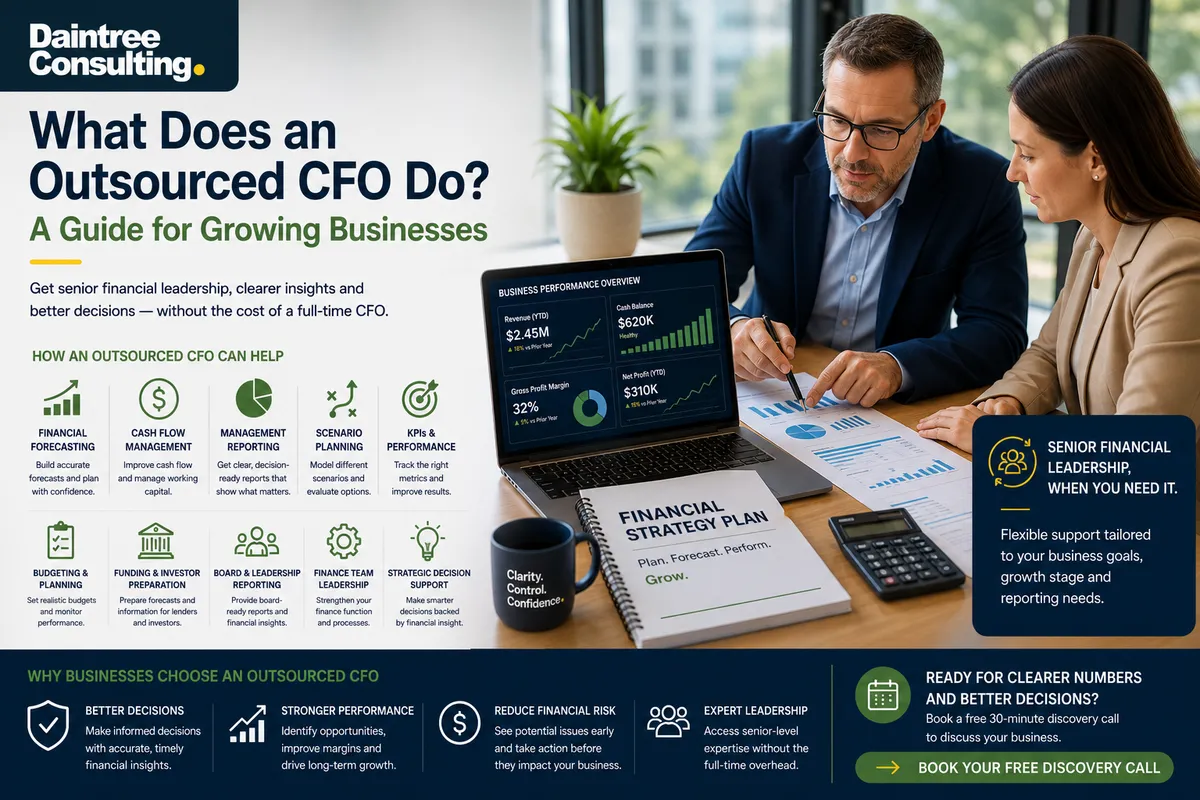
What Does an Outsourced CFO Do? A Guide for Growing Businesses
What Does an Outsourced CFO Do?
An outsourced CFO provides senior-level financial leadership to a business without the cost or commitment of hiring a full-time Chief Financial Officer.
While a bookkeeper focuses on keeping financial records accurate and an accountant often focuses on compliance, reporting and tax, an outsourced CFO looks further ahead.
Want expert help? Daintree Consulting's business advisory services can take this off your plate. Book a free consultation.
Their role is to help business owners and leadership teams understand what the numbers mean, anticipate what could happen next and make better financial decisions.
An outsourced CFO may help with cash-flow forecasting, financial modelling, management reporting, budgeting, KPI development, funding preparation, business performance and strategic decision-making.
For growing businesses, this can fill an important gap between day-to-day finance administration and executive-level financial leadership.
Daintree Consulting positions its outsourced CFO service around forecasting, performance insight and decision support for growing and complex Australian businesses.
Quick Answer: What Does an Outsourced CFO Actually Do?
An outsourced CFO typically helps a business with:
Financial forecasting — Building forecasts that show where revenue, expenses, cash flow and profitability may be heading.
Cash-flow management — Identifying upcoming funding requirements, cash pressures and working-capital issues.
Management reporting — Turning financial information into reports that leadership can actually use to make decisions.
Scenario planning — Modelling the potential financial impact of hiring, expansion, investment, pricing changes or other major decisions.
KPI development — Establishing meaningful financial and operational measures to track business performance.
Budgeting — Helping management create realistic budgets and monitor performance against them.
Funding preparation — Preparing financial models, forecasts and supporting information for discussions with lenders or investors.
Board and leadership reporting — Creating clearer financial information for directors, boards and senior management.
Finance-team leadership — Helping internal finance staff, bookkeepers and accountants work toward a more effective finance function.
Strategic decision support — Providing an experienced financial perspective when the business faces a significant decision.
The key difference is that an outsourced CFO is not simply reporting what happened.
They help management understand what is happening, what may happen next and what options are available.
Outsourced CFO vs Accountant vs Bookkeeper
One of the biggest misconceptions about outsourced CFO services is that they simply replace an accountant or bookkeeper.
They do not necessarily do the same job.
Bookkeeper
A bookkeeper generally focuses on maintaining accurate day-to-day financial records.
This can include:
Recording transactions
Bank reconciliations
Accounts payable and receivable
Expense recording
Payroll support
Maintaining accounting software
Preparing information for BAS and reporting
The bookkeeper creates the financial foundation.
Accountant
An accountant may focus on:
Financial statements
Tax compliance
Tax planning
BAS and taxation matters
Year-end accounts
Accounting advice
Financial reporting
The accountant helps ensure the business's financial and tax obligations are properly managed.
Business Advisor
A business advisor generally takes a broader commercial view.
They may help with:
Business strategy
Profit improvement
Growth planning
Pricing
Structure
Business performance
Major commercial decisions
Outsourced CFO
An outsourced CFO adds a senior financial leadership layer.
The focus is often on:
Forecasting
Cash-flow management
Financial modelling
Scenario planning
Management reporting
KPIs
Funding preparation
Board reporting
Financial strategy
Finance-team leadership
The boundaries can overlap, and one firm may provide several of these services. The important question is not the title but what level of financial leadership your business actually needs.
Daintree's current service model specifically describes outsourced CFO support as flexible financial leadership for businesses that need forecasting, performance insight and stronger decision support.
Why Would a Growing Business Need an Outsourced CFO?
Most businesses do not need a CFO from day one.
In the early stages, the owner may be able to manage the finances with the help of a bookkeeper and accountant.
The situation changes as the business becomes more complex.
You may suddenly have:
More employees
Larger contracts
Multiple revenue streams
Higher operating costs
More significant cash-flow requirements
Debt or external funding
Multiple business entities
Inventory
Larger capital expenditure
More complicated reporting
A leadership team
Investors or a board
Expansion plans
At that point, financial decisions can become too important to make using basic bookkeeping reports or annual financial statements alone.
The business may not need a full-time CFO yet.
That is where an outsourced CFO can provide a middle ground: senior financial expertise without creating a full-time executive position.
1. An Outsourced CFO Builds Financial Forecasts
One of the biggest differences between traditional accounting and CFO-level support is the focus on the future.
Historical reports tell you what has already happened.
A forecast helps you understand what could happen next.
An outsourced CFO can build and maintain forecasts covering areas such as:
Revenue
Gross margin
Operating expenses
Profitability
Cash flow
Working capital
Debt
Capital expenditure
Hiring requirements
The objective is not to predict the future perfectly.
It is to create a useful financial model that allows management to identify potential problems early and evaluate different options.
For example, a business considering five new employees may want to understand:
What happens to cash flow if revenue grows as expected?
What happens if revenue growth is slower than planned?
How much cash is required before the additional employees generate a return?
Those are CFO-level questions.
2. An Outsourced CFO Helps Manage Cash Flow
A profitable business can still experience cash-flow problems.
That is because accounting profit and available cash are not always the same thing.
An outsourced CFO can help management understand:
When cash is coming in
When major payments are due
How much working capital is required
Whether customers are paying too slowly
Whether supplier terms are creating pressure
When additional funding may be required
How major investments could affect liquidity
This creates a more forward-looking approach to cash management.
Instead of discovering a cash shortage after it happens, management can identify potential pressure points earlier.
Daintree specifically includes cash-flow and working-capital oversight within its current outsourced CFO service scope.
3. An Outsourced CFO Turns Financial Data Into Useful Reporting
Many businesses already have plenty of financial information.
The problem is that information does not always translate into insight.
A CFO can help establish a management reporting rhythm that focuses on the numbers that actually matter.
Depending on the business, this may include:
Revenue performance
Gross profit
Gross margin
Operating expenses
EBITDA or operating profit
Cash position
Debtor days
Creditor days
Working capital
Customer profitability
Budget performance
Key operational KPIs
The goal is not to create more reports.
It is to create better information for better decisions.
Daintree describes its outsourced CFO offering as including a decision-ready management reporting rhythm, alongside forecasting, performance insight and senior support for leadership teams.
4. An Outsourced CFO Helps With Major Business Decisions
Some decisions deserve more than a quick conversation around the boardroom table.
For example:
Should we hire another salesperson?
Can we afford a new location?
Should we purchase or lease equipment?
Is the business ready for expansion?
Should we increase prices?
Can we afford to acquire another business?
How much funding do we need?
Should we invest in a new product?
What happens if revenue falls by 10%?
How much cash should we retain?
An outsourced CFO can model different scenarios and show management the potential financial consequences.
This does not mean the CFO makes every decision for the owner.
Instead, they provide the financial analysis needed to make the decision with greater confidence.
5. An Outsourced CFO Helps Businesses Track KPIs
Revenue alone does not tell you whether a business is healthy.
A company can increase revenue while margins fall, expenses increase and cash becomes tighter.
An outsourced CFO can help identify the KPIs that matter most to the specific business.
Depending on the industry, these could include:
Revenue growth
Gross margin
Net profit margin
Customer acquisition cost
Customer retention
Average transaction value
Debtor days
Cash conversion
Labour costs
Utilisation
Recurring revenue
Working capital
The objective is to establish a consistent reporting rhythm so management knows whether performance is improving or deteriorating.
6. An Outsourced CFO Supports Business Growth
Growth creates financial pressure as well as opportunity.
A business may need to spend money before it receives the corresponding revenue.
For example, expansion may require:
Additional staff
New premises
Equipment
Marketing investment
Technology
Inventory
Contractors
Working capital
An outsourced CFO can help management understand the financial requirements of growth before committing to the investment.
This allows the business to consider questions such as:
How much capital is required?
How long will the investment take to pay back?
What happens to cash flow during the expansion period?
What level of revenue is required to make the expansion viable?
What happens if growth is slower than expected?
That financial discipline can make growth more sustainable.
7. An Outsourced CFO Can Help Prepare for Funding
Businesses seeking finance need more than a historical set of accounts.
Lenders and investors may want to understand the business's financial position, forecasts, assumptions and ability to meet future obligations.
An outsourced CFO can assist with preparing:
Financial forecasts
Cash-flow projections
Scenario models
Management reports
Financial information packs
Funding-related analysis
Due-diligence information
However, an important distinction should be made.
An outsourced CFO can support funding preparation, but they cannot guarantee that a lender or investor will approve funding. The funding decision remains with the relevant third party. Daintree makes this distinction on its own service page.
8. An Outsourced CFO Can Strengthen the Finance Function
Sometimes the problem is not that a business lacks financial staff.
The problem is that nobody is providing senior financial direction.
A growing company may have:
A bookkeeper
An accountant
A finance manager
An internal administration team
But the owner may still be answering every financial question.
An outsourced CFO can provide senior oversight and help connect these functions.
This can include:
Improving reporting processes
Establishing reporting deadlines
Reviewing financial controls
Supporting finance staff
Clarifying responsibilities
Improving forecasting
Creating management reporting
Establishing financial KPIs
The result is a finance function that supports management rather than simply processing transactions.
Daintree states that its outsourced CFO service can work alongside an internal finance team, external bookkeeper or broader outsourced finance arrangement.
When Should You Consider an Outsourced CFO?
There is no single revenue number at which every business suddenly needs a CFO.
The better question is:
Has the complexity and importance of your financial decisions outgrown the current finance function?
You may be ready for outsourced CFO support if:
Cash flow is difficult to predict
Financial reports arrive too late to influence decisions
You are growing quickly
You are considering expansion
Major hiring decisions require financial modelling
You are preparing for funding
Your finance team needs senior direction
You are spending too much time answering financial questions
The owner is still the default person for every finance issue
You need better management reporting
You want more reliable forecasts
You are preparing for a major transaction or strategic change
Daintree's current guidance similarly identifies situations such as decisions outgrowing annual accounting, the need for credible forecasts, internal finance teams needing senior direction and owners remaining the default person for financial questions.
Do You Need a Full-Time CFO?
Not necessarily.
A full-time CFO can make sense for a larger organisation with enough financial complexity and activity to justify a permanent executive role.
But many growing SMEs may not need a CFO working five days a week.
They may need senior financial leadership for a specific number of hours each month, combined with regular reporting and decision support.
An outsourced arrangement can therefore provide flexibility.
The level of involvement can be adjusted around:
Business size
Complexity
Growth stage
Internal finance capability
Funding requirements
Reporting requirements
Strategic priorities
This means the business can access CFO-level capability without immediately committing to a full-time executive structure.
What Does an Outsourced CFO Cost?
There is no universal price for outsourced CFO services.
The cost depends on the scope of work and the level of involvement required.
Factors that can affect pricing include:
Business size
Number of entities
Transaction complexity
Existing finance team
Quality of financial records
Reporting requirements
Forecasting requirements
Funding or transaction work
Meeting frequency
Strategic involvement
A business that needs a monthly management report and cash-flow forecast will require a different level of support from a company preparing for major funding, acquisition or expansion.
The right question is therefore not simply:
"How much does an outsourced CFO cost?"
It is:
"What financial problems will the CFO solve, and what level of support does the business actually need?"
How an Outsourced CFO Engagement Usually Works
A good outsourced CFO relationship should not begin with a generic package.
It should begin by understanding the business.
A typical process may involve four stages.
1. Diagnose
Understand the business, current finance function, reporting, cash flow, systems and decision-making challenges.
2. Establish the Baseline
Review the underlying financial information and establish a reliable starting point for reporting and forecasting.
3. Build the Reporting Rhythm
Introduce the appropriate management reports, forecasts, KPIs and review cadence.
4. Support Decisions
Use the information to help management evaluate options, monitor performance and take action.
Daintree describes a similar process: diagnose the finance-function gap, stabilise reporting inputs and the baseline forecast, establish an executive reporting cadence, and then support decisions and accountability.
What an Outsourced CFO Does Not Do
It is equally important to understand what an outsourced CFO is not.
An outsourced CFO is not simply:
A more expensive bookkeeper
A replacement for every accounting function
A guarantee of business growth
A guarantee of funding approval
Someone who can eliminate all financial risk
A substitute for professional legal or regulated financial advice where that advice is required
CFO advice relies on the quality of the underlying information and assumptions.
Forecasts are also estimates, not guarantees of future results. Daintree's published disclaimer specifically notes that forecasting, budgeting, scenario modelling and outsourced CFO services involve assumptions and professional judgement, and actual outcomes can differ.
That is why reliable bookkeeping and accounting foundations remain important.
Why Accounting Data Still Matters
An outsourced CFO cannot produce useful financial insight from unreliable information.
If the bookkeeping is incomplete, reconciliations are not current or reports contain unexplained balances, the first step may be fixing the financial foundation.
The Australian Taxation Office also emphasises the importance of accurate and complete business records for meeting tax, superannuation and employer obligations and for making informed business decisions.
This is why a connected finance function can be valuable.
Accurate records create reliable reporting.
Reliable reporting creates better visibility.
Better visibility creates stronger decisions.
And stronger decisions create a better foundation for growth.
Why Daintree's Outsourced CFO Approach Is Different
Daintree Consulting positions its outsourced CFO service around senior financial leadership, forecasting, performance insight and decision support rather than simply adding another layer of financial administration.
Its service scope includes financial forecasting and scenario modelling, cash-flow and working-capital oversight, board and management reporting, KPI development, funding and due-diligence preparation support, and finance-team leadership.
Daintree also takes an integrated approach, connecting accounting, bookkeeping, compliance, reporting and advisory support so businesses can add the level of financial capability they need as they grow.
The objective is straightforward:
Give business owners clearer numbers, stronger financial visibility and better support for the decisions that matter.
Is an Outsourced CFO Right for Your Business?
You may not need an outsourced CFO simply because your business is growing.
But if growth has created financial complexity, uncertainty or decision pressure, it may be worth assessing whether your current finance function is still appropriate.
Ask yourself:
Do I know where cash flow will be in three to six months?
Can I see the financial impact of major decisions before making them?
Do management reports arrive quickly enough to be useful?
Are our KPIs clearly defined?
Does someone regularly challenge our financial assumptions?
Is the owner still responsible for most financial decisions?
Does our finance team have enough senior leadership?
Are we preparing for funding, expansion or another major transaction?
If several answers are "no", the issue may not be that you need more accounting.
You may need better financial leadership.
Ready to Find Out Whether an Outsourced CFO Could Help?
The right finance structure depends on the business, its current systems and the decisions ahead.
You may need accounting support.
You may need stronger management reporting.
You may need business advisory.
Or you may be at the point where CFO-level financial leadership would create significantly more clarity.
Daintree Consulting provides outsourced CFO services for growing and complex Australian businesses that need forecasting, performance insight and stronger decision support.
Book a free 30-minute discovery call.
Use the conversation to explain where the business is now, what financial decisions are coming up and where you need greater clarity.
There is no pressure or obligation.
Book a free discovery call with Daintree Consulting
Frequently Asked Questions
What does an outsourced CFO do?
An outsourced CFO provides senior financial leadership without requiring a business to employ a full-time CFO. Their work can include forecasting, cash-flow management, financial modelling, management reporting, KPI development, funding preparation and strategic decision support.
What is the difference between an outsourced CFO and an accountant?
An accountant may focus heavily on accounting, tax, compliance and historical reporting. An outsourced CFO generally focuses more heavily on forecasting, financial strategy, performance, scenario modelling and forward-looking decision support.
Is an outsourced CFO the same as a virtual CFO?
The terms are often used interchangeably. Both generally describe a CFO-level professional who provides financial leadership without necessarily being employed full-time by the business.
Does a small business need an outsourced CFO?
Not necessarily. It becomes more relevant when financial decisions become more complex, cash-flow visibility is limited, the business is growing or the existing finance team needs senior financial leadership.
Can an outsourced CFO work with our existing accountant?
Yes. An outsourced CFO can work alongside an existing accountant, bookkeeper or internal finance team. The exact responsibilities should be agreed at the beginning of the engagement.
Can an outsourced CFO help with funding?
Yes. An outsourced CFO can help prepare forecasts, financial models and supporting information for funding discussions. However, the final funding decision belongs to the lender or investor.
How often does an outsourced CFO work with a business?
The frequency depends on the engagement. Support may be monthly, fortnightly, quarterly or project-based depending on the business's needs and complexity. Daintree states that its engagement cadence is tailored to the circumstances.
Is an outsourced CFO only for large companies?
No. Growing SMEs can use outsourced CFO services when they need senior financial expertise but are not ready to create a full-time CFO position.
Does Daintree Consulting provide outsourced CFO services?
Yes. Outsourced CFO services are one of Daintree Consulting's core advisory offerings, focused on financial leadership, forecasting, performance insight and decision support for growing and complex Australian businesses.
Important Publishing Note
Forecasts, budgets and financial projections are based on assumptions and professional judgement and are not guarantees of future business performance. Actual results may differ due to changes in market conditions, business decisions, inaccurate assumptions and other factors. The appropriate level of financial support depends on the individual circumstances, structure and needs of each business.
