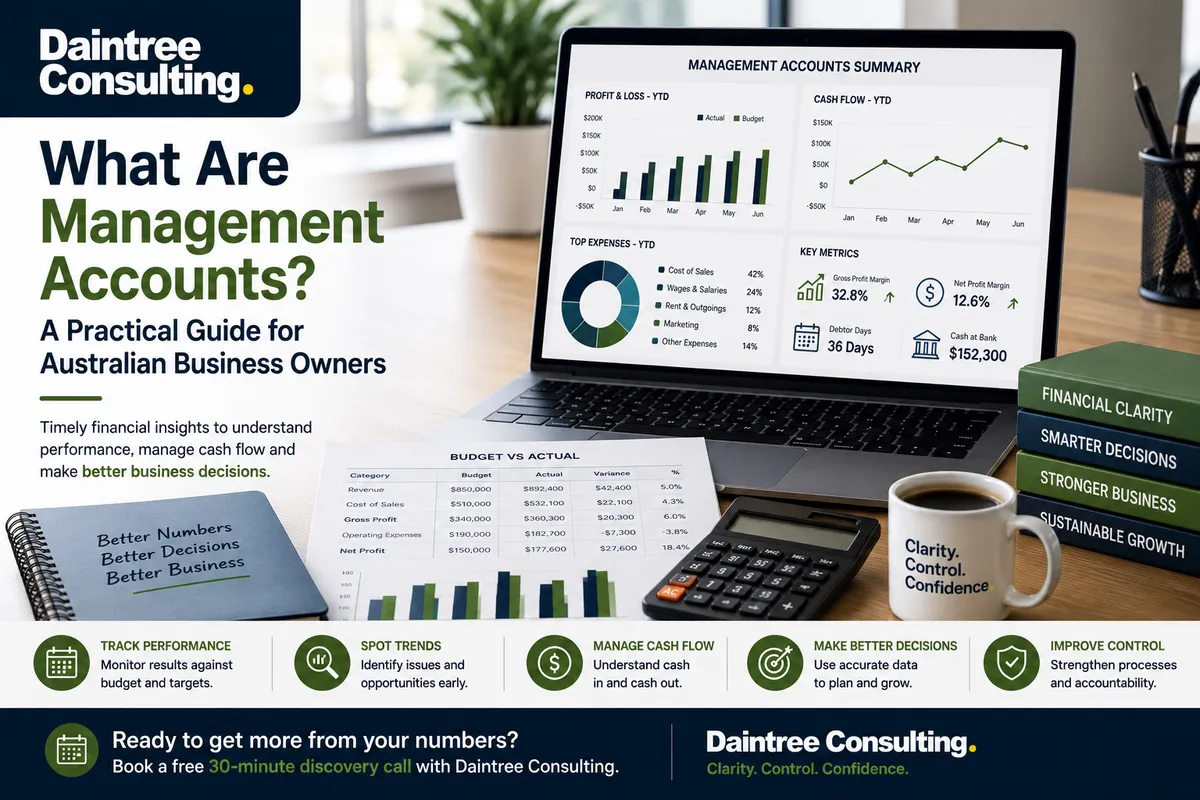
What Are Management Accounts? A Practical Guide for Australian Businesses
Running a business based only on your bank balance or annual tax return can leave you without the information you need to make confident decisions.
You may know how much money is in the bank, but do you know whether your business is actually profitable?
Want expert help? Daintree Consulting's accounting services can take this off your plate. Book a free consultation.
Do you know which costs are increasing?
Are sales performing as expected?
Is cash flow improving or becoming tighter?
And if revenue suddenly falls, would you know why?
This is where management accounts become valuable.
Management accounts are financial reports prepared for the people running a business. Unlike statutory or year-end accounts, they are designed primarily to provide timely information that helps owners and managers understand performance and make better decisions.
For growing Australian businesses, management accounts can turn accounting from a compliance exercise into a practical management tool.
Daintree Consulting describes management accounts as part of a connected accounting and reporting function, alongside reconciliations, budget-to-actual reporting, cash-flow reporting and financial dashboards.
Quick Answer: What Are Management Accounts?
Management accounts are regular financial reports prepared for business owners and managers to help them understand the current financial performance and position of the business.
They commonly include:
Profit and loss reporting
Balance-sheet information
Cash-flow reporting
Budget vs actual analysis
Variance analysis
Key performance indicators
Accounts receivable information
Other reports relevant to the business
Management accounts are generally prepared monthly or quarterly, depending on the size, complexity and reporting needs of the business.
The key difference is their purpose.
Statutory accounts primarily satisfy external reporting or compliance requirements. Management accounts are designed to help management run the business.
What Do Management Accounts Include?
There is no single management accounts format that works for every business.
A good reporting pack should be designed around the questions the owner or management team actually needs to answer.
However, several reports are commonly included.
1. Profit and Loss Statement
The profit and loss statement shows how the business performed over a particular period.
It typically provides information about:
Revenue
Cost of sales
Gross profit
Operating expenses
Operating profit
Other income and expenses
Net profit
The important point is not simply knowing whether the business made a profit.
Management should also be able to identify why profitability changed.
For example, revenue may have increased while gross margin declined. That could indicate pricing pressure, increased supplier costs or a change in the sales mix.
Management accounts help bring these movements into focus.
2. Balance Sheet
The balance sheet provides a snapshot of the business's financial position.
It generally includes:
Assets
Liabilities
Equity
A business can appear profitable while still experiencing financial pressure.
For example, increasing accounts receivable may mean that profits are being generated on paper while cash is taking longer to arrive.
That is why reviewing the balance sheet alongside the profit and loss statement is important.
The Australian Taxation Office also emphasises the importance of accurate financial records for understanding a business's financial position and meeting tax and other obligations.
3. Cash-Flow Reporting
Profit and cash are not the same thing.
A profitable business can still experience cash-flow problems if customers pay slowly, inventory absorbs cash or major expenses fall due before expected receipts arrive.
Cash-flow reporting helps management understand:
Cash coming into the business
Cash leaving the business
Timing differences
Upcoming cash requirements
Working-capital pressure
Available liquidity
This is particularly useful when the business is growing quickly.
Daintree includes cash-flow reporting and financial dashboards within its accounting and management reporting services.
4. Budget vs Actual Reporting
A budget tells you what you expected to happen.
Management accounts can show you what actually happened.
Comparing the two allows management to identify significant differences.
For example:
Revenue is below budget
Advertising costs are higher than expected
Payroll has increased
Gross margin is below target
Cash collections are slower than forecast
These differences are called variances.
The value is not simply identifying that a number is different.
The real value comes from asking:
Why did it happen, and what should we do about it?
5. Key Performance Indicators
Financial statements do not always tell the entire story.
Depending on the industry, management accounts may include KPIs such as:
Gross profit margin
Net profit margin
Revenue growth
Debtor days
Revenue per employee
Customer acquisition cost
Average transaction value
Recurring revenue
Project profitability
The right KPIs depend on the business model.
A professional services firm may care about utilisation and revenue per employee, while a retailer may focus more heavily on gross margin, inventory turnover and average transaction value.
The objective is to track the numbers that actually influence business performance.
6. Accounts Receivable and Debtor Reporting
A business can make sales without collecting the cash immediately.
Accounts receivable reporting helps management see how much customers owe and how long those invoices have been outstanding.
This can highlight:
Overdue invoices
Slow-paying customers
Collection problems
Concentration of outstanding debt
Potential cash-flow pressure
This information can then feed into cash-flow planning.
Management Accounts vs Year-End Accounts
One of the most common questions business owners ask is how management accounts differ from their normal financial accounts.
The simplest answer is:
Year-end accounts look back for compliance and formal reporting purposes. Management accounts look at performance regularly so management can act.
Management accounts are typically:
Produced monthly or quarterly
Tailored to management needs
Focused on performance and decision-making
More flexible in format
Designed to highlight trends and variances
Year-end financial accounts are generally more focused on formal financial reporting and compliance requirements.
A business may therefore need both.
Management accounts do not replace the business's statutory, tax or other reporting obligations.
Why Are Management Accounts Important for Growing Businesses?
For a very small business with straightforward operations, basic financial reports may be enough.
As the business grows, however, decisions become more complicated.
You may have:
More employees
Higher transaction volumes
Multiple revenue streams
More suppliers
Larger contracts
Inventory
Multiple locations
Significant borrowing
More complex cash-flow requirements
At that point, waiting until year-end to understand performance can be too late.
Daintree identifies late or unreliable reporting, increased business complexity and the need for more than annual compliance accounts as situations where management accounting support can become particularly useful.
How Often Should Management Accounts Be Prepared?
For many growing businesses, monthly management accounts provide a useful balance between timely information and the effort involved in preparing the reports.
Monthly reporting gives management the opportunity to identify trends before they become larger problems.
Some businesses may only need quarterly reporting.
Others may benefit from more frequent information, particularly when cash flow is tight or the business is changing rapidly.
The right frequency depends on:
Business size
Transaction volume
Industry
Growth rate
Cash-flow requirements
Management structure
Decision-making frequency
Daintree notes that reporting cadence can be agreed around the decisions and obligations of the business, commonly monthly or quarterly.
When Should You Start Using Management Accounts?
There is no universal revenue threshold.
The better question is:
Do you have enough financial complexity and decision-making pressure that regular reporting would improve the way you run the business?
You may benefit from management accounts if:
You are growing quickly
Financial reports arrive too late
You are unsure where profit is coming from
Cash flow feels unpredictable
You are hiring more employees
You have multiple revenue streams
You are regularly comparing performance against targets
You are considering expansion
You are preparing for funding
You want to understand business performance before making major decisions
If the business has outgrown basic bookkeeping, management accounts can be the next step toward a more mature finance function.
Management Accounts Are More Than a Collection of Reports
Simply producing reports does not automatically create better financial management.
The real value comes from interpretation.
For example, imagine your monthly management accounts show:
Revenue increased by 12%
Gross margin decreased by 5%
Payroll increased by 15%
Accounts receivable increased significantly
The numbers tell you that something changed.
A good management reporting process goes further.
It asks:
What caused these changes?
Are they temporary or ongoing?
What impact will they have on cash flow?
Do we need to change pricing, staffing or spending?
What should management do next?
That is where accounting begins to connect with business advisory.
How Management Accounts Support Better Decisions
Management accounts can help owners make more informed decisions about:
Hiring
Can the business afford another employee?
What impact will the additional salary have on cash flow and profitability?
Pricing
Are margins strong enough to support the current pricing strategy?
Expansion
Can the business financially support another location, product or service?
Cost control
Which costs are increasing faster than expected?
Cash flow
Will the business have enough cash to meet upcoming commitments?
Investment
Can the business afford new equipment, technology or other capital expenditure?
Funding
What does the business's current financial position look like to a lender or investor?
This is why timely management reporting can become increasingly valuable as a business grows.
What Makes Good Management Accounts?
Good management accounts should be:
Accurate
The underlying bookkeeping and reconciliations need to be reliable.
Timely
Reports that arrive months after the period ends have limited value for immediate decisions.
Relevant
The reporting pack should focus on information that management actually needs.
Consistent
Using a consistent format makes trends easier to identify.
Clear
Business owners should be able to understand the key messages without needing to decode accounting terminology.
Actionable
The report should help management identify what needs attention.
Daintree's management reporting process includes reconciling and closing the period, producing a tailored reporting pack, reviewing key findings and connecting those findings to business decisions.
Can Xero or MYOB Produce Management Accounts?
Cloud accounting software can produce many financial reports automatically.
However, software does not guarantee that the reports are meaningful or accurate.
The quality of the output depends on the quality of the underlying data.
Issues such as:
Incorrect transaction coding
Unreconciled accounts
Poor chart-of-accounts structure
Missing transactions
Incorrect classifications
Inconsistent bookkeeping
can affect the reliability of the reports.
Daintree works with cloud accounting platforms including Xero and MYOB and can assess whether the existing setup supports accurate, timely reporting.
The technology is important, but the process behind it matters just as much.
How Daintree Consulting Uses Management Accounts
At Daintree Consulting, management accounts form part of a connected accounting and reporting approach.
The aim is to establish accurate financial foundations first, then turn that information into reporting that helps management understand the business.
Depending on the engagement, this can include:
Monthly or periodic management accounts
Balance-sheet and control-account reconciliations
Budget-to-actual reporting
Variance analysis
Cash-flow reporting
Financial dashboards
Fixed-asset and ledger oversight
Coordination with bookkeeping, tax and business advisory
Daintree positions this service around helping Australian businesses understand where they stand without waiting until year-end.
The result is a more connected finance function:
Accurate records → Clear reporting → Better decisions → More confident growth.
Ready to Get More From Your Business Numbers?
If you are currently relying on annual accounts, basic bookkeeping or spreadsheets to understand how your business is performing, management accounts may provide the additional visibility you need.
The goal is not to create unnecessary reports.
It is to make sure you have the right information at the right time to make better business decisions.
Book a free 30-minute discovery call with Daintree Consulting to discuss your current reporting process and identify where greater financial clarity could make the biggest difference.
Frequently Asked Questions
What are management accounts?
Management accounts are regular financial reports prepared for business owners and management to monitor financial performance, understand trends and support decision-making.
What is included in management accounts?
Management accounts commonly include profit and loss, balance-sheet information, cash-flow reporting, budget-versus-actual analysis and relevant KPIs. The exact reporting pack should be tailored to the business.
How often should management accounts be prepared?
Many growing businesses use monthly management accounts, while others may use quarterly reporting. The appropriate frequency depends on the business's complexity and decision-making needs.
Are management accounts the same as financial statements?
Not exactly. Management accounts are generally designed for internal decision-making and can be tailored to management's needs. Financial statements may be prepared for formal reporting, taxation, compliance or external stakeholders.
Do small businesses need management accounts?
Not every small business needs a sophisticated reporting pack. However, management accounts can become increasingly useful when a business grows, becomes more complex or starts making larger financial decisions.
Can my accountant prepare management accounts?
Yes. Many accounting firms offer management accounting or management reporting services. Ask whether the service includes not only producing the reports but also helping you interpret the results and identify important actions.
Can management accounts help with cash flow?
Yes. Cash-flow reporting can form part of a management accounts pack and help owners understand the timing of money coming into and leaving the business.
What is the difference between management accounts and bookkeeping?
Bookkeeping records and reconciles financial transactions. Management accounts use that underlying financial information to produce structured reports that help management understand performance and make decisions.
Important Publishing Note
Management reporting and accounting requirements can vary depending on the business's structure, industry, systems and circumstances. This article provides general information only and should not be treated as accounting, tax, financial or legal advice. Businesses should obtain professional advice relevant to their individual circumstances before making significant financial decisions.
Talk to Daintree about your accounting
Our ex-Big 4 team gives clear, senior-reviewed advice so you can act with confidence.
Book a free consultation →
Or explore our accounting services.
