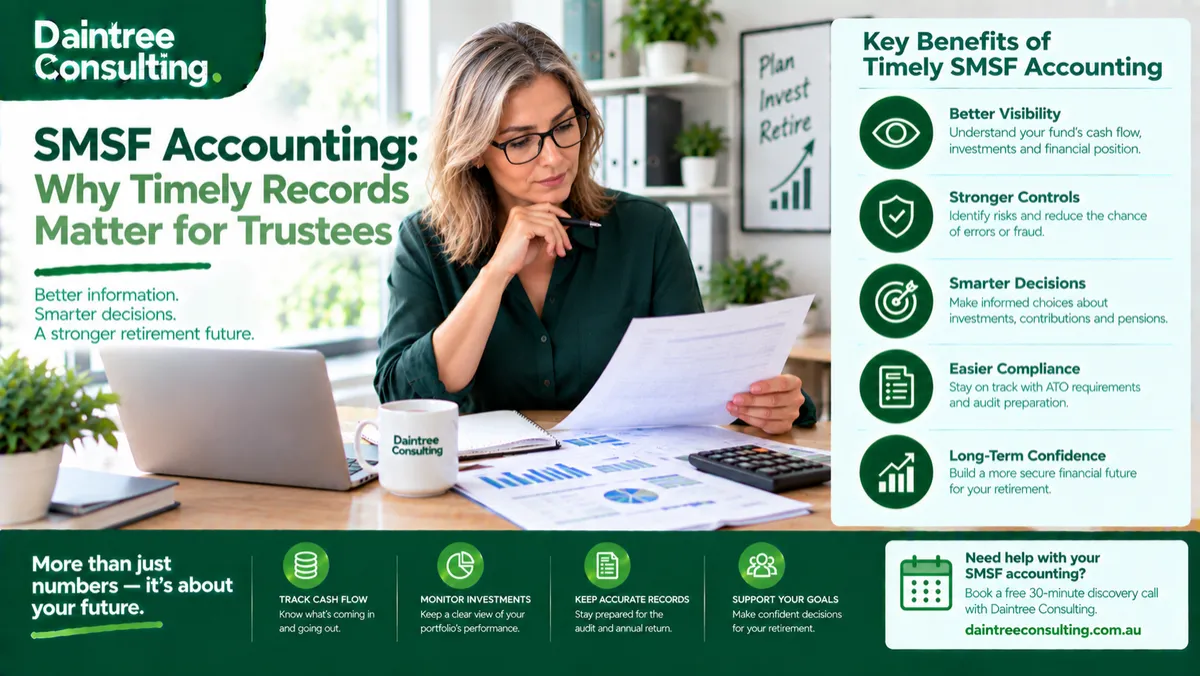
SMSF Accounting: Why Timely Records Matter for Trustees
Managing a self-managed super fund involves more than keeping records for tax and audit purposes.
As an SMSF trustee, you are responsible for making decisions about the fund's investments, cash flow, contributions, pensions, expenses and overall administration. Those decisions are much easier to make when you have accurate and up-to-date financial information.
Want expert help? Daintree Consulting's SMSF accounting services can take this off your plate. Book a free consultation.
That is why timely SMSF accounting matters.
If the fund's accounts are only updated once a year, trustees may have limited visibility over the fund's current financial position when important decisions need to be made.
By contrast, timely accounting can help trustees understand what the fund owns, what it owes, how investments are performing, what cash is available and whether recent transactions have been recorded correctly.
The ATO requires SMSF trustees to maintain proper and accurate tax and superannuation records, including accounting records that explain the transactions and financial position of the fund. Depending on the type of record, minimum retention periods can be five or 10 years.
But good SMSF accounting is not simply about satisfying a record-keeping requirement.
It can also give trustees better information when making decisions about their fund.
What Is Timely SMSF Accounting?
Timely SMSF accounting means keeping the fund's financial records updated and reconciled within an appropriate timeframe rather than allowing transactions and information to accumulate until the end of the financial year.
The right frequency will depend on the fund.
Some SMSFs may need more regular updates because they have multiple investments, property, pension payments, significant transactions or other activity requiring closer monitoring.
Other funds may have relatively straightforward transactions.
The important point is that the accounting process should provide trustees with information when they need it.
Timely accounting can include keeping track of:
contributions and rollovers
pension or benefit payments
investment income
dividends and distributions
investment purchases and sales
bank transactions
investment expenses
accounting fees
tax-related transactions
asset valuations
member accounts
investment-related documentation
changes affecting the fund's financial position
The exact accounting requirements will depend on the SMSF's circumstances and the transactions it undertakes.
Why Does Timely SMSF Accounting Matter?
The main benefit is visibility.
Trustees cannot make well-informed decisions about a fund if they do not have a reasonably current understanding of its financial position.
For example, a trustee considering whether the SMSF has sufficient liquidity to meet upcoming expenses or pension obligations needs reliable information about available cash and expected commitments.
Similarly, a trustee reviewing the fund's investment strategy needs to understand the fund's current assets, liabilities, cash-flow requirements and member circumstances.
The ATO states that an SMSF investment strategy should consider matters including investment risk and return, diversification, liquidity, the fund's ability to meet liabilities and member circumstances. The strategy must be reviewed regularly, with the ATO advising that it should be reviewed at least annually and after certain significant events.
Timely accounting helps provide some of the financial information needed for those discussions.
1. Timely Accounting Gives Trustees Better Visibility Over Cash
Cash is one of the most important financial resources within an SMSF.
The fund may need cash to pay:
administration expenses
accounting and audit fees
investment expenses
tax liabilities
pension payments
other valid fund obligations
If accounting records are not kept up to date, trustees may have difficulty determining how much cash is genuinely available.
A bank balance alone does not necessarily provide the complete picture.
Trustees also need to consider upcoming obligations, transactions that have not yet settled and other commitments affecting the fund.
Regular accounting and reconciliation can help trustees distinguish between the cash currently sitting in the fund and the broader financial position that should be considered before making decisions.
2. It Helps Trustees Understand the Fund's Current Financial Position
An SMSF's financial position can change considerably during a financial year.
Investments may be bought or sold. Distributions may be received. Contributions may be made. Pension payments may begin or change. Investment values may move.
If the accounts are not updated regularly, the financial statements may no longer reflect the information trustees need for current decision-making.
Timely accounting can help trustees monitor:
total assets
liabilities
investment balances
cash
member entitlements
income and expenses
changes in the fund's financial position
This does not mean trustees need to monitor every figure every day.
It means the accounting information should be maintained at a frequency that is appropriate for the fund's circumstances.
3. It Supports Better Investment Discussions
Investment decisions are ultimately the responsibility of SMSF trustees.
Accounting does not replace investment advice, and maintaining the accounts does not mean an accountant is making investment decisions for the trustees.
However, reliable financial information can help trustees understand the financial context in which those decisions are being made.
For example, before reviewing the fund's investments, trustees may need to consider:
the current composition of the portfolio
available cash
expected cash requirements
investment income
liabilities
member circumstances
pension obligations
asset values
diversification
the fund's investment strategy
The ATO states that an SMSF's investment strategy provides a framework for investment decisions and must reflect the purpose and circumstances of the fund and its members. Trustees must also be able to demonstrate how investment decisions comply with the strategy and superannuation laws.
Up-to-date accounting information can therefore form part of the information trustees use when reviewing the fund's position.
4. It Can Help Identify Errors Earlier
The longer an accounting error remains undetected, the harder it can become to identify its cause.
For example, a transaction may be incorrectly classified, an investment distribution may not have been recorded correctly or a bank transaction may not have been reconciled.
If the accounts are reviewed regularly, discrepancies may be identified closer to when they occurred.
That can make investigation and correction easier.
Regular accounting can also help identify situations where supporting documentation is missing.
The ATO's SMSF auditor checklist highlights the importance of evidence concerning matters such as the existence and ownership of assets, completeness of transactions, classification, valuation and the fund's financial statements.
Keeping records organised throughout the year can therefore make it easier to demonstrate what happened and why.
5. It Makes Annual SMSF Compliance More Manageable
SMSF trustees need to complete a range of annual compliance tasks.
An approved SMSF auditor must conduct an annual audit before the SMSF annual return can be lodged. The audit covers the fund's financial statements as well as compliance with superannuation law.
When accounting records are maintained throughout the year, the annual process can be more straightforward.
Instead of reconstructing transactions months after they occurred, trustees and their professional advisers can work from records that have been maintained progressively.
This can help with:
preparing financial statements
reviewing transactions
confirming investment information
organising supporting documents
preparing the fund for audit
identifying missing information
addressing issues before lodgement
The ATO also requires trustees to keep accurate and accessible accounting records and annual financial statements for the relevant retention period.
6. It Helps Trustees Monitor Investment Values
Investment values are particularly important for SMSFs because the fund's financial statements need to reflect appropriate values at the relevant reporting date.
The ATO's auditor guidance includes verification of asset existence, ownership and valuation as part of the audit process. It also refers to supporting evidence for market values.
Keeping investment information organised throughout the year can make it easier to identify:
what the fund owns
how each asset is recorded
where ownership documentation is held
what evidence supports valuations
what income has been generated
what expenses relate to investments
This becomes increasingly important when an SMSF has a more complex investment portfolio.
7. It Supports Pension and Liquidity Planning
SMSFs paying pensions can have additional cash-flow considerations.
Trustees need to understand the fund's ability to meet its obligations and maintain appropriate liquidity.
The ATO specifically notes that investment strategies should consider the fund's ability to pay expenses and benefits, as well as the liquidity of investments. Significant events, such as a member commencing a pension, can also prompt a review of the investment strategy.
Timely accounting can help trustees see the relationship between:
assets → income → cash → expenses → pension payments → remaining investments
That information can be valuable when trustees are reviewing whether the fund's financial position continues to align with its circumstances.
8. It Helps Trustees Understand Contributions and Member Accounts
Contributions and benefit payments need to be accurately recorded and allocated.
An SMSF bank account is used to receive contributions and rollovers, hold investment earnings and pay fund expenses. The ATO also notes that each member account records contributions, investment earnings allocated to the member and benefit payments.
Keeping these records current can help trustees identify discrepancies earlier.
For example, if a contribution appears in the bank account but has not been appropriately reflected in the accounting records, the discrepancy should be investigated rather than left until the annual accounts are prepared.
The same principle applies to benefit payments and other transactions affecting member entitlements.
9. It Can Make Trustee Meetings More Productive
Trustee decisions should be supported by appropriate records.
The ATO advises SMSF trustees to document investment decisions, including why a particular investment was chosen and whether all trustees agreed with the decision.
Current accounting information can make these discussions more useful.
Instead of reviewing a year's worth of transactions retrospectively, trustees can consider the fund's current position and identify matters that require attention.
A trustee meeting might cover:
changes in the fund's financial position
investment performance
cash requirements
upcoming expenses
pension obligations
contributions
significant transactions
investment strategy considerations
outstanding documentation
compliance issues
actions required before the next review
The accounting information does not make the decisions for trustees.
It gives them better information to work with.
10. It Can Help Identify Issues Before the Annual Audit
An annual audit should not be the first time trustees discover that something needs attention.
If accounting records are updated and reviewed throughout the year, potential issues may be identified earlier.
For example:
a transaction may not have sufficient supporting evidence
an investment may be recorded incorrectly
a bank reconciliation may contain an unexplained difference
an asset valuation may need supporting documentation
a transaction may require further review for compliance
an investment strategy may need to be considered following a significant change
Early identification does not guarantee that an issue will not occur.
It simply gives trustees more time to investigate and obtain appropriate professional advice where necessary.
Timely SMSF Accounting Does Not Mean Constant Accounting
It is important to avoid interpreting "timely" as "daily".
The appropriate accounting frequency depends on the SMSF.
A fund with a small number of straightforward transactions may not require the same level of ongoing accounting activity as a fund with:
multiple investment accounts
direct property
frequent investment transactions
pension payments
multiple members
complex contribution activity
related-party transactions
significant investment income
borrowing arrangements where permitted
substantial changes in investments
The objective is to establish an accounting process that provides reliable information at the point when trustees need it.
What Should Trustees Look for in Their SMSF Accounts?
Depending on the fund's circumstances, trustees may want to review whether the accounting records provide visibility over:
Bank transactions
Are transactions being recorded and reconciled appropriately?
Investments
Are investment purchases, sales, income and expenses being captured correctly?
Asset values
Is appropriate evidence available to support valuations where required?
Contributions
Are contributions and other amounts received by the fund recorded correctly?
Pension or benefit payments
Are payments accurately reflected in the member records and financial statements?
Expenses
Are fund expenses appropriately recorded and supported?
Member accounts
Are member entitlements being maintained accurately?
Liabilities
Are outstanding obligations identified?
Supporting documentation
Can the fund demonstrate the basis for significant transactions and decisions?
Investment strategy
Does the information available help trustees review whether the strategy continues to reflect the fund's circumstances?
This is not a substitute for professional advice or a complete compliance checklist. SMSF requirements can vary depending on the fund's structure and activities.
What Happens When SMSF Accounting Is Left Until Year-End?
There is nothing inherently wrong with preparing annual financial statements for an SMSF where that approach is appropriate.
The issue is what happens if all accounting information is left until the end of the year, even when trustees need information during the year to make decisions.
Potential problems can include:
limited visibility over current cash
delayed identification of errors
difficulty tracking investment transactions
missing supporting documentation
more work required before the annual audit
delayed financial information
difficulty understanding changes in the fund's position
less useful information for trustee discussions
For a simple fund, these issues may be limited.
For a more active or complex SMSF, they can become more significant.
How Often Should SMSF Accounts Be Updated?
There is no single accounting frequency that is appropriate for every SMSF.
The right approach depends on the fund's circumstances, transaction volume, investments, pension arrangements, trustee needs and compliance requirements.
Some trustees may benefit from quarterly updates. Others may require monthly or more frequent accounting support.
The key question is:
Are the accounts being updated often enough for trustees to have the information they need to manage the fund responsibly?
If trustees regularly make decisions without knowing the fund's current financial position, it may be worth reviewing the accounting process.
Timely Accounting vs Annual SMSF Accounting
These approaches are not necessarily opposites.
Annual accounting remains an important part of SMSF administration because the fund needs annual financial statements, tax reporting and an annual audit.
Timely accounting is about what happens before that year-end process.
A useful way to think about it is:
Ongoing accounting → better records → better visibility → better trustee discussions → smoother year-end process
The annual accounts remain important.
But the information used to manage the fund throughout the year can be equally valuable.
When Should an SMSF Consider More Frequent Accounting Support?
More frequent accounting support may be worth considering when:
the fund has multiple investments
transaction volumes are increasing
members are approaching retirement
pension payments are being made
the fund has direct property
the portfolio is changing frequently
trustees are finding it difficult to keep records current
annual accounts are becoming difficult to prepare
supporting documents are often missing
trustees need more regular visibility over cash
the fund has experienced recurring accounting or compliance issues
The right level of support should be based on the fund's actual needs rather than applying the same process to every SMSF.
How Daintree Consulting Can Help With SMSF Accounting
Timely SMSF accounting can give trustees a clearer view of the information behind their fund's financial position.
Daintree Consulting provides SMSF Accounting support designed to help trustees maintain organised financial records, prepare annual financial information, track contributions and pension activity, manage investment records and prepare documentation for the annual audit.
For funds with multiple investments or more complex activity, keeping information organised throughout the year can make it easier to identify what needs attention and prepare for year-end reporting.
If you are finding it difficult to keep your SMSF records current, or you want a more structured accounting process, professional support may help.
Book a free 30-minute discovery call with Daintree Consulting to discuss your SMSF accounting requirements.
Frequently Asked Questions
Why is timely SMSF accounting important?
Timely SMSF accounting gives trustees more current information about the fund's assets, liabilities, cash, investments, income and expenses. This can help trustees make informed decisions and identify issues earlier.
Do SMSF accounts need to be updated monthly?
Not necessarily. The appropriate frequency depends on the SMSF's circumstances and transaction activity. A simple fund may need less frequent accounting than a fund with multiple investments, property, pension payments or more complex transactions.
Does timely accounting replace the annual SMSF audit?
No. SMSFs generally require an annual audit by an approved SMSF auditor, and the audit must be completed before the annual return is lodged.
Can SMSF accounting help with investment decisions?
Accounting does not replace investment advice or trustee responsibilities. However, accurate financial information can help trustees understand the fund's current financial position, liquidity, investments and obligations when reviewing investment decisions and strategy.
How long do SMSF accounting records need to be kept?
The ATO states that different SMSF records have different minimum retention periods. Certain accounting records and annual financial statements generally need to be kept for at least five years, while records such as trustee meeting minutes and investment strategy decisions generally have longer retention requirements.
Who is responsible for SMSF decisions?
SMSF trustees remain responsible for managing the fund and complying with relevant superannuation and tax requirements. Professional accountants and advisers can provide services and advice within their areas of responsibility, but trustees should understand their own obligations.
Final Takeaway
Timely SMSF accounting is about more than keeping the books up to date.
It gives trustees better visibility over the financial information they may need when managing the fund.
Current accounting information can help trustees understand cash flow, investment activity, member accounts, expenses, liabilities and changes in the fund's financial position.
It can also make it easier to identify errors, organise supporting documentation, prepare for the annual audit and review whether the fund's circumstances continue to align with its investment strategy.
For some SMSFs, annual accounting may be sufficient for their needs. For others, particularly funds with more complex investments or regular activity, more frequent accounting can provide greater visibility.
The key is to have an accounting process that gives trustees reliable information when they need it to manage the fund.
Important Publishing Note: SMSF rules, ATO requirements and superannuation obligations can change. The appropriate accounting frequency and level of professional support will depend on the fund's structure, investments, member circumstances and transactions. This article provides general information only and should not be treated as personal financial or investment advice. Trustees remain responsible for their SMSF obligations.
Talk to Daintree about your SMSF accounts
Our ex-Big 4 team gives clear, senior-reviewed advice so you can act with confidence.
Book a free consultation →
Or explore our SMSF accounting services.
