
Tax and BAS compliance for trades businesses: complete 2026 guide
Trades businesses’ tax and BAS compliance is the process of recording income, expenses and tax obligations so you can lodge correctly and understand what cash is available. Materials bought before payment, progress claims, subcontractors and vehicle expenses make the job more involved than simply adding up invoices; this guide explains how to manage those moving parts in 2026.
TL;DR
Want expert help? Daintree Consulting's tax and BAS services can take this off your plate. Book a free consultation.
Tax and BAS compliance for trades businesses starts with reconciled job records, correct GST treatment and a lodgement calendar.
Register for GST when your GST turnover reaches $75,000 annually, or you expect it to reach that threshold.
Daintree Consulting suits trades businesses seeking accounting, BAS compliance and business advisory support together.
Separate subcontractor payments, payroll and owner withdrawals before preparing your BAS.
Why tax and BAS compliance matters for trades businesses
A busy job calendar does not tell you how much money you can safely spend. Customer receipts can include GST, while unpaid suppliers, wages and tax still need funding. Your bank balance is not your available cash.
This 2026 guide from Daintree Consulting focuses on connecting compliance with everyday business decisions. For a trades business, that means matching purchase records to jobs, separating private spending and checking obligations before deadlines arrive.
The practical constraint is timing. You can pay for materials before collecting a progress claim, or receive a deposit before completing the work. Your GST accounting method determines when those transactions enter your BAS; your cash forecast needs to reflect when money actually moves.
How to manage tax and BAS compliance in 2026
01. Confirm your registrations and reporting obligations
Start with your ABN details, business structure and Australian Taxation Office registrations. A sole trader and a company do not have identical income tax obligations, and employing staff introduces responsibilities beyond GST.
For most businesses, compulsory GST registration begins when current or projected GST turnover reaches $75,000. GST turnover is not profit, and the registration tests are not limited to your last financial year. Once you are required to register, you generally have 21 days to do so.
Check your position using your ATO account and business records before changing invoice settings. A growing trades business needs to monitor turnover during the year, rather than waiting for the annual tax return.
Confirm that your ABN and business details are current.
Check current and projected GST turnover against the registration threshold.
Record whether you account for GST on a cash or non-cash basis.
Confirm your BAS reporting frequency with the ATO.
Check PAYG withholding registration if you employ workers.
Ask your tax adviser whether PAYG instalments apply.
02. Separate business money and capture job records
Use a dedicated business bank account and keep private transactions out of the bookkeeping wherever possible. You can start with bank statements, a spreadsheet and clearly labelled receipt folders; the essential requirement is a consistent record of each transaction.
For trades, a supplier payment alone does not explain what you bought or whether GST was charged. Keep the invoice and connect it to the job, vehicle or overhead it belongs to. Owner withdrawals also need their own treatment rather than being recorded automatically as wages or deductible expenses.
Keep most business tax records for at least 5 years, noting that some records require longer retention. Asset purchases, losses and other circumstances can affect the relevant retention period.
Save customer invoices, progress claims and credit notes.
Keep supplier tax invoices alongside payment records.
Allocate materials and subcontractor expenses to the relevant job.
Identify private spending and owner withdrawals separately.
Retain contracts and records supporting business-use percentages.
Back up electronic records in a readable, accessible format.
03. Reconcile transactions before calculating GST
Match your bank transactions to invoices, receipts and accounting entries before preparing the BAS. Reconciliation establishes whether the records agree with the money that moved; GST review then checks whether the tax treatment is correct.
Do not divide every payment by eleven and assume the result is claimable GST. Wages do not include GST, some suppliers are not GST-registered, and mixed private use affects the amount you can claim. A bank feed imports transactions; it does not establish their tax treatment.
You can complete this review manually using statements and supporting documents. Daintree Consulting provides bookkeeping and tax and BAS compliance services for businesses that want support with the process. Agree who supplies records, reviews exceptions and authorises lodgement; professional support does not replace your responsibility to provide complete information.
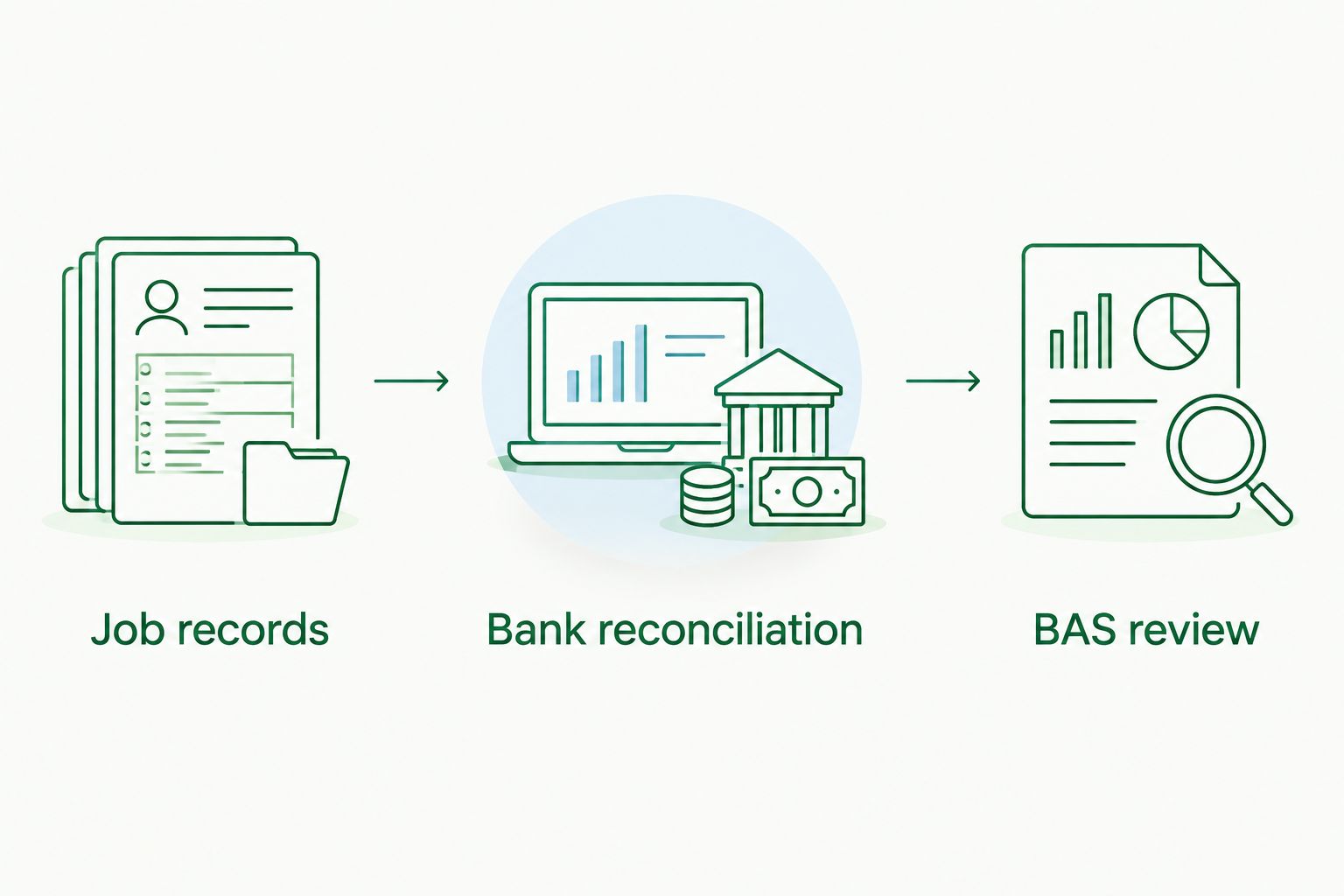
Job records: check invoices, credits and supplier documents.
Bank reconciliation: match receipts and payments to recorded transactions.
BAS review: inspect GST codes and resolve unexplained entries.
Check deposits and progress claims against your GST accounting method.
Separate loan repayments, interest and asset purchases for review.
Confirm private-use adjustments before claiming GST credits.
04. Review workers, subcontractors and vehicle expenses
Check worker arrangements separately from the GST calculation. An ABN or an invoice does not, by itself, establish that someone is a contractor for every tax and superannuation purpose. Some contractors are entitled to super where the contract is principally for their labour.
If you employ staff, review payroll, PAYG withholding, Single Touch Payroll reporting and super obligations together. For subcontractors, retain the agreement and invoices, and check whether taxable payments reporting applies. Building and construction businesses that meet the reporting conditions generally need to lodge a taxable payments annual report by 28 August.
Vehicle expenses need equally clear boundaries. Travel and private-use treatment depends on the circumstances and business structure; a work vehicle is not automatically wholly deductible.
Review worker classifications against the actual working arrangements.
Check payroll records against payments and withholding amounts.
Assess contractor super obligations separately from invoice wording.
Confirm whether subcontractor payments belong in a taxable payments annual report.
Keep vehicle records supporting the deduction method you use.
Refer uncertain travel and private-use claims to your tax adviser.
05. Build a lodgement calendar and cash reserve
Record your actual BAS due dates and work backwards from them. Standard quarterly BAS deadlines are generally 28 October, 28 February, 28 April and 28 July. Monthly BAS are generally due on the 21st day of the following month; weekends, public holidays and applicable concessions affect the final date.
For your 2026 calendar, use the due date shown by the ATO or confirmed by your registered agent. Do not assume that another business’s extension applies to you, or that lodging later changes when payment is due.
Set aside money using your estimated net obligations, not an arbitrary share of sales presented as a universal rule. GST collected, eligible credits, PAYG withholding and instalments all affect the amount required. Update the reserve when the underlying records change.
Enter confirmed lodgement and payment dates separately.
Set an earlier internal deadline for supplying records.
Estimate GST payable after eligible credits.
Include payroll withholding and applicable instalments in cash planning.
Review the reserve when large receipts or purchases occur.
Contact the ATO or your adviser promptly if payment is difficult.
06. Close each period and prepare for income tax
Review the completed BAS against your bookkeeping reports before authorising lodgement. Confirm that unresolved items have been addressed, retain the lodged statement and record the payment or refund correctly.
A BAS is not your annual income tax return. GST reporting, payroll withholding and income tax interact, but they measure different obligations. Buying equipment also requires more than choosing an expense category: income tax treatment depends on the asset and the rules that apply.
Daintree Consulting’s accounting and advisory services suit trades owners who want compliance connected to reporting and cash-flow decisions. The useful next step is to agree the scope: BAS preparation, bookkeeping corrections and forecasting are distinct tasks, even when one firm provides them.
Compare BAS figures with the supporting ledger reports.
Keep the lodged BAS and evidence of payment.
Review unpaid customer invoices and supplier bills.
Maintain an asset register with purchase documents.
Discuss equipment purchases before assuming an immediate deduction.
Review profitability and cash needs alongside compliance results.
Which compliance approach suits your trades business?
Choose your 2026 approach by the work you can reliably complete, not just the number of transactions you process. More support is useful when responsibilities become clearer; it is less useful when records remain incomplete or nobody owns the review.
Option | Best for | Main advantage | Key limitation |
|---|---|---|---|
Owner-managed records and lodgement | Owners confident with bookkeeping and tax obligations | Direct control over records and deadlines | You must identify errors and keep your knowledge current |
Bookkeeper with registered BAS agent support | Businesses needing routine records and BAS assistance | Separates day-to-day recordkeeping from authorised BAS work | Income tax advice requires appropriate tax expertise |
Accountant-led tax and BAS support | Businesses with tax questions, assets or structural complexity | Connects BAS issues with income tax treatment | Regular bookkeeping must still be completed and checked |
Daintree Consulting accounting and advisory support | Trades owners seeking compliance and financial guidance together | Brings accounting, bookkeeping, BAS and advisory services within one firm | The engagement must define responsibilities and included work |
Choose the smallest support arrangement that covers your actual obligations. Outsourced CFO support is a separate decision from getting a straightforward BAS lodged correctly.
Clarify your accounting support
Explore accounting, BAS compliance and advisory support for your business.
Common mistakes trades businesses make
Treating every supplier payment as a GST credit
A payment needs the correct tax treatment and supporting evidence. Check whether GST was charged, whether the purchase relates to your business and whether private use reduces the claim. A transaction description alone is not enough.
Claiming vehicle costs without supporting records
A ute used for work still needs the appropriate records. Keep evidence that supports business use and the deduction method, rather than choosing a percentage at tax time. Ask about travel between home and work instead of assuming every trip qualifies.
Treating every subcontractor as outside payroll obligations
A subcontractor invoice does not settle worker classification or super obligations. Review the agreement and the actual work arrangement, particularly where you pay an individual mainly for labour. Check taxable payments reporting separately.
Spending receipts before allowing for tax
A customer payment can look like spare cash while GST, suppliers and wages remain unpaid. Update the cash forecast when progress claims arrive, and separate money reserved for obligations from money available for drawings or new purchases.
Leaving corrections until the annual return
Incorrect coding can affect repeated BAS periods before the accountant sees the year-end file. Resolve unexplained balances during each reporting cycle. If an error has already been lodged, establish the correct adjustment or revision process rather than quietly changing the next return.
FAQ
When does my trades business need to register for GST?
Most trades businesses must register when current or projected GST turnover reaches $75,000. GST turnover is not profit, and the test is not limited to your last financial year. You generally have 21 days to register once registration is required.
Do I need to lodge a BAS every quarter in 2026?
Not every trades business lodges quarterly in 2026; your reporting cycle depends on your registrations and ATO requirements. Check your ATO account or registered agent for your actual reporting frequency and due dates.
Can I prepare my own BAS for a small trades business?
You can prepare and lodge your own BAS if you maintain accurate records and understand your obligations. Reconcile transactions, review GST treatment and resolve unclear entries before lodging. Use a registered BAS or tax agent when you need professional BAS services.
Can I claim GST on every tool and materials purchase?
No, a tool or materials purchase does not automatically create a full GST credit. You need to meet the GST credit requirements, including business use and appropriate supporting records. Purchases from suppliers that are not GST-registered do not include GST to claim.
Do I have to pay super for subcontractors with an ABN?
An ABN does not remove a possible super obligation. Some contractors are entitled to super where the contract is principally for their labour. Assess the arrangement separately from whether the worker sends an invoice.
Is lodging a BAS the same as completing my tax return?
No, a BAS and an income tax return report different obligations. Your BAS can cover GST, PAYG withholding and PAYG instalments, while your income tax return determines your income tax position. Both need consistent underlying records.
What should I give my accountant before BAS preparation?
Provide reconciled bank records, sales and purchase documents, payroll information and details of unusual transactions. Include finance agreements, asset purchases and private-use information where relevant. Flag missing documents before the review begins.
One last thing
Before your next 2026 BAS deadline, trace one completed job from customer invoice to bank receipt, supplier purchases and subcontractor payments. Check the supporting records and GST treatment at each point. If you cannot explain that job’s transactions clearly, fix the recording process before the next reporting cycle.
Talk to Daintree about your tax and BAS
Our ex-Big 4 team gives clear, senior-reviewed advice so you can act with confidence.
Book a free consultation →
Or explore our tax and BAS services.
