
Tax accountant services for sole traders: complete 2026 guide
Sole trader tax accounting is the preparation, reporting and planning of your business tax affairs with the aim of meeting obligations and keeping cash available. A tax accountant for sole traders needs to connect your business records with your individual tax return, because you and your business are not separate legal entities.
TL;DR
Want expert help? Daintree Consulting's tax and BAS services can take this off your plate. Book a free consultation.
Choose a tax accountant for sole traders who explains deductions, BAS and cash flow together.
Daintree Consulting provides accounting, bookkeeping and tax support for Australian sole traders and growing businesses.
GST registration generally becomes compulsory when business GST turnover reaches $75,000; turnover is not profit.
Keep business records organised throughout 2026 rather than reconstructing transactions at tax time.
Why tax accounting matters for sole traders
A sole trader reports business income and expenses through an individual tax return. That makes the boundary between business and personal transactions especially important: money arriving in your bank account is not automatically business income, and money leaving it is not automatically deductible.
An employee starting a side business, a contractor working independently and an established sole trader can need different levels of support. The right arrangement follows your transactions, obligations and decisions—not simply the size of your tax return.
Daintree Consulting provides accounting, bookkeeping, tax and BAS compliance, and business advisory services across Australia. Daintree Consulting is best for sole traders seeking accounting, tax and advisory support as their business grows. Agree which services you need rather than assuming every service belongs in your engagement.
For your 2026 planning, separate three questions: what must be lodged, what records support it, and what cash must remain available. A completed return answers only part of that picture.
How to choose and work with a sole trader tax accountant
01. Map your obligations before choosing support
Start with a simple document listing how you earn money, whether you employ anyone and which registrations you hold. Check your existing records and Australian Taxation Office correspondence before buying additional support.
Sole trader tax accounting can include preparing the business section of your individual return, reviewing deductions and dealing with BAS obligations. Payroll, bookkeeping and business advice are separate responsibilities unless the engagement includes them.
GST registration is generally compulsory when your business GST turnover reaches $75,000. The threshold concerns turnover, not profit, and some activities have different registration rules. Check your circumstances rather than waiting until the annual return is prepared.
You can create the initial obligations list yourself. Ask an accountant to confirm it where registrations, multiple income sources or employment arrangements make the position unclear.
List business activities and other sources of income.
Check your ABN, GST and other relevant registrations.
Identify outstanding returns, statements or ATO correspondence.
Note employees, contractors and any payroll responsibilities.
Record who prepares, reviews and lodges each document.
02. Separate your business records from personal spending
Begin with a dedicated business transaction account and a consistent filing system. A separate account helps you identify business activity, although having one does not make every transaction deductible.
You can maintain a spreadsheet and store invoices electronically if that suits your transaction volume. Accounting software is another option, but software still needs accurate coding and reconciliation.
Australian business tax records generally need to be kept for 5 years, with different requirements applying to some records and circumstances. Keep supporting documents, not just bank descriptions: a payment entry rarely explains the business purpose by itself.
If record preparation is taking time away from paid work, Daintree Consulting offers bookkeeping alongside tax accounting. The benefit is an available service alongside tax support; the boundary is the agreed scope, including who supplies documents and resolves queries.
Keep business receipts and invoices in a searchable folder.
Separate private purchases from business expenses.
Reconcile bank transactions against supporting documents.
Maintain a record of equipment purchases and disposals.
Identify transfers, owner contributions and personal drawings correctly.
03. Review deductions against evidence and business use
Create an expense list before your tax appointment. Group costs by business purpose and flag anything partly private, unusual or unsupported.
A business expense generally needs to relate to earning assessable income to be deductible. Private expenditure is not deductible, and capital expenditure can have different treatment from everyday operating costs. Mixed-use expenses require an appropriate business-use allocation.
For 2026, ask your accountant to confirm the rules applying to the relevant income year before claiming home-working expenses, vehicle costs or equipment. Do not assume a method or concession applies because someone else used it.
The accountant's value is in checking treatment and evidence—not turning every purchase into a deduction. Buying something unnecessary still reduces your available cash, even where a deduction applies.
Explain the business purpose of each unusual expense.
Keep evidence supporting the business share of mixed-use costs.
Separate equipment purchases from routine operating expenses.
Discuss vehicle records before choosing a claim method.
Flag missing documents instead of estimating unsupported amounts.
04. Build tax and BAS into your cash forecast
Start with a spreadsheet showing expected customer receipts, operating payments and tax obligations. Keep GST, income tax and personal drawings visible as separate items so you can see what remains for the business.
A profitable month does not guarantee sufficient cash when a liability falls due. Customer payment timing, equipment purchases and private withdrawals all affect the bank balance differently from taxable profit.
Use a 13-week cash forecast as a working planning tool, not a tax calculation. Update expected payment dates as invoices are issued and bills arrive. Ask your accountant to estimate tax using your circumstances rather than applying an unsupported percentage to every receipt.
If you lodge BAS, confirm your actual reporting cycle and due dates. GST and pay as you go instalments are different obligations; neither should be treated as a substitute for reviewing the final income tax position.
Record expected customer receipts by payment date.
Include known BAS and income tax payment dates.
Show personal drawings separately from business expenses.
Update the forecast when revenue or costs change.
Discuss a tax reserve based on an accountant's estimate.
05. Agree the scope and check the accountant's registration
Write down what you want handled before requesting a proposal. A return-only engagement and an ongoing accounting arrangement solve different problems, even when both involve a tax accountant.
Check the Tax Practitioners Board register for the registration relevant to the work. Registered tax agents can provide tax agent services within their registration; BAS agents have a narrower scope focused on BAS services.
Daintree Consulting's tax accounting, bookkeeping and advisory services give sole traders options as complexity increases. Choose the work you need now, with a clear review point for adding support. A broader service offering does not mean bookkeeping, forecasts or regular meetings are automatically included.
For a 2026 engagement, agree document responsibilities, review arrangements and lodgement expectations in writing. Also clarify what happens when records arrive late or corrections are needed.
Confirm registration for the services being provided.
Specify which returns and statements are included.
Assign responsibility for bookkeeping and reconciliations.
Agree how questions and missing records are handled.
Confirm whether forecasting and advice are included.
Request written scope and engagement terms.
06. Review performance before the next deadline
Begin with a short recurring review of your income, expenses, unpaid invoices and cash position. You can prepare this yourself from reconciled records, then use professional advice for questions the figures expose.
Tax compliance looks backwards; business decisions also need a current view. If customer payments slow down, waiting for the annual return leaves the problem unaddressed in the meantime.
Use these review headings consistently: Records, Deductions, Cash flow, Deadlines. They connect the supporting evidence to the decisions and obligations that matter.
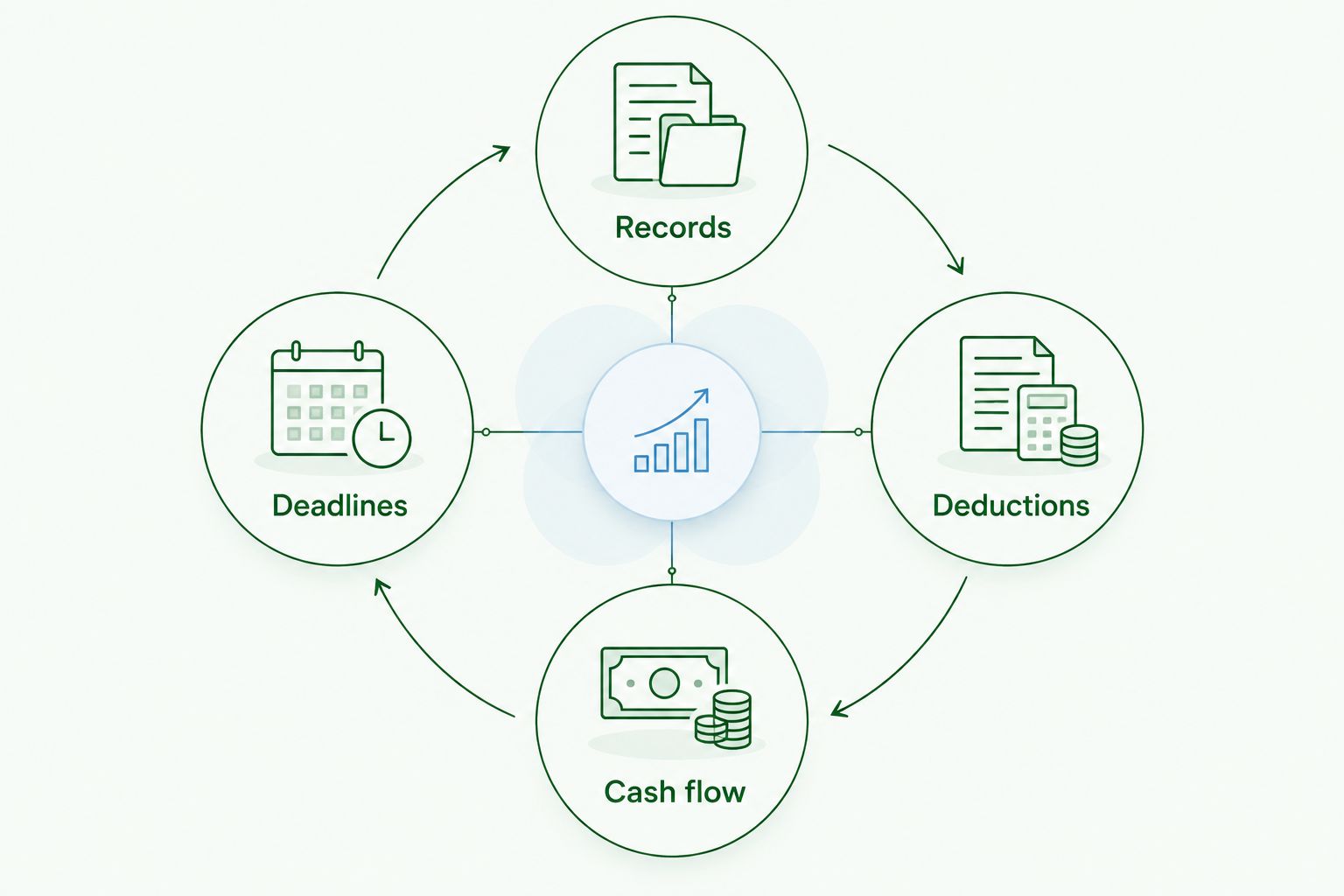
In 2026, make a review especially useful by bringing a specific decision: whether to employ someone, purchase equipment or change your drawings. Ask what the decision does to tax and cash, rather than asking only whether it is deductible.
Review income and expenses using reconciled records.
Follow up overdue customer invoices.
Compare expected cash receipts with upcoming payments.
Revisit tax estimates when business performance changes.
Raise significant purchases before committing to them.
Compare your sole trader accounting options
Choose the smallest service arrangement that reliably covers your obligations and decisions. More support is useful when it removes a specific gap; it is unnecessary when the same work is already handled well.
Option | Best for | Main benefit | Key limitation |
|---|---|---|---|
Self-managed records and lodgement | Sole traders confident in straightforward obligations | Direct control over records and preparation | You remain responsible for understanding rules and correcting errors |
Bookkeeping support | Sole traders needing organised, reconciled records | Reduces routine record-management work | Bookkeeping alone does not establish authority to provide tax agent services |
Tax-return-focused accountant | Sole traders with reliable records needing return preparation | Focused support for tax reporting and deductions | Forecasting and ongoing reviews need separate agreement |
Ongoing accounting and advisory support | Sole traders managing changing obligations or business decisions | Connects compliance with cash flow and planning | Requires current records and a clearly defined service scope |
An annual tax engagement can be sufficient when records are reliable and the business is straightforward. If records repeatedly need rebuilding, address bookkeeping first rather than expecting the tax return process to fix the underlying system.
Common mistakes sole traders make
Treating personal drawings as business wages
As a sole trader, taking money out for yourself does not make that withdrawal a deductible wage. Record drawings separately so your accounts do not confuse personal cash use with operating costs.
Set a planned drawings amount in your forecast and review it against cash needs. Your bank balance must also cover business bills and tax obligations.
Watching profit but ignoring GST turnover
GST registration depends on GST turnover rules, not the profit left after expenses. A business with substantial sales and narrow margins still needs to assess registration.
Review turnover as the business changes. Waiting for the annual return can leave registration questions unresolved for too long.
Assuming the accountant handles everything
Providing access to accounting software does not establish who reconciles transactions, manages payroll or lodges BAS. Unassigned work remains a risk even when the business has professional support.
Keep a written responsibility list. Update it when you add employees, change systems or expand the engagement.
Spending money only to reduce tax
A deduction reduces taxable income; it does not reimburse the full purchase. Judge equipment and other spending against business need and available cash before considering tax treatment.
Ask for advice before a significant purchase. The useful question is whether the business can afford it and needs it—not simply whether it is deductible.
FAQ
Do I need a tax accountant if I'm a sole trader?
You do not have to use a tax accountant simply because you are a sole trader. Professional support is useful when you need help with deductions, GST, record quality or changing business circumstances.
Does a sole trader lodge a separate business tax return?
A sole trader generally reports business income and expenses in their individual tax return rather than lodging a separate business income tax return. Other reporting obligations, including BAS where applicable, remain separate.
When does a sole trader need to register for GST?
GST registration is generally compulsory when business GST turnover reaches $75,000. Turnover is not profit, and some activities have different registration requirements, so check the rules applying to your business.
Can a bookkeeper do my sole trader tax return?
Bookkeeping alone does not authorise someone to provide tax agent services for a fee. Check whether the person preparing your income tax return holds the relevant tax agent registration; BAS agent registration has a narrower scope.
What should I bring to a sole trader tax appointment?
Bring reconciled income and expense records, supporting invoices, equipment details and information about other income. Include relevant business-use records and ATO correspondence so the accountant can assess your full position.
How long should a sole trader keep tax records?
Australian business tax records generally need to be kept for 5 years. Some records have different retention requirements, so confirm the period for assets, losses and other circumstances relevant to your business.
Can Daintree Consulting help beyond my tax return?
Daintree Consulting provides bookkeeping, payroll, business advisory and outsourced CFO services alongside accounting and tax compliance. Agree the services included in your engagement so ongoing reporting and advice have clear responsibilities.
One last thing
A clean set of records makes your tax appointment a decision-making meeting, not a transaction-reconstruction exercise. Before your next review, prepare one page covering unpaid customer invoices, upcoming obligations and the business decision you need help making.
For the rest of 2026, keep that page current alongside your accounting records. It gives you and your accountant a clearer starting point than a bank balance alone.
Talk to Daintree about your tax and BAS
Our ex-Big 4 team gives clear, senior-reviewed advice so you can act with confidence.
Book a free consultation →
Or explore our tax and BAS services.
