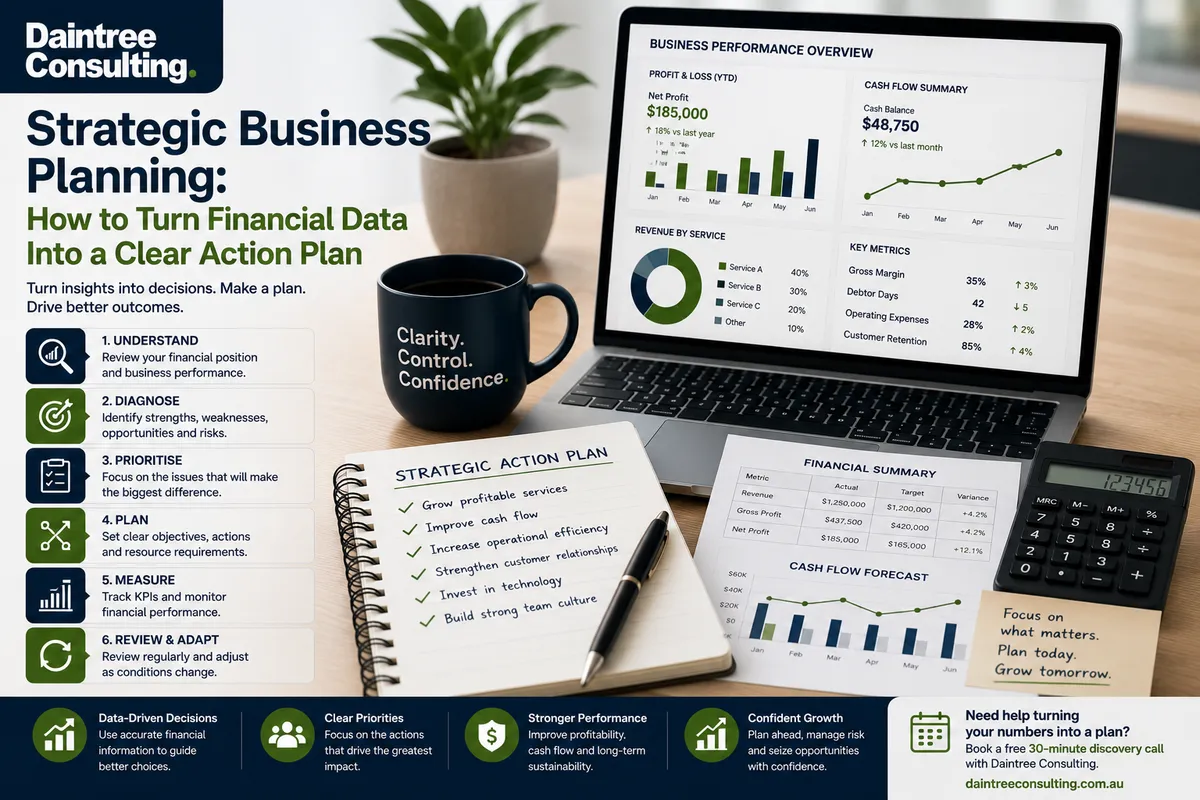
Strategic Business Planning: How to Turn Financial Data Into a Clear Action Plan
Financial data tells you what is happening in your business.
Strategic business planning helps you decide what to do about it.
Want expert help? Daintree Consulting's business advisory services can take this off your plate. Book a free consultation.
For many business owners, the challenge is not a lack of financial information. It is having too much information without a clear way to turn it into decisions.
You may have a profit and loss statement, balance sheet, cash-flow report, budget, sales figures and various operational KPIs. But if those numbers are reviewed only after the month or year has passed, they can become historical information rather than a practical decision-making tool.
The real value comes when financial data is connected to:
business priorities
cash flow
profitability
performance
risks
opportunities
measurable targets
specific actions.
That is the purpose of strategic business planning.
A strong plan does not need to be a 50-page document that sits in a drawer. For a growing Australian business, it can be a practical framework that answers five straightforward questions:
Where are we now?
Where do we want to go?
What is stopping us?
What needs to happen next?
How will we know whether the plan is working?
Daintree Consulting's business advisory approach is built around turning financial information into a practical path forward, including performance analysis, strategic planning, cash-flow and working-capital review, KPI design and priority setting.
Quick Answer: What Is Strategic Business Planning?
Strategic business planning is the process of using financial and operational information to define business priorities, evaluate options, set measurable objectives and establish practical actions for achieving them.
Financial data provides the evidence.
Strategy provides the direction.
An effective strategic business plan connects the two.
Instead of simply saying:
"We want to grow."
A financially informed plan might say:
"We want to increase revenue by expanding our most profitable service line, while maintaining a target gross margin and ensuring cash flow can support the additional staffing and working-capital requirements."
That is a much more useful strategy because it connects the ambition with financial reality.
Why Financial Data Should Be at the Centre of Business Planning
Strategic decisions are often discussed in terms of vision, growth and opportunity.
But every major business decision eventually affects the numbers.
Consider decisions such as:
hiring another employee
opening another location
increasing marketing expenditure
launching a new service
purchasing equipment
changing pricing
taking on debt
entering a new market
acquiring another business
reducing costs
investing in technology.
Each decision has financial consequences.
Financial data can help you understand whether the business has the resources to support the decision and whether the expected outcome is commercially realistic.
For example, increasing revenue sounds positive.
But what if:
gross margins are falling?
customers are paying slowly?
staffing costs are rising faster than revenue?
inventory is consuming cash?
the business needs significant investment before the additional revenue arrives?
Revenue growth alone does not necessarily mean the business is becoming stronger.
This is why strategic business planning needs to look beyond a single financial metric.
Step 1: Establish a Reliable Starting Point
Before deciding where the business is going, establish where it is today.
Your strategic plan is only as useful as the information supporting it.
Start by reviewing your current financial position.
Look at:
Revenue
How much revenue is the business generating?
Is revenue increasing, declining or relatively stable?
Are certain products, services or customers responsible for most of the growth?
Gross profit
Revenue does not tell the complete story.
Review your gross margin and determine whether the business is generating enough gross profit from its sales.
Operating expenses
Identify the major costs of running the business.
Look for changes in:
wages
rent
technology
marketing
professional fees
insurance
financing costs
administration.
Net profit
Is the business actually converting revenue into sustainable profit?
Cash flow
Profit and cash are not the same thing.
Review:
cash balances
operating cash flow
accounts receivable
accounts payable
debt repayments
working capital
upcoming commitments.
Balance sheet
The balance sheet can reveal issues that may not be obvious from the profit and loss statement.
Consider:
debt
working capital
assets
liabilities
retained earnings
debtor balances
creditor balances.
Daintree's accounting service specifically focuses on reconciled financial records, management accounts, budget-to-actual reporting, variance reporting and cash-flow visibility.
Step 2: Identify What the Numbers Are Actually Telling You
Financial reports are not just records.
They are signals.
The next step is to look for patterns.
For example:
Revenue is growing but profit is falling.
This could indicate pricing pressure, increasing costs, inefficient delivery or an unfavourable sales mix.
Profit is strong but cash flow is weak.
This could point towards slow collections, inventory investment, debt repayments or other working-capital pressures.
Sales are stable but one service is significantly more profitable than another.
That may influence future marketing and resource allocation.
Expenses have increased substantially without corresponding revenue growth.
That may require closer examination of cost structure and return on investment.
One customer represents a large proportion of revenue.
That could represent concentration risk.
The important question is not simply:
"What changed?"
It is:
"Why did it change, and what should we do about it?"
Step 3: Separate Symptoms From the Real Problem
One of the biggest mistakes in strategic planning is responding to symptoms rather than causes.
Suppose profitability has declined.
The immediate response might be:
"We need to cut costs."
But that may not be the real solution.
Perhaps:
prices have not kept pace with costs
low-margin customers have increased
the sales mix has changed
projects are taking longer to complete
employee utilisation has declined
discounts have increased
procurement costs have risen.
Cutting costs without understanding the underlying issue could damage the business while leaving the actual problem untouched.
Strategic planning should therefore ask:
What is happening?
Then:
Why is it happening?
Then:
What response is most likely to improve the outcome?
Step 4: Define the Strategic Priorities
A business cannot pursue everything at once.
Once you understand the financial position, identify the few priorities that matter most.
For example, your strategic priorities might include:
Improve profitability
Focus on pricing, margins, service mix and operating efficiency.
Strengthen cash flow
Improve collections, working-capital management and cash forecasting.
Grow revenue
Expand existing services, enter new markets or increase customer acquisition.
Reduce financial risk
Improve controls, diversify customers or reduce excessive debt exposure.
Build capacity
Hire people, invest in technology or improve operational processes.
Prepare for funding
Strengthen financial reporting, forecasts and supporting information.
Prepare for succession
Improve systems, management capability and business performance before a future transition.
The key is to keep the number of priorities manageable.
A plan with 20 "strategic priorities" is usually a list of everything the business wants to do.
A strong strategy identifies what matters most right now.
Step 5: Turn Financial Goals Into Business Objectives
Financial targets are useful, but they become much more powerful when connected to operational actions.
For example:
Financial goal:
Increase operating profit.
Possible strategic actions:
review pricing
focus sales on higher-margin services
reduce unnecessary overheads
improve project management
monitor gross margins by service.
Another example:
Financial goal:
Improve cash flow.
Possible strategic actions:
reduce debtor days
introduce clearer payment terms
improve invoice timing
review supplier terms
create a rolling cash-flow forecast.
Another:
Financial goal:
Support sustainable growth.
Possible strategic actions:
forecast staffing requirements
model additional overheads
assess working-capital requirements
establish a minimum cash reserve
identify funding requirements.
This is where strategic business planning becomes practical.
The numbers tell you what needs attention.
The strategy defines what you will do about it.
Step 6: Build a Financial Forecast
Historical data tells you what happened.
A forecast helps you think about what could happen next.
A useful forecast might include:
revenue assumptions
gross margin assumptions
staffing costs
operating expenses
capital expenditure
debt repayments
cash balances
working-capital requirements.
You do not need to pretend that a forecast can predict the future perfectly.
It cannot.
Forecasts are based on assumptions and professional judgement, and actual results can differ because of market conditions, business decisions, inaccurate assumptions and events outside the business's control. Daintree explicitly recognises these limitations in its advisory and CFO service framework.
The value of forecasting is therefore not necessarily predicting the exact future.
It is understanding what might happen under different circumstances.
Step 7: Use Scenario Planning Instead of One Forecast
One forecast can create false confidence.
Scenario planning can provide a better strategic view.
Consider building at least three scenarios:
Base case
What happens if the business performs broadly as expected?
Upside case
What happens if sales grow faster or margins improve?
Downside case
What happens if revenue falls, costs increase or a major customer is lost?
Then ask:
What changes between each scenario?
For example:
If revenue increases by 15%, can the business deliver the additional work?
If revenue falls by 10%, how long can the business maintain its current cost structure?
If a major customer leaves, what happens to cash flow?
If you hire five additional employees, what happens to monthly overheads?
If you open another location, how much capital and working capital will be required?
Scenario planning helps turn strategy into something that can be tested.
Daintree's outsourced CFO service includes integrated forecasts and scenario modelling, cash-flow and working-capital oversight, KPI design and decision support for businesses facing higher-stakes decisions.
Step 8: Choose KPIs That Actually Drive the Strategy
Not every number deserves to be a KPI.
A business can have dozens of financial metrics and still lack meaningful performance visibility.
The right KPIs should connect directly to the strategic priorities.
For example:
If your priority is profitability
Monitor:
gross margin
operating margin
profit by service
profit by customer
operating expenses.
If your priority is cash flow
Monitor:
cash balance
operating cash flow
debtor days
creditor days
working capital.
If your priority is revenue growth
Monitor:
sales revenue
sales pipeline
conversion rate
average transaction value
recurring revenue where applicable.
If your priority is operational efficiency
Monitor:
revenue per employee
utilisation
labour costs
project margins
delivery times.
The objective is not to track everything.
It is to identify the measures that tell leadership whether the strategy is moving in the right direction.
Daintree's business advisory service includes KPI and management dashboard design to help connect performance information with business priorities.
Step 9: Turn the Strategy Into an Action Plan
This is where many business plans fail.
The strategy sounds good.
The goals sound ambitious.
But nobody knows what happens next.
Every major strategic priority should have:
Action
What needs to be done?
Owner
Who is responsible?
Deadline
When should it happen?
Measure
How will success be assessed?
Resources
What people, technology or funding are required?
Review date
When will leadership assess progress?
For example:
Priority: Improve cash flow
Action: Review customer payment terms and overdue receivables.
Owner: Finance manager.
Deadline: End of month.
Measure: Reduce average debtor days.
Review: Monthly management meeting.
This is much more actionable than:
"Improve cash flow."
Step 10: Create a Strategic Planning Rhythm
Strategic planning should not be an annual event that disappears after the planning meeting.
Create a regular review rhythm.
Weekly
Focus on immediate operational signals such as:
cash movements
major collections
urgent expenses
sales pipeline
significant financial exceptions.
Monthly
Review:
profit and loss
balance sheet
cash flow
budget versus actual
KPIs
major variances.
Quarterly
Take a broader strategic view:
Are priorities progressing?
Are assumptions still valid?
Has the market changed?
Are financial targets still realistic?
Are new risks emerging?
Should resources be redirected?
Annually
Review the overall direction:
business performance
strategic objectives
financial position
major investments
funding requirements
succession considerations
future opportunities.
The exact cadence should reflect the size and complexity of the business.
Daintree notes that reporting cadence can be structured around the decisions and obligations of the business, commonly monthly or quarterly.
The Difference Between Financial Reporting and Strategic Planning
It is useful to understand the distinction.
Financial reporting asks:
What happened?
It provides accurate information about the business's financial performance and position.
Management reporting asks:
What does it mean?
It adds context, comparisons, trends and useful measures.
Strategic business planning asks:
What should we do next?
It connects the information to priorities, decisions and actions.
All three have a role.
A business needs reliable financial records before it can produce useful reports.
It needs useful reports before leadership can confidently interpret performance.
And leadership needs that insight before it can make informed strategic decisions.
This creates a simple progression:
Accurate records → Clear reporting → Useful insight → Strategic decisions → Action → Review
That connected approach is central to Daintree's positioning across accounting and advisory services.
Common Strategic Planning Mistakes
1. Planning Without Reliable Numbers
If the underlying financial information is inaccurate or incomplete, the strategy may be based on the wrong assumptions.
Fix the reporting foundation first.
2. Focusing Only on Revenue
Revenue growth can look impressive while margins and cash flow deteriorate.
Always consider revenue alongside profitability and cash.
3. Setting Too Many Priorities
If everything is important, nothing is truly prioritised.
Identify the few objectives that will make the greatest difference.
4. Creating Targets Without Owners
A target without accountability is simply an aspiration.
Assign responsibility for each major action.
5. Ignoring Cash Flow
A profitable business can still experience financial stress if cash is tied up in receivables, inventory or growth.
Cash-flow planning should be part of strategic planning.
6. Using Last Year's Numbers as the Whole Strategy
Historical performance is useful, but the future may look very different.
Consider changing market conditions, costs, customer behaviour, staffing requirements and investment needs.
7. Creating a Plan Nobody Reviews
A strategy should evolve as new information becomes available.
Regular reviews keep the plan relevant.
How Daintree Consulting Can Help Turn Numbers Into a Plan
Strategic planning becomes much easier when financial information, commercial context and decision-making are connected.
Daintree's Business Advisory service supports business owners and leadership teams with:
business performance and profitability analysis
strategic planning and priority setting
cash-flow and working-capital review
KPI and management dashboard design
business structure and risk discussions with specialists where needed
growth, succession and transition planning support.
The process begins by understanding the decision, pressure point or desired outcome.
From there, the focus is on building an accurate view of performance and constraints, evaluating options and risks, and agreeing actions, owners and a review rhythm.
That means the objective is not simply to produce another financial report.
It is to help answer:
What does the information mean for this business?
What decisions need to be made?
What should happen next?
When Should Your Business Consider Strategic Planning Support?
Professional strategic planning support may be useful when:
financial decisions are becoming more complex
the business is growing quickly
revenue is increasing but profitability is unclear
cash flow is becoming difficult to predict
management reporting is inconsistent
leadership meetings focus heavily on historical numbers
you are considering expansion
you need to assess an investment
the business is preparing for funding
you are considering restructuring
there is a major change in ownership or leadership
the owner remains responsible for too many financial decisions.
You do not necessarily need to wait until the business reaches a particular size.
Daintree states that its advisory scope can support startups, growing SMEs and established organisations where there is a defined commercial need.
A Simple Strategic Business Planning Framework
If you are starting from scratch, use this framework:
1. Understand
Review your current:
financial performance
cash flow
balance sheet
customers
products/services
operational capacity.
2. Diagnose
Identify:
strengths
weaknesses
risks
opportunities
financial constraints
performance gaps.
3. Prioritise
Choose the three to five issues that matter most.
4. Decide
Determine what the business should do about each priority.
5. Model
Test the financial implications through budgets, forecasts and scenarios.
6. Act
Assign owners, deadlines and measurable outcomes.
7. Review
Monitor KPIs and financial results regularly.
8. Adapt
Update the strategy when the underlying assumptions change.
This creates a continuous cycle:
Understand → Diagnose → Prioritise → Decide → Model → Act → Review → Adapt
Final Thoughts: Turn Financial Information Into Better Decisions
Financial data becomes valuable when it changes what you do.
A profit and loss statement can tell you whether revenue and expenses moved.
A cash-flow report can show whether money is coming in quickly enough.
A KPI dashboard can highlight performance trends.
But strategic business planning takes those insights one step further.
It asks:
What does this mean?
What matters most?
What options do we have?
What should we do now?
How will we measure the result?
That is the difference between simply reporting on the business and actively using financial information to lead it.
The strongest strategic plans are not necessarily the longest.
They are the ones that connect reliable numbers, clear priorities, practical actions and regular accountability.
If your business has financial information but you are finding it difficult to turn that information into a clear direction, Daintree Consulting can help you assess the gap and develop a practical next step.
Book a free 30-minute discovery call with Daintree Consulting to discuss your business, your numbers and the decision in front of you.
Frequently Asked Questions
What is strategic business planning?
Strategic business planning is the process of setting business priorities and determining the actions, resources and measures needed to achieve them. Financial and operational information helps ensure those decisions are grounded in the actual position of the business.
Why is financial data important for strategic planning?
Financial data provides evidence about profitability, cash flow, costs, margins, working capital and financial capacity. This helps leadership evaluate opportunities and risks before committing resources.
How often should a business review its strategic plan?
There is no single schedule that suits every business. Financial performance may be reviewed monthly, while broader strategic priorities can be reviewed quarterly and annually. The appropriate rhythm depends on the business's size, complexity and decision-making needs.
What financial reports are useful for strategic planning?
Commonly useful reports include:
profit and loss
balance sheet
cash-flow reports
budget-versus-actual reports
management accounts
KPI dashboards
accounts receivable and payable reports.
The exact reporting pack should be based on the decisions management needs to make.
Is strategic planning only for large companies?
No. Strategic planning can be useful for startups, small businesses, growing SMEs and established organisations. The process should simply be scaled to the complexity and needs of the business.
What is the difference between accounting and strategic business planning?
Accounting focuses on creating and maintaining reliable financial information and reporting. Strategic business planning uses that information, together with commercial and operational context, to determine priorities, evaluate options and plan future actions.
Can strategic planning improve cash flow?
It can help identify the drivers of cash flow and allow management to model the financial effect of different decisions. However, forecasts and plans are based on assumptions and do not guarantee future outcomes.
Does Daintree Consulting provide strategic business planning?
Yes. Daintree's Business Advisory service includes strategic planning and priority setting, performance and profitability analysis, cash-flow and working-capital review, KPI design and growth, succession and transition planning support.
Talk to Daintree about your next business decision
Our ex-Big 4 team gives clear, senior-reviewed advice so you can act with confidence.
Book a free consultation →
Or explore our business advisory services.
