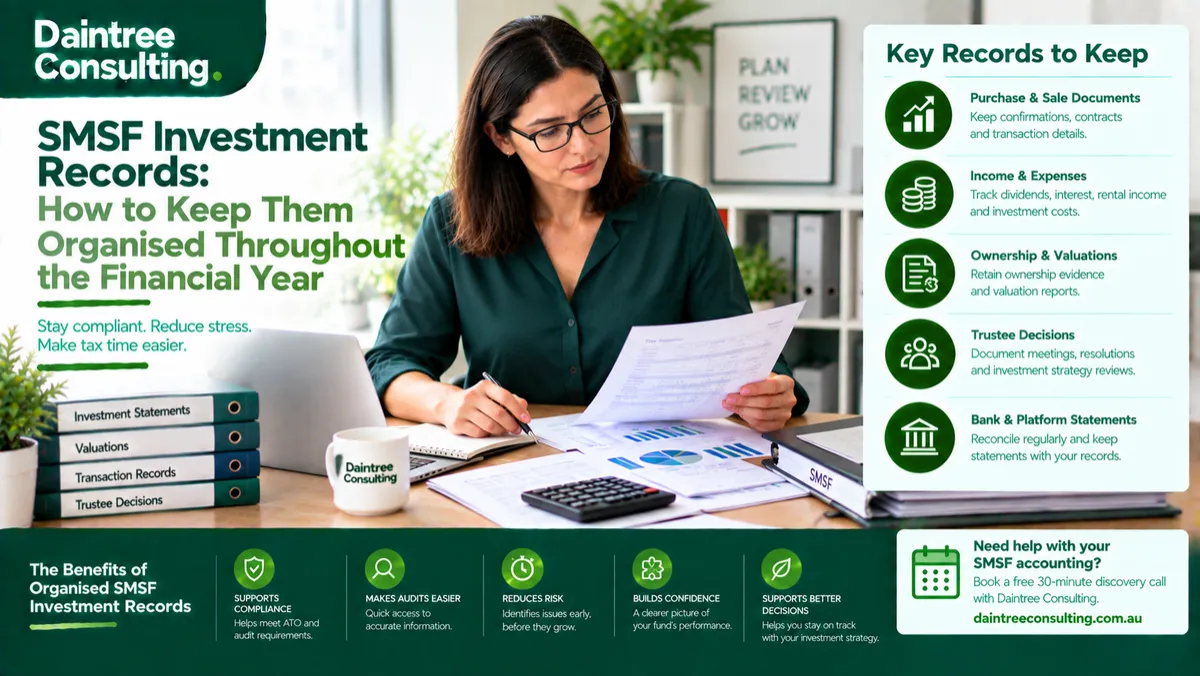
How to Keep SMSF Investment Records Organised Throughout the Financial Year
Managing an SMSF involves more than choosing investments and monitoring their performance.
Trustees also need to maintain records that show what the fund owns, what it has earned or spent, how transactions occurred and why important decisions were made.
Want expert help? Daintree Consulting's SMSF accounting services can take this off your plate. Book a free consultation.
When those records are collected and organised throughout the financial year, the annual accounting and audit process can be much easier to manage.
When records are left until the end of the financial year, however, trustees may find themselves searching through emails, investment platforms, bank statements and property documents trying to reconstruct what happened months earlier.
This is why keeping SMSF investment records organised should be treated as an ongoing process rather than an annual task.
For an SMSF, investment records can include evidence of asset ownership, purchase and sale transactions, income received, expenses paid, valuations, bank and investment statements and documentation supporting trustee decisions.
The Australian Taxation Office requires SMSF trustees to maintain proper and accurate records. Depending on the type of record, the retention period can be at least five or 10 years. Records must also be kept in writing and in English and, where electronic records are used, they must be accessible and capable of being understood and verified.
A consistent record-keeping system can therefore help trustees maintain a clearer picture of the fund throughout the year while also creating a more complete file for annual accounts, tax reporting and independent audit.
Quick Answer: What SMSF Investment Records Should You Keep?
SMSF trustees should keep records that help establish what the fund owns, how investments were acquired or disposed of, the income and expenses associated with those investments, their value and the decisions made about the fund's investment strategy.
Depending on the investments held, useful records may include:
Investment purchase and sale confirmations
Broker or investment-platform statements
Bank statements
Dividend and distribution statements
Interest statements
Tax statements
Capital gains and losses information
Property purchase and sale documents
Property valuation evidence
Rental income records
Property-related expense records
Loan documentation where applicable
Evidence of asset ownership
Records supporting investment valuations
Trustee meeting minutes
Investment strategy documentation
Records of trustee decisions
Documentation supporting related-party transactions, where applicable
Records provided to the SMSF's accountant and auditor
The exact records required depend on the fund's circumstances and investments.
The goal is to ensure that every significant investment transaction has a clear documentary trail.
Why Keeping SMSF Investment Records Organised Matters
Good record keeping is not simply an administrative exercise.
The records help demonstrate how the SMSF operates and provide evidence supporting its financial and tax information.
The ATO explains that proper records can help demonstrate compliance with tax and superannuation obligations, support deductions and capital gains or losses, show how the fund operates and document investment decisions.
For trustees, organised records can also make it easier to answer practical questions such as:
When did the fund acquire this investment?
How much did it pay?
What costs were associated with the transaction?
What income did the investment generate?
What is the current value?
Has the investment been sold?
Where is the evidence of ownership?
Was the transaction properly documented?
What decision did the trustees make?
Does the investment continue to fit the fund's investment strategy?
If the answers are difficult to find, the record-keeping process may need improvement.
1. Create a Separate Record for Each Investment
One of the simplest ways to organise SMSF investment records is to think about the fund's investments individually.
For each investment, maintain a logical collection of supporting documents.
For example, a listed shareholding might have:
Purchase confirmation
Broker statement
Settlement record
Dividend statements
Distribution information
Tax information
Sale documentation
Capital gains information
Year-end valuation evidence
A property investment could require a much larger collection, including:
Contract of purchase
Settlement documentation
Ownership records
Loan documents, where applicable
Rental statements
Property-management statements
Rates
Insurance
Repairs and maintenance records
Valuation information
Sale documentation, if disposed of
The exact documents required depend on the investment.
The important principle is consistency.
If every investment is documented using the same basic structure, trustees and professional advisers can find information more easily.
2. Record the Purchase Properly
The purchase of an SMSF investment creates an important documentary trail.
Do not rely solely on the accounting transaction appearing in the fund's software.
Keep the underlying evidence.
For an investment purchase, this may include:
Date of purchase
Quantity acquired
Purchase price
Transaction costs
Broker or platform confirmation
Settlement information
Evidence of payment
Ownership documentation
This information can become important later when the investment is sold and the fund needs to establish its acquisition details and calculate the relevant tax treatment.
For some investments, particularly those with more complex ownership or documentation requirements, keeping the original legal and transactional records is especially important.
3. Keep Investment Income Records Throughout the Year
Investment records are not limited to purchases and sales.
Trustees also need to keep evidence of income generated by the fund's investments.
Depending on the portfolio, this could include:
Dividends
Interest
Managed fund distributions
Trust distributions
Rental income
Other investment income
Rather than waiting for annual tax statements to arrive and then trying to reconstruct the year, trustees can maintain these records as they are received.
This can help identify missing information before year-end.
For example, if an investment platform statement shows distributions that are not reflected in the accounting records, the discrepancy can be investigated while the transaction is still relatively recent.
4. Keep Track of Investment Expenses
Investment income tells only part of the story.
The SMSF may also incur expenses associated with its investments.
Depending on the investment, these could include:
Brokerage
Investment management fees
Property-management costs
Insurance
Rates
Repairs and maintenance
Interest costs where applicable
Professional fees
Other investment-related expenses
Keep supporting documentation for relevant expenses rather than relying on a bank transaction alone.
A bank statement can show that money left the fund.
It may not explain exactly what the payment was for.
An invoice, statement or other supporting document can provide the additional evidence needed to explain the transaction.
5. Reconcile Investment Accounts Regularly
Reconciliation is one of the most useful habits for keeping SMSF investment records under control.
A reconciliation compares the fund's accounting records with an external source.
Depending on the investment, that source could be:
Bank statements
Brokerage statements
Investment-platform statements
Managed fund statements
Property-management records
Loan statements
The objective is to identify differences.
For example, the accounting records may show 10,000 shares while an investment statement shows 9,500.
That difference needs to be investigated.
It could result from a sale, transfer, corporate action, timing difference or accounting error.
The longer a discrepancy remains unresolved, the harder it can become to determine what caused it.
Regular reconciliation helps prevent small record-keeping issues from becoming year-end problems.
6. Maintain Evidence of Asset Ownership
The ATO identifies proof of ownership of fund assets as an example of SMSF records that trustees should maintain.
This is particularly important because the SMSF, rather than the individual trustee personally, needs to have clear legal ownership of fund assets.
The evidence required can vary depending on the asset.
For example, records may include:
Shareholding statements
Broker records
Investment platform records
Property title or settlement documentation
Trust or unit records
Other ownership documentation
Keep ownership evidence with the other records relating to the investment.
If the fund is audited or an asset is sold later, being able to locate this documentation quickly can be valuable.
7. Keep Investment Valuation Records
SMSF financial statements require investments to be appropriately accounted for, which means trustees need reliable information about the value of fund assets.
The ATO identifies asset valuations among the records SMSF trustees may need to maintain.
The evidence required depends on the type of investment.
For listed investments, market information may be readily available.
For other assets, particularly property or less frequently traded investments, trustees may need more supporting evidence.
The important habit is to retain the information used to establish the investment's value rather than simply recording a number at year-end without supporting documentation.
This creates a clearer audit trail.
8. Keep Trustee Decisions With the Investment Records
Investment records should not only show what the fund invested in.
They should also help demonstrate how and why important trustee decisions were made.
The ATO requires certain trustee meeting minutes and records of decisions to be retained for at least 10 years. This includes decisions relating to matters such as reviewing the fund's investment strategy.
For example, if trustees make an important investment decision, retain the relevant documentation in the fund's records.
This could include:
Meeting minutes
Written resolutions
Investment analysis
Relevant correspondence
Supporting documentation
Investment strategy considerations
Not every investment transaction necessarily requires an elaborate written explanation.
However, significant trustee decisions should be appropriately documented.
9. Review the SMSF Investment Strategy Regularly
Investment records and the investment strategy should not be treated as completely separate areas.
The ATO states that SMSF trustees should regularly review their investment strategy to ensure it continues to meet the current and future needs of members.
The ATO also states that the strategy should be reviewed at least annually and that trustees should document the review and decisions made. Significant events, such as a market correction, a new member joining or leaving, or a member commencing a pension, can also prompt a review.
This means the investment strategy review should form part of the fund's regular governance process.
Keep evidence of:
When the strategy was reviewed
Who reviewed it
What was considered
Decisions made
Any changes to the strategy
Relevant supporting information
The documentation can then be provided to the auditor as evidence that the strategy has been reviewed.
10. Organise Records as Transactions Happen
One of the biggest mistakes trustees can make is treating record keeping as a year-end activity.
By then, documents may be scattered across:
Email accounts
Online investment platforms
Cloud storage
Bank portals
Paper files
Accounting software
Property-management systems
Broker accounts
Instead, establish a process for capturing records as they arise.
For example:
Investment transaction → Save confirmation → Record transaction → Reconcile → File supporting documentation
This approach reduces the amount of work required at the end of the financial year.
It also makes it easier to identify missing documents while they can still be obtained from the relevant provider.
11. Use a Consistent Digital Filing Structure
Electronic record keeping can be particularly effective when the filing system is consistent.
A simple structure could be organised around:
Financial Year
→ Investments
→ Shares
→ Managed Investments
→ Property
→ Cash and Term Deposits
→ Loans
→ Income
→ Expenses
→ Valuations
→ Trustee Decisions
→ Investment Strategy
The exact structure is up to the trustees and their professional advisers.
The important thing is that everyone involved in managing the SMSF understands where records belong.
File names should also make sense.
Instead of:
statement-final-new.pdf
use something such as:
2026-03-31_Broker-Statement_Investment-Account.pdf
A consistent naming system can make searching much easier.
12. Keep Bank and Investment Statements Together
Investment transactions often flow through the SMSF's bank account.
For example:
The fund transfers cash to an investment platform.
The platform purchases an investment.
The investment generates income.
The income is deposited into the platform or bank account.
Fees are deducted.
The investment is eventually sold.
Keeping the bank records and investment-platform records together can make the transaction trail easier to follow.
It can also help the accountant reconcile the accounting records with the underlying investment activity.
13. Pay Attention to Corporate Actions
Share investments can generate additional record-keeping requirements when corporate actions occur.
Depending on the investment, an SMSF may encounter:
Share splits
Consolidations
Takeovers
Mergers
Rights issues
Dividend reinvestment
Capital returns
Other corporate actions
These events can affect the fund's records and may have tax or cost-base implications.
Keep the relevant statements and notices rather than assuming the investment platform will retain everything indefinitely.
If the corporate action changes the nature, quantity or cost of an investment, make sure the accounting records are updated accordingly.
14. Keep Property Investment Records Especially Organised
Property can generate significantly more documentation than many listed investments.
For an SMSF property investment, trustees may need to manage records relating to:
Purchase
Settlement
Ownership
Financing
Rental income
Property management
Repairs
Maintenance
Insurance
Rates
Valuations
Capital improvements
Sale
Because property transactions can involve substantial amounts of money, keeping complete supporting documentation is particularly important.
Do not assume that the property manager, lender, solicitor or other service provider will automatically provide every document required for the SMSF's accounting and audit.
Maintain copies within the fund's records.
15. Reconcile Before the Annual Accounting Process
A strong year-round record-keeping process should make the annual accounts easier to prepare.
Before the financial year closes, trustees can work with their accountant or SMSF administrator to check whether:
All bank accounts have been reconciled
Investment statements are available
Purchases and sales have been recorded
Investment income has been captured
Expenses have supporting documents
Asset ownership evidence is available
Valuation information has been collected
Property records are complete
Loan balances agree with lender statements
Trustee decisions have been documented
The investment strategy review has been completed
Missing documents have been identified
This turns year-end preparation into a review process rather than a document-recovery exercise.
16. Understand the Different Record-Retention Periods
Not every SMSF record has the same retention period.
The ATO currently distinguishes between records that generally need to be retained for at least five years and records that generally need to be retained for at least 10 years. For example, accurate accounting records, annual operating statements and annual financial-position statements fall within the five-year requirements, while trustee meeting minutes and decisions, changes of trustees and certain trustee declarations fall within the 10-year requirements.
This is one reason trustees should avoid simply deleting older records because they appear to be out of date.
The specific retention requirement depends on the type of record and circumstances.
Some tax-related records may also need to be retained for particular periods beyond the basic SMSF record-keeping categories.
When in doubt, check the current ATO requirements or ask your SMSF professional before disposing of records.
Common SMSF Investment Record-Keeping Mistakes
Even trustees who are careful with their SMSF records can encounter recurring problems.
Waiting until the end of the financial year
This creates unnecessary administrative pressure and increases the risk of missing documents.
Keeping only bank statements
Bank statements show transactions but may not provide enough information about the underlying investment activity.
Not keeping purchase documentation
The original acquisition records can become important when calculating gains, losses or other tax information later.
Losing valuation evidence
Recording an asset value without retaining the supporting information can make the year-end process more difficult.
Not documenting trustee decisions
Important investment and strategy decisions should be properly recorded.
Mixing personal and SMSF records
The fund's records should clearly distinguish SMSF transactions and assets from personal financial affairs.
Relying entirely on online platforms
Investment providers may change platforms, statements or access arrangements. Retaining the fund's own copies can provide greater continuity.
Ignoring small discrepancies
A small unexplained difference can become much harder to investigate months later.
A Simple Year-Round SMSF Investment Records Routine
Trustees do not necessarily need to spend hours every week maintaining their records.
A simple recurring routine can help.
Monthly
Check:
Bank transactions
Investment-platform statements
Purchases and sales
Investment income
Investment expenses
Outstanding documents
Unreconciled transactions
Quarterly
Review:
Investment holdings
Significant transactions
Asset valuations where relevant
Cash position
Investment income
Documentation gaps
Before financial year-end
Check:
All investment transactions are recorded
Supporting documents are available
Asset ownership records are complete
Valuation information is available
Investment income has been captured
Expenses are supported
Property records are complete
Loan balances have been confirmed
Trustee decisions are documented
Annually
Review:
Investment strategy
Trustee decisions
Fund records
Asset valuations
Accounting information
Documents required for the annual accounts and audit
This routine can make the overall SMSF administration process considerably more manageable.
When Should You Get Professional SMSF Accounting Support?
Some SMSFs are relatively straightforward.
Others involve property, multiple investments, pensions, complex transactions, related-party arrangements or other circumstances that require more detailed administration.
Professional SMSF accounting support can help trustees maintain accurate records, prepare annual financial statements, organise information required for the independent audit and support annual return preparation.
It can also help identify missing documentation before the annual accounts and audit process begins.
For trustees, the value is not simply having someone prepare the accounts once a year.
A well-organised accounting process can provide a clearer record of what happened throughout the financial year.
How Daintree Consulting Can Help With SMSF Accounting
Daintree Consulting provides specialist SMSF accounting support for trustees who need help keeping their fund's financial records organised and up to date.
Support can include:
Annual SMSF financial statements
Investment transaction records
Contributions and pension tracking
Investment income and expenses
Records for independent audit
Annual return support
Audit-file preparation
Independent auditor coordination
For trustees with multiple investments or a more complex fund structure, having an organised accounting process can reduce the administrative burden and make it easier to maintain the records needed throughout the year.
If you are finding it difficult to keep your SMSF investment records organised, Daintree Consulting can help you establish a more structured approach to SMSF accounting and record management.
Book a free 30-minute discovery call to discuss your SMSF accounting requirements.
Final Thoughts
Keeping SMSF investment records organised should not be something trustees think about only when the financial year ends.
The better approach is to maintain the records continuously.
Save transaction documents when investments are purchased or sold. Keep income and expense information as it is received. Reconcile investment accounts regularly. Maintain evidence of ownership and valuations. Document important trustee decisions and keep evidence of the investment strategy review.
The ATO requires SMSFs to maintain proper and accurate records, with different minimum retention periods applying depending on the type of record.
For trustees, the practical benefit of good organisation is straightforward: fewer missing documents, clearer financial records and a smoother process when the fund's annual accounts and independent audit are prepared.
Good SMSF investment records also create a useful historical record of the fund's investments and trustee decisions.
The objective is not to create unnecessary paperwork.
It is to make sure that when a trustee, accountant or auditor needs to understand what happened during the year, the evidence is there.
Frequently Asked Questions
What are SMSF investment records?
SMSF investment records are documents that support the fund's investments and related transactions. They can include purchase and sale confirmations, investment statements, income records, expense documents, ownership evidence, valuations and relevant trustee decisions.
How long do SMSF investment records need to be kept?
The required retention period depends on the type of record. The ATO currently specifies minimum periods of five or 10 years for different categories of SMSF records. Some records, including certain trustee meeting minutes and decisions, need to be kept for at least 10 years.
Should SMSF investment records be kept electronically?
Yes. SMSF records can be kept electronically, provided they are maintained in a form that can be accessed, understood and verified when required.
What records should I keep when my SMSF buys shares?
Keep the purchase confirmation, transaction details, evidence of payment, broker or investment-platform statements and other documentation establishing the fund's ownership and acquisition details. Continue keeping relevant income, corporate-action and sale records throughout the investment's life.
What records should I keep for an SMSF property investment?
Property records can include purchase and settlement documents, ownership records, loan documents where applicable, rental statements, property-management records, rates, insurance, repairs, maintenance, valuations and sale documentation.
How often should SMSF investment records be updated?
Investment records should ideally be updated throughout the year rather than waiting until the end of the financial year. Regular reconciliation and document collection can help identify missing or inconsistent information earlier.
Does the SMSF investment strategy need to be reviewed every year?
The ATO states that SMSF trustees should review their investment strategy at least annually and document the review and decisions made. Certain significant events can also prompt a review.
Do SMSF trustees need to keep records of investment decisions?
Important trustee decisions affecting the SMSF should be documented. The ATO specifically includes minutes of trustee meetings and decisions among records that generally need to be retained for at least 10 years.
Can an SMSF accountant help organise investment records?
Yes. An SMSF accountant can help trustees maintain accounting records, reconcile investment transactions, prepare financial statements, organise information required for the annual audit and support annual return preparation. The precise scope depends on the engagement and the fund's circumstances.
Important Publishing Note: SMSF record-keeping, investment, taxation, valuation and reporting requirements can vary depending on the fund's circumstances and the type of investment held. ATO requirements can change, so trustees should confirm current requirements for the relevant financial year. This article provides general information and is not personal financial, tax or legal advice. Trustees remain responsible for complying with the requirements applying to their SMSF.
Talk to Daintree about your SMSF accounts
Our ex-Big 4 team gives clear, senior-reviewed advice so you can act with confidence.
Book a free consultation →
Or explore our SMSF accounting services.
