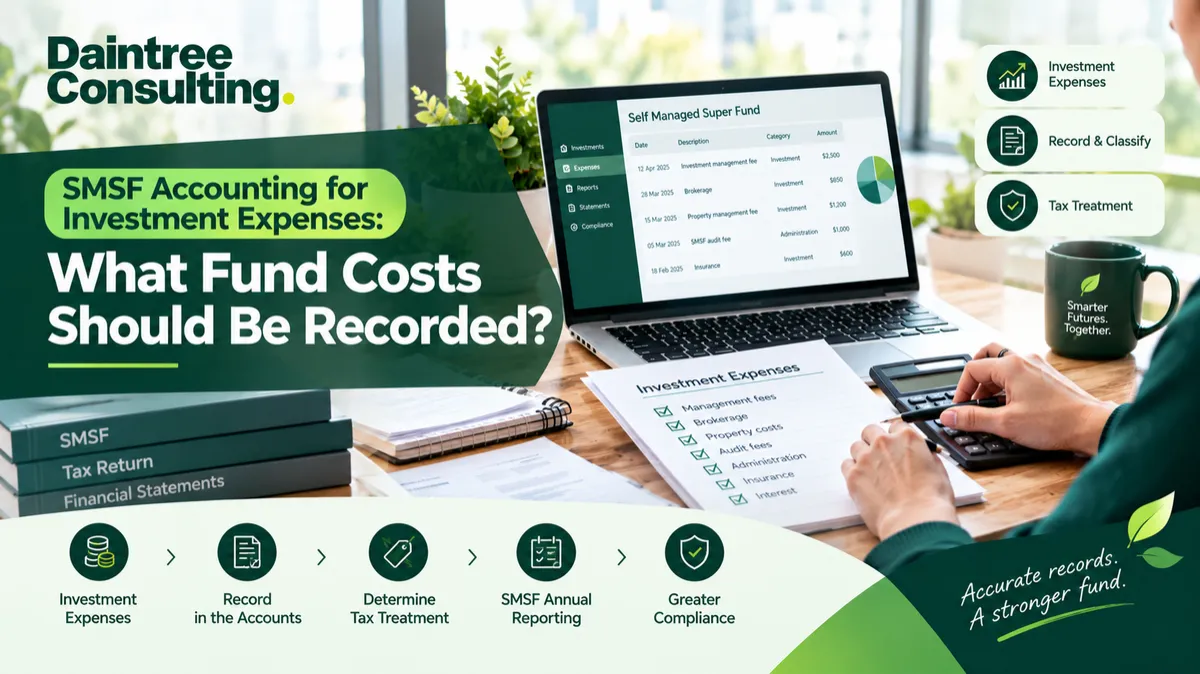
SMSF Investment Expenses: What Costs Should Be Recorded?
When an SMSF pays a cost connected with its investments, trustees need to do more than simply record the amount that left the fund bank account.
The expense needs to be identified, recorded and classified correctly. It may be an investment expense, an administration expense, an audit cost, a capital cost or another type of fund expenditure. Its tax treatment can also differ depending on the nature of the expense and whether the SMSF earns assessable or exempt income.
Want expert help? Daintree Consulting's SMSF accounting services can take this off your plate. Book a free consultation.
This is why SMSF investment expenses deserve careful attention during the year and when the annual accounts are prepared.
The Australian Taxation Office (ATO) distinguishes between deductible and non-deductible expenses in an SMSF's annual reporting. For investment-related expenses, the nature of the expense is critical to determining whether a deduction is available.
For trustees, the practical rule is simple:
Record the fund cost first. Determine its tax treatment separately.
That approach helps prevent expenses being missed simply because they are not immediately deductible.
Quick answer: What SMSF investment expenses should be recorded?
An SMSF should maintain records of expenses incurred by the fund, including costs associated with acquiring, holding, managing or disposing of investments, as well as broader administration and compliance costs.
Depending on the fund's investments, this can include:
Investment management fees
Ongoing investment adviser fees
Brokerage and portfolio-related bank fees
Certain investment advice costs
Rental property expenses
Interest expenses
Insurance and storage costs for eligible collectables and artworks
SMSF accounting and administration costs
SMSF audit fees
Tax-related expenses
Other legitimate fund expenses
Not all of these expenses are necessarily deductible in the same way.
For example, the ATO identifies interest, ongoing investment adviser fees, portfolio-servicing costs, bank fees, rental property expenses and brokerage fees as examples of deductible investment-related expenses, subject to the applicable rules.
The important distinction is between recording an expense in the SMSF's accounting records and claiming a tax deduction for that expense.
What are SMSF investment expenses?
SMSF investment expenses are costs incurred by the fund in connection with its investments and the process of earning investment income.
The exact classification depends on what the fund has paid for.
For example, an SMSF that invests in listed shares might incur:
Brokerage
Investment platform fees
Portfolio management fees
Investment advice fees
Bank charges associated with the investment portfolio
An SMSF that owns an investment property may have costs such as:
Property management fees
Certain repairs and maintenance
Rates and other property-related costs
Insurance
Interest expenses, where applicable
The ATO's SMSF annual return instructions specifically identify investment expenses as expenses of a revenue nature incurred in deriving investment income, where they are not more appropriately reported elsewhere.
That classification matters because the tax treatment of an expense can depend on its nature.
Why should trustees record every fund expense?
A common mistake is to think:
"If it isn't tax deductible, we don't need to record it."
That is not a good approach.
SMSF accounting needs to capture the fund's financial activity, not just the expenses that ultimately produce a tax deduction.
The ATO's reporting framework distinguishes between deductible and non-deductible expenses, and total SMSF expenses can include both.
Recording the full expenditure helps the accounts show what actually happened within the fund.
It can also help with:
Preparing the SMSF financial statements
Completing the SMSF annual return
Calculating taxable income
Preparing for the annual audit
Tracking investment performance
Reconciling the fund's bank account
Maintaining an audit trail
Identifying transactions requiring further review
In other words, non-deductible does not mean irrelevant to the accounts.
Which SMSF investment expenses are commonly recorded?
The precise expenses will depend on the SMSF's investment strategy and portfolio.
Here are some of the more common categories.
1. Investment management fees
An SMSF may pay an investment manager or adviser ongoing fees for managing or advising on its investment portfolio.
Where the expense is genuinely incurred in relation to earning assessable investment income, it may qualify as a deductible investment expense, subject to the applicable rules. The ATO specifically lists ongoing management fees or retainers paid to investment advisers as an example of deductible investment-related expenditure.
The invoice should make it clear what service was provided.
If a fee covers multiple services or includes matters that do not relate to assessable investment income, the appropriate treatment may require further analysis.
2. Brokerage and investment transaction costs
An SMSF buying or selling listed investments may incur brokerage.
Brokerage needs to be properly captured in the fund's accounting records and considered in the appropriate tax treatment.
The ATO lists brokerage fees among examples of costs associated with servicing and managing an investment portfolio.
However, trustees should not assume that every transaction cost is automatically a simple annual tax deduction.
The underlying transaction matters.
A cost associated with acquiring or disposing of an investment may need to be considered in the context of the investment's tax and accounting treatment rather than simply being treated as an ordinary recurring expense.
3. Investment platform and portfolio fees
Some SMSFs use investment platforms, custodial arrangements or portfolio services.
These may produce regular fees or charges.
Trustees should retain statements or invoices showing:
The provider
The period covered
The amount charged
The nature of the service
Any relevant GST information
The investment or account to which the fee relates
This gives the accountant enough information to classify the expense appropriately.
4. Investment advice fees
An SMSF may incur fees for investment advice.
The tax treatment can depend heavily on what the advice was actually for.
For example, the ATO identifies advice relating to changing the mix of investments as potentially deductible where it does not amount to a new financial plan. If advice covers other matters or investments that do not produce assessable income, only the appropriate portion may be deductible.
Advice connected with establishing a new investment structure can have different treatment.
This is why trustees should avoid categorising an invoice simply as "financial advice" and assuming it is deductible.
The underlying service should be reviewed.
What about SMSF investment property expenses?
Property can make SMSF accounting considerably more detailed.
If an SMSF owns an investment property, trustees may encounter costs such as:
Property management fees
Repairs and maintenance
Rates
Insurance
Certain property-related bank charges
Interest expenses
Other property operating costs
The ATO specifically includes rental property expenses among examples of investment-related expenses that may be deductible, subject to the applicable rules.
But property expenses should still be supported by appropriate documentation.
Trustees should retain invoices, receipts, statements and other records showing what was paid and why.
The accounting records should also distinguish between ordinary property expenses and costs that may need different treatment for tax or capital purposes.
What about interest expenses?
Interest can be an SMSF investment expense, but trustees should not assume that every interest payment is automatically deductible.
The purpose of the borrowing and the applicable superannuation and tax rules need to be considered.
The ATO identifies interest expenses as an example of investment-related expenses, while also providing specific reporting categories for interest expenses within Australia and overseas.
Where an SMSF has borrowing arrangements, trustees should keep the relevant loan statements and supporting documentation with the fund's accounting records.
What about SMSF accounting and administration costs?
Not every cost associated with running an SMSF is an investment expense.
This is an important distinction.
Costs incurred in managing and administering the SMSF may belong in the management and administration category rather than investment expenses.
The ATO's reporting instructions distinguish investment expenses from management and administration expenses and state that investment management expenses should be reported with investment expenses rather than general management and administration expenses.
Depending on the circumstances, administration-related costs can include services associated with:
SMSF accounting
Tax return preparation
Fund administration
Record keeping
Certain professional services
Other compliance and administration activities
The correct classification depends on the service provided.
What about the SMSF auditor fee?
The annual SMSF audit fee is another important cost to record.
The auditor's fee is separately identified in the SMSF annual return reporting framework rather than simply being lumped into investment expenses or general administration expenses.
Trustees should therefore retain the auditor's invoice and make sure the payment is reflected correctly in the fund's accounting records.
The fact that an expense is separately reported does not necessarily mean it receives the same tax treatment in every circumstance.
Deductible does not mean the same thing as recorded
This distinction is worth emphasising.
Consider an SMSF that pays:
$1,200 in investment management fees
$800 in accounting and administration fees
$700 for the annual audit
$400 in brokerage
$500 for an expense that is capital in nature
All of these transactions may need to appear in the fund's accounting records.
But they do not necessarily receive identical tax treatment.
The ATO states that expenses of a capital, private or domestic nature, and expenses incurred in gaining exempt or non-assessable non-exempt income, are generally not allowable deductions.
So the accounting process should not work backwards from the question:
"Can I claim this?"
Instead, it should begin with:
"What did the SMSF actually pay for?"
The tax treatment can then be determined from there.
What expenses may not be immediately deductible?
Some expenses may be recorded in the accounts but require different tax treatment.
Examples can include costs that are:
Capital in nature
Related to exempt income
Related to non-assessable non-exempt income
Related to foreign income subject to special rules
Associated with non-arm's-length income
Otherwise excluded under specific tax provisions
The ATO specifically notes that investment expenses relating to foreign income or non-arm's-length income should not simply be included in the ordinary investment expense deduction label.
This is one reason why classification should be completed carefully rather than treating every investment-related transaction as an ordinary deductible expense.
What changes when an SMSF is in pension phase?
This is one of the areas where expense treatment can become more complicated.
An SMSF may have both accumulation and retirement-phase interests.
Where an expense relates to both assessable income and exempt current pension income (ECPI), it may need to be apportioned.
The ATO states that, generally, expenses incurred in gaining or producing exempt or non-assessable non-exempt income are not deductible. Where an expense relates to both ECPI and assessable income, the expense generally needs to be apportioned so that only the appropriate portion is claimed.
The ATO also notes that if a fund is 100% in retirement phase, expenses generally should not be deducted where they are incurred in gaining ECPI, although certain deductions have specific rules that can allow them in full.
This means trustees should be particularly careful when an SMSF has both accumulation and pension interests.
What records should trustees keep for SMSF investment expenses?
Good records are essential.
The ATO advises trustees to retain invoices and receipts supporting fund expenses. Those documents should be in the name of the SMSF and, wherever possible, the expense should be paid directly from the fund's bank account.
Depending on the expense, useful records can include:
Invoices
Receipts
Broker statements
Investment platform statements
Bank statements
Property management statements
Loan statements
Adviser invoices
Investment management reports
Insurance documents
Auditor invoices
Accounting invoices
Contracts
Supporting correspondence
A clear documentary trail makes it easier to establish what the fund paid for and how the expense should be treated.
Why should expenses be paid from the SMSF bank account?
Wherever possible, fund expenses should be paid directly from the SMSF's bank account.
This helps maintain a clear separation between the fund's transactions and the trustees' personal finances.
The ATO specifically recommends that, wherever possible, SMSF expenses should be paid directly from the fund's bank account.
If a trustee pays an SMSF expense personally, the transaction may require additional accounting treatment and supporting documentation.
Rather than allowing these transactions to accumulate until year-end, trustees should provide the relevant records to their SMSF accountant promptly.
Common SMSF investment expense mistakes
Treating every investment cost as deductible
An investment-related expense is not automatically deductible simply because it relates to an investment.
Its nature and purpose need to be considered.
Recording only deductible expenses
The SMSF's accounting records should reflect the fund's transactions, not just the expenses that produce tax deductions.
Mixing administration and investment costs
Accounting, administration, audit and investment management expenses can have different classifications.
Losing invoices
A bank transaction may show that money left the account, but it may not explain exactly what the payment was for.
Paying fund expenses personally without keeping records
Where trustees personally pay fund costs, the supporting documentation and accounting treatment should be maintained carefully.
Ignoring pension-phase considerations
Expenses can require apportionment where the SMSF has both assessable and exempt income.
Waiting until year-end
Trying to reconstruct 12 months of investment expenses immediately before the accounts and audit are due can create unnecessary work.
How trustees can keep SMSF investment expenses organised
A simple system can make year-end accounting much easier.
Keep documentation with the transaction
Save the invoice, receipt or statement when the expense occurs.
Use clear expense descriptions
Instead of recording "fee", retain enough information to identify the provider and purpose of the payment.
Separate investment categories
Where practical, keep investment-related records organised by asset or investment type.
For example:
Listed shares
Broker statements
Brokerage
Investment platform fees
Dividend information
Investment property
Property manager statements
Rates
Insurance
Repairs
Loan statements
Managed investments
Distribution statements
Management fees
Investment statements
Reconcile regularly
Regular reconciliation can identify missing invoices, duplicate entries and unexplained transactions before year-end.
Give complete records to the SMSF accountant
The accountant needs enough information to determine the appropriate accounting and tax treatment.
This is particularly important when an expense could be capital, partly deductible or connected with both assessable and exempt income.
How SMSF investment expenses affect the annual audit
Investment expenses can also become relevant during the SMSF's annual audit.
The auditor needs to obtain evidence supporting the financial information and the fund's compliance.
If an expense appears in the accounting records but there is no supporting invoice, statement or other evidence, the auditor may need to make further enquiries.
Good documentation creates a clearer audit trail:
Payment → supporting document → accounting classification → financial statements → annual return → audit evidence
That makes the annual reporting process more straightforward.
It also helps trustees answer questions from their accountant or auditor without having to reconstruct transactions months after they occurred.
How Daintree Consulting can help with SMSF accounting
Managing SMSF investment expenses becomes more involved when a fund has multiple investments, property, pension accounts or a high volume of transactions.
Daintree Consulting's SMSF Accounting service supports trustees with fund records, accounting, reconciliations, year-end documentation, audit-file preparation and coordination with the independent SMSF auditor.
This can help trustees keep investment transactions and expenses properly organised throughout the financial year rather than trying to reconstruct everything at year-end.
Daintree's service can be particularly useful when:
Fund records are fragmented
Investment statements are difficult to reconcile
The SMSF holds several asset classes
Trustees want clearer year-end documentation
The annual audit requires significant follow-up
Investment expenses need to be properly classified
The fund has both accumulation and pension interests
The aim is to provide trustees with clearer accounting records and a more organised process for annual reporting.
Frequently asked questions
What are SMSF investment expenses?
SMSF investment expenses are costs incurred by an SMSF in connection with managing investments or deriving investment income. Examples can include investment management fees, certain adviser fees, brokerage, bank fees, rental property expenses and interest, subject to the applicable rules.
Are all SMSF investment expenses tax deductible?
No. The tax treatment depends on the nature and purpose of the expense and the SMSF's circumstances. Some investment expenses may be deductible, while others may be non-deductible or require different treatment.
Should an SMSF record non-deductible expenses?
Yes. The fund's accounting records need to reflect its transactions, and the ATO's reporting framework distinguishes between deductible and non-deductible expenses.
Can SMSF investment expenses be apportioned?
They can be in some circumstances. For example, where an expense relates to both assessable income and exempt current pension income, the appropriate amount may need to be apportioned.
Should SMSF expense invoices be in the fund's name?
The ATO advises trustees to retain invoices and receipts evidencing fund expenses and states that invoices and receipts must be in the name of the SMSF.
What is the difference between an investment expense and an administration expense?
An investment expense relates to the fund's investments or deriving investment income, while management and administration expenses relate to running and administering the SMSF. The ATO's annual return instructions distinguish the two categories.
Final takeaway
The key to managing SMSF investment expenses is not simply identifying which costs are deductible.
Trustees need to make sure the fund's actual expenses are recorded, supported by appropriate documentation and classified correctly.
Investment management fees, brokerage, certain adviser fees, property costs, interest and other investment-related expenses may all need to be considered. But some expenses may be capital, non-deductible or subject to special rules.
The distinction becomes even more important where an SMSF has retirement-phase members, foreign investments, non-arm's-length income or multiple investment structures.
Keeping invoices and statements, paying expenses from the SMSF bank account where possible and maintaining organised records throughout the year can make the annual accounting and audit process considerably easier.
If you're unsure whether your SMSF's investment expenses are being recorded and classified correctly, Daintree Consulting can help you organise the fund's accounting records and prepare for annual reporting and audit requirements.
Book a free 30-minute discovery call with Daintree Consulting to discuss your SMSF accounting requirements.
Talk to Daintree about your SMSF accounts
Our ex-Big 4 team gives clear, senior-reviewed advice so you can act with confidence.
Book a free consultation →
Or explore our SMSF accounting services.
