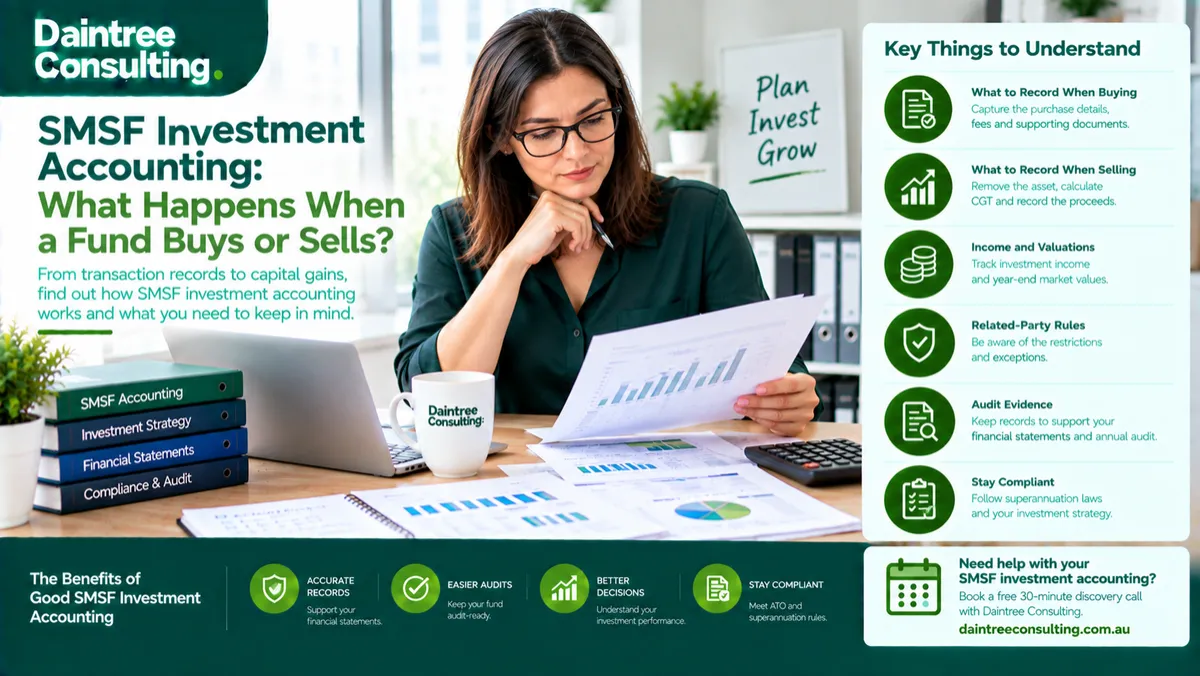
What Happens to SMSF Accounting When a Fund Buys or Sells an Investment?
Buying or selling an investment is a normal part of managing a self-managed super fund (SMSF). But from an accounting perspective, an investment transaction involves more than recording money leaving or entering the SMSF bank account.
The transaction can affect the fund's asset records, cost base, investment income, capital gains or losses, market valuations, financial statements and annual tax reporting. The supporting documentation may also need to be available for the SMSF's annual audit.
Want expert help? Daintree Consulting's SMSF accounting services can take this off your plate. Book a free consultation.
This is why SMSF investment accounting needs to be handled carefully whenever a fund buys or sells shares, managed funds, property or other permitted investments.
The accounting treatment will depend on what the SMSF bought or sold, how the transaction occurred, the relevant dates and the fund's circumstances.
Quick answer
When an SMSF buys an investment, the transaction generally needs to be recorded as the acquisition of a fund asset, with the relevant purchase costs and supporting documentation captured in the accounting records.
When an SMSF sells an investment, the accounting process generally involves recording the disposal, removing the asset from the fund's records, calculating the resulting capital gain or loss where applicable, and recording the cash proceeds and related income or expenses.
The investment may also need to be valued at market value for the SMSF's financial statements and reporting requirements.
For SMSF trustees, the important point is that buying or selling an investment creates an accounting trail that needs to remain accurate from the original transaction through to the fund's annual accounts and audit.
The ATO states that SMSF investments must comply with the fund's trust deed and superannuation laws. Trustees also need an investment strategy covering how assets are made, held and realised, while investments must meet requirements including the sole purpose test, arm's-length requirements, legal ownership and specific investment restrictions.
What happens when an SMSF buys an investment?
Suppose an SMSF purchases listed shares for $30,000.
The SMSF accounting records need to reflect the acquisition of those shares as an asset of the fund. The corresponding payment will generally be reflected through the fund's bank or investment account.
The accounting file should also retain evidence showing what was purchased, when it was purchased and how much the fund paid.
Depending on the investment, this could include:
Contract notes
Broker statements
Investment platform statements
Bank statements
Invoices or settlement documents
Ownership or title documentation
Investment income statements
Relevant transaction records
The ATO's SMSF auditor checklist specifically identifies purchase contracts, title documentation, bank transactions and other supporting records as documents that may be relevant when checking acquisitions.
The purchase price becomes important later
The original acquisition information is particularly important when the SMSF eventually sells the investment.
For example, if the fund purchases shares for $30,000 and later sells them for $42,000, the original acquisition information is needed to determine the relevant gain or loss.
If transaction costs or other amounts affect the tax treatment or cost base, those details also need to be properly identified.
This is one reason why investment accounting should not simply record the amount appearing in the bank account.
The accounting records need to retain enough information to understand the underlying investment transaction.
What happens when an SMSF sells an investment?
Selling an investment creates another set of accounting entries.
Assume the SMSF purchased an investment for $30,000 and later sold it for $42,000.
The accounting process needs to capture the disposal and the proceeds received by the fund. The investment is removed from the fund's asset records, and the relevant capital gain or loss is determined based on the transaction and applicable tax rules.
For a complying SMSF, the ATO notes that a capital gains tax discount of one-third can apply where the relevant asset has been owned for more than 12 months.
The actual tax treatment can depend on the fund's circumstances, the type of asset, the transaction and whether other rules apply.
That is why the sale should not be treated as simply:
Money received → profit recorded.
The accounting and tax records need to connect the sale back to the original acquisition.
SMSF investment accounting needs to track the investment lifecycle
A useful way to think about SMSF investment accounting is as a complete lifecycle:
Acquisition → holding → income → valuation → disposal → capital gain or loss → reporting
Each stage can create information that needs to be reflected in the fund's records.
1. Acquisition
The fund buys the investment.
Records should establish:
What was purchased
Purchase date
Purchase price
Quantity or units acquired
Transaction costs where relevant
Ownership details
Source of payment
Supporting documentation
2. Holding period
While the SMSF owns the investment, it may receive income.
For example:
Share dividends
Managed fund distributions
Interest
Rental income
Other investment income
The income needs to be correctly identified and recorded in the SMSF accounts.
3. Valuation
SMSF investments generally need to be reflected at appropriate market value for financial reporting and other compliance purposes.
The ATO explains that asset valuation is important for preparing meaningful SMSF financial reports and for determining compliance with several superannuation requirements.
The valuation process can be straightforward for some listed investments because market prices are readily available.
Other assets, particularly property and certain less-liquid investments, can require more supporting evidence.
4. Disposal
The investment is sold or otherwise disposed of.
The accounting records need to capture the disposal date, proceeds and removal of the asset.
5. Capital gain or loss
The SMSF then needs to determine the relevant capital gain or loss for tax reporting purposes.
The ATO requires SMSFs to retain records relating to capital gains and capital losses, including records of transactions that affect the fund's CGT position.
6. Financial statements and annual reporting
The completed investment information feeds into the SMSF's financial statements and annual reporting.
SMSF trustees are responsible for preparing financial statements, arranging an annual audit and lodging the SMSF annual return.
This is why a transaction that happened months earlier can still matter when the annual accounts are being prepared.
What documents should an SMSF keep when buying or selling investments?
Good documentation makes SMSF accounting significantly easier.
For an investment purchase, relevant records may include:
Contract notes
Broker confirmations
Bank statements
Investment platform statements
Settlement statements
Purchase invoices
Ownership records
Trustee resolutions or minutes where relevant
Valuation evidence where required
Investment strategy documentation where relevant
For a sale, the records may include:
Sale contract or contract note
Broker statement
Bank receipt
Disposal date
Sale proceeds
Transaction costs
Original acquisition records
Cost-base information
Supporting CGT calculations
The exact records required will depend on the investment and circumstances.
The ATO's SMSF guidance indicates that trustees need to maintain records supporting information reported in the annual return, while some records relating to capital gains and losses need to be retained for specific periods.
Why the original purchase information matters when an SMSF sells
One of the easiest problems to create is losing track of an investment's original acquisition information.
Imagine an SMSF has held shares for several years.
During that time:
The SMSF buys additional shares
Some shares are sold
Dividends are received
The investment platform changes
Shares may be transferred or consolidated
The fund's accounting software is updated
By the time the SMSF sells part of its holding, the original transaction information may no longer be immediately obvious.
Without a reliable investment history, calculating the relevant tax position can become much harder.
This is particularly important where an SMSF has multiple investment parcels.
The accounting records should make it possible to trace the relevant investment from acquisition through to disposal.
What about investment income?
Buying and selling investments is only one part of SMSF investment accounting.
An SMSF may also receive income while it holds an investment.
For example, a share portfolio may generate:
Dividends
Franking credits
Distributions
Interest
Capital gains distributions
A managed fund may issue annual tax statements containing information that differs from the simple cash amount received.
Property investments can create another layer of accounting involving rental income, expenses, depreciation and other property-related information.
The accounting process therefore needs to distinguish between cash movements and the underlying nature of the transaction.
A bank statement might show that $2,000 was received, but the accounting records need to identify what that $2,000 represents.
What happens at year-end?
At the end of the financial year, investment transactions become particularly important.
The SMSF's accounting records need to support the preparation of the fund's financial statements and annual return.
The fund's investments also need to be appropriately valued.
For example, if an SMSF owns listed shares at 30 June, the accounting records need to reflect the relevant year-end position rather than simply carrying forward the amount originally paid for the shares.
The ATO notes that SMSF asset valuations are relevant to financial statements, related-party acquisitions, arm's-length requirements, in-house asset calculations and other superannuation compliance matters.
This means year-end investment accounting is not simply about checking whether the bank account reconciles.
The accounting file needs to provide a reliable picture of what the SMSF owns and the relevant financial position at year-end.
What if the SMSF buys an investment from a related party?
This is an area where trustees need to be particularly careful.
SMSF investment rules contain restrictions around acquiring assets from related parties.
The ATO states that SMSFs are generally prohibited from acquiring assets from related parties, subject to limited exceptions. Examples of exceptions include certain listed securities and business real property acquired at market value, subject to the applicable requirements.
The transaction therefore cannot simply be treated as a normal purchase because the parties agree on a price.
Trustees need to consider:
Whether the transaction is permitted
Whether the parties are related
Whether the investment is being acquired at market value
Whether the transaction is conducted on an arm's-length basis
Whether the investment strategy supports the transaction
Whether in-house asset rules apply
Whether appropriate documentation has been retained
The ATO's SMSF investing guidance states that investments must be made on a commercial arm's-length basis and reflect true market value.
If a related-party transaction is being considered, trustees should obtain appropriate professional advice before proceeding.
What if the SMSF sells an investment to a related party?
Selling an SMSF investment to a related party also requires careful consideration.
The accounting treatment alone does not determine whether the transaction complies with superannuation law.
Trustees need to consider the applicable investment, related-party, market-value and arm's-length requirements before the transaction occurs.
For certain assets, particularly property, the transaction may involve additional legal, valuation, tax and superannuation considerations.
This is an example of why SMSF accounting and SMSF compliance cannot always be separated.
The accounting records need to accurately reflect what happened, but trustees also need to ensure the transaction itself was permitted.
What about SMSF property investments?
Property can make investment accounting considerably more involved.
If an SMSF buys property, the accounting records may need to track:
Purchase price
Settlement costs
Legal costs
Stamp duty where applicable
Rental income
Property management expenses
Repairs and maintenance
Loan transactions where applicable
Depreciation-related information
Market valuation
Sale proceeds
Disposal costs
Capital gain or loss
Property also creates additional documentation requirements.
The ATO's SMSF auditor checklist identifies purchase documents, title deeds, market-value evidence, financial statements, bank transactions and other supporting documentation as relevant audit evidence for SMSF acquisitions.
Where an SMSF uses borrowing to acquire an investment, additional rules and documentation may apply. An LRBA, for example, has specific requirements around the asset, borrowing arrangement and holding trust structure.
How investment transactions affect the SMSF audit
Every SMSF must arrange an annual audit.
Investment transactions are therefore likely to form part of the information reviewed during the audit.
An auditor may need to establish that:
The investment exists
The SMSF owns the investment
The transaction occurred
The investment was acquired or disposed of appropriately
The transaction value is supported
Relevant income has been recorded
The year-end value is supported
Related-party rules have been considered where relevant
The accounting records agree with supporting documentation
This is where good SMSF investment accounting can make the annual process much smoother.
If the accounting records already contain the contract notes, statements, valuations, transaction history and relevant supporting information, there is less need to reconstruct the investment history at year-end.
Common SMSF investment accounting mistakes
Several problems can make investment accounting more difficult than it needs to be.
Recording only the bank movement
A bank statement may show the cash movement, but it does not necessarily provide all the information needed for the investment accounting and tax records.
Losing original acquisition records
If the original purchase information cannot be located, calculating a later capital gain or loss may become unnecessarily difficult.
Failing to reconcile investment statements
Broker and investment-platform statements should be checked against the accounting records.
Differences should be investigated rather than carried forward.
Incorrect year-end valuations
The fund's financial statements need reliable information about the value of its assets at year-end.
Mixing personal and SMSF investment transactions
SMSF assets belong to the fund and need to be kept separate from personal assets.
Not identifying related-party transactions
A transaction involving a trustee, member or related entity may require additional consideration.
Treating every investment the same
Shares, managed funds, property and other investments can have different accounting and tax characteristics.
A consistent process is important, but the underlying transaction still needs to be correctly classified.
How to make SMSF investment accounting easier
Trustees can reduce year-end problems by keeping investment records organised throughout the year.
A practical process can include:
Keep every contract note and investment statement.
Reconcile investment accounts regularly.
Record acquisitions promptly.
Keep the original purchase information with the investment records.
Record investment income against the correct investment.
Track sales and disposal information carefully.
Maintain evidence supporting year-end valuations.
Identify related-party transactions before they occur.
Keep accounting records consistent with the SMSF bank account and investment platform.
Prepare the records in a way that makes the annual audit easier.
The goal is not simply to have accurate bookkeeping.
The goal is to maintain a clear financial history of the SMSF's investments.
When should you get professional SMSF accounting support?
SMSF investment accounting can become more complex as a fund's investment portfolio grows.
Professional accounting support may be useful where the fund has:
Multiple investment accounts
Frequent share transactions
Managed fund investments
Property
Complex investment structures
Large numbers of transactions
Related-party transactions
Limited recourse borrowing arrangements
Multiple members
Pension-phase considerations
Difficult-to-value assets
Significant capital gains or losses
The benefit is not simply having someone enter transactions into accounting software.
A good SMSF accounting process should help create reliable records that connect the fund's investments, income, expenses, valuations, financial statements, tax reporting and annual audit.
How Daintree Consulting can help with SMSF investment accounting
Investment activity can make SMSF administration more demanding, particularly when trustees are managing several investments or dealing with transactions that require additional documentation.
Daintree Consulting provides specialist SMSF accounting support covering areas such as annual financial statements, investment tracking, contribution and pension information, records for independent audit, annual return support and audit-file preparation.
For trustees, the objective is to keep the fund's accounting records organised and supported throughout the financial year rather than trying to reconstruct investment activity at the end of the year.
If your SMSF has recently bought or sold investments, or your investment accounting process is becoming difficult to manage, you can explore Daintree's SMSF Accounting service or book a free 30-minute discovery call to discuss your requirements.
Frequently Asked Questions
Does buying an investment affect SMSF accounting?
Yes. The acquisition needs to be recorded as an SMSF asset, with the relevant transaction details and supporting documentation retained. The investment may also generate income and will generally need to be considered in the fund's year-end valuation and reporting.
Does selling an SMSF investment create a capital gain?
A disposal can create a capital gain or capital loss for the SMSF. The calculation depends on the asset, acquisition and disposal details and the applicable tax rules.
For complying SMSFs, the ATO states that a one-third CGT discount can apply to a relevant asset held for more than 12 months.
What records should I keep when my SMSF sells shares?
Keep the sale contract note or broker statement, sale date, proceeds, transaction costs and the original acquisition records needed to establish the relevant cost base and capital gain or loss.
Does an SMSF need to value its investments?
SMSF assets need to be appropriately valued for financial reporting and various superannuation compliance purposes. The valuation approach depends on the type of investment and the circumstances.
Can an SMSF buy an investment from a related party?
Generally, SMSFs are restricted from acquiring assets from related parties, although specific exceptions exist. For example, certain listed securities and business real property may qualify for exceptions when the relevant conditions, including market-value requirements, are met.
Trustees should obtain appropriate advice before entering into a related-party transaction.
Why are investment records important for an SMSF audit?
Investment records provide evidence of transactions, ownership, values, income and disposals. Auditors may need to review documents such as contract notes, bank statements, purchase documents, title records and valuation evidence.
How long should SMSF investment records be kept?
Record-retention periods depend on the type of record. The ATO states that records affecting SMSF capital gains and capital losses generally need to be retained for at least five years after the relevant CGT event, while other SMSF records have different retention requirements.
Final takeaway
Buying or selling an investment may look like a simple transaction from the trustee's perspective, but it can have several accounting and reporting consequences for an SMSF.
A reliable SMSF investment accounting process should connect each investment transaction to its supporting documents, income, valuation, disposal history, capital gains or losses and year-end financial reporting.
Keeping these records accurate throughout the year can make the annual accounts and audit process considerably easier.
If your SMSF investment activity has become more complex, getting the accounting process right early can help prevent problems later.
Book a free 30-minute discovery call with Daintree Consulting to discuss your SMSF accounting requirements.
Talk to Daintree about your SMSF accounts
Our ex-Big 4 team gives clear, senior-reviewed advice so you can act with confidence.
Book a free consultation →
Or explore our SMSF accounting services.
