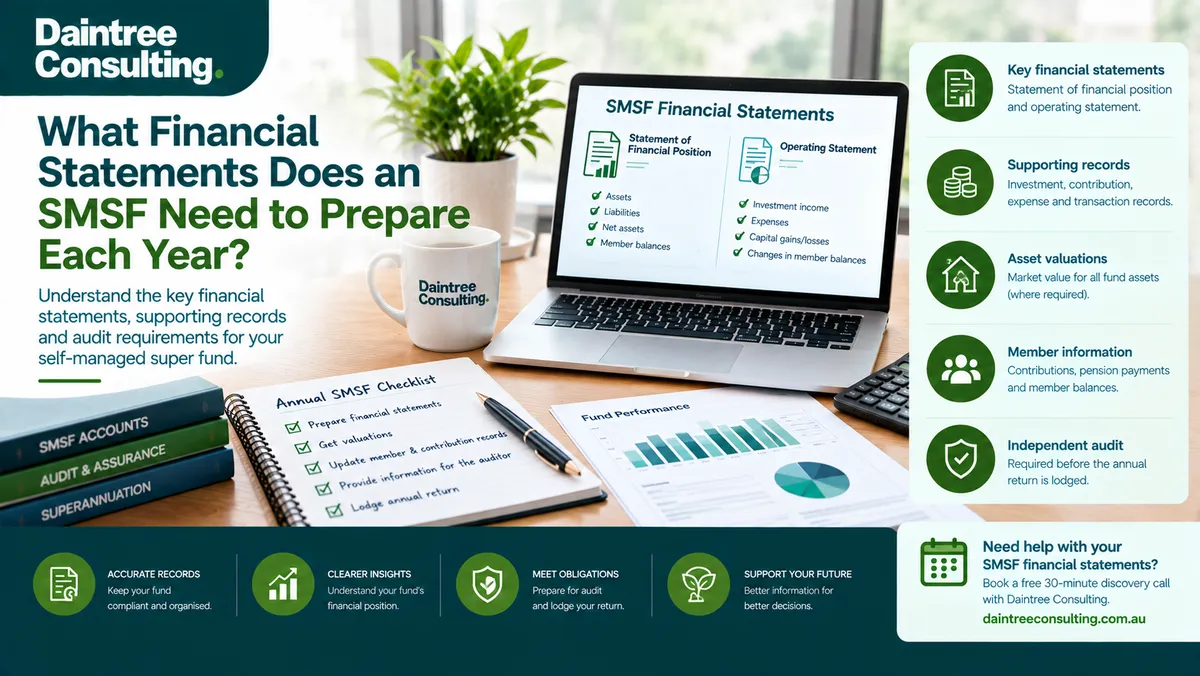
What Financial Statements Does an SMSF Need to Prepare Each Year?
Running a self-managed super fund (SMSF) comes with more than investment decisions. Each year, trustees need to make sure the fund’s financial records are properly maintained, its financial statements are prepared, an independent audit is completed and the SMSF annual return is lodged.
For many trustees, the question is simple: What financial statements does an SMSF actually need to prepare each year?
Want expert help? Daintree Consulting's SMSF accounting services can take this off your plate. Book a free consultation.
The core requirement is straightforward. The Australian Taxation Office (ATO) states that an SMSF needs to prepare a statement of financial position and an operating statement each year. The fund must then provide its financial statements and supporting records to its approved SMSF auditor.
But those two statements are only part of the annual accounting process. Depending on the fund's investments, contributions, pension arrangements and other transactions, trustees may also need supporting schedules, calculations, valuations and documentation to substantiate the figures reported.
This guide explains what SMSF financial statements are, what they normally contain, how they fit into the annual audit and what trustees should have ready before their accountant or administrator starts preparing the year-end accounts.
Quick Answer: What Financial Statements Does an SMSF Need?
Each year, an SMSF generally needs to prepare:
Statement of financial position
Operating statement
Supporting accounting records and documentation
Asset valuation information
Records supporting contributions, payments and investments
Other calculations or reports relevant to the fund's circumstances
The ATO specifically identifies the statement of financial position and operating statement as the key financial statements an SMSF must prepare each year.
Once the financial statements and supporting information are ready, the fund's accounts are provided to an independent approved SMSF auditor. The audit needs to be finalised before the SMSF annual return can be lodged.
1. Statement of Financial Position
The statement of financial position provides a snapshot of the SMSF's financial position at the end of the financial year.
It generally shows:
Assets
Liabilities
Net assets
Member balances or interests, where applicable
Think of it as a year-end snapshot of what the SMSF owns, what it owes and the resulting position of the fund.
What might appear as SMSF assets?
Depending on the fund, assets may include:
Bank accounts
Listed shares
Managed investments
Term deposits
Property
Private company investments
Trust investments
Other permitted investments
The values reported need to reflect the fund's position at the relevant reporting date. The ATO requires SMSF assets to be valued at market value each year so that the fund's accounts, statements and annual return can be prepared. Evidence supporting those valuations should also be retained for the auditor.
This is particularly important where an SMSF owns assets that are not regularly traded on a public market.
For example, an SMSF holding listed shares may have readily available market information, while an SMSF holding property or certain private investments may require additional valuation evidence.
Why the statement matters
A statement of financial position gives trustees and their advisers a consolidated view of the fund at year end.
It can help identify issues such as:
An asset balance that does not reconcile to supporting records
Incorrect investment valuations
Unrecorded liabilities
Unexpected changes in member balances
Transactions that may have been incorrectly classified
It also provides important information for the SMSF audit and annual return.
2. Operating Statement
The second core financial statement is the operating statement.
While the statement of financial position shows where the fund stands at year end, the operating statement shows what happened financially during the year.
It generally captures income and expenses relevant to the SMSF's operations.
Depending on the fund, this may include:
Investment income
Interest
Dividends
Rental income
Capital gains and losses
Other income
Investment expenses
Administration expenses
Other deductible or non-deductible expenses
The operating statement therefore helps explain how the SMSF's financial position changed over the year.
For example, an SMSF might start the year with a particular investment portfolio, receive dividends and rental income throughout the year, incur administration and investment expenses, sell an investment and make contributions or pension payments.
The operating statement helps bring those financial activities together into an annual picture.
The ATO specifically confirms that SMSFs need to prepare an operating statement each year.
3. Supporting Investment Records
The financial statements cannot simply be prepared from a bank balance.
The underlying records need to support the numbers reported in the accounts.
For example, if an SMSF owns shares, the accounting records may need to reconcile:
Opening investment balances
Purchases
Sales
Dividends
Corporate actions
Brokerage and transaction costs
Closing holdings
Year-end market values
The same principle applies to other investments.
For property, relevant records may include:
Purchase documentation
Settlement records
Rental statements
Property expenses
Loan documentation, where applicable
Valuation evidence
Sale documentation if the property was disposed of
The exact documentation will depend on the SMSF's activities.
The ATO states that trustees need to keep accurate records explaining the transactions and financial position of the fund, and that records must be sufficient to enable the accounts and annual return to be properly prepared and audited.
4. Asset Valuations
Asset valuations are an important part of preparing SMSF financial statements.
An SMSF's assets generally need to be valued at market value each year for the purpose of preparing the fund's accounts, statements and annual return.
This does not mean every asset requires the same type of valuation evidence.
For example:
Listed shares
A market price may provide readily available evidence of value.
Bank accounts
The year-end balance can generally be supported by a bank statement.
Property
Property may require appropriate valuation evidence, depending on the circumstances.
Private investments
Private company or other less-liquid investments may require more detailed evidence supporting the reported value.
The important point is that trustees should not simply choose a number that appears reasonable.
The valuation needs to be supportable and appropriate for the asset and circumstances.
5. Member and Contribution Records
SMSF financial statements also need to reflect the fund's transactions involving members.
This can include:
Employer contributions
Personal contributions
Government contributions
Rollovers
Pension payments
Lump-sum payments
Member balances
Other transactions affecting member interests
Accurate classification matters because contributions and benefit payments can have different tax and superannuation consequences.
A mistake in the underlying records can therefore flow through to the financial statements, annual return and potentially the member's broader superannuation reporting.
This is one reason why year-end SMSF accounting is more than simply reconciling the fund's bank account.
6. Pension and Retirement-Phase Records
SMSFs paying pensions may require additional records and calculations.
For example, trustees may need to maintain information relating to:
Pension commencement
Pension type
Member balances
Pension payments
Minimum pension requirements
Transfer balance reporting
Investment income and expenses
Supporting calculations
The ATO's current guidance specifically identifies pension-related matters, actuarial certificates where required and transfer balance reporting as areas trustees need to consider as part of SMSF administration.
If an SMSF is paying retirement-phase income streams, the annual accounting process may therefore involve additional work compared with a simpler accumulation-only fund.
7. Capital Gains and Investment Transactions
Investment disposals can make SMSF financial statements more complex.
If the fund sells an investment during the year, the accounting and tax records may need to capture:
Original acquisition information
Acquisition date
Cost base
Disposal date
Sale proceeds
Transaction costs
Capital gain or loss
Relevant tax treatment
This information may feed into the fund's operating results and annual tax reporting.
It also needs to be supported by appropriate documentation.
For an SMSF with frequent investment transactions, maintaining these records throughout the year can make year-end preparation considerably easier.
8. What About a Cash Flow Statement?
This is an area where trustees can become confused.
The ATO's current practical guidance for starting and running an SMSF identifies the statement of financial position and operating statement as the annual financial statements SMSFs need to prepare.
Older ATO annual-return instructions and legislative material also refer to cash-flow statements in certain circumstances, including reporting entities.
The important takeaway is that trustees should not assume that every SMSF has exactly the same reporting requirements beyond the core statements.
The appropriate accounts and supporting reports can depend on the fund's circumstances and applicable requirements.
If your SMSF accountant prepares additional financial reports as part of the annual accounts, that does not necessarily mean the fund has an additional standalone obligation in every circumstance. It may simply be part of the accounting and audit work required to properly support the fund.
9. Why SMSF Financial Statements Are Needed Before the Audit
An SMSF must be audited every year by an independent approved SMSF auditor.
The auditor examines the fund's financial statements and assesses whether the fund has complied with relevant superannuation requirements. ASIC also confirms that SMSFs must have a registered SMSF auditor conduct an annual audit.
The audit has two important components:
Financial audit
This involves examining the financial statements and supporting financial information.
Compliance audit
This considers whether the SMSF has complied with relevant superannuation laws and requirements.
The two areas are connected, but they are not the same thing.
A set of financial statements can be mathematically accurate while the underlying transaction may still raise a compliance issue.
That is why SMSF accounting and SMSF auditing serve different purposes.
10. The Audit Must Be Completed Before the Annual Return
The annual sequence is important.
A simplified process looks like this:
1. Close the financial year
Gather bank, investment, contribution, pension and expense records.
2. Reconcile the accounts
Make sure transactions and balances agree with supporting documentation.
3. Value SMSF assets
Determine appropriate year-end market values and retain supporting evidence.
4. Prepare SMSF financial statements
Prepare the statement of financial position and operating statement, together with relevant supporting schedules and calculations.
5. Provide information to the auditor
The approved auditor reviews the financial statements and supporting documentation.
6. Complete the audit
The auditor issues the required independent auditor's report.
7. Lodge the SMSF annual return
The annual return is lodged after the audit has been finalised.
The ATO specifically states that the SMSF audit must be completed before the annual return is lodged.
11. What Records Should Trustees Have Ready?
Good year-end preparation can significantly reduce delays.
Depending on the SMSF, an accountant or administrator may need records such as:
Bank statements
Investment statements
Share transaction reports
Dividend statements
Managed fund reports
Property rental statements
Property expense records
Loan statements
Contribution information
Rollover documentation
Pension payment records
Member information
Trustee minutes
Investment strategy documentation
Asset valuation evidence
Insurance documentation
Relevant tax documents
Previous year's financial statements
Previous year's audit report
Previous year's annual return
Not every SMSF will require every document.
A fund holding listed shares and cash, for example, will have a different documentation profile from an SMSF holding commercial property, private company investments and pensions.
The goal is to have enough reliable evidence to support the transactions, balances and calculations included in the accounts.
12. Common SMSF Financial Statement Problems
Year-end SMSF accounting problems are often caused by incomplete records rather than complicated accounting.
Common issues include:
Bank accounts that have not been fully reconciled
Small differences can become bigger problems when they remain unresolved across multiple years.
Investments that do not reconcile
The accounting records should agree with investment statements and transaction records.
Missing valuation evidence
The fund may have recorded an asset value without retaining sufficient evidence to support it.
Incorrect member transactions
Contributions, rollovers and pension payments may have been incorrectly classified or recorded.
Missing documents
An auditor may need supporting evidence that the trustee cannot immediately locate.
Unrecorded transactions
Transactions made outside the primary accounting system can sometimes be missed.
Outdated records
Relying on incomplete prior-year information can create problems in the current year's accounts.
These issues can delay the accounting and audit process.
13. Why Accurate SMSF Financial Statements Matter
Preparing the annual statements is not just a compliance exercise.
Good financial statements give trustees a clearer picture of the fund.
They can help trustees understand:
What the SMSF owns
What the SMSF owes
How investments performed
What income the fund generated
What expenses were incurred
How member balances changed
Whether records are complete
What information needs to be addressed before the audit
Accurate accounts also make it easier for the auditor to perform their work and for the annual return to be prepared correctly.
For trustees, this can make the annual SMSF process more organised and predictable.
14. Should You Prepare SMSF Financial Statements Yourself?
Some trustees maintain their own bookkeeping and transaction records. That can work when the fund's activities are straightforward and the trustee understands the accounting and compliance requirements.
However, preparing year-end SMSF financial statements can become more complicated when the fund has:
Multiple investments
Property
Pension accounts
Complex contribution history
Private investments
Investment disposals
Related-party transactions
Borrowing arrangements
Multiple members
Significant changes during the year
The important distinction is that keeping transaction records and preparing complete year-end SMSF financial statements are not necessarily the same task.
An experienced SMSF accountant can help bring the records together, reconcile the accounts, prepare the financial statements and organise the information required for the independent audit.
15. How Professional SMSF Accounting Can Help
At Daintree Consulting, SMSF accounting support is designed to keep the fund's annual accounting and administration organised and ready for independent audit.
The process can include:
Reviewing the fund's structure and prior-year position
Collecting bank and investment records
Reconciling transactions
Tracking contributions and pension accounts
Preparing annual financial statements
Preparing the audit file
Coordinating with the independent SMSF auditor
Supporting annual return preparation and lodgement
The objective is not simply to produce a set of numbers.
It is to create a clear, organised financial record that can be reviewed, audited and used to support the fund's annual reporting obligations.
If your SMSF records are fragmented, you're approaching year end or you simply want a more structured annual process, professional SMSF accounting support may make the process easier to manage.
Frequently Asked Questions
What financial statements does an SMSF need to prepare each year?
An SMSF needs to prepare a statement of financial position and an operating statement each year. Additional supporting schedules, calculations and documentation may be required depending on the fund's activities and circumstances.
Does an SMSF need annual financial statements even if there were no transactions?
SMSFs generally still have annual accounting and audit obligations. The ATO states that an SMSF must be audited each year, including where there have been no contributions or payments during the year.
Does an SMSF need to have its financial statements audited?
Yes. SMSFs must have their financial accounts and statements audited annually by an approved independent SMSF auditor.
Can an SMSF lodge its annual return before the audit?
No. The audit must be finalised before the SMSF annual return is lodged.
What records are needed to prepare SMSF financial statements?
The exact records depend on the fund. Common examples include bank statements, investment reports, transaction records, contribution information, pension records, expense documentation and asset valuation evidence.
Does every SMSF need a cash flow statement?
The core ATO guidance identifies the statement of financial position and operating statement as the annual financial statements an SMSF needs to prepare. Additional reporting requirements can depend on the fund and applicable rules, so trustees should confirm the requirements relevant to their circumstances.
Who is responsible for the SMSF financial statements?
The SMSF trustees remain responsible for the proper management and administration of the fund. An accountant or administrator can assist with preparing the accounts, but trustees should understand their responsibilities and ensure information supplied to the professional is complete and accurate.
Final Takeaway
The annual SMSF accounting process starts with accurate records and ends with completed financial statements, an independent audit and the SMSF annual return.
At the centre of the process are two key financial statements:
Statement of financial position — shows the SMSF's financial position at year end.
Operating statement — summarises the fund's financial activity during the year.
Around these statements sits the supporting evidence: investment records, valuations, contribution information, pension records, transaction documentation and other information relevant to the fund.
Getting these records organised before year end can make the accounting and audit process significantly easier.
If you're looking for SMSF accounting support to prepare your annual financial statements and coordinate the audit process, Daintree Consulting can help keep the fund's records organised and ready for independent audit.
Book a free discovery call with Daintree Consulting to discuss your SMSF accounting requirements.
Talk to Daintree about your SMSF accounts
Our ex-Big 4 team gives clear, senior-reviewed advice so you can act with confidence.
Book a free consultation →
Or explore our SMSF accounting services.
