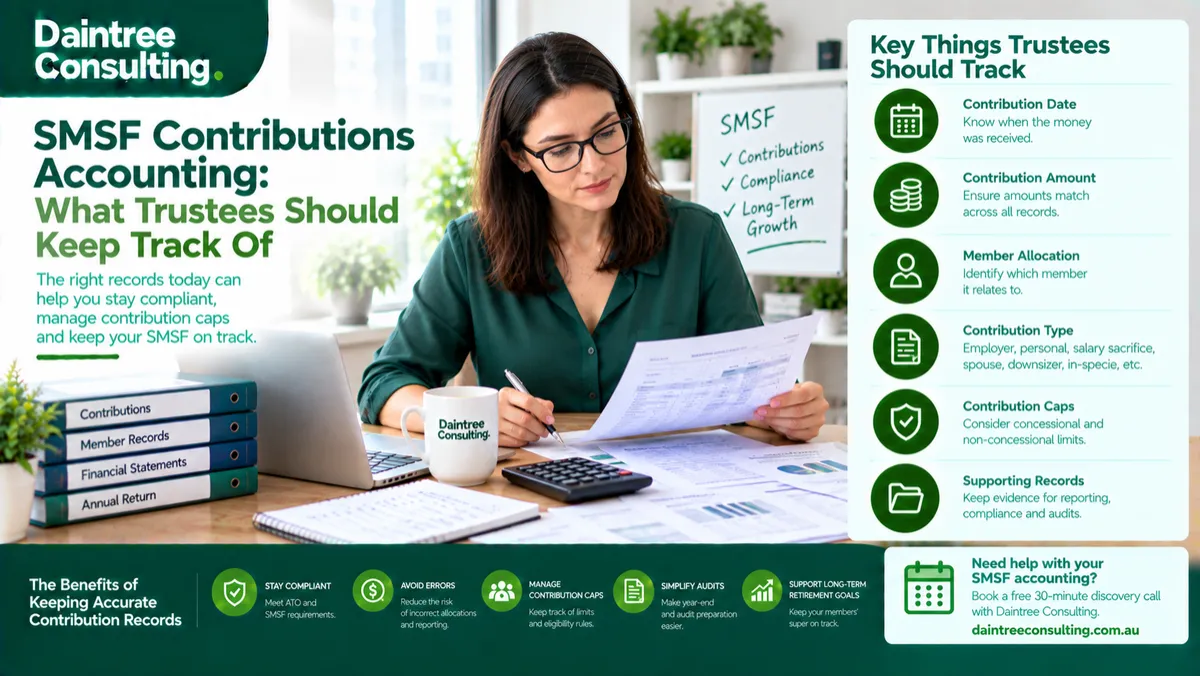
SMSF Contributions and Accounting: What Trustees Should Keep Track Of
Contributions are one of the most important transactions an SMSF needs to record correctly.
For trustees, it can be tempting to think of a contribution simply as money transferred into the fund. From an accounting and compliance perspective, however, there can be much more to track.
Want expert help? Daintree Consulting's SMSF accounting services can take this off your plate. Book a free consultation.
The fund needs to identify who made the contribution, what type of contribution it is, when it was received, how it should be allocated and how it should be reported. The treatment can also affect a member's contribution caps, tax position and member account records.
The Australian Taxation Office (ATO) states that SMSF contributions should be properly documented, including their amount, type and breakdown, and allocated to members' accounts within the required timeframe. The ATO also requires member contributions to be reported in the SMSF annual return.
For trustees, good SMSF contributions accounting is therefore about more than keeping a record of deposits. It is about maintaining an accurate trail from the contribution entering the fund through to the member's records and annual reporting.
Quick answer: What should SMSF trustees track for contributions?
Trustees should generally keep track of:
The date the contribution was received
The amount received
Which member the contribution relates to
Who made the contribution
The type of contribution
Whether it is concessional or non-concessional where relevant
Whether it is an employer, personal, spouse, downsizer or other contribution
Supporting payment records
The member's contribution history
The allocation to the member's account
Relevant contribution cap considerations
Any required notices or declarations
How the contribution is reported in the SMSF's records and annual return
The exact requirements depend on the type of contribution and the circumstances of the member and fund.
This is why contributions should be recorded as they occur rather than reconstructed at the end of the financial year.
Why SMSF contributions accounting matters
An SMSF has separate legal, accounting and tax obligations from its individual members.
Money entering the SMSF needs to be recorded as a fund transaction and allocated appropriately to a member.
The ATO explains that an SMSF bank account is used to accept contributions and rollovers, while each member must have a separate record of their entitlement. Member accounts record contributions made by or on behalf of the member, investment earnings allocated to them and payments of super benefits.
This means trustees need to maintain a clear connection between:
Bank transaction → contribution type → member → accounting record → annual reporting
If that connection is unclear, problems can arise during the preparation of the SMSF's financial statements, annual return or independent audit.
A contribution that is incorrectly classified or allocated may also affect the member's contribution history.
Good accounting records make these transactions easier to verify and explain.
What types of SMSF contributions need to be tracked?
Not all contributions have the same accounting or tax treatment.
The ATO identifies several categories of contributions that an SMSF may receive, including mandated employer contributions, non-mandated contributions and in-specie contributions. Non-mandated contributions can include salary sacrifice, personal contributions, downsizer contributions, spouse contributions, government co-contributions and certain third-party contributions.
Understanding the source and type of each contribution is therefore important.
1. Employer contributions
Employer contributions can include compulsory superannuation contributions and additional contributions made by an employer.
Salary sacrifice contributions are an example of additional employer contributions that need to be appropriately identified.
The accounting records should make it clear which member the contribution relates to and where it came from.
If employer contributions are being paid into an SMSF, trustees should also ensure the fund's receiving arrangements and details are correctly established.
2. Personal contributions
A member may make personal contributions directly to their SMSF.
The eventual tax treatment can depend on whether the member claims a deduction and whether the relevant requirements have been satisfied.
This makes accurate classification particularly important.
The ATO notes that personal contributions need to be distinguished appropriately for relevant tax and superannuation purposes, and incorrectly categorising personal contributions as employer contributions can create reporting and cap-related problems.
Trustees should therefore avoid assuming that every contribution made personally by a member is treated in exactly the same way.
3. Salary sacrifice contributions
Salary sacrifice contributions are generally additional employer contributions made under an arrangement with the employee.
From an SMSF accounting perspective, the fund should be able to identify the contribution, member and relevant period.
Trustees should also ensure that the contribution is supported by appropriate records from the employer or payroll process.
4. Spouse contributions
Contributions made for a spouse need to be correctly identified and allocated to the appropriate member.
The accounting records should make the source and recipient clear.
This is particularly important where an SMSF has multiple members and contributions are being made by different people.
5. Downsizer contributions
Downsizer contributions have specific eligibility and reporting requirements.
The ATO states that eligibility includes requirements relating to the member's age, the sale of an eligible dwelling and the timing of the contribution. The member also needs to provide the required information to the fund.
A trustee should therefore not simply record a payment as a downsizer contribution because the member describes it that way.
The supporting documentation and eligibility requirements need to be considered.
6. In-specie contributions
A contribution does not necessarily have to be cash.
An in-specie contribution involves contributing an asset rather than depositing money.
The ATO notes that in-specie contributions are non-monetary assets and that SMSFs are generally restricted from intentionally acquiring assets from related parties, subject to specific exceptions.
These transactions require particular care because the accounting records need to capture the asset, its value, the contribution and the member allocation.
7 key things trustees should keep track of
1. The contribution date
The date a contribution is received can matter.
Trustees should retain evidence showing when the fund received the contribution rather than relying only on an approximate transaction date.
Bank statements, payment records and contribution documentation can help establish the transaction trail.
This becomes particularly important around financial year-end when trustees are determining which transactions belong in which reporting period.
2. The contribution amount
The amount should agree across the relevant records.
For example:
Bank statement → accounting software → member transaction record
If these amounts do not agree, the discrepancy should be investigated.
Small differences can sometimes arise from transaction timing or processing issues, but unexplained differences should not simply be ignored.
3. Which member the contribution belongs to
An SMSF with multiple members needs clear member-level records.
A contribution received into the fund's bank account is not enough by itself.
The accounting records need to show which member's account should receive the contribution.
The ATO specifically states that each member's account records contributions made by or on behalf of that member, alongside investment earnings and benefit payments.
This is one reason why accurate member allocation is a central part of SMSF accounting.
4. The type of contribution
Trustees should record enough information to identify what the contribution represents.
For example:
Employer contribution
Salary sacrifice
Personal contribution
Spouse contribution
Downsizer contribution
Government co-contribution
Third-party contribution
In-specie contribution
The classification can affect how the transaction is reported and how it interacts with the member's superannuation position.
The ATO advises that SMSFs should properly document the amount, type and breakdown of contributions.
5. Contribution cap considerations
Contribution caps are an important part of SMSF contribution management.
Concessional and non-concessional contributions are subject to different rules, and a member's circumstances can affect how the rules apply.
The ATO explains that concessional contributions can include employer contributions and deductible personal contributions, while non-concessional contributions generally include personal contributions for which no tax deduction is claimed.
There can also be circumstances involving unused concessional cap amounts, total superannuation balance considerations and other special contribution rules.
This means trustees should not rely on a simple annual total without considering the type and circumstances of the contributions.
Important: contribution caps and eligibility requirements can change. Trustees should verify the applicable limits and rules for the relevant financial year before making decisions.
What records should an SMSF keep for contributions?
Good SMSF contributions accounting depends on supporting documentation.
Depending on the transaction, relevant records may include:
SMSF bank statements
Employer contribution reports
Payroll records
Salary sacrifice arrangements
Payment confirmations
Member contribution instructions
Notices of intent to claim a deduction where relevant
Downsizer contribution documentation
Records supporting in-specie contributions
Trustee resolutions where applicable
Member account records
Accounting records
Annual return information
Correspondence relating to contribution classification
The ATO states that SMSFs generally need to retain relevant records for five years after they were prepared or obtained, or after the relevant transaction or act is completed, whichever is later. Certain records, including trustee meeting minutes and records of trustee decisions, have longer retention requirements.
The practical lesson is simple:
Do not wait until the annual accounts are being prepared to start looking for contribution evidence.
Why contribution timing matters at financial year-end
Financial year-end can create additional complexity.
Suppose a member makes a contribution near 30 June.
The trustee needs to establish when the SMSF actually received it and how it should be recorded.
The transaction may need to be considered alongside:
Bank processing times
Employer payment records
Contribution type
Member allocation
Annual reporting
Contribution cap considerations
The ATO also has specific rules for circumstances where a contribution is made in one financial year but allocated to the member in another. Documentation can be important in supporting the treatment.
For this reason, year-end contribution reconciliations can be particularly useful.
How contribution records connect to SMSF financial statements
Contributions form part of the financial information used to prepare an SMSF's annual accounts and return.
If contribution records are incomplete, the accounting process may require additional investigation before the financial statements can be finalised.
A typical accounting process may involve:
Review bank transactions
↓
Identify contribution transactions
↓
Confirm member and contribution type
↓
Reconcile amounts
↓
Allocate to member accounts
↓
Review contribution reporting
↓
Prepare financial statements and annual return
↓
Provide records for independent audit
The more accurate the underlying records are, the easier this process can be.
Common SMSF contribution accounting mistakes
Trustees do not necessarily make mistakes because they are careless.
SMSF transactions can become complicated, particularly when multiple members, employers and contribution types are involved.
Some common problems include:
Recording the contribution but not identifying the member
The fund's bank account shows the money, but the accounting records do not clearly identify whose account should receive it.
Treating every personal contribution the same way
The eventual treatment of a personal contribution can depend on whether a deduction is claimed and other circumstances.
Missing supporting documentation
A transaction appears in the bank account, but there is insufficient evidence explaining what it represents.
Incorrectly categorising contributions
Personal, employer, salary sacrifice, spouse and other contributions can have different reporting implications.
Ignoring timing differences
A contribution close to year-end may be recorded without properly confirming when the fund received it.
Failing to reconcile member accounts
The total contributions recorded for members do not agree with the fund's bank transactions and supporting documentation.
Waiting until the audit to investigate discrepancies
Problems identified during the audit process can take more time to resolve when supporting evidence is no longer readily available.
How trustees can make SMSF contribution accounting easier
A few practical habits can make contribution records significantly easier to maintain.
Reconcile contributions regularly
Do not wait until the annual accounts are prepared.
Regular reconciliation can help identify:
Missing contributions
Duplicate entries
Incorrect member allocations
Incorrect dates
Unusual amounts
Misclassified transactions
Keep contribution evidence together
Create a clear digital record for contribution-related documents.
This can make year-end accounting and audit preparation more efficient.
Separate member records clearly
Where an SMSF has multiple members, contribution records should make it easy to identify each member's transactions.
Review unusual transactions early
Large contributions, in-specie transactions, year-end payments and unusual third-party contributions may require additional attention.
Do not rely solely on the bank statement
The bank statement tells you that money entered the fund.
It does not necessarily tell you the complete accounting and tax treatment of the transaction.
When should trustees seek professional SMSF accounting support?
Professional assistance can be particularly useful when:
The fund has multiple members
Contributions are made by different employers
Large contributions are being considered
Members are approaching contribution caps
The fund receives in-specie contributions
A downsizer contribution is involved
Contributions occur around financial year-end
Member records do not reconcile
The fund is preparing its annual accounts
The independent audit identifies contribution-related questions
A contribution may have been incorrectly classified
The objective is not simply to have someone enter transactions into accounting software.
Good SMSF accounting should help maintain a reliable record of what happened, who it relates to and how it should be reported.
How Daintree Consulting can help with SMSF accounting
SMSF accounting requires careful attention to member records, transactions, investment information and supporting documentation.
Daintree Consulting provides specialist SMSF accounting support covering areas such as annual financial statements, records for independent audit, contribution and pension tracking, investment records, annual return support and audit-file preparation.
For trustees, this can provide a more organised process for maintaining the fund's financial records throughout the year rather than trying to reconstruct everything at year-end.
Daintree can also coordinate with the fund's independent auditor and help ensure the accounting records and supporting information are prepared for the audit process.
If you are unsure whether your SMSF's contribution records are complete, or you have transactions that need to be reviewed before the annual accounts are prepared, book a free 30-minute discovery call with Daintree Consulting.
Frequently Asked Questions
What is SMSF contributions accounting?
SMSF contributions accounting involves recording, classifying, reconciling and allocating contributions received by an SMSF to the appropriate member accounts and ensuring the transactions are properly supported for reporting and compliance purposes.
What records should trustees keep for SMSF contributions?
Records can include bank statements, payment confirmations, employer contribution information, salary sacrifice documentation, member instructions, relevant notices, supporting documents for special contributions and accounting records.
Do all SMSF contributions count towards the same cap?
No. Different types of contributions can be subject to different rules. Concessional and non-concessional contributions are treated differently, and some contributions may be subject to specific exclusions or separate requirements.
How quickly should SMSF contributions be allocated to a member?
The ATO states that contributions should be properly documented and allocated to members' accounts within 28 days from the end of the month in which the fund receives them.
What happens if an SMSF contribution is recorded incorrectly?
The appropriate response depends on what was recorded incorrectly and when the issue was identified. The trustee or professional adviser may need to review the transaction, supporting evidence, member allocation and reporting implications before determining how to correct it.
Can an SMSF receive property or other assets as a contribution?
In-specie contributions can be possible, but specific rules apply. SMSFs are generally restricted from acquiring assets from related parties, subject to certain exceptions. The contribution and asset transaction should therefore be reviewed carefully before it occurs.
Should SMSF contributions be reconciled before the annual audit?
Yes. Reconciling contribution records before the audit can help identify missing documentation, incorrect classifications and member allocation issues earlier in the process.
Final takeaway
SMSF contributions accounting is about more than recording money entering a fund.
Trustees need a clear record of the amount, date, member, contribution type, supporting evidence and relevant reporting treatment.
Keeping these records accurate throughout the year can make annual accounting, contribution reporting and independent audit preparation much easier.
It can also help trustees identify potential issues before they become difficult to resolve.
If your SMSF has multiple contribution types, complex transactions or records that need to be reconciled, professional accounting support can help keep the process organised.
Book a free 30-minute discovery call with Daintree Consulting to discuss your SMSF accounting requirements.
Talk to Daintree about your SMSF accounts
Our ex-Big 4 team gives clear, senior-reviewed advice so you can act with confidence.
Book a free consultation →
Or explore our SMSF accounting services.
