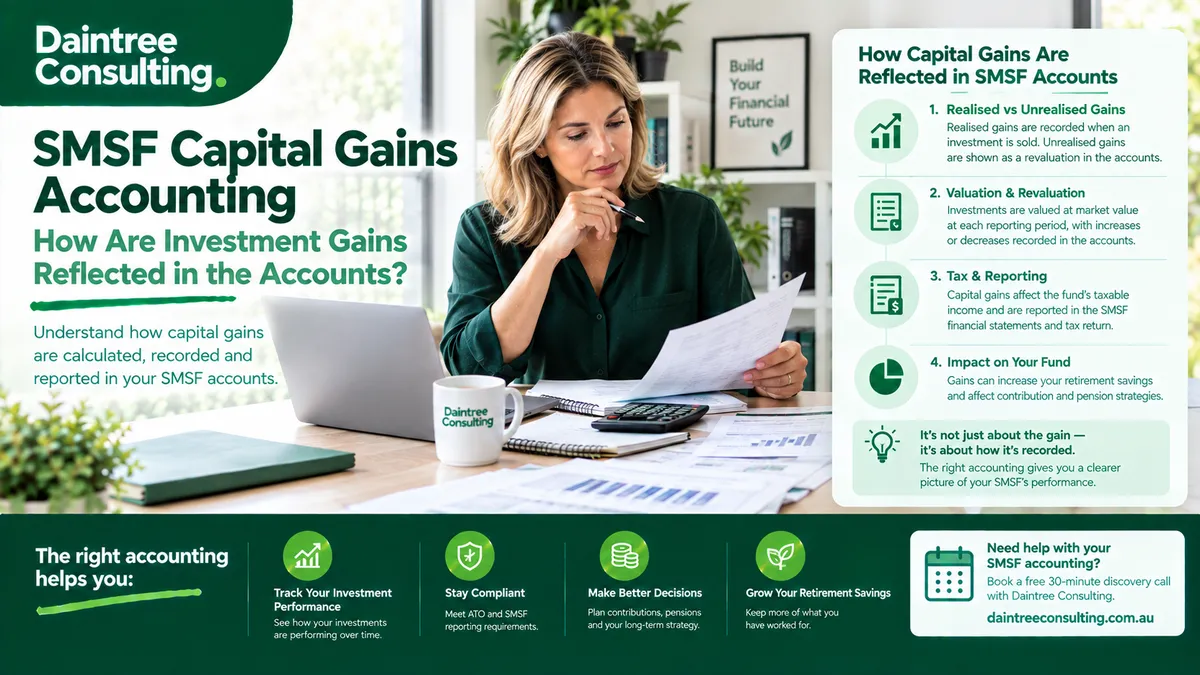
SMSF Accounting for Capital Gains: How Are Investment Gains Reflected in the Accounts?
When an SMSF investment increases in value, trustees often want to know one simple thing:
“How does that gain actually appear in the SMSF accounts?”
Want expert help? Daintree Consulting's SMSF accounting services can take this off your plate. Book a free consultation.
The answer depends on whether the gain is realised or unrealised, how the investment is valued at reporting date, whether a capital gains tax event has occurred, and whether the fund is entirely or partly supporting retirement-phase income streams.
For SMSF trustees, capital gains accounting is important because investment performance, financial statements and tax reporting are connected, but they are not the same thing.
An investment can increase in market value during the year without the SMSF having sold it. That change can affect the fund's financial statements, while the tax treatment of a capital gain generally depends on whether a relevant CGT event has occurred.
The Australian Taxation Office (ATO) states that SMSF assets are required to be valued at market value for financial reporting purposes, and its SMSF auditor checklist specifically refers to trustees valuing assets at market value in the financial statements with supporting evidence for how the valuation was determined.
For tax purposes, the ATO states that an SMSF's assessable income includes net capital gains, subject to relevant exemptions such as capital gains relating to segregated current pension assets. Complying SMSFs may also be eligible for a one-third CGT discount where the relevant asset has been held for at least 12 months.
Understanding this distinction can help trustees keep better records and avoid confusing an increase in investment value with a taxable capital gain.
Quick answer: How are SMSF capital gains reflected in the accounts?
SMSF capital gains can be reflected differently depending on whether the investment has been sold.
Unrealised gain
An investment may increase in market value but remain unsold.
The SMSF's financial statements can reflect the investment at its required market value, with the change in value contributing to the fund's reported investment performance.
However, an unrealised increase in value is not automatically the same thing as a taxable capital gain arising from a disposal.
Realised gain
If the SMSF sells an investment for more than its relevant cost base, a CGT event generally occurs and the fund calculates the resulting capital gain or capital loss under the applicable tax rules.
The resulting tax treatment can involve:
Capital proceeds
Cost base
Capital gains
Capital losses
Prior-year capital losses
Applicable CGT concessions
Retirement-phase exemptions where relevant
The accounting and tax treatment therefore needs to be considered together without treating them as identical.
What is a capital gain for an SMSF?
A capital gain generally arises when an SMSF disposes of an investment for more than its relevant cost base.
For many common CGT events, the ATO describes the capital gain or loss as being calculated by comparing what it cost the SMSF to acquire the asset with what the SMSF received when it disposed of it.
Examples of SMSF investments that can potentially generate capital gains include:
Listed shares
Managed funds
ETFs
Property
Units in trusts
Other eligible investments
The exact CGT treatment depends on the asset, transaction and circumstances.
A capital gain is not simply the amount by which an investment's current market value exceeds its purchase price.
That distinction is particularly important for trustees who monitor their fund's investment portfolio throughout the year.
Realised vs unrealised capital gains
One of the easiest ways to understand SMSF capital gains accounting is to separate realised and unrealised gains.
What is an unrealised capital gain?
Suppose an SMSF purchases listed shares for $100,000.
At the end of the financial year, those shares have a market value of $125,000.
The investment has increased in value by $25,000.
However, the SMSF has not sold the shares.
The $25,000 represents an unrealised increase in value.
The investment is still held by the SMSF.
This can be reflected in the fund's financial reporting because SMSF investments need to be reported at market value.
But that does not mean the SMSF has automatically generated a realised capital gain for tax purposes merely because the investment's market value increased.
What happens when the SMSF sells the investment?
Now assume the SMSF sells those shares for $130,000.
The sale creates a CGT event.
The SMSF then needs to calculate the capital gain or capital loss according to the relevant CGT rules.
The calculation may require consideration of:
Original acquisition cost
Transaction costs
Relevant adjustments to the cost base
Sale proceeds
Capital losses
Holding period
Applicable CGT concessions
The tax status of the relevant investment
This is where accurate investment records become particularly important.
The accounting records need to show what the SMSF acquired, when it acquired it, what it paid, what it sold it for and when the disposal occurred.
Why market value matters in SMSF accounting
SMSF trustees have an obligation to ensure fund assets are appropriately valued.
Market value is important because the financial statements need to present a meaningful picture of the SMSF's financial position at the reporting date.
For example, consider an SMSF holding:
Australian shares
An investment property
Managed funds
Cash
If the accounts simply continued to report investments at historical purchase prices without considering applicable market-value requirements, the financial statements could fail to accurately reflect the fund's position.
The ATO's SMSF auditor checklist specifically identifies market value as an area auditors verify, including whether trustees have valued assets at market value in the financial statements and whether supporting evidence exists for the valuation.
For listed shares, market value may be relatively straightforward to establish.
For other assets, such as property or certain unlisted investments, determining an appropriate market value can require substantially more supporting evidence.
How does an unrealised gain appear in SMSF accounts?
The exact presentation depends on the accounting framework and financial statement preparation process.
At a high level, however, the financial statements need to reflect the SMSF's investment assets at their relevant market values.
If an investment has increased in value, the increase can therefore affect the reported value of the SMSF's assets and its investment performance.
For example:
Purchase value: $200,000
Market value at reporting date: $240,000
Increase in value: $40,000
The SMSF has not necessarily realised a $40,000 taxable capital gain simply because the investment is now worth $240,000.
But the $240,000 market value can be relevant to the financial statements.
This distinction between financial reporting value and taxable capital gain is one of the most important concepts in SMSF capital gains accounting.
How does a realised capital gain affect the accounts?
When an SMSF sells an investment, the accounting records need to reflect the disposal.
The records should generally allow the fund to establish:
What the investment was
Its acquisition date
Its acquisition cost
Relevant transaction costs
Sale date
Sale proceeds
Resulting accounting gain or loss
Resulting tax capital gain or loss
Any applicable tax treatment
The accounting gain and tax calculation may not always be identical.
This is because tax rules can require adjustments, concessions or other calculations that differ from the accounting treatment.
For example, an eligible SMSF capital gain may receive a CGT discount for tax purposes where the relevant conditions are satisfied.
Do SMSFs get a CGT discount?
Yes, eligible complying SMSFs can receive a one-third CGT discount where the relevant asset has been owned for at least 12 months.
This is different from the general individual CGT discount that many people are familiar with.
The ATO states that a complying SMSF can receive a one-third CGT discount where the relevant asset has been owned for at least 12 months.
However, trustees should not simply apply the discount to every investment gain.
The relevant CGT rules and circumstances need to be considered.
Capital gains and losses also need to be calculated correctly before determining the fund's net capital gain.
What happens to SMSF capital losses?
A capital loss is treated differently from an ordinary deductible expense.
The ATO states that an SMSF capital loss cannot simply be claimed as a deduction against ordinary income.
Instead, capital losses can generally be used to reduce capital gains.
If capital losses exceed capital gains for the income year, the resulting net capital loss can generally be carried forward to offset capital gains in future income years.
This makes accurate historical investment records particularly important.
A trustee may need information from previous financial years to correctly determine how available capital losses affect the current year's tax position.
How are capital gains reflected in the SMSF annual return?
The SMSF annual return contains specific reporting requirements for capital gains and CGT events.
Where an SMSF has a CGT event, the relevant tax calculations need to be completed as part of preparing the fund's annual tax return.
The ATO's SMSF annual return instructions distinguish between capital gains, capital losses and the resulting net capital gain.
This means the SMSF accounting process needs to provide reliable information to support the tax calculations.
Investment records should therefore be maintained throughout the year rather than trying to reconstruct the fund's entire investment history at year-end.
What records should an SMSF keep for capital gains?
Good investment records make SMSF accounting significantly easier.
Depending on the investment, useful records can include:
Purchase contracts
Sale contracts
Broker statements
Share transaction records
Distribution statements
Dividend statements
Managed fund annual tax statements
Trust distribution information
Bank statements
Investment platform reports
Property purchase documents
Property sale documents
Valuation evidence
Records of transaction costs
Records of corporate actions
Investment registers
Historical cost-base information
For property and unlisted investments, supporting valuation documentation can also be particularly important.
The ATO's SMSF auditor checklist identifies purchase and sale documents, evidence of market value, investment returns and ownership information among the documentation that may be examined by an SMSF auditor.
Why corporate actions can complicate SMSF capital gains accounting
Investment transactions are not always as simple as buying and selling shares.
Corporate actions can affect investment records and potentially the tax treatment of holdings.
Examples can include:
Share splits
Consolidations
Mergers
Takeovers
Rights issues
Bonus issues
Demergers
Return of capital
Other changes to an investment
These transactions can affect the information required to establish the correct cost base or tax treatment.
If an SMSF's investment records are not updated when these events occur, reconstructing the correct position at year-end can become difficult.
SMSF capital gains and investment property
Capital gains accounting can become more complex when an SMSF owns property.
Suppose an SMSF purchases an investment property for $700,000.
Several years later, the property is worth $950,000.
The $250,000 difference represents an increase in market value, but the SMSF has not necessarily realised a capital gain because the property has not been sold.
The financial statements need to reflect the applicable market value.
If the property is later sold, the SMSF then needs to determine the relevant capital gain or loss for tax purposes.
Property transactions may also involve additional considerations, including:
Acquisition costs
Disposal costs
Improvements
Valuation evidence
Ownership documentation
Rental income
Borrowings where applicable
Related-party transactions
GST considerations where relevant
Property should therefore receive careful accounting and record-keeping attention.
What happens if an SMSF sells an investment at a loss?
A capital loss is not automatically a bad accounting result.
Investment values fluctuate, and a fund can realise both gains and losses over time.
From a tax perspective, however, the treatment of a capital loss is different from an ordinary deduction.
For example, if an SMSF has:
Capital gains: $80,000
Capital losses: $30,000
The capital losses may reduce the capital gains when calculating the fund's net capital gain, subject to the applicable rules.
If losses exceed gains, the net capital loss may generally be carried forward.
The important point is that the loss needs to be properly documented and correctly classified.
SMSF capital gains in accumulation and retirement phase
The tax treatment of SMSF investment gains can differ depending on whether income is supporting accumulation interests or retirement-phase income streams.
The ATO states that an SMSF's assessable income generally includes net capital gains, but capital gains relating to segregated current pension assets can be disregarded where the relevant conditions are met.
This is an area where trustees need to be particularly careful.
The existence of a pension account does not mean every investment gain automatically becomes tax-free.
The fund's circumstances, method of calculating exempt current pension income (ECPI), asset segregation and other relevant requirements need to be considered.
The ATO explains that SMSFs may use different methods to calculate ECPI depending on their circumstances, including the segregated and proportionate methods.
Why accurate asset classification matters
A fund's investment records need to support more than just the purchase and sale price.
They also need to provide information about the nature and status of the fund's assets.
This can be important when determining:
Whether an asset supports retirement-phase income
Whether ECPI applies
Whether a capital gain is taxable
Whether a capital loss is available
How investments should be reported
Whether supporting documentation is complete
Incorrect or incomplete records can create problems during both the annual accounting process and the SMSF audit.
What does the SMSF auditor look at?
An SMSF auditor independently examines the fund's records and compliance with relevant requirements.
Investment records can form an important part of this process.
The ATO's approved SMSF auditor checklist includes verification of matters such as:
Investment ownership
Purchase and sale documentation
Market value
Investment returns
Bank records
Distribution statements
Asset separation
Investment strategy
Supporting valuation evidence
For an investment property, for example, the auditor may need evidence supporting ownership and market value.
For listed investments, broker statements, dividend statements and transaction information can help support the fund's records.
This is another reason trustees should maintain investment documentation throughout the year.
Common SMSF capital gains accounting mistakes
Capital gains accounting problems often arise from record-keeping issues rather than from the investment itself.
Mistake 1: Treating market value increases as taxable capital gains
An investment increasing in value does not automatically mean the SMSF has realised a taxable capital gain.
The tax treatment depends on the relevant CGT event and circumstances.
Mistake 2: Losing original purchase records
Without reliable acquisition information, establishing the correct cost base can become difficult.
Mistake 3: Ignoring transaction costs
Relevant costs may affect the calculation of a capital gain or loss.
Mistake 4: Forgetting corporate actions
Share splits, mergers, rights issues and other events can affect investment records and cost-base information.
Mistake 5: Treating all capital losses as ordinary deductions
Capital losses generally have specific treatment and are used against capital gains rather than simply deducted from ordinary income.
Mistake 6: Assuming pension-phase gains are automatically tax-free
The tax treatment of gains supporting retirement-phase income streams depends on the fund's circumstances and the relevant ECPI rules.
Mistake 7: Using unsupported valuations
SMSF assets need appropriate market-value evidence, particularly for assets where market value is not readily observable.
How can trustees make SMSF capital gains accounting easier?
The easiest time to organise investment records is before the annual accounting process begins.
Keep investment records throughout the year
Do not wait until year-end to collect transaction documents.
Maintain an investment register
Record:
Investment name
Acquisition date
Acquisition cost
Units or shares held
Corporate actions
Disposal information
Current value
Keep valuation evidence
For assets without readily observable market prices, maintain appropriate evidence supporting the valuation.
Reconcile investment accounts
Compare investment-platform records, broker statements and bank transactions with the accounting records.
Track capital losses
Maintain records of available carried-forward capital losses so they are not overlooked.
Separate accounting and tax calculations
Understand that an accounting increase in investment value and a taxable capital gain are not necessarily the same thing.
Prepare early for the SMSF audit
Having investment records organised can reduce unnecessary delays when the fund's annual accounts and audit are being completed.
A simple example of SMSF capital gains accounting
Consider an SMSF that buys shares for $150,000.
At 30 June, the shares have a market value of $180,000.
The fund has an unrealised increase in value of $30,000.
The shares are still held.
The financial statements need to reflect the investment at the applicable market value.
The $30,000 increase is not automatically a realised taxable capital gain merely because the shares are worth more.
Now suppose the SMSF sells the shares for $190,000.
A CGT event has occurred.
The SMSF then needs to calculate the relevant capital gain based on the applicable tax rules, including the relevant cost base and any applicable concessions or losses.
If the investment had been held for at least 12 months and the relevant requirements are satisfied, the SMSF may be eligible for the one-third CGT discount.
This example is simplified. Actual calculations can be affected by transaction costs, corporate actions, distributions, cost-base adjustments, capital losses, pension-phase treatment and other circumstances.
Why SMSF capital gains accounting matters for trustees
Investment performance is one of the most important parts of an SMSF's financial position.
But trustees need more than a current investment balance.
They need records that explain:
What the fund owns
What it paid
What it is worth
What income it generated
Whether an investment was sold
Whether a CGT event occurred
What capital gains or losses arose
What supporting evidence exists
How the investment fits within the fund's circumstances
Good SMSF accounting brings these pieces together.
It also makes it easier for the accountant, tax agent and auditor to work from consistent information.
How Daintree Consulting can help with SMSF accounting
SMSF accounting involves more than recording transactions.
Investment income, capital gains, valuations, contributions, pension-related information and supporting records all need to come together accurately for the annual financial statements and tax reporting process.
Daintree Consulting can support trustees with SMSF accounting and administration, including:
Annual SMSF financial statements
Investment record management
Capital gains information
Investment income tracking
Reconciliations
Contribution and pension information
Audit-file preparation
Supporting documentation
Annual return support
Coordination with the SMSF auditor
The aim is to help trustees maintain organised, reliable financial records and make the annual accounting and audit process more straightforward.
If your SMSF has multiple investments, property or significant investment transactions, keeping capital gains and supporting records organised throughout the year can make a meaningful difference at year-end.
Book a free 30-minute discovery call with Daintree Consulting to discuss your SMSF accounting requirements.
Frequently Asked Questions
What is SMSF capital gains accounting?
SMSF capital gains accounting involves recording and reporting investment value changes and investment disposals appropriately within the fund's accounting and tax records.
The accounting treatment and tax treatment are related but are not necessarily identical.
Are unrealised capital gains taxable in an SMSF?
An increase in an investment's market value does not automatically mean a realised taxable capital gain has occurred. Tax treatment generally depends on whether a relevant CGT event has occurred and the fund's circumstances.
How are SMSF investments valued?
SMSF assets are required to be valued at market value for financial reporting purposes. The trustee should retain appropriate evidence supporting valuations, particularly for assets where market value is not readily observable.
Do SMSFs get a capital gains tax discount?
A complying SMSF can generally receive a one-third CGT discount for an eligible capital gain where the relevant asset has been held for at least 12 months, subject to the applicable rules.
Can SMSFs deduct capital losses?
Capital losses generally cannot simply be deducted against ordinary income. They can generally be used to offset capital gains, with eligible net capital losses carried forward for future capital gains.
Are SMSF capital gains tax-free in pension phase?
Not automatically.
Capital gains relating to segregated current pension assets can be disregarded where the relevant requirements are met. Other retirement-phase arrangements can involve different ECPI calculations.
What records should I keep for SMSF capital gains?
Keep purchase and sale records, broker statements, investment statements, distribution information, bank records, valuation evidence and other documents needed to establish the fund's investment history and tax position.
Does the SMSF auditor check investment valuations?
Yes. Investment valuations and supporting evidence can form part of the SMSF audit process. The ATO's SMSF auditor checklist specifically includes market-value verification.
Why is an investment register important?
An investment register can help trustees track acquisition costs, dates, holdings, disposals, corporate actions and valuations. This information can make annual accounting and capital gains calculations more efficient.
Should SMSF trustees calculate capital gains themselves?
Trustees remain responsible for managing their SMSF and maintaining appropriate records, but capital gains calculations can become complex, particularly where there are multiple investments, corporate actions, property, carried-forward losses or pension-phase considerations. Professional SMSF accounting support can help ensure the records and calculations are appropriately prepared.
Talk to Daintree about your SMSF accounts
Our ex-Big 4 team gives clear, senior-reviewed advice so you can act with confidence.
Book a free consultation →
Or explore our SMSF accounting services.
