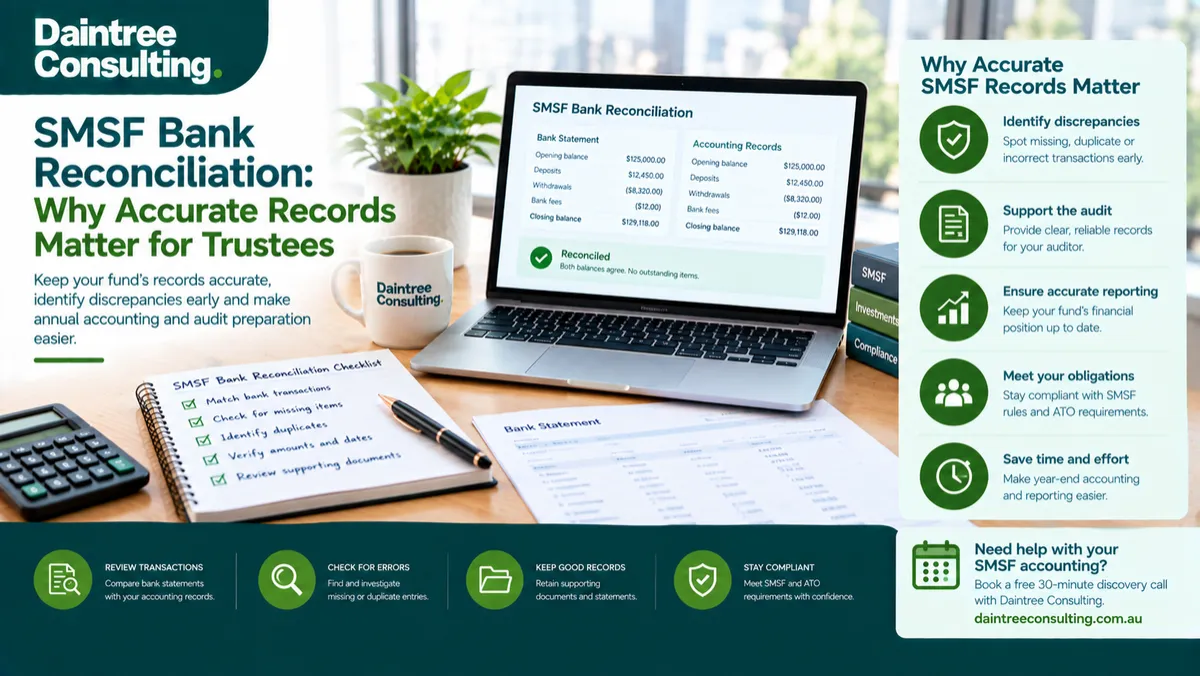
SMSF Bank Reconciliation: Why Accurate Records Matter for Trustees
For SMSF trustees, keeping accurate financial records is more than an administrative task.
Every contribution, pension payment, investment transaction, fund expense and bank transaction needs to be properly recorded and supported. When the SMSF's bank records do not agree with its accounting records, it can become harder to understand the fund's true financial position and prepare accurate annual accounts.
Want expert help? Daintree Consulting's SMSF accounting services can take this off your plate. Book a free consultation.
This is why SMSF bank reconciliation is an important part of maintaining reliable SMSF accounting records.
A proper bank reconciliation helps identify missing transactions, duplicate entries, incorrect amounts, timing differences and other discrepancies before they become larger problems.
It can also make the year-end accounting and independent audit process more straightforward.
In this guide, we explain what SMSF bank reconciliation involves, why it matters and what trustees should check when reviewing their fund's records.
Quick Answer: What Is an SMSF Bank Reconciliation?
An SMSF bank reconciliation is the process of comparing the transactions and balance recorded in the fund's accounting records with the corresponding bank statement.
The purpose is to confirm that:
Transactions have been recorded accurately
The accounting balance agrees with the bank balance, allowing for legitimate timing differences
Missing transactions are identified
Duplicate transactions are detected
Incorrect amounts can be corrected
Unexplained differences are investigated
Supporting records are available where required
For SMSF trustees, regular and accurate reconciliations can help maintain reliable records throughout the financial year rather than leaving problems to be discovered during year-end accounting or audit preparation.
Why Does SMSF Bank Reconciliation Matter?
An SMSF may have relatively few bank transactions compared with a large business, but each transaction still matters.
The fund's bank account can contain transactions relating to:
Employer or personal contributions
Pension payments
Investment income
Interest
Investment purchases
Investment sales
Accounting fees
Audit fees
Insurance
Other fund expenses
Tax payments and refunds
If a transaction is missing or incorrectly recorded, it can affect the fund's financial statements and other calculations.
For example, an incorrectly recorded contribution could affect the way the fund's records reflect member activity.
A missing investment transaction could affect the recorded investment balance.
An unrecorded expense could result in the accounts being incomplete.
The reconciliation process provides a practical check that the accounting records reflect what actually happened through the bank account.
What Does an SMSF Bank Reconciliation Involve?
The basic process is straightforward.
The accounting records for the SMSF are compared against the relevant bank statement for the same period.
The person performing the reconciliation checks transactions such as:
Deposits
Withdrawals
Bank fees
Interest
Transfers
Payments
Investment-related transactions
Other account activity
The objective is to identify differences and determine why they exist.
Not every difference means there is an error.
For example, a legitimate timing difference may occur where a transaction has been recorded in the accounting system but has not yet appeared on the bank statement.
The important point is that differences should be understood and supported rather than simply ignored.
Common SMSF Bank Reconciliation Problems
Several issues can cause the accounting records and bank statement to differ.
1. Missing transactions
A bank transaction may not have been entered into the accounting system.
This can happen when records are incomplete or transactions are manually entered.
2. Duplicate transactions
A transaction may accidentally be entered twice.
This can make the accounting balance appear different from the actual bank balance.
3. Incorrect transaction amounts
A transaction may have been recorded using the wrong amount.
Even a relatively small error can create reconciliation differences.
4. Incorrect transaction dates
A transaction can sometimes be entered using the wrong date, making it appear in a different reporting period.
5. Unrecorded bank fees
Bank charges can be overlooked, particularly when the fund has relatively infrequent transactions.
6. Unexplained transfers
Transfers between SMSF accounts or investment accounts may not have been recorded consistently.
7. Incomplete supporting documentation
A transaction may appear on the bank statement without adequate supporting evidence explaining its nature.
These issues should be investigated rather than carried forward indefinitely.
SMSF Bank Reconciliation and Investment Transactions
SMSF accounting becomes more complex when the fund has investments.
The bank account may contain transactions relating to:
Share purchases
Share sales
Managed funds
Term deposits
Distributions
Dividends
Interest
Investment fees
Brokerage
Other investment-related activity
Trustees should make sure the relevant investment records and statements are retained alongside the bank information.
A bank reconciliation can identify the cash movement, but it may not by itself provide all the information needed to correctly account for an investment.
For example, an investment purchase may require supporting records showing what was purchased, when it was purchased and the associated costs.
This is why SMSF accounting should bring together bank records, investment statements and other supporting documentation.
SMSF Bank Reconciliation and Contributions
Contributions are another area where accurate records matter.
A deposit into an SMSF bank account needs to be correctly identified and recorded.
Trustees may need to distinguish between different types of transactions rather than simply recording every deposit as generic income.
Supporting contribution information can help explain:
Who made the contribution
When it was made
The nature of the contribution
The amount received
The relevant member account
The exact treatment of contributions depends on the circumstances of the fund and members.
Keeping clear records from the beginning makes the accounting process easier and reduces the risk of having to reconstruct transactions later.
SMSF Bank Reconciliation and Pension Payments
For SMSFs paying pensions, accurate transaction records are also important.
Bank payments need to be appropriately recorded and supported by the fund's broader pension and member records.
A reconciliation can help identify whether payments appearing in the bank account have been properly captured in the accounting records.
Trustees should not rely solely on the bank statement to determine whether pension obligations have been met.
The fund's circumstances, pension arrangements and applicable requirements need to be considered when determining what records and calculations are required.
Why Reconciliations Should Not Be Left Until Year-End
One of the biggest practical problems is leaving all reconciliation work until the end of the financial year.
When transactions are reviewed months later:
Supporting documents may be difficult to locate
Trustees may not remember why a payment was made
Investment information may be scattered across different platforms
Errors may have been carried forward
Missing records may take longer to reconstruct
Regular reconciliation helps identify problems while the information is still accessible.
For an SMSF, this can make annual accounting preparation more organised.
It can also reduce the risk of discovering a large number of unexplained transactions immediately before the accounts need to be finalised.
How Often Should an SMSF Bank Account Be Reconciled?
There is no single reconciliation frequency that will suit every SMSF.
It depends on factors such as:
The number of transactions
The complexity of investments
Whether the fund is accumulating or paying pensions
How frequently contributions are received
The number of bank accounts
The accounting system being used
Who is responsible for maintaining the records
A fund with limited activity may have a relatively simple reconciliation process.
A fund with frequent investment transactions and multiple accounts may require more regular attention.
The important principle is that reconciliations should be performed consistently enough to identify discrepancies promptly.
What Should Trustees Keep for SMSF Bank Reconciliation?
Bank statements are an important starting point, but they may not be the only records required.
Depending on the fund's activities, useful supporting information can include:
Bank statements
Investment statements
Trade confirmations
Dividend statements
Distribution statements
Contribution records
Pension payment records
Expense invoices
Insurance documentation
Loan documentation where relevant
Trustee minutes and resolutions where applicable
Other transaction evidence
Keeping records organised throughout the year can make the accounting process considerably easier.
What Happens When the Bank Balance Doesn't Match the Accounting Records?
A difference should be investigated.
Start by checking:
The opening balance
Deposits
Withdrawals
Transfers
Bank fees
Interest
Investment transactions
Transaction dates
Duplicate entries
Missing transactions
If the difference cannot be explained, additional investigation may be required.
Do not simply adjust the accounting records to make the balances agree without understanding why the difference exists.
The purpose of a reconciliation is not to make two numbers match artificially.
It is to establish why they match or why a legitimate difference exists.
SMSF Bank Reconciliation Errors That Trustees Should Avoid
Treating every deposit as the same type of transaction
Different transactions can have different accounting and reporting implications.
Ignoring small differences
A small unexplained difference can indicate a broader record-keeping problem.
Making unsupported adjustments
An adjustment should have a clear reason and appropriate supporting information.
Keeping records in multiple disconnected places
Scattered records make it harder to establish a complete transaction history.
Waiting until the annual accounts are due
Late reconciliation can turn a simple discrepancy into a time-consuming investigation.
Forgetting investment-related transactions
Investment activity often creates additional records that need to be matched with cash movements.
Assuming the bank statement tells the whole story
The bank statement shows cash movements, but it does not necessarily provide all the information required for complete SMSF accounting.
How Accurate Bank Reconciliations Help With SMSF Annual Accounting
SMSFs generally need annual financial statements and an independent audit.
The quality of the underlying records can have a direct impact on how efficiently the annual accounting and audit process can be completed.
Accurate reconciliations can help provide a clearer starting point for:
Preparing financial statements
Reconciling member activity
Reviewing contributions
Reviewing pension payments
Accounting for investment transactions
Preparing information for the independent auditor
Preparing the fund's annual reporting and tax-related work
The exact records and processes required depend on the fund's circumstances.
The key is to avoid treating reconciliation as an isolated bookkeeping task.
It forms part of the broader process of maintaining reliable SMSF records.
SMSF Bank Reconciliation and the Independent Audit
An SMSF generally requires an annual audit by an approved auditor.
The auditor needs appropriate evidence to perform the audit within the applicable requirements.
Well-maintained financial records can help make this process more efficient.
When bank transactions are properly reconciled and supported, it can be easier to explain:
Contributions
Payments
Investment transactions
Expenses
Transfers
Other material movements
Poorly organised records can lead to additional questions and requests for supporting information.
This does not mean a perfectly reconciled bank account guarantees a particular audit outcome.
It simply means that reliable records provide a stronger foundation for the accounting and audit process.
A Simple SMSF Bank Reconciliation Checklist
Trustees can use the following checklist when reviewing their records.
Bank records
Obtain the relevant bank statements
Confirm the opening balance
Check the closing balance
Review all deposits
Review all withdrawals
Check bank fees and interest
Investigate unusual transactions
Accounting records
Confirm transactions have been entered
Check for duplicate entries
Verify transaction amounts
Check transaction dates
Review account classifications
Investigate unreconciled items
Supporting records
Match investment transactions with statements
Retain contribution evidence
Retain pension payment records
Keep expense invoices
Keep relevant contracts and agreements
Organise trustee documentation where applicable
Before year-end
Resolve outstanding reconciliation differences
Make sure supporting records are available
Review investment information
Confirm member-related records are complete
Prepare the accounting and audit file
When Should an SMSF Trustee Get Professional Accounting Support?
Managing SMSF records can become increasingly difficult when the fund has more complex transactions.
Professional SMSF accounting support may be useful when:
The fund has multiple investments
There are frequent investment transactions
The SMSF is paying pensions
Contributions are more complex
Records are incomplete
Bank reconciliations have fallen behind
Previous-year records contain unresolved issues
Trustees are unsure how transactions should be recorded
Annual accounting and audit preparation is becoming time-consuming
Professional support can help trustees keep the accounting records organised while coordinating the information required for the annual process.
How Daintree Consulting Can Help With SMSF Accounting
Daintree Consulting provides SMSF accounting and administration support for trustees who need dependable financial records and a more organised year-end process.
Support can include:
Transaction coding
Bank and investment reconciliations
Annual SMSF financial statements
Member reporting
Contribution and pension tracking
Year-end document preparation
Audit-file preparation
Coordination with the fund's independent approved auditor
Annual return preparation and lodgement support
Daintree can work with trustees to establish an organised process for collecting records and preparing the fund's annual accounts.
SMSF accounting support does not replace personal financial advice. Where trustees need advice about SMSF suitability, investments, establishment or other regulated financial matters, appropriately licensed advice may be required.
Final Thoughts
An SMSF bank reconciliation may seem like a straightforward administrative task, but it plays an important role in maintaining accurate fund records.
When bank transactions are regularly checked against the accounting records, trustees have a better opportunity to identify errors, missing transactions and unexplained differences early.
It can also make annual accounting and audit preparation more organised.
The best approach is not to wait until the end of the financial year to discover that records do not agree.
Keep bank statements and supporting documents organised.
Reconcile transactions consistently.
Investigate differences.
Keep investment and member records together with the relevant financial information.
And when the fund becomes too complex to manage confidently, consider getting professional SMSF accounting support.
Accurate records give trustees a clearer picture of the fund and provide a stronger foundation for the annual accounting and independent audit process.
Need Help With Your SMSF Accounting?
Daintree Consulting can help trustees keep SMSF financial records organised, reconcile transactions and prepare the fund's annual accounting and audit file.
Book a free 30-minute discovery call to discuss your SMSF accounting and administration requirements.
Frequently Asked Questions
What is an SMSF bank reconciliation?
An SMSF bank reconciliation compares the transactions and balance recorded in the fund's accounting records with the relevant bank statement to identify missing, duplicated, incorrect or unexplained transactions.
Why is bank reconciliation important for an SMSF?
It helps trustees maintain accurate financial records and identify discrepancies before they affect year-end accounts, reporting or the audit process.
How often should an SMSF bank account be reconciled?
The appropriate frequency depends on the fund's transaction volume, investments, pension arrangements and accounting processes. The key is to reconcile regularly enough to identify and investigate discrepancies promptly.
What should I do if my SMSF bank balance doesn't match the accounting records?
Review the opening balance, deposits, withdrawals, transfers, fees, interest, investment transactions, dates and duplicate entries. Any unexplained difference should be investigated rather than simply adjusted without supporting evidence.
Does an SMSF bank reconciliation replace the annual audit?
No. A bank reconciliation is one part of maintaining the fund's financial records. An SMSF generally requires an annual independent audit by an approved auditor, subject to the applicable requirements.
Can bank reconciliation errors affect SMSF accounts?
Yes. Missing or incorrectly recorded transactions can affect the accuracy of the fund's financial records and may flow through to annual financial statements and other reporting.
Do SMSFs need to keep bank statements?
SMSF trustees have record-keeping obligations, and relevant financial records should be retained for the periods required under applicable rules. Trustees should check current ATO requirements for their circumstances.
Can an accountant perform SMSF bank reconciliations?
Yes. SMSF accounting services can include transaction coding, bank and investment reconciliations, annual financial statements and preparation of records for the independent audit, depending on the agreed scope.
Can Daintree Consulting help with SMSF bank reconciliation?
Daintree Consulting provides SMSF accounting and administration support, including transaction coding, bank and investment reconciliations, annual financial statements and audit-file preparation.
Talk to Daintree about your SMSF accounts
Our ex-Big 4 team gives clear, senior-reviewed advice so you can act with confidence.
Book a free consultation →
Or explore our SMSF accounting services.
