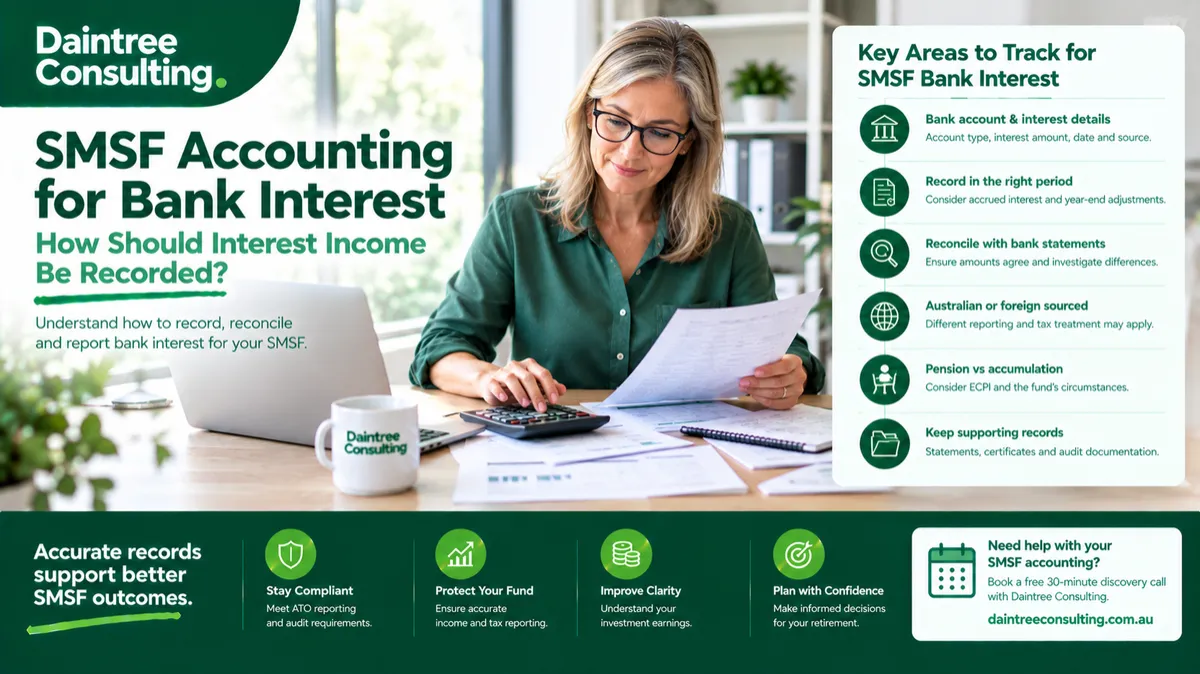
SMSF Bank Interest Accounting: How Should Interest Income Be Recorded?
Interest earned on cash held in an SMSF bank account can look like a relatively simple accounting entry.
The fund receives interest from its bank, the amount appears on the bank statement, and it needs to be included in the fund's financial records.
Want expert help? Daintree Consulting's SMSF accounting services can take this off your plate. Book a free consultation.
But for SMSF trustees, accurate recording of bank interest is important because investment income flows through the fund's accounting records, financial statements, tax reporting and annual audit.
The challenge is not usually the calculation itself.
It is making sure the interest is:
Correctly identified
Recorded in the SMSF's accounts
Reconciled to the bank statement
Included in the appropriate income category
Supported by appropriate records
Properly considered when preparing the SMSF annual return
Reflected correctly when determining the fund's taxable and exempt income
For an SMSF with several investments, bank interest may also be one of several income streams that need to be reconciled at year-end.
This guide explains SMSF bank interest accounting, what trustees should keep track of and what records can help support the fund's financial statements and annual audit.
Quick answer: How should SMSF bank interest be recorded?
Bank interest earned by an SMSF should be recorded as income of the fund in its accounting records and reconciled to supporting bank documentation.
Trustees should generally keep track of:
The SMSF bank account earning the interest
The interest amount
The date the interest was credited
The relevant financial year
Any interest accrued or otherwise requiring year-end adjustment
Whether the interest is Australian or foreign sourced
Whether the income may form part of exempt current pension income
Bank statements supporting the amount
Accounting entries recording the income
The amount reported in the SMSF's annual return
Any related tax treatment
Records needed for the annual SMSF audit
The exact accounting and tax treatment depends on the circumstances of the fund.
A normal Australian bank account held in the name of the SMSF will generally produce straightforward interest income. However, trustees should still ensure the income is correctly classified and reconciled.
What is bank interest income for an SMSF?
Bank interest is income earned when an SMSF holds cash with a bank or similar financial institution.
For example, an SMSF may maintain cash in:
A transaction account
A high-interest savings account
A term deposit
Another eligible bank deposit
The bank may pay or credit interest monthly, quarterly, annually or at another agreed interval.
From an accounting perspective, the interest is investment income earned by the SMSF.
The ATO's SMSF annual return instructions identify interest earned on money held in a bank or similar institution as gross interest income. The instructions also distinguish Australian-source interest from certain other types of income, such as foreign-source income and income included through trust distributions.
This means trustees should not simply record every amount labelled "interest" in exactly the same way.
The source and nature of the income matter.
Why accurate SMSF bank interest accounting matters
Bank interest might be a relatively small part of an SMSF's overall investment income.
That does not mean it can be ignored.
Accurate recording helps ensure that:
The financial statements are complete
The fund's income is correctly reported
Bank accounts reconcile
Investment income is not understated
Tax calculations are based on accurate information
Audit evidence is available
Member accounting is supported
Year-end adjustments can be identified
A small recurring error can also become significant over several years.
For example, if interest from a high-interest SMSF bank account is not properly captured in the accounting records each month, the year-end balance may require a manual adjustment.
That creates unnecessary work for the trustee, accountant and auditor.
1. Make sure the bank account belongs to the SMSF
Before considering the interest itself, trustees should make sure the underlying bank account is properly established for the fund.
The ATO states that an SMSF needs a bank account in the name of the SMSF to manage fund operations, accept contributions and rollovers, hold investment earnings and pay expenses and liabilities.
The fund's money and assets must also be kept separate from personal or related-party assets.
This is important because the bank account is not simply a convenient place to hold money.
It is part of the fund's financial structure.
The ATO also states that trustees must ensure their fund's bank account details are accurate and current.
For accounting purposes, this makes the bank account a key source of evidence for transactions and income earned by the fund.
2. Identify each interest payment
When reconciling the SMSF bank account, trustees should identify interest transactions separately from other bank transactions.
A bank statement might contain:
Interest income
Bank fees
Contributions
Rollovers
Investment proceeds
Dividend payments
Member benefit payments
Tax payments
Other fund transactions
Interest should be correctly identified and allocated to the appropriate income account in the SMSF's accounting system.
This sounds straightforward, but problems can occur when transactions are imported automatically into accounting software.
A transaction may be categorised incorrectly or left unreconciled.
That is why the bank reconciliation process still matters even when the SMSF uses automated accounting software.
3. Record the interest in the correct accounting period
Timing is an important part of SMSF accounting.
Suppose an SMSF earns interest during June but the bank credits the interest to the account in July.
The accounting treatment may require consideration of whether income has been earned or recognised in the relevant reporting period, depending on the accounting basis and circumstances.
This is one reason year-end accounting can involve adjustments beyond simply importing transactions from the bank feed.
Trustees should not assume that the final bank statement transaction automatically represents every amount that needs to be considered for the financial year.
The SMSF accountant should review the relevant bank information and determine whether any year-end adjustments are required.
4. Reconcile bank interest to the bank statement
One of the simplest controls is to reconcile recorded interest against the bank's own records.
For example:
Accounting records
Interest income: $1,850
Bank statements
Interest credited: $1,850
If the amounts agree, the transaction can be supported by the bank statement.
If they do not agree, the difference should be investigated.
Possible explanations include:
Interest credited after year-end
Interest accrued but not yet credited
A missed bank transaction
Incorrect accounting classification
Duplicate transaction
Bank correction
Interest from another SMSF account
A proper reconciliation should explain differences rather than simply force the accounts to balance.
5. Keep the bank statements
Bank statements are important supporting records for SMSF accounting.
They can provide evidence of:
Opening balances
Closing balances
Interest received
Contributions
Investment transactions
Expenses
Tax payments
Benefit payments
Other fund transactions
They can also help the accountant and auditor trace transactions back to the SMSF's bank account.
The ATO's SMSF auditor checklist specifically identifies bank statement transactions as evidence auditors may examine when carrying out required verification checks.
For this reason, trustees should keep complete bank statements rather than relying solely on the accounting software's transaction history.
6. Check whether the interest is Australian or foreign sourced
Not all interest income should necessarily be treated identically.
The ATO's SMSF annual return instructions distinguish Australian-source interest from foreign-source interest.
Australian-source interest is reported as gross interest in the relevant section of the annual return.
Foreign-source income has separate reporting treatment.
This distinction matters if an SMSF holds cash or investments with overseas financial institutions.
Trustees should therefore identify the source of interest income rather than assuming that every interest transaction belongs in the same reporting category.
7. Consider interest earned on term deposits
Term deposits can create a slightly different reconciliation process.
An SMSF might place $100,000 into a term deposit for a fixed period and earn interest according to the terms of the deposit.
Depending on the product, interest may be:
Paid periodically
Paid at maturity
Credited to another account
Rolled into the deposit
Reinvested
The accounting records should reflect the relevant income and transaction information for the fund.
The supporting documents may include:
Term deposit confirmation
Bank statements
Interest statements
Maturity notices
Renewal documents
Transaction records
The trustee should also ensure the term deposit itself is properly reflected in the SMSF's investment records.
8. Do not confuse interest income with bank fees
SMSF bank accounts can generate both income and expenses.
For example:
Interest income: $1,200
Bank fees: $180
These should not simply be netted together in the accounting records without considering the appropriate accounting and tax treatment.
The gross interest and relevant expenses should be appropriately recorded.
The ATO's SMSF guidance includes gross interest as an income category and separately addresses deductions and expenses.
Keeping income and expenses properly classified makes the financial statements easier to understand and supports more accurate tax preparation.
9. Consider whether the interest relates to pension or accumulation interests
SMSF tax treatment can become more complex when a fund has both accumulation and retirement-phase interests.
Interest income may form part of the fund's income that is considered when determining exempt current pension income (ECPI), depending on the fund's circumstances and the applicable method.
The ATO provides examples where gross interest forms part of fund income and a portion is treated as exempt current pension income.
For example, the ATO has published an example involving an SMSF earning $30,000 of interest where part of the fund's assets supported current pension liabilities. The example illustrates how a portion of the interest could form part of ECPI.
This is why trustees should not assume:
“The SMSF earned $10,000 interest, therefore all $10,000 is automatically taxed in the same way.”
The fund's pension and accumulation circumstances need to be considered.
What is exempt current pension income?
Exempt current pension income, commonly called ECPI, is income that may be exempt from tax when it relates to eligible retirement-phase pension interests and the relevant requirements are met.
The calculation can depend on factors including:
Whether the fund uses the segregated method
Whether the fund uses the proportionate method
The pension interests in the fund
The assets supporting those interests
Whether an actuarial certificate is required
The circumstances of the fund during the financial year
This means interest income can have a different tax outcome depending on how the SMSF is structured and how its assets and liabilities relate to pension interests.
Trustees should therefore avoid making tax assumptions based only on the interest amount shown on the bank statement.
10. Keep track of interest for member accounting
An SMSF's bank interest contributes to the overall investment earnings of the fund.
The ATO explains that member accounts record contributions, fund investment earnings allocated to members and payments of super benefits.
This means accurate investment income records can also support member accounting.
The exact allocation of earnings between members depends on the fund's governing documents, accounting methodology and circumstances.
Trustees should therefore ensure that the investment income recorded in the accounts is consistent with the fund's member records and broader accounting process.
11. Record interest separately from contributions
A bank account can receive several different types of payments.
For example:
Employer contributions
Personal contributions
Government contributions where applicable
Rollovers
Investment income
Interest
Dividend income
These are not interchangeable.
Interest is investment income.
A contribution is a contribution.
A rollover is a rollover.
Correct classification is important because these amounts can have different accounting and tax consequences.
This is one reason trustees should avoid manually coding transactions without understanding what each transaction represents.
12. What happens if the bank pays interest after 30 June?
Year-end timing is a common question.
Suppose an SMSF's bank account earns interest during June, but the bank credits the interest in early July.
The accountant may need to consider whether an amount should be recognised or accrued at 30 June based on the applicable accounting and tax treatment.
The correct treatment depends on the circumstances and the basis used in preparing the fund's accounts and tax return.
The important point for trustees is simple:
Do not assume that the bank's July transaction automatically means the income has nothing to do with the previous financial year.
Year-end accounting should consider transactions and amounts relevant to the reporting period.
13. Keep evidence for the SMSF audit
Every SMSF must have its financial statements and compliance position audited by an approved SMSF auditor each income year.
That makes supporting documentation important.
For bank interest, the auditor or accountant may need evidence such as:
Bank statements
Term deposit statements
Interest certificates
Accounting ledger
Bank reconciliation
Investment records
Year-end interest calculations
Other supporting documents
The ATO's auditor checklist shows that auditors may examine bank statements, financial accounts, ledgers and other supporting records when performing required checks.
The better the records, the easier it is to demonstrate how the interest amount was determined.
Common SMSF bank interest accounting mistakes
Bank interest accounting is relatively simple, but mistakes can still occur.
Missing small interest transactions
An SMSF may receive several small interest credits throughout the year.
If they are not reconciled, the total interest income can be understated.
Recording interest in the wrong account
Interest may be incorrectly coded as contributions, other income or a bank adjustment.
Using net interest instead of gross interest
Interest income should be appropriately recorded rather than automatically netting it against unrelated bank fees.
Ignoring term deposit interest
Interest from term deposits can be overlooked when the funds are locked away and no regular bank transaction appears in the main operating account.
Failing to identify foreign-source interest
Overseas interest may have different reporting requirements.
Missing year-end adjustments
Interest relevant to the financial year may require consideration even when the bank transaction appears after 30 June.
Failing to reconcile the bank account
A bank balance that agrees does not necessarily mean every income transaction has been correctly classified.
Assuming all interest is taxed identically
Pension-phase arrangements and ECPI can affect the tax treatment of fund income.
A practical SMSF bank interest accounting checklist
Before finalising the SMSF accounts, trustees can check:
Bank accounts
Is every SMSF bank account identified?
Are the accounts held in the fund's name?
Are opening and closing balances correct?
Are all bank statements available?
Interest income
Has every interest transaction been identified?
Does recorded interest agree with bank statements?
Has term deposit interest been included?
Has any interest been received from another source?
Classification
Is the interest Australian or foreign sourced?
Has it been recorded in the appropriate income account?
Has it been kept separate from contributions and rollovers?
Have related expenses been recorded separately where appropriate?
Year-end
Does any interest relate to the period but appear after 30 June?
Are any year-end accruals or adjustments required?
Does the accounting ledger reconcile to supporting documentation?
Tax and pension considerations
Has the interest been considered when preparing the SMSF annual return?
Does ECPI need to be considered?
Is the fund's accumulation and pension position properly reflected?
Audit
Are bank statements available?
Are term deposit documents available?
Can the interest amount be traced from the accounts to source documentation?
Are supporting records organised for the approved SMSF auditor?
How should SMSF trustees organise bank interest records?
A simple record-keeping structure can make year-end accounting easier.
For each bank or deposit account, keep:
Bank account details
The name and identifying information for the SMSF bank account.
Bank statements
Complete statements covering the financial year.
Interest documentation
Statements, certificates or other evidence showing interest earned.
Reconciliation
A record showing that the accounting balance agrees with the bank information.
Accounting ledger
The transactions recorded in the SMSF accounting system.
Year-end adjustments
Documentation supporting any accrued or adjusted interest amount.
Tax reporting
Records supporting the amount included in the SMSF's annual return.
This creates a clear trail from the original bank transaction through to the financial statements and tax reporting.
Why bank reconciliation matters for SMSF accounting
Bank reconciliation is more than a bookkeeping task.
It is a control that helps trustees and accountants confirm that the SMSF's accounting records reflect the transactions that actually occurred.
A reconciliation can identify:
Missing transactions
Duplicate entries
Incorrect classifications
Unrecorded interest
Unpresented payments
Bank charges
Timing differences
Incorrect opening balances
For an SMSF, this can be particularly useful because the bank account is often central to the evidence supporting contributions, expenses, investment transactions and income.
Accurate bank reconciliation therefore supports more than just the interest-income figure.
It supports the overall quality of the fund's financial records.
What if an SMSF has multiple bank accounts?
Some SMSFs may have more than one bank or deposit account.
For example, the fund could have:
An operating account
A high-interest savings account
One or more term deposits
A separate account used for a particular investment arrangement
In this situation, trustees should make sure interest is captured across all relevant accounts.
A common problem is reconciling the main transaction account while overlooking a secondary savings or deposit account.
The annual financial statements should reflect the fund's complete financial position.
That means all relevant accounts and investment income need to be considered.
How Daintree can help with SMSF accounting
SMSF accounting requires more than recording transactions.
The financial records need to support the fund's annual financial statements, tax reporting and audit process.
Daintree Consulting can support SMSF trustees with:
SMSF accounting
Annual financial statements
Investment income recording
Bank reconciliations
Investment record organisation
Member accounting
Annual return support
Audit-file preparation
Supporting documentation
Coordination with the approved SMSF auditor
For trustees, the objective is to maintain records that are organised, complete and ready for the annual accounting and audit process.
Bank interest may be a small part of an SMSF's investment income, but recording it accurately is part of maintaining reliable fund records.
Need help keeping your SMSF accounts organised?
If your SMSF has multiple bank accounts, investments, pension interests or increasingly complex accounting records, professional support can make the annual accounting and audit process easier to manage.
Book a free 30-minute discovery call with Daintree Consulting to discuss your SMSF accounting requirements.
Frequently Asked Questions
How is bank interest recorded in an SMSF?
Bank interest is generally recorded as investment income in the SMSF's accounting records and reconciled to the relevant bank statement or other supporting documentation.
The exact accounting treatment depends on the circumstances and applicable accounting and tax requirements.
Is bank interest taxable in an SMSF?
Bank interest can form part of an SMSF's assessable income, subject to the fund's circumstances and applicable tax rules.
Where pension interests are involved, ECPI may affect the tax treatment of some fund income.
Does SMSF bank interest need to be reported?
Yes.
Interest income needs to be appropriately considered when preparing the SMSF's financial statements and annual return.
The ATO's annual return instructions include gross interest as a specific income category for relevant Australian-source interest.
What records should an SMSF keep for bank interest?
Useful records can include bank statements, interest statements, term deposit documentation, accounting ledgers, reconciliations and supporting year-end calculations.
What if interest is credited after 30 June?
The treatment depends on the circumstances and the applicable accounting and tax requirements.
The fact that a bank credits the interest after 30 June does not necessarily resolve whether the income needs to be considered for the previous reporting period.
Is interest from a term deposit recorded differently?
Term deposit interest is still investment income, but the timing and supporting documentation can differ depending on the product and when interest is paid or credited.
Does ECPI affect SMSF bank interest?
It can.
Where an SMSF has eligible retirement-phase interests, the fund may need to determine the amount of income that qualifies as exempt current pension income.
Can bank interest be allocated directly to an SMSF member?
SMSF investment earnings form part of the fund's overall accounting and member allocation process.
The appropriate allocation depends on the fund's governing documents, accounting methodology and circumstances.
Why does the SMSF auditor need bank statements?
Bank statements provide evidence of transactions and balances and can help the auditor verify the fund's financial records and compliance position.
What happens if interest income is missing from the SMSF accounts?
The omission should be identified and corrected as appropriate. The effect on the financial statements, annual return and audit should then be considered.
Can Daintree help with SMSF bank reconciliations?
Yes.
Daintree Consulting can support SMSF accounting, bank reconciliations, investment income records, annual financial statements, audit preparation and related accounting processes.
Talk to Daintree about your SMSF accounts
Our ex-Big 4 team gives clear, senior-reviewed advice so you can act with confidence.
Book a free consultation →
Or explore our SMSF accounting services.
