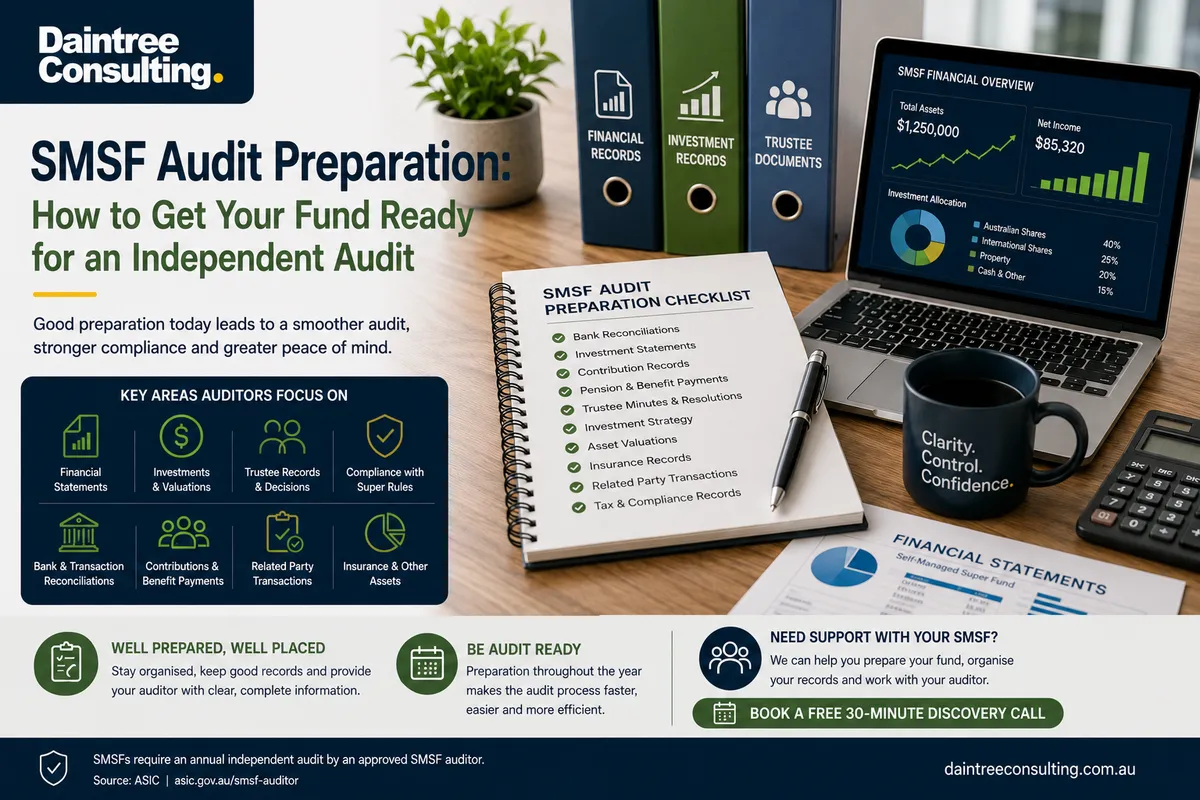
SMSF Audit Preparation: How to Get Your Fund Ready for an Independent Audit
Running a self-managed super fund comes with an important annual responsibility: the fund's financial statements and compliance need to be independently audited.
For trustees, good SMSF audit preparation is about more than simply sending financial statements to an auditor. The auditor needs sufficient evidence to assess the fund's financial position and whether it has complied with the relevant superannuation rules.
Want expert help? Daintree Consulting's SMSF accounting services can take this off your plate. Book a free consultation.
Every SMSF must have its financial accounts and statements audited annually by an approved SMSF auditor. The audit covers both the fund's financial statements and its compliance with applicable superannuation requirements.
The good news is that preparation does not have to be complicated.
If your accounting records are complete, investments are properly documented, trustee decisions are recorded and supporting evidence is organised, the audit process can be considerably smoother.
This guide explains what trustees should prepare before their SMSF audit and how to reduce avoidable delays.
Quick Answer: How Do You Prepare for an SMSF Audit?
Before the audit begins, trustees should generally make sure:
The fund's accounting records are complete and up to date.
Bank and investment accounts have been reconciled.
Contributions and benefit payments have been correctly recorded.
Investment ownership and valuations can be supported by evidence.
The fund's investment strategy is current and documented.
Trustee decisions and important transactions have appropriate records.
Related-party transactions have supporting documentation.
Property and other significant assets have appropriate evidence of ownership and value.
Previous audit issues have been addressed.
The auditor receives the requested information promptly.
The SMSF's auditor is appropriately registered and independent.
The exact documents required will depend on the fund's activities, investments, transactions and circumstances.
1. Understand What the SMSF Audit Covers
The first step in effective SMSF audit preparation is understanding what the auditor is actually reviewing.
An SMSF audit is not simply a check that the bookkeeping adds up.
The auditor considers both:
Financial position
This involves examining the fund's financial statements and supporting evidence to determine whether the financial information is properly supported.
Compliance
The auditor also assesses whether the SMSF has complied with relevant superannuation legislation and regulations.
ASIC explains that an SMSF auditor examines the validity and accuracy of the fund's financial records and checks the fund's compliance with superannuation rules.
This means trustees need to be prepared to provide evidence for both sides of the audit.
2. Get the Accounting Records Up to Date
Before sending anything to your auditor, make sure the SMSF's accounting records are complete.
This should include reviewing:
Bank transactions
Contributions
Pension or benefit payments
Investment transactions
Dividends and distributions
Interest income
Investment expenses
Tax-related transactions
Insurance premiums
Accounting fees
Other fund expenses
Bank accounts should be reconciled and unexplained transactions investigated.
If the accounting file contains unreconciled transactions, missing documentation or unexplained balances, the auditor may need to request additional information.
Good bookkeeping therefore forms the foundation of good SMSF audit preparation.
3. Prepare Your Bank and Investment Records
Investment documentation is particularly important because an auditor needs evidence supporting the fund's investments and transactions.
Depending on the SMSF's investment portfolio, this may include:
Bank statements
Share trading statements
Dividend statements
Managed fund statements
Trust distribution statements
Term deposit documentation
Investment purchase and sale records
Brokerage reports
Cryptocurrency records, where applicable
Investment income records
Evidence supporting investment ownership
For significant investments, make sure the legal ownership and accounting records are consistent.
Where an investment has been bought or sold during the year, retain the relevant transaction documentation.
4. Check Investment Valuations
Trustees should also make sure investment values are properly supported.
This becomes particularly important for assets that do not have a readily available market price.
For example, if the SMSF owns property, trustees may need appropriate evidence supporting its value.
Other investments may also require supporting valuation information depending on their nature.
Do not simply enter an estimated value into the accounting software without considering what evidence supports it.
A well-organised valuation file can make the audit process significantly easier.
5. Review the SMSF's Investment Strategy
The SMSF's investment strategy is another important area for trustees to review.
Before the audit, confirm that the fund has a documented investment strategy and that trustee decisions and investments are consistent with the strategy where required.
The strategy should reflect the fund's actual circumstances rather than being treated as a generic document that is never reviewed.
Consider whether there have been material changes during the year, such as:
New investments
Major asset sales
Changes in member circumstances
Changes in retirement or pension arrangements
Significant changes in the fund's asset allocation
Changes affecting liquidity or diversification
If circumstances have changed, trustees should ensure the fund's records appropriately reflect the decisions made.
6. Organise Trustee Minutes and Decisions
SMSF trustees are responsible for making and documenting important decisions relating to the fund.
Before the audit, gather records of relevant trustee decisions.
These may include documentation relating to:
Investment decisions
Investment strategy reviews
Benefit payments
Pension commencement
Pension changes
Contributions
Related-party transactions
Asset purchases and disposals
Changes to trustees
Changes to members
Other significant fund decisions
The ATO identifies trustee meetings and decisions as records SMSF trustees should retain.
The objective is to create a clear record showing what decision was made, why it was made and when it was made.
7. Check Contributions and Benefit Payments
Contributions and payments to members should be carefully reviewed before the audit.
Check that records agree with supporting documentation and that transactions have been allocated correctly.
Depending on the fund's circumstances, this may involve reviewing:
Employer contributions
Personal contributions
Government contributions, where applicable
Pension payments
Lump-sum payments
Rollovers
Transfers
Related member transactions
Any unusual or significant transaction should have supporting evidence available.
If there is uncertainty about how a contribution or payment should have been treated, it is better to investigate it before the audit rather than waiting for the auditor to identify the issue.
8. Review Related-Party Transactions Carefully
Related-party transactions deserve particular attention.
Trustees should review transactions involving:
Members
Relatives of members
Related entities
Businesses connected with members
Property transactions
Loans or financial arrangements
Purchases from or sales to related parties
These transactions can raise additional compliance considerations.
The auditor will need sufficient evidence to understand the transaction and determine whether relevant requirements have been met.
If your SMSF has significant related-party transactions, professional advice before the audit can help identify potential issues early.
9. Make Sure Asset Ownership Can Be Proven
An auditor needs evidence supporting the fund's ownership of its assets.
Depending on the investment, this could include:
Shareholding statements
Property documentation
Bank records
Managed investment statements
Term deposit certificates
Loan documentation
Trust documentation
Investment contracts
Other ownership records
This is especially important where the SMSF owns assets outside straightforward listed investments.
Keep legal documents and accounting records consistent wherever possible.
10. Review Previous Audit Issues
If the previous SMSF audit identified issues, do not simply file the audit report away.
Review the previous findings and determine:
Was the issue fixed?
Was the underlying cause addressed?
Is there evidence supporting the corrective action?
Could the same issue have occurred again during the current financial year?
The ATO's SMSF annual return materials require trustees to consider whether reported compliance issues have been rectified.
Resolving issues before the next audit can prevent repeat findings and unnecessary delays.
11. Give the Auditor a Complete Information Pack
One of the easiest ways to improve the audit process is to provide information in an organised way.
Instead of sending documents randomly over several weeks, create a structured audit file.
For example:
Financial records
Trial balance
General ledger
Financial statements
Bank reconciliations
Investment records
Investment statements
Purchase and sale documentation
Income statements
Valuation evidence
Trustee records
Minutes
Investment strategy
Trustee declarations
Important resolutions
Member transactions
Contributions
Rollovers
Pension payments
Benefit payments
Compliance records
Previous audit report
Annual return information
Relevant supporting documentation
Records relating to identified compliance issues
Your auditor may request additional information depending on the fund.
12. Choose an Appropriately Registered and Independent Auditor
SMSF trustees cannot simply use any accountant or financial professional to perform the fund's annual audit.
The SMSF auditor must be appropriately registered.
ASIC states that SMSFs must have an annual audit performed by a registered SMSF auditor.
Independence is also important.
The auditor needs to be independent from the fund and must comply with applicable professional independence requirements.
ASIC has continued to take regulatory action against SMSF auditors for breaches including independence requirements, demonstrating that auditor independence remains an important regulatory issue.
Trustees should therefore consider whether their proposed auditor is properly registered and independent before the engagement begins.
13. Don't Wait Until the Last Minute
One of the biggest practical mistakes trustees make is treating the audit as something that happens automatically after the accounts are prepared.
A better approach is to work backwards from the fund's annual reporting obligations.
Allow enough time for:
Bookkeeping and accounting records to be finalised.
Investments to be reconciled and valued.
Supporting documentation to be collected.
Trustee records to be reviewed.
The auditor to perform the audit.
Any questions or issues to be resolved.
The audit report to be finalised.
The annual return to be lodged after the audit is complete.
The ATO states that the SMSF audit must be finalised before the fund's annual return is lodged.
Starting early gives trustees more time to resolve questions before the reporting deadline.
SMSF Audit Preparation Checklist
Before sending your fund to audit, ask:
Are all bank accounts reconciled?
Are investment transactions recorded?
Are investment values supported?
Do investment records show ownership?
Are contributions correctly recorded?
Are benefit payments supported?
Are pension transactions properly documented where applicable?
Is the investment strategy current?
Are important trustee decisions documented?
Are related-party transactions supported?
Are previous audit findings resolved?
Are relevant financial statements prepared?
Are supporting documents organised?
Has the auditor been provided with the requested information?
Have you confirmed the auditor's registration and independence?
The precise checklist will vary depending on the SMSF's structure, investments and transactions.
Common SMSF Audit Preparation Mistakes
Waiting until the audit starts to find missing documents
If supporting records are missing, the auditor may need to request them after the engagement has already begun.
Treating the investment strategy as a formality
The investment strategy should reflect the fund's circumstances and investment decisions.
Not documenting trustee decisions
A transaction may make sense to the trustee but still require evidence showing how and why the decision was made.
Ignoring previous audit findings
Repeat issues can create unnecessary compliance concerns.
Assuming the accountant and auditor are the same role
The auditor provides an independent audit function. The accounting and audit roles should not be confused, particularly where independence requirements apply.
How Daintree Can Help With SMSF Accounting and Audit Preparation
Preparing an SMSF for audit requires accurate accounting records, organised documentation and an understanding of the fund's transactions and reporting requirements.
Daintree Consulting provides SMSF accounting support designed to help trustees maintain reliable financial records and prepare the information required for the annual compliance process.
The goal is straightforward: make the numbers clear, keep the records organised and reduce avoidable audit delays.
If your SMSF is approaching its annual reporting period and you are unsure whether the records are ready, a focused review can help identify gaps before they become bigger problems.
Book a free 30-minute discovery call to discuss your SMSF accounting and audit preparation needs.
Frequently Asked Questions
What is SMSF audit preparation?
SMSF audit preparation is the process of getting the fund's financial records, investment documentation, trustee decisions and supporting evidence organised before the independent annual audit.
Does every SMSF need an audit?
Yes. SMSFs are required to have their financial accounts and statements audited annually by an approved SMSF auditor. The audit also considers the fund's compliance with relevant superannuation requirements.
What documents are needed for an SMSF audit?
The documents required depend on the fund. They may include financial statements, bank records, investment statements, valuation evidence, trustee minutes, investment strategy documentation, contribution records, benefit payment records and other supporting evidence.
Can my accountant also be my SMSF auditor?
The answer depends on the services provided and the applicable independence requirements. SMSF auditors must meet independence requirements, so the relationship should be assessed before the audit engagement begins.
What does an SMSF auditor check?
An SMSF auditor examines the fund's financial records and assesses compliance with relevant superannuation requirements. The precise audit procedures depend on the fund's circumstances, transactions and risks.
How can I avoid SMSF audit delays?
Keep accounting records up to date, reconcile accounts, organise investment evidence, document trustee decisions, resolve previous audit issues and provide requested information promptly.
When should I start preparing for my SMSF audit?
Ideally, preparation should begin well before the audit engagement. Keeping records organised throughout the year is much easier than reconstructing transactions and decisions immediately before the audit.
Important Publishing Note
Because SMSF legislation, ATO requirements and reporting obligations can change, specific deadlines, thresholds and compliance requirements should be verified for the relevant financial year before publication or updating this article.
The appropriate audit and reporting requirements can also depend on the SMSF's structure, investments, transactions and individual circumstances. For current obligations, trustees should refer to the ATO and ASIC or obtain professional advice relevant to their fund. The ATO confirms that SMSFs must have their annual audit completed before the annual return is lodged.
Talk to Daintree about your SMSF accounts
Our ex-Big 4 team gives clear, senior-reviewed advice so you can act with confidence.
Book a free consultation →
Or explore our SMSF accounting services.
