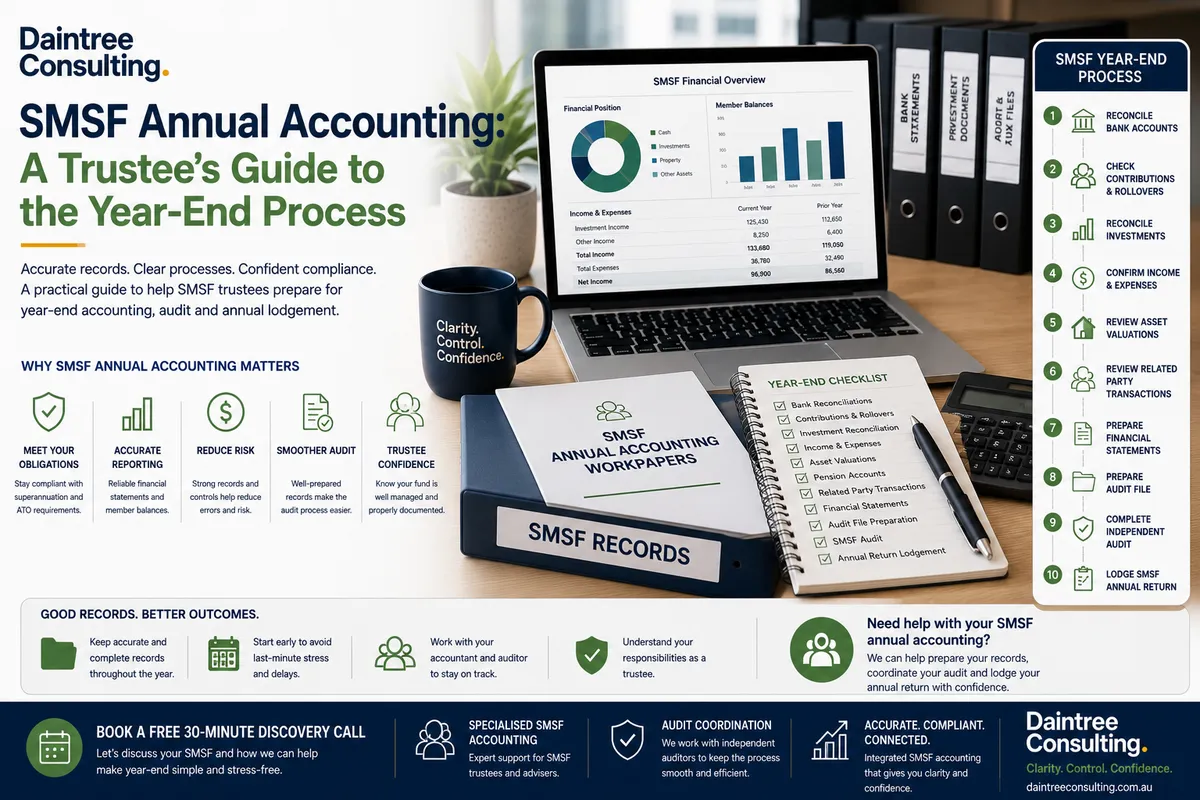
SMSF Annual Accounting: A Trustee’s Guide to the Year-End Process
Running a Self-Managed Super Fund (SMSF) comes with more responsibility than simply choosing investments.
As an SMSF trustee, you are responsible for making sure the fund's records are accurate, its financial statements are prepared correctly, its annual audit is completed, and its annual return is lodged with the Australian Taxation Office (ATO).
Want expert help? Daintree Consulting's SMSF accounting services can take this off your plate. Book a free consultation.
That makes SMSF annual accounting an important part of the fund's yearly compliance cycle.
The good news is that the process does not need to be complicated. With organised records, accurate reconciliations and a clear year-end process, trustees can make the annual accounting and audit process much smoother.
This guide explains what happens during SMSF year-end accounting, what records trustees typically need, how the audit fits into the process and what you should do before your annual return is lodged.
Important: SMSF rules can depend on the fund's structure, investments, transactions and individual circumstances. This article is general information only and is not personal financial, tax or legal advice.
Quick Answer: What Is SMSF Annual Accounting?
SMSF annual accounting is the process of preparing the fund's financial records and statements for the financial year, reconciling transactions and investments, calculating relevant income and expenses, preparing member information and getting the fund ready for its independent SMSF audit and annual return.
A typical year-end process includes:
Reconciling the SMSF's bank accounts
Recording contributions and rollovers
Checking pension payments and member balances
Reconciling investment transactions
Confirming investment income and expenses
Obtaining appropriate asset valuations
Reviewing related-party transactions
Preparing annual financial statements
Preparing the audit file
Coordinating the independent SMSF audit
Addressing any issues identified by the auditor
Preparing and lodging the SMSF annual return
The annual accounting process is therefore more than simply preparing a set of accounts. It brings together the financial and compliance information needed to demonstrate that the SMSF has been properly administered during the year.
Why SMSF Annual Accounting Matters
An SMSF operates under specific superannuation and taxation rules.
Trustees need reliable records to demonstrate what happened during the financial year and support the information reported to the ATO.
Good accounting records also make the annual audit easier.
The ATO states that SMSFs must keep accurate and accessible accounting records that explain the fund's transactions and financial position. Certain records must also be retained for longer periods, depending on the type of record.
Poor record keeping can create unnecessary problems.
For example, missing investment statements can make it difficult to verify income and asset values. Missing contribution records can create uncertainty around member balances. Incomplete documentation for related-party transactions can result in additional questions during the audit.
The objective of annual accounting is therefore simple:
Create a reliable financial record of the fund that can support its annual reporting and independent audit.
1. Start With the Previous Financial Year
The first step in the SMSF year-end process is to review the previous year's information.
This gives you a starting point for the current year and helps identify anything that needs to be carried forward.
Review:
Previous financial statements
Previous SMSF annual return
Previous audit report
Prior-year member balances
Investment holdings
Outstanding contributions
Pension accounts
Tax losses or carried-forward amounts
Any issues identified during the previous audit
Pay particular attention to matters raised by the previous auditor.
If the auditor identified a compliance issue or requested additional documentation, do not assume it has automatically been resolved.
Make sure the issue has been addressed and that supporting documentation is available.
2. Reconcile the SMSF's Bank Accounts
Bank reconciliation is one of the foundations of accurate SMSF accounting.
Every SMSF bank account should be reconciled to the accounting records.
This means checking that transactions recorded in the accounting system agree with the actual bank activity.
Review:
Opening balance
Contributions
Rollovers
Pension payments
Investment purchases
Investment proceeds
Fees
Tax payments
Other expenses
Interest income
Closing balance
Any unexplained difference should be investigated before the accounts are finalised.
A small unreconciled amount can sometimes indicate a simple data-entry issue. In other cases, it can reveal a transaction that has not been recorded correctly.
Resolving these issues before the audit generally makes the year-end process much easier.
3. Check Contributions and Rollovers
Contributions and rollovers are important parts of SMSF annual accounting because they affect member balances and the fund's reporting.
Trustees should make sure the accounting records agree with supporting documentation.
Depending on the fund's circumstances, this may include:
Employer contributions
Personal contributions
Salary sacrifice contributions
Spouse contributions
Government co-contributions
Rollovers into the fund
Rollovers out of the fund
The accounting records should clearly identify transactions and the member they relate to.
If contribution information does not agree with the records held by the fund, investigate the difference before finalising the accounts.
This is particularly important where the fund has multiple members or significant contribution activity.
4. Reconcile All SMSF Investments
Investment records are another major part of the year-end process.
The accounting records should reflect what the SMSF actually owns at year end.
Depending on the fund's investment portfolio, this may include:
Australian shares
International shares
Managed funds
Term deposits
Property
Listed securities
Private investments
Cash
Other permitted investments
For listed investments, obtain appropriate year-end statements or portfolio reports.
For managed funds, collect the relevant annual tax and distribution information.
For property and other assets where valuation evidence is required, make sure appropriate documentation is available.
You should also reconcile investment purchases and sales to the relevant contracts, statements or transaction records.
The objective is to establish a clear connection between:
the asset → the transaction → the accounting record → the year-end value.
5. Confirm Investment Income and Expenses
The annual accounts need to capture the income and expenses associated with the SMSF's investments.
Depending on the portfolio, income may include:
Dividends
Interest
Managed fund distributions
Rental income
Capital gains
Other investment income
Expenses may include:
Investment management fees
Accounting fees
Audit fees
Legal expenses where applicable
Property-related expenses
Brokerage and transaction costs
Other legitimate fund expenses
Supporting documents should be retained so the accounting records can be verified.
Not every expense associated with an investment is automatically deductible or allowable for tax purposes, so the treatment should be reviewed according to the fund's circumstances.
6. Review Asset Valuations
SMSF assets generally need to be appropriately valued for annual reporting purposes.
This is particularly important when the fund owns assets that do not have a readily available market price.
Examples may include:
Property
Private company shares
Unlisted investments
Certain collectables or other specialised assets
The evidence needed will depend on the asset.
For property, this could include relevant market evidence or a valuation where appropriate.
For private investments, supporting financial information and other evidence may be required.
The key point is that trustees should not simply reuse an old value without considering whether it remains appropriate for the current reporting period.
7. Review Pension Payments and Member Balances
If your SMSF pays pensions, year-end accounting requires additional attention.
The records should clearly show:
Member opening balances
Contributions
Investment earnings
Pension payments
Other transactions affecting the member account
Closing balances
Pension documentation should also be retained.
The accounting treatment can become more complex where a fund has both accumulation and pension interests or where members have different types of accounts.
This is an area where professional SMSF accounting support can be particularly valuable because an error can affect both reporting and tax calculations.
8. Review Related-Party Transactions
Related-party transactions deserve particular attention during SMSF year-end accounting.
Trustees should identify transactions involving related parties and ensure the relevant documentation is available.
This may include:
Loans
Property transactions
Leases
Asset purchases
Investments
Transactions involving related businesses
The supporting documentation should clearly establish what the transaction was, who was involved and the terms under which it occurred.
Where an SMSF owns business property or has transactions involving a related business, the accounting and compliance review should be especially thorough.
Related-party transactions can receive significant attention during an SMSF audit.
9. Prepare the SMSF Financial Statements
Once the underlying records have been reconciled, the annual financial statements can be prepared.
The financial statements generally provide a picture of the fund's financial position and activity during the year.
They may include information relating to:
Assets
Liabilities
Income
Expenses
Member balances
Investment activity
Tax-related amounts
The financial statements form an important part of the audit process.
They should therefore be prepared from reconciled records rather than being treated as a final administrative step.
Good annual accounting starts with good records throughout the year.
10. Prepare the Audit File
Before the SMSF can complete its annual compliance cycle, the fund generally needs an independent audit.
The ATO states that an SMSF audit must be completed before the SMSF annual return is lodged because information from the audit report is needed to complete the regulatory information in the annual return.
The audit file should therefore contain the information the approved SMSF auditor needs to assess the fund.
Depending on the SMSF, this may include:
Financial statements
Bank statements
Investment statements
Investment transaction records
Asset valuation evidence
Contribution records
Rollover documentation
Pension documentation
Trustee minutes
Investment strategy documentation
Related-party transaction documentation
Property documents
Previous audit information
Other supporting records requested by the auditor
The exact information required will vary depending on the fund.
11. Complete the Independent SMSF Audit
SMSFs generally require an annual audit by an approved SMSF auditor.
The audit is separate from the preparation of the fund's accounting records.
This distinction matters.
The person preparing the SMSF accounts cannot simply assume that the accounting work replaces the independent audit requirement.
Daintree's SMSF accounting service, for example, describes its role as preparing annual financial statements, organising records and coordinating with an independent SMSF auditor.
The auditor assesses the fund's financial and compliance position and provides the relevant audit reporting.
If the auditor raises questions, trustees should respond promptly and provide the requested evidence.
12. Resolve Any Audit Issues Before Lodgement
An audit should not be treated as a box-ticking exercise.
If the auditor identifies an issue, trustees should understand what happened and what needs to be done next.
Depending on the circumstances, this may involve:
Providing additional documentation
Correcting accounting records
Clarifying a transaction
Reviewing a valuation
Addressing a compliance issue
Obtaining additional professional advice
Some matters may require specialist tax, legal or licensed financial advice.
The important point is to resolve issues as early as possible rather than allowing them to carry into another financial year.
13. Prepare and Lodge the SMSF Annual Return
Once the accounts and audit are complete, the SMSF annual return can be finalised.
The SMSF annual return combines income tax and regulatory reporting requirements. The ATO states that trustees must lodge the annual return by the applicable due date.
The applicable lodgement date can depend on the fund's circumstances and the ATO's lodgement arrangements.
Do not assume that every SMSF has exactly the same deadline.
If you use a registered tax agent, the applicable lodgement program may provide a different date, but trustees should confirm the actual deadline that applies to their fund.
The ATO also advises new SMSFs to allow enough time for accounts, audit and annual return preparation, and notes that an approved SMSF auditor must be appointed at least 45 days before the lodgement due date.
How Long Should SMSF Records Be Kept?
Record retention requirements depend on the type of record.
The ATO states that SMSFs generally need to keep relevant records for at least five years, while certain records must be retained for at least 10 years. Examples of longer-retention records include trustee meeting minutes and records of trustee changes, member reports and trustee declarations.
Trustees should therefore avoid deleting old records simply because the current year's accounts have been completed.
A good digital filing system can make this much easier.
Keep records organised by financial year and document type, with appropriate backups and access controls.
Common SMSF Year-End Mistakes to Avoid
The annual accounting process becomes much harder when trustees leave everything until the last minute.
Common problems include:
Missing investment statements
Without complete investment records, reconciling income and year-end balances can take significantly longer.
Unreconciled bank accounts
Unexplained differences can delay the preparation of financial statements.
Missing contribution documentation
Contribution records should be clearly linked to the appropriate member and supporting evidence.
Outdated asset values
Using unsupported or outdated valuations can create problems during the audit.
Incomplete trustee minutes
Important trustee decisions should be properly documented and retained.
Poor documentation of related-party transactions
Transactions involving related parties should have appropriate supporting documentation.
Ignoring prior-year audit issues
If an issue was raised previously, make sure it has actually been addressed.
Starting the audit too late
The audit needs to be completed before the annual return is lodged, so leaving the process until immediately before the deadline creates unnecessary pressure.
A Simple SMSF Year-End Checklist for Trustees
Before sending your SMSF records to your accountant or administrator, check that you have:
Bank statements for all SMSF accounts
Investment statements and transaction records
Property documentation where applicable
Asset valuation evidence where required
Contribution records
Rollover documentation
Pension payment records
Expense invoices and receipts
Loan documentation where applicable
Related-party transaction records
Trustee minutes and decisions
Current investment strategy documentation
Previous financial statements
Previous audit report
Previous annual return
Any documents relating to issues raised in the previous audit
The exact checklist will depend on the SMSF's investments, members and transactions.
How Daintree Consulting Supports SMSF Annual Accounting
SMSF annual accounting involves more than entering transactions into accounting software.
The records need to be organised so the fund's financial position can be understood, the annual financial statements can be prepared and the auditor has the evidence required to complete the engagement.
Daintree Consulting provides SMSF accounting and administration support focused on keeping fund records organised and ready for independent audit.
Its SMSF service includes support with:
Annual financial statements and member reporting
SMSF annual return preparation support
Transaction coding and investment reconciliation
Contribution and pension-account tracking
Year-end document and audit-file preparation
Coordination with the independent SMSF auditor and appropriately licensed advisers
Importantly, trustees remain responsible for their SMSF and its obligations. Accounting support does not transfer the trustee's legal responsibilities.
Where personal financial-product advice is required — such as advice about whether an SMSF is suitable, investment decisions or insurance — an appropriately licensed adviser should be involved.
When Should You Start Your SMSF Year-End Process?
The best time to start is before the end of the financial year, not when the annual return deadline is approaching.
A practical approach is to keep records organised throughout the year and begin a dedicated year-end review once the financial year closes.
If your SMSF has property, private investments, related-party transactions, pension accounts or other complex arrangements, allow additional time to collect supporting documentation and resolve questions.
The earlier missing information is identified, the easier it is to fix.
Final Thoughts: Make SMSF Annual Accounting a Process, Not a Scramble
SMSF annual accounting does not have to become a stressful once-a-year exercise.
The process becomes much easier when trustees maintain accurate records throughout the year, reconcile transactions regularly and keep investment and compliance documentation organised.
At year end, the goal is to move through a clear sequence:
Organise the records → reconcile the accounts → prepare the financial statements → complete the independent audit → resolve issues → lodge the annual return.
For trustees, the biggest advantage of a well-managed process is confidence.
You know where the fund stands, you have the evidence to support the accounts and the annual compliance process is less likely to become a last-minute problem.
If your SMSF records are difficult to manage or you are approaching year end without knowing what needs to be prepared, professional SMSF accounting support can help bring the process under control.
Book a free 30-minute discovery call with Daintree Consulting to discuss your SMSF's accounting and annual reporting requirements.
Frequently Asked Questions
What is SMSF annual accounting?
SMSF annual accounting is the process of preparing and reconciling an SMSF's financial records for the financial year, preparing financial statements and getting the fund ready for its independent audit and annual return.
Does every SMSF need annual accounting?
SMSFs have ongoing accounting, record-keeping, reporting and audit obligations. The exact work required depends on the fund's structure, members, investments and transactions.
Does an SMSF need an annual audit?
Generally, yes. SMSFs generally require an annual audit by an approved SMSF auditor before the annual return is lodged.
Can the accountant also perform the SMSF audit?
The accounting and audit roles need to comply with applicable independence requirements. The accounting provider and independent approved SMSF auditor should be appropriately separated where required. Daintree specifically states that its SMSF accounting service coordinates with an independent auditor.
What records do SMSF trustees need to keep?
Common records include accounting records, bank and investment statements, contribution information, pension documentation, trustee decisions and supporting documents for transactions. Retention periods vary depending on the record type.
When should an SMSF auditor be appointed?
The ATO advises that an approved SMSF auditor should be appointed at least 45 days before the SMSF's lodgement due date, allowing time for the audit to be completed before the annual return is lodged.
What happens if the SMSF audit identifies an issue?
The trustee should understand the issue, provide any additional evidence requested and take appropriate corrective action where required. Some issues may require accounting, tax, legal or licensed financial advice.
Can Daintree prepare my SMSF annual accounts?
Daintree Consulting provides SMSF accounting and administration support, including annual financial statements, investment reconciliation, contribution and pension tracking, year-end audit-file preparation and coordination with an independent SMSF auditor.
Important Publishing Note
SMSF rules, ATO requirements and reporting obligations can change over time. Specific deadlines, thresholds and compliance requirements may also depend on the circumstances of the SMSF and its members.
For this reason, this article provides general information rather than a definitive statement of the requirements for every SMSF. Trustees should confirm the applicable requirements for the relevant financial year and refer to the ATO as the primary source for current lodgement, reporting and compliance obligations.
Where professional advice is required, trustees should speak with a qualified SMSF accountant or adviser who can assess the specific circumstances of their fund.
Talk to Daintree about your SMSF accounts
Our ex-Big 4 team gives clear, senior-reviewed advice so you can act with confidence.
Book a free consultation →
Or explore our SMSF accounting services.
