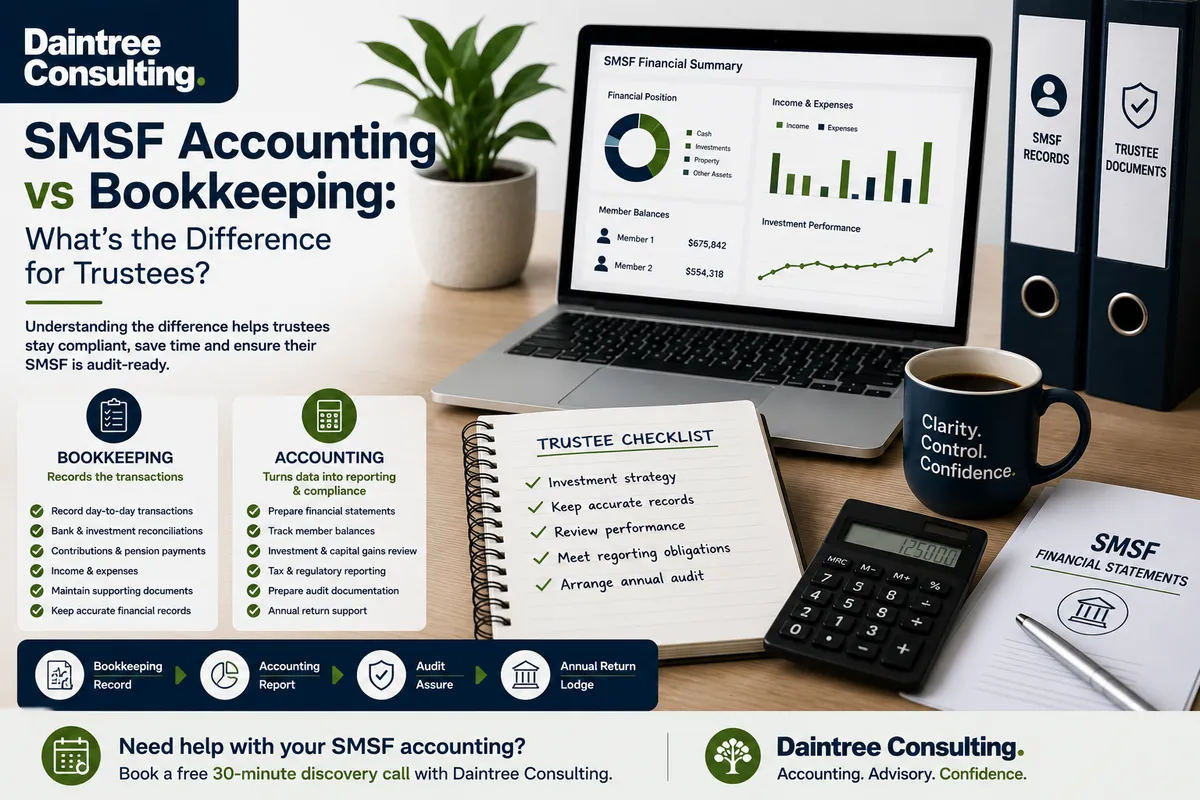
SMSF Accounting vs Bookkeeping: What’s the Difference for Trustees?
Managing a self-managed super fund comes with more than investment decisions. Trustees also need to maintain accurate records, prepare financial statements, meet reporting obligations and arrange the fund’s annual audit.
This is where many trustees get confused.
Want expert help? Daintree Consulting's SMSF accounting services can take this off your plate. Book a free consultation.
Is bookkeeping enough? What does SMSF accounting actually involve? And where does the accountant’s role end and the trustee’s responsibility begin?
The short answer is:
Bookkeeping records the transactions. SMSF accounting turns those records into financial statements, reporting and compliance information.
Both functions can be important, but they are not the same.
For SMSF trustees, understanding the difference can help prevent missing information, reduce year-end delays and make the annual accounting and audit process much easier.
Quick Answer: What Is the Difference Between SMSF Accounting and Bookkeeping?
SMSF bookkeeping generally focuses on recording and organising the fund's financial transactions, such as contributions, pension payments, investment income, expenses, purchases and sales.
SMSF accounting goes further. It uses those records to prepare financial statements, reconcile the fund's accounts, track member balances and support annual reporting and tax requirements.
An SMSF may also require additional work around investment transactions, capital gains, pension accounts, asset valuations and supporting documentation.
The annual audit is a separate function. SMSFs must have an annual audit performed by a registered SMSF auditor, and the auditor must independently assess the fund's financial and compliance position.
In simple terms:
Bookkeeping → Accounting → Independent Audit → Annual Return
Each stage has a different purpose.
What Is SMSF Bookkeeping?
Bookkeeping is the foundation of the SMSF's financial records.
It involves recording financial transactions accurately and keeping the underlying documentation organised.
For an SMSF, this may include:
Bank transactions
Contributions
Pension payments
Investment purchases
Investment sales
Dividend income
Interest income
Rental income
Investment expenses
Professional fees
Insurance payments
Tax-related transactions
Transfers and rollovers
Member-related transactions
The objective is to create a reliable record of what happened financially during the year.
For example, suppose an SMSF owns shares.
The bookkeeping records may need to capture:
The purchase of the shares
The purchase date
Purchase costs
Sale transactions
Sale proceeds
Brokerage
Dividend income
Franking credits
Related bank transactions
Those records become important later when the accountant prepares the fund's financial statements and determines the relevant tax and reporting treatment.
The ATO expects SMSF trustees to maintain accurate and accessible accounting records that explain the fund's transactions and financial position.
Why accurate bookkeeping matters
Poor bookkeeping can create problems further down the reporting process.
A missing transaction may affect:
Financial statements
Member balances
Investment records
Tax calculations
Capital gains calculations
Pension reporting
The annual return
The audit process
In other words, bookkeeping is not simply administrative data entry.
For an SMSF, it forms part of the evidence supporting the fund's financial records.
What Is SMSF Accounting?
SMSF accounting takes the financial records and turns them into meaningful financial and compliance information.
This is a broader function than simply entering transactions.
Depending on the fund and engagement, SMSF accounting can involve:
Preparing annual financial statements
Reconciling bank and investment accounts
Reviewing contributions
Tracking pension accounts
Reviewing investment transactions
Calculating relevant tax amounts
Supporting capital gains calculations
Preparing member reporting
Preparing the SMSF annual return
Preparing documentation for the annual audit
Identifying missing or inconsistent records
Coordinating with the independent SMSF auditor
The ATO identifies preparation of SMSF financial statements, arranging the yearly audit, lodging the annual return and keeping accurate records among the responsibilities associated with running an SMSF.
This is why SMSF accounting is more than bookkeeping.
The accountant needs to understand how the transactions affect the fund's financial position, member accounts, taxation and reporting requirements.
SMSF Bookkeeping vs SMSF Accounting: A Simple Example
Imagine an SMSF owns an investment property.
During the financial year, the property generates rental income and incurs expenses.
Bookkeeping may involve recording:
Rental receipts
Property management fees
Repairs
Insurance
Rates
Other expenses
Bank transactions
Accounting may involve:
Reconciling the property-related transactions
Reviewing the financial records
Determining the appropriate accounting treatment
Incorporating the property into the financial statements
Considering the relevant tax treatment
Reviewing the asset valuation
Preparing information required for the audit
The auditor then independently examines evidence
The auditor may need evidence relating to:
Ownership
Existence of the asset
Valuation
Rental income
Expenses
Related-party arrangements
Compliance with applicable SMSF requirements
The ATO's SMSF auditor checklist specifically includes checks around asset existence, ownership, completeness, classification and valuation.
That illustrates the difference clearly.
Bookkeeping records what happened. Accounting determines how the information is reported. Auditing independently tests the information and compliance.
Why SMSF Accounting Is More Complex Than Standard Bookkeeping
An SMSF is not simply another bank account with investments attached.
There are specific superannuation, taxation, trust and reporting considerations that trustees need to manage.
For example, trustees have responsibilities relating to:
The fund's purpose
Investment strategy
Contributions and rollovers
Benefit payments
Investment restrictions
Asset valuations
Financial statements
Annual audit
Annual return
Record keeping
Trustee changes
Residency requirements
The ATO lists these responsibilities as part of the obligations associated with running an SMSF.
This means an accountant working with an SMSF needs to understand more than basic transaction processing.
They need to understand how the fund operates and how individual transactions fit into the broader reporting and compliance picture.
What Does an SMSF Accountant Actually Do?
The exact scope depends on the engagement, but SMSF accounting commonly covers the fund's annual accounting cycle.
1. Review the fund's structure and prior-year position
The process may begin with reviewing:
The fund structure
Previous financial statements
Previous annual return
Prior-year audit report
Member balances
Investment records
Trust documentation
Previous adjustments or issues
This provides a starting point for the current financial year.
2. Reconcile financial records
Bank and investment information needs to be reconciled against the accounting records.
This helps identify:
Missing transactions
Duplicate transactions
Incorrect classifications
Unexplained balances
Transactions requiring supporting documents
3. Review contributions and pensions
Contribution and pension transactions can require careful tracking.
The accountant may need to reconcile:
Contributions
Rollovers
Pension payments
Member balances
Relevant supporting documentation
This is particularly important when the fund has multiple members or pension accounts.
4. Review investments
SMSF accounting can involve a significant amount of investment-related information.
Depending on the fund's investments, this could include:
Shares
Managed funds
Term deposits
Property
Cash
Other permitted investments
The accounting process needs to capture relevant income, expenses, acquisitions, disposals and valuations.
5. Prepare annual financial statements
The accounting records ultimately need to support the fund's financial reporting.
The ATO's SMSF guidance identifies annual operating and financial-position statements among the records trustees need to maintain.
6. Prepare the audit file
The accounting team can organise the records and supporting documentation required by the independent auditor.
This may include:
Bank statements
Investment statements
Property documentation
Valuations
Transaction evidence
Contribution information
Pension information
Trustee documentation
Financial statements
Daintree Consulting's SMSF accounting service specifically includes year-end document and audit-file preparation and coordination with the independent SMSF auditor.
7. Support annual return preparation
Once the accounting information has been prepared and the audit process completed, the information can be used to support the SMSF annual return.
The audit itself remains independent.
Does Bookkeeping Include the SMSF Audit?
No.
Bookkeeping, accounting and auditing are separate functions.
An SMSF must have an annual audit performed by a registered SMSF auditor. ASIC states that anyone running an SMSF must ensure the fund is audited annually by a registered SMSF auditor.
The auditor's role is not simply to check whether the bookkeeping has been completed.
The auditor independently examines the financial records and considers whether the fund has complied with relevant superannuation requirements.
This distinction is important.
An accountant may prepare the fund's accounts and audit file, while an independent auditor performs the audit.
Why does independence matter?
The audit is intended to provide an independent assessment.
ASIC requires approved SMSF auditors to comply with auditor independence requirements and applicable auditing and assurance standards.
This means trustees should understand exactly who is responsible for:
Bookkeeping
Accounting
Tax work
Audit
The roles should not be treated as interchangeable.
Can the Same Firm Do SMSF Accounting and Auditing?
This is an area where trustees should be particularly careful.
Accounting and auditing are not automatically interchangeable services.
An SMSF auditor has independence obligations that need to be considered when other professional services are being provided to the fund.
ASIC has taken enforcement action against SMSF auditors for independence issues, including situations involving accounting, bookkeeping or tax services and audit engagements.
For trustees, the practical takeaway is simple:
Ask who is preparing the accounts and who is independently auditing them.
If your accountant prepares the SMSF financial statements, the audit should be handled in accordance with the applicable independence requirements by an appropriately registered and independent SMSF auditor.
Do SMSF Trustees Still Have Responsibilities If They Hire an Accountant?
Yes.
This is one of the most important points for SMSF trustees to understand.
Hiring an accountant, administrator or adviser does not transfer the trustee's legal responsibilities to that professional.
Daintree's current SMSF guidance similarly notes that trustees remain responsible for managing the fund and complying with applicable superannuation, taxation and trust-law requirements.
Trustees remain responsible for making appropriate decisions and ensuring the fund is operated properly.
Professional support can make the process easier, but trustees should still understand:
What the fund owns
What transactions occurred
What decisions were made
What documents need to be retained
What reporting obligations apply
What their investment strategy requires
When the annual accounts and audit need to be completed
Think of the accountant as a professional support function—not a replacement for the trustee.
What Records Should SMSF Trustees Keep?
Good SMSF accounting starts with good records.
The ATO requires SMSFs to maintain records and retain different types of records for specified periods. Some records generally need to be kept for at least five years, while certain trustee and governance records have longer retention requirements.
Depending on the record, this can include:
Accounting records
Bank statements
Investment records
Annual financial statements
Annual returns
Trustee meeting minutes
Trustee decisions
Records of trustee changes
Member reports
Trustee declarations
Documentation supporting transactions
Good record keeping makes the annual accounting process much easier.
It can also make the audit process significantly smoother because supporting evidence is available when the auditor needs it.
7 Signs Your SMSF Bookkeeping Needs Professional Accounting Support
You may need more than basic bookkeeping if:
1. Your records are regularly behind
If transactions are sitting unreconciled for months, year-end accounting can become unnecessarily difficult.
2. You have multiple investments
Shares, managed investments, property and other investments can create additional reconciliation, valuation and tax work.
3. Your SMSF has pension accounts
Pension transactions can require more detailed tracking than straightforward accumulation activity.
4. You struggle to explain your member balances
If you cannot easily understand how the fund's balances have changed, the accounting records may need review.
5. Your auditor keeps requesting additional information
Repeated audit queries may indicate that the underlying records or supporting documentation need improvement.
6. Your annual accounts take too long to finalise
Delays can be a sign that bookkeeping, accounting and audit preparation are not properly coordinated.
7. You are spending too much time managing the fund's administration
An SMSF can require significant administrative attention.
Professional accounting support can help organise the annual process so trustees can focus on their responsibilities and investment decisions rather than chasing paperwork.
What Should Trustees Look for in an SMSF Accounting Service?
Not all accounting support is structured the same way.
When comparing providers, consider whether the service includes:
SMSF-specific accounting experience
Annual financial statements
Transaction reconciliation
Investment reconciliation
Contribution tracking
Pension tracking
Annual return support
Audit-file preparation
Coordination with an independent auditor
Clear document requirements
A defined annual workflow
It is also worth asking how the accountant communicates with the auditor.
A good process should not feel like:
Trustee → Accountant → Auditor → Trustee → Accountant → Auditor
with everyone repeatedly asking for the same information.
A coordinated process should make it clear what information is needed, who is responsible for it and what happens next.
How Daintree Consulting Supports SMSF Accounting
Daintree Consulting provides specialist SMSF accounting and administration support designed around the fund's annual reporting cycle.
Its current SMSF accounting service includes:
Annual financial statements and member reporting
SMSF annual return preparation support
Transaction coding and investment reconciliation
Contribution and pension-account tracking
Year-end document and audit-file preparation
Coordination with the independent SMSF auditor and appropriately licensed adviser.
The aim is to create clearer records and a more orderly annual compliance process, rather than simply processing transactions at year-end.
Daintree can also work alongside an existing professional team where appropriate.
That can be useful for trustees who already have some support but need stronger accounting organisation, reconciliations or audit preparation.
Explore Daintree Consulting's SMSF Accounting Services
SMSF Accounting vs Bookkeeping: Which One Do You Need?
The answer depends on your fund.
If your SMSF has relatively straightforward transactions and you already have an appropriate accounting process in place, bookkeeping may form part of the routine administration.
But bookkeeping alone does not replace the broader accounting and reporting process.
A useful way to think about the difference is:
Bookkeeping
Records and organises transactions.
SMSF accounting
Reconciles, reviews and converts those records into financial statements, reporting and tax information.
Audit
Independently examines the financial statements and relevant compliance matters.
Trustee
Remains responsible for the fund and its decisions.
Understanding these roles can help trustees avoid one of the most common SMSF administration mistakes: assuming that because transactions are being entered into accounting software, everything required for the fund has been completed.
It hasn't necessarily.
Final Thoughts: Good SMSF Accounting Starts Before Year-End
The easiest SMSF accounting process is usually the one that does not have to be rescued at year-end.
Keeping records organised throughout the year, reconciling transactions regularly and retaining appropriate supporting documentation can make the annual financial statement and audit process much more straightforward.
And if your fund has investments, pension accounts, property, complex transactions or recurring record-keeping issues, professional SMSF accounting support can provide another layer of organisation and oversight.
The goal is not simply to produce a set of accounts.
It is to give trustees a reliable financial record of the fund, make the annual reporting process more efficient and ensure the information is ready for independent audit.
If you're unsure whether your current SMSF bookkeeping process is enough, it may be worth reviewing the entire annual workflow rather than waiting until the next audit deadline.
Need help getting your SMSF accounting organised?
Daintree Consulting can help review your current process, identify gaps and establish a practical accounting and audit-preparation workflow.
Book a free 30-minute discovery call with Daintree Consulting
Frequently Asked Questions
Is SMSF accounting the same as bookkeeping?
No. Bookkeeping primarily records and reconciles financial transactions. SMSF accounting uses those records to prepare financial statements, reporting and other information required for the fund's annual compliance process.
Do all SMSFs need an annual audit?
Yes. SMSFs must have an annual audit performed by a registered SMSF auditor.
Can an accountant prepare my SMSF financial statements?
Yes, an appropriately engaged accounting professional can prepare SMSF financial statements and related accounting work. The annual audit is a separate independent function.
Can my accountant also be my SMSF auditor?
This depends on the circumstances and applicable independence requirements. Trustees should ensure the auditor is appropriately registered and independent. ASIC specifically highlights independence obligations for SMSF auditors.
How long do SMSF records need to be kept?
Different records have different retention requirements. Some SMSF records generally need to be retained for at least five years, while certain trustee and governance records have longer retention periods.
What does an SMSF accountant need from the trustee?
Depending on the fund, this may include bank statements, investment records, transaction documentation, contribution information, pension information, valuations, property records and trustee documentation.
Does hiring an SMSF accountant remove my responsibilities as trustee?
No. Trustees remain responsible for managing the SMSF and meeting their legal and compliance obligations, even when professional service providers are engaged.
When should I organise SMSF accounting?
Ideally, accounting should be managed throughout the financial year rather than left until the annual reporting deadline. Regular reconciliation and record keeping can make year-end accounting and audit preparation considerably easier.
Talk to Daintree about your SMSF accounts
Our ex-Big 4 team gives clear, senior-reviewed advice so you can act with confidence.
Book a free consultation →
Or explore our SMSF accounting services.
