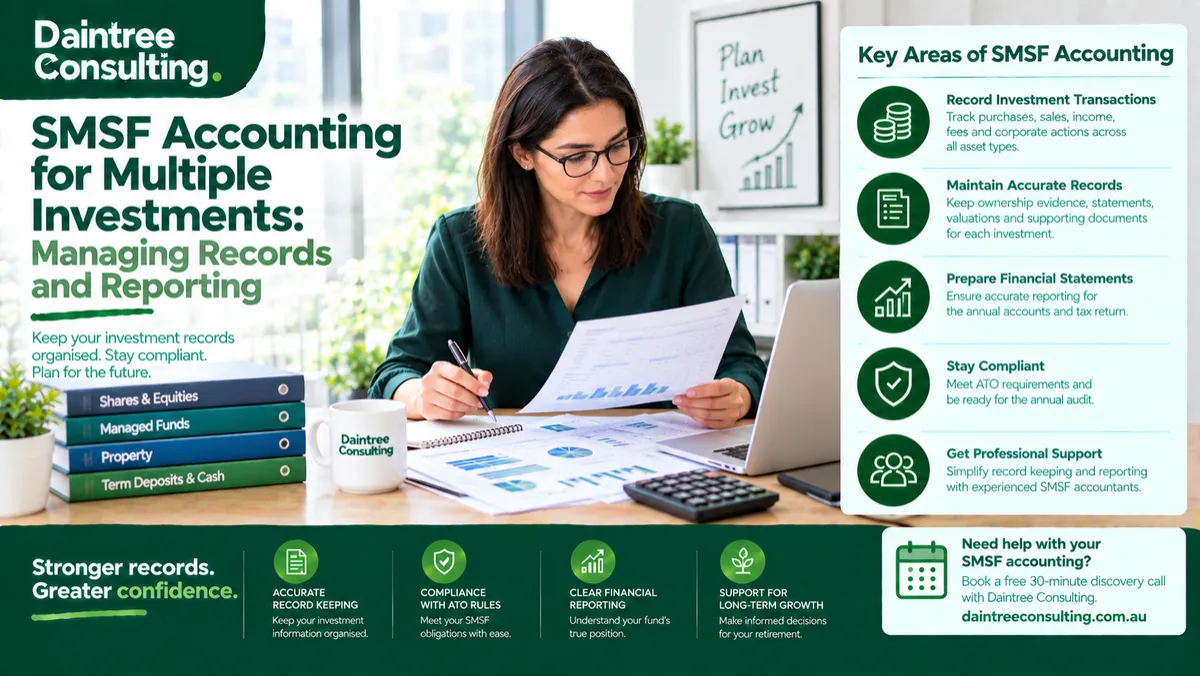
SMSF Accounting for Multiple Investments: Managing Records and Reporting
Managing an SMSF with one or two straightforward investments can be relatively simple. As the fund grows, however, keeping accurate records across shares, managed funds, property, cash, term deposits and other investments can become considerably more involved.
Every investment creates its own transactions, statements, income records, ownership documents, valuation evidence and tax considerations. When these records are not kept consistently, preparing the SMSF's annual financial statements and audit can become more difficult.
Want expert help? Daintree Consulting's SMSF accounting services can take this off your plate. Book a free consultation.
This is where effective SMSF accounting services can provide practical value.
Good SMSF accounting is not simply about producing financial statements at the end of the financial year. It involves maintaining accurate records throughout the year so trustees can understand the fund's position, support its reporting obligations and provide the evidence required for the annual audit.
Quick answer
SMSF accounting for multiple investments involves recording and reconciling investment transactions, tracking income and expenses, maintaining evidence of ownership, supporting asset valuations, recording trustee decisions and preparing accurate financial statements and tax reporting.
The more varied an SMSF's investments become, the more important it is to have a consistent record-keeping system.
An SMSF must maintain proper and accurate tax and superannuation records. The ATO states that different types of SMSF records generally need to be retained for either a minimum of five or ten years.
SMSFs must also have their financial accounts and statements audited annually by an approved SMSF auditor.
Why multiple SMSF investments make accounting more complex
An SMSF holding a single bank account and a small portfolio of listed shares may have relatively straightforward transactions.
A fund holding several different investment types can be very different.
For example, an SMSF could hold:
Australian listed shares
International shares
Managed funds
Term deposits
Commercial property
Residential property where permitted
Unlisted trusts
Private company investments
Cash
Other permitted investments
Each investment can generate different types of accounting records.
Shares may generate dividend statements, buy and sell confirmations, brokerage costs and corporate actions.
Managed funds can generate distribution statements and annual tax information.
Property can involve purchase documents, title records, rental income, expenses, loan documentation, depreciation information and valuation evidence.
Unlisted investments can require additional documentation demonstrating ownership, valuation and the nature of the underlying investment.
The result is that SMSF accounting needs to keep pace with the complexity of the fund's investment portfolio.
What does SMSF accounting involve?
SMSF accounting generally brings together the fund's transactions and supporting records to prepare accurate accounts, tax reporting and other required documentation.
For a fund with multiple investments, this can involve several key areas.
1. Recording investment purchases and sales
Every investment transaction should be properly recorded.
For an investment purchase, relevant information may include:
Date of purchase
Investment description
Number of units or shares
Purchase price
Brokerage or transaction costs
Settlement information
Ownership details
Source of funds
When an investment is sold, the corresponding sale information needs to be captured.
This provides the accounting records needed to determine the fund's financial position and, where relevant, tax outcomes.
Keeping the purchase and sale documentation together can also make it easier to answer auditor questions later.
2. Tracking investment income
Different investments produce different forms of income.
Depending on the portfolio, an SMSF may receive:
Dividends
Interest
Managed fund distributions
Rental income
Trust distributions
Other investment income
The accounting records need to capture the income accurately and reconcile it against the relevant bank, platform or investment statements.
This is particularly important where an SMSF has several investment accounts.
A difference between the accounting records and investment statements may indicate a missing transaction, timing difference, incorrectly classified amount or another issue that needs to be investigated.
3. Maintaining ownership evidence
An SMSF needs evidence that its investments are held by the fund rather than personally by the trustees.
This is particularly important when the fund holds investments outside straightforward listed securities.
The ATO's SMSF auditor checklist includes verification of ownership, purchase and sale documents, market value evidence and investment returns.
For example, property investments may require documentation such as:
Title information
Contracts
Settlement documents
Trust or ownership documentation where relevant
Insurance records
Lease agreements
Rental records
The exact documentation required depends on the investment.
4. Reconciling investment accounts
Reconciliation is one of the most important parts of maintaining accurate SMSF accounting records.
The accounting records should be compared against the relevant external records, such as:
Bank statements
Share trading platforms
Investment platforms
Managed fund statements
Property records
Loan statements
Dividend statements
Regular reconciliation helps identify missing transactions, duplicate entries and unexplained differences before they become larger year-end problems.
It also provides a clearer picture of the fund's financial position throughout the year.
How should an SMSF track multiple investments?
A useful approach is to maintain an investment record for each major asset or investment account.
For example, an SMSF holding listed shares could maintain records covering:
Investment details
Name of security
Number of shares
Acquisition date
Acquisition cost
Ownership evidence
Income
Dividends
Franking information where relevant
Distribution statements
Transactions
Purchases
Sales
Corporate actions
Brokerage
Other transaction costs
Year-end information
Market value
Supporting valuation or statement
Reconciliation to accounting records
This structure can be adapted for managed funds, property and other investments.
The objective is not to create unnecessary paperwork.
It is to make sure that the information needed for accounting, reporting and audit purposes can be located efficiently.
SMSF investment valuations and financial reporting
SMSF assets generally need to be valued at market value for financial statements.
The ATO states that SMSF assets need to be valued each income year for preparing financial statements, with additional valuation requirements applying in certain circumstances.
Trustees also need to retain objective and supportable evidence for valuations.
This can be straightforward for listed investments where reliable market information is available.
It can require more work for assets such as:
Property
Unlisted companies
Unlisted trusts
Collectables
Other assets without readily available market prices
The ATO's auditor checklist specifically refers to supporting evidence for market value, including evidence showing when and how trustees determined the value.
This is one reason why valuation documentation should not be treated as a year-end afterthought.
Why the investment strategy matters
SMSF accounting does not operate separately from the fund's investment strategy.
SMSF trustees must prepare and follow an investment strategy and review it regularly.
The ATO says the strategy should consider matters including diversification, risk and return, liquidity, the fund's ability to meet expenses and benefits, and the circumstances of its members. Trustees should also document decisions and changes arising from the review.
For a fund with multiple investments, this becomes particularly relevant.
Suppose an SMSF has gradually accumulated:
Australian shares
International shares
Property
Managed funds
Cash
The trustees should be able to demonstrate how investment decisions relate to the fund's strategy and circumstances.
The ATO's SMSF auditor checklist also identifies the investment strategy as an area auditors examine, including whether the strategy is compliant, regularly reviewed and considers the fund's circumstances.
Keeping investment records separate from personal records
One of the fundamental principles of SMSF administration is keeping fund assets and transactions separate from trustees' personal or business assets.
This means the SMSF's investments should be properly recorded as belonging to the fund, and fund transactions should flow through the appropriate fund accounts.
The ATO's auditor checklist specifically includes checking whether the fund trustee is recorded as the owner of fund investments and whether fund money and assets are kept separate from those held personally by trustees.
This becomes especially important when trustees have several investments personally as well as investments held through their SMSF.
A similar-looking investment account or incomplete ownership documentation can create unnecessary questions during the audit.
What records should an SMSF keep?
The exact records required depend on the circumstances, but SMSF records can include:
Trust deed
Investment strategy
Investment strategy review records
Trustee meeting minutes
Trustee declarations
Records of changes to trustees or members
Accounting records
Bank statements
Investment statements
Purchase and sale documents
Evidence of asset ownership
Valuation evidence
Dividend and distribution statements
Property records
Rental agreements
Loan documentation
Contribution records
Pension payment records
Annual financial statements
Annual returns
Audit reports
The ATO recommends maintaining permanent records separately from records relating to individual financial years. It also notes that organising records this way can make it easier to compile the information required for the fund's independent auditor.
How long do SMSF records need to be kept?
SMSF trustees need to pay attention to record-retention requirements.
The ATO states that different records have different minimum retention periods.
For example, certain accounting and financial records generally need to be kept for at least five years, while trustee meeting minutes, trustee changes, declarations and certain other records generally have a ten-year minimum retention period.
Because retention requirements can differ according to the type of record, trustees should not simply delete older documents on a fixed annual schedule.
A well-organised digital filing system can make long-term record keeping much easier.
Preparing multiple investments for the annual SMSF audit
Every SMSF must have an annual audit performed by an approved SMSF auditor.
The audit involves more than checking whether the financial statements balance.
An SMSF auditor also considers compliance with relevant superannuation requirements.
For investment-heavy funds, audit evidence may cover areas such as:
Ownership of assets
Market value
Investment transactions
Investment income
Investment strategy
Separation of fund assets
Arm's-length dealings
Related-party transactions
In-house asset considerations
Supporting documentation
The ATO's current auditor checklist includes checks covering listed and unlisted investments, property, ownership, valuations, investment strategy and separation of assets.
This means good SMSF accounting and record keeping can make the audit process considerably easier.
Common SMSF accounting problems with multiple investments
The more investments a fund has, the more opportunities there are for records to become incomplete or inconsistent.
Common problems can include:
Missing investment statements
A transaction may appear in the bank account without the corresponding investment documentation being retained.
Unreconciled investment balances
The accounting records may not agree with the investment platform or external statement.
Missing ownership documents
The fund may hold an asset, but the supporting evidence showing the SMSF as owner may be incomplete.
Unsupported valuations
The year-end value may be recorded without sufficient evidence explaining how it was determined.
Unrecorded corporate actions
Share splits, consolidations, takeovers, distributions and other corporate actions can affect investment records.
Poor separation of records
Personal and SMSF investments can become mixed in documentation or transaction records.
Investment strategy reviews not documented
Trustees may review their investments but fail to keep adequate evidence of the review and decisions.
These issues can make annual accounting and audit work more time-consuming.
A practical record-keeping routine for SMSF trustees
You do not need to wait until 30 June to organise your SMSF records.
A simple routine can help.
Monthly
Review:
Bank transactions
Investment platform transactions
Contributions
Pension payments
Investment income
Major expenses
Quarterly
Check:
Investment balances
Unusual transactions
Missing statements
Property income and expenses
Loans and interest
Changes to investments
Annually
Before financial statements are prepared:
Reconcile all accounts
Confirm investment holdings
Gather purchase and sale documents
Obtain valuation evidence
Review investment income
Check trustee records
Review the investment strategy
Organise audit documentation
The exact frequency can vary depending on the fund's circumstances and investment activity.
When should you consider SMSF accounting services?
Managing a diversified SMSF portfolio can become increasingly time-consuming as the number and type of investments grows.
Professional SMSF accounting services may be worth considering when:
Your fund holds several investment types
You have property investments
The fund owns unlisted investments
There are frequent investment transactions
The fund has pension and accumulation interests
You are struggling to reconcile investment records
Previous audits raised documentation issues
You are spending significant time preparing annual records
You want a more organised year-round accounting process
Professional support can help bring investment transactions, financial records, valuations and reporting information into a more consistent process.
It can also help trustees prepare the information required for the annual audit.
How Daintree Consulting can help with SMSF accounting
Daintree Consulting provides SMSF accounting services designed to help trustees keep their fund's financial records organised and ready for annual reporting and audit requirements.
Support can include areas such as:
Annual SMSF financial statements
Investment transaction records
Investment income tracking
Bank and investment reconciliations
Asset valuation records
Member accounting
Annual return support
Audit-file preparation
Coordination with an independent SMSF auditor
The goal is not simply to complete the accounts at year-end.
It is to create a clearer process for keeping the fund's records organised throughout the financial year.
If your SMSF has multiple investments and managing the records is becoming difficult, book a free 30-minute discovery call with Daintree Consulting to discuss your requirements.
Frequently asked questions
What does SMSF accounting include?
SMSF accounting can include recording fund transactions, reconciling bank and investment accounts, tracking investment income, preparing financial statements, maintaining member records and supporting annual tax and reporting requirements.
Does an SMSF need to keep records for every investment?
Yes. Trustees need to maintain proper and accurate records supporting the fund's transactions, financial position and investment activities. The specific records required depend on the fund and the investment involved.
How are SMSF investments valued?
SMSF assets generally need to be valued at market value for financial statements. The ATO states that valuation evidence should be objective and supportable.
Does an SMSF need an annual audit?
Yes. An SMSF must have an approved SMSF auditor audit the fund annually. The audit covers both the financial accounts and relevant compliance requirements.
What happens if an SMSF has investments in property and shares?
The accounting process needs to capture the different transactions and supporting records for each investment type. Property may require ownership, rental, expense and valuation documentation, while listed shares may involve transaction records, dividends, corporate actions and market values.
Can SMSF accounting services help with audit preparation?
Yes. SMSF accounting support can help organise financial records, reconcile transactions, prepare financial statements and assemble documentation needed for the annual audit. The SMSF auditor must remain independent from the accounting work performed for the fund.
Final takeaway
Managing an SMSF with multiple investments requires more than keeping a bank balance and a list of assets.
Trustees need accurate records showing what the fund owns, what it has bought and sold, what income it has received, how assets have been valued and how investment decisions relate to the fund's investment strategy.
As an SMSF's portfolio becomes more diversified, having a consistent accounting and record-keeping process becomes increasingly important.
Keeping records organised throughout the year can make annual financial reporting and audit preparation much easier and give trustees a clearer picture of the fund's financial position.
If your SMSF holds multiple investments and you need help keeping the accounting and reporting process under control, Daintree Consulting can help.
Book a free 30-minute discovery call to discuss your SMSF accounting requirements.
Talk to Daintree about your SMSF accounts
Our ex-Big 4 team gives clear, senior-reviewed advice so you can act with confidence.
Book a free consultation →
Or explore our SMSF accounting services.
