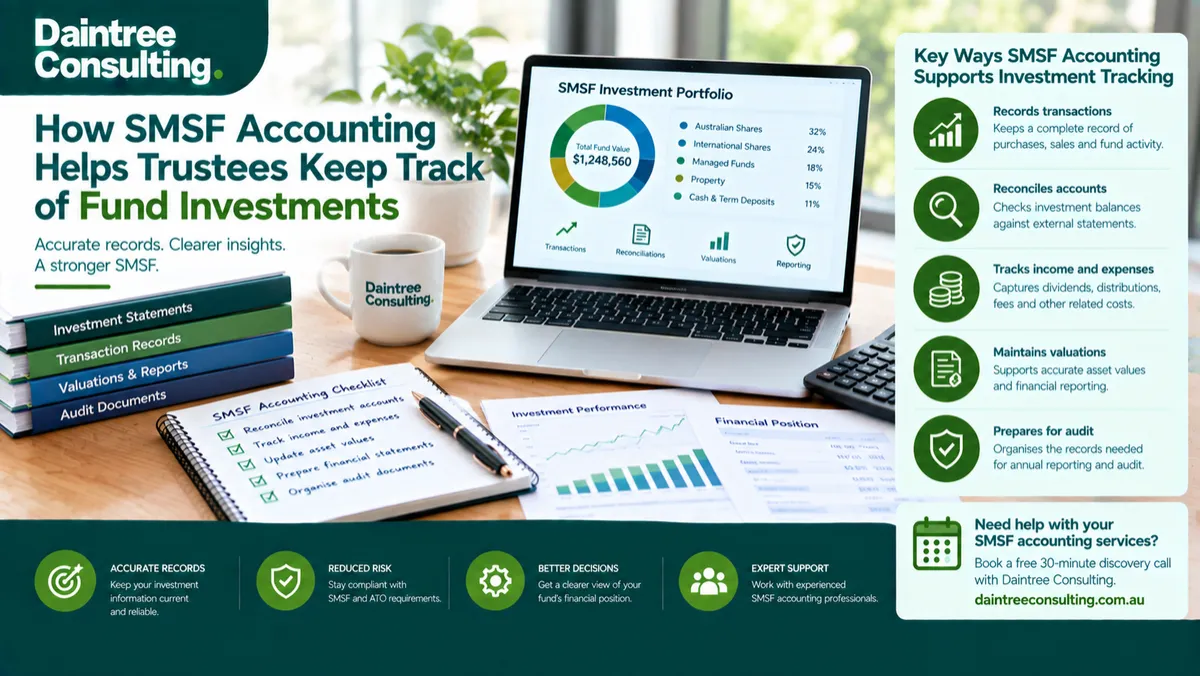
How SMSF Accounting Helps Trustees Keep Track of Fund Investments
Managing an SMSF involves more than choosing investments and checking their performance.
Trustees also need reliable records showing what the fund owns, what each investment is worth, what transactions have occurred and how those transactions affect the fund's financial position.
Want expert help? Daintree Consulting's SMSF accounting services can take this off your plate. Book a free consultation.
This is where SMSF accounting services can play an important role.
Good SMSF accounting helps trustees maintain an accurate financial record of the fund and provides the information needed for annual financial statements, reporting and the fund's independent audit.
It can also make it much easier for trustees to understand how their investments fit into the broader financial position of the SMSF.
For trustees with multiple investments, property, managed funds, listed securities, cash accounts or more complex transactions, keeping this information organised can become increasingly difficult.
Quick Answer: How Does SMSF Accounting Help Track Investments?
SMSF accounting services help trustees keep track of fund investments by recording investment transactions, reconciling accounts, maintaining supporting documentation, tracking income and expenses, recording asset values and incorporating investment information into the fund's financial statements.
Accurate accounting records can also help trustees and their professional advisers identify missing information, investigate discrepancies and prepare the fund's records for its annual independent audit.
The ATO expects SMSF trustees to maintain proper and accurate records that explain the fund's transactions and financial position. These records also need to support the preparation of the fund's accounts, returns and audit.
The important point is that investment tracking is not just about knowing what the SMSF owns. It is about maintaining a reliable record of the investment activity surrounding those assets.
Why Investment Tracking Matters for an SMSF
SMSF trustees are responsible for managing the fund in accordance with the relevant superannuation and tax requirements.
Investments can generate a range of transactions throughout the year.
For example, a listed share portfolio may involve:
Purchases
Sales
Dividends
Dividend reinvestments
Corporate actions
Brokerage costs
Capital gains or losses
Franking credits
Cash transfers
Property investments can involve a different set of records, including:
Purchase documentation
Settlement records
Rental income
Property expenses
Loan-related transactions where applicable
Repairs and maintenance
Insurance
Property valuations
Sale documentation
Without accurate records, it becomes much harder to establish a complete picture of the fund's financial position.
Good SMSF accounting brings these transactions together into an organised financial record.
What Does SMSF Accounting Involve?
SMSF accounting is broader than simply entering transactions into accounting software.
Depending on the fund and the agreed scope of work, SMSF accounting services may include:
Recording fund transactions
Bank reconciliations
Investment reconciliations
Recording investment income
Tracking contributions
Tracking pension payments
Recording expenses
Maintaining asset information
Reconciling investment balances
Preparing financial statements
Preparing information required for the annual return
Organising records for the independent audit
Coordinating with the SMSF auditor
Preparing member reporting
The exact services provided will depend on the SMSF's structure, investments, transactions and engagement with its accounting professional.
The objective is to keep the fund's financial information accurate, organised and supported by appropriate documentation.
1. Keeping a Record of What the Fund Owns
One of the most basic questions an SMSF needs to answer is:
What assets does the fund actually own?
This might include:
Australian shares
International shares
Managed funds
ETFs
Term deposits
Cash
Commercial property
Residential property, where permitted
Other permitted investments
The fund's accounting records should provide an accurate picture of its investments and financial position.
The ATO identifies proof of ownership of fund assets, bank statements, accounting records and asset valuations among the records trustees may need to maintain.
This becomes particularly important when investment holdings change during the financial year.
2. Recording Investment Transactions Correctly
Knowing that an SMSF owns an investment is only part of the picture.
The accounting records also need to capture relevant transactions involving that investment.
For example, if an SMSF buys shares, the records may need to reflect:
The date of purchase
Number of units or shares acquired
Purchase price
Brokerage or transaction costs
Cash movement
Investment holding
Supporting documentation
When the investment is later sold, the transaction needs to be recorded appropriately so the fund's financial and tax position can be determined.
Accurate transaction records can therefore help establish a reliable history of the investment.
3. Reconciling Investment Accounts
Reconciliation is an important part of keeping SMSF accounting records accurate.
The purpose is to compare accounting records against supporting external information and investigate differences.
For investments, this might involve comparing records against:
Broker statements
Investment platform reports
Share registry information
Managed fund statements
Bank statements
Property records
Other investment documentation
A difference does not automatically mean something has gone wrong.
It may be caused by timing, fees, distributions, corporate actions or another legitimate transaction.
The important thing is that unexplained differences are identified and investigated rather than simply carried forward.
4. Tracking Investment Income
SMSF investments can generate different forms of income.
Depending on the fund's investments, this may include:
Dividends
Interest
Distributions
Rental income
Other investment income
Recording this information accurately helps build a complete picture of the fund's financial performance.
It also provides information that may be required when preparing the fund's financial statements and annual return.
This is one reason investment statements and other supporting records should be retained and provided to the accounting professional responsible for preparing the fund's accounts.
5. Keeping Track of Investment Expenses
Investment activity can also generate expenses.
These might include:
Brokerage
Investment management fees
Property expenses
Insurance
Professional fees
Valuation costs
Other investment-related expenses
The accounting treatment of an expense depends on the nature of the cost and the circumstances of the SMSF.
Good accounting records make it easier to identify these transactions, retain supporting documentation and determine their appropriate treatment.
The ATO notes that SMSF management and administration expenses and certain investment-related expenses can have different tax treatment depending on the circumstances.
This is another reason trustees should avoid relying solely on bank statements without maintaining appropriate supporting records.
6. Tracking Investment Values
Investment values can change significantly during the year.
For example, the market value of listed securities may move daily, while property values may change over a longer period.
Accurate asset valuations form an important part of preparing an SMSF's financial position.
Trustees need appropriate evidence to support the value attributed to fund assets.
The ATO's guidance identifies asset valuations among the financial and tax records that SMSF trustees may need to maintain.
The appropriate valuation evidence will depend on the type of asset.
For example, evidence supporting the value of listed securities may look very different from evidence supporting the market value of property.
7. Connecting Investment Records to the Financial Statements
Investment information does not exist in isolation.
It ultimately contributes to the SMSF's broader financial reporting.
The financial statements need to reflect the fund's financial position and relevant transactions for the reporting period.
Accurate investment records therefore help support the preparation of:
Statement of financial position
Operating statement
Investment information
Member-related records
Annual return information
Supporting audit documentation
The ATO requires SMSF trustees to maintain accounting records that correctly explain the transactions and financial position of the fund.
Good accounting creates the link between individual investment transactions and the fund's overall financial position.
8. Making Annual Audit Preparation Easier
SMSFs generally need an approved SMSF auditor each income year.
The auditor examines the fund's financial records and compliance with relevant requirements.
Good accounting records can make this process more efficient because the information needed to support the fund's accounts and transactions is already organised.
Depending on the fund's investments, the audit file may need supporting information such as:
Bank statements
Investment statements
Shareholding information
Property documentation
Purchase and sale contracts
Valuation evidence
Contribution records
Pension records
Expense documentation
Trustee minutes
Investment strategy documentation
The ATO's approved SMSF auditor checklist includes evidence such as contracts, minutes, investment strategy documents, financial statements, bank statements and other supporting records depending on the relevant compliance area.
The better organised the records are, the easier it can be to respond to information requests.
9. Identifying Missing Investment Information
One of the practical benefits of organised SMSF accounting is that gaps can become easier to identify.
For example, an accounting review may reveal:
An investment statement has not been received
A bank transaction has not been allocated
A distribution does not match the records
A purchase document is missing
An investment balance does not reconcile
A valuation needs supporting evidence
A transaction has been recorded incorrectly
Finding these issues early is generally preferable to discovering them while preparing the annual accounts or responding to an audit request.
It gives trustees and their professional team more time to investigate and resolve the issue.
10. Helping Trustees Understand the Fund's Investment Position
Accounting is not the same as investment advice.
An accountant should not automatically be treated as the person responsible for deciding which investments an SMSF should buy or sell.
However, accurate accounting information can help trustees understand the financial position of the fund.
For example, accounting records can help show:
The value of different asset holdings
Investment income
Investment expenses
Cash available within the fund
Changes in asset values
Realised gains and losses
The fund's overall financial position
This information can then be used alongside appropriate investment advice where required.
The ATO specifically distinguishes its role from financial and investment advice, and trustees should obtain appropriately licensed advice where personal financial or investment advice is required.
SMSF Accounting and the Investment Strategy
Investment tracking should also be considered alongside the SMSF's investment strategy.
Trustees have responsibilities regarding the fund's investment strategy and investment decisions.
Accounting records can help provide evidence of what the fund actually owns and what transactions occurred during the year.
For example, if an SMSF's portfolio changes significantly, trustees need to consider the fund's investment strategy and their trustee responsibilities in the context of those changes.
Importantly, accounting professionals do not replace the trustee's responsibility for managing the SMSF.
The ATO's guidance emphasises that good records help demonstrate how the fund operates, including its investment decisions.
What Records Should SMSF Trustees Keep for Investments?
A practical investment record-keeping system may include:
Investment purchase records
Keep documentation showing how and when an investment was acquired.
Investment sale records
Retain evidence of disposals and relevant transaction information.
Investment statements
Keep regular statements from brokers, platforms, managed funds and other investment providers.
Bank records
Maintain statements showing cash movements connected to investments.
Distribution and dividend records
Retain information supporting investment income received by the fund.
Valuation evidence
Keep appropriate records supporting the market value attributed to assets.
Property records
Where the SMSF owns permitted property, retain relevant purchase, ownership, rental, expense and valuation records.
Trustee decisions
Maintain appropriate records of relevant trustee decisions.
The ATO states that SMSF trustees must maintain proper and accurate records, with different records subject to different minimum retention periods. Some records need to be retained for at least five years, while others must generally be retained for at least 10 years.
Common Investment Accounting Problems SMSF Trustees Should Watch For
Even a well-managed SMSF can encounter accounting issues.
Some common problems include:
Unreconciled investment balances
The accounting records do not agree with external investment statements.
Missing transaction documentation
A purchase, sale or distribution has been recorded but the supporting evidence is unavailable.
Incorrect investment classification
An asset or transaction has been recorded incorrectly in the accounting system.
Missing income
A dividend, distribution or interest payment has not been captured correctly.
Incomplete valuation information
The fund does not have adequate evidence supporting an asset's reported value.
Unclear ownership documentation
Records do not clearly establish that an asset belongs to the SMSF.
Delayed record collection
Investment statements and documents are collected only when the annual accounts are being prepared.
These issues can create unnecessary work during year-end accounting and audit preparation.
How SMSF Accounting Services Can Make the Process Easier
Professional SMSF accounting services can help trustees establish a more structured process for maintaining the fund's financial records.
Depending on the agreed scope, this can include:
Transaction processing
Investment and fund transactions are recorded in an organised accounting system.
Reconciliations
Bank and investment balances are checked against supporting records.
Investment tracking
The fund's holdings, income and transactions are maintained throughout the reporting period.
Year-end preparation
Financial information is brought together for the preparation of annual accounts.
Audit preparation
Relevant documents are organised to support the independent audit.
Member reporting
Relevant member information can be prepared as part of the annual accounting process.
Coordination
The accounting process can be coordinated with the SMSF's independent auditor and other appropriately qualified professionals.
The exact scope will depend on the fund and its engagement.
When Should Trustees Consider Professional SMSF Accounting Services?
Professional support can become particularly useful when an SMSF has:
Multiple investment accounts
Direct property investments
Frequent investment transactions
Multiple members
Pension accounts
Complex contribution activity
Significant investment income
Corporate actions
More complicated year-end reporting requirements
Limited trustee time
Disorganised historical records
It can also be useful when trustees simply want a more structured process for keeping the fund's accounting records current and ready for annual reporting.
Why Year-Round Record Keeping Is Better Than a Year-End Scramble
One of the biggest advantages of maintaining SMSF accounting records throughout the year is reducing the amount of work left until year-end.
Instead of trying to reconstruct 12 months of investment activity, trustees can maintain an organised record as transactions occur.
This can make it easier to:
Identify missing documents
Reconcile transactions
Resolve discrepancies
Maintain accurate investment records
Prepare annual financial statements
Respond to auditor requests
Keep trustee records organised
The ATO notes that good record-keeping systems should make it easier for trustees and SMSF professionals to complete the fund's independent audit each year.
That is a practical reason to treat accounting as an ongoing process rather than a once-a-year exercise.
SMSF Accounting Is About More Than Numbers
For trustees, accounting records are part of the broader governance and administration of the fund.
They help establish:
What the fund owns.
What transactions occurred.
What income and expenses were generated.
What the investments are worth.
What the fund's financial position looks like.
What information is needed for annual reporting and audit.
Good SMSF accounting does not replace the trustee's responsibilities or investment decision-making.
Instead, it provides a reliable financial foundation for managing those responsibilities.
Final Thoughts: Keep Your SMSF Investment Records Under Control
Managing an SMSF can become increasingly complex as the fund's investment portfolio grows.
Shares, managed funds, property, cash and other investments can each create different transactions and record-keeping requirements.
Without a structured accounting process, it can become difficult to maintain a complete and accurate picture of the fund.
SMSF accounting services can help trustees keep investment transactions organised, reconcile financial information, maintain supporting records and prepare the fund's accounts for annual reporting and independent audit.
The benefit is not simply having cleaner accounts.
It is having better visibility over the fund's financial position and a more organised process for meeting ongoing SMSF responsibilities.
Daintree Consulting provides SMSF accounting and administration support designed to help trustees keep their records organised, prepare annual financial statements and coordinate the information required for independent audit.
If you want to understand whether professional SMSF accounting support is appropriate for your fund, book a free 30-minute discovery call with Daintree Consulting.
Frequently Asked Questions
What are SMSF accounting services?
SMSF accounting services can include maintaining accounting records, recording and reconciling transactions, tracking investments, preparing annual financial statements, supporting annual return preparation and organising records for the fund's independent audit. The exact scope depends on the fund and engagement.
How does SMSF accounting help track investments?
SMSF accounting helps record investment purchases and sales, income, expenses, valuations and related cash movements. It can also reconcile investment information against statements and supporting documentation.
Do SMSF trustees need to keep investment records?
Yes. SMSF trustees have record-keeping responsibilities, including maintaining accurate and accessible accounting records and supporting information relating to the fund's transactions and financial position. Different types of records have different minimum retention periods.
Does SMSF accounting include investment advice?
Not necessarily. Accounting and investment advice are different services. Trustees who need personal financial or investment advice should obtain that advice from an appropriately licensed professional.
Does an SMSF need to have its accounts audited?
An SMSF generally needs an approved SMSF auditor appointed each income year to audit the fund. The auditor examines the fund's financial and compliance position within the scope of the annual SMSF audit.
What investment records should an SMSF keep?
Depending on the fund's investments, records may include investment statements, purchase and sale documentation, bank statements, distribution information, ownership records, valuation evidence and relevant trustee decisions.
How often should SMSF investment records be updated?
Investment records should be maintained as transactions occur rather than left entirely until year-end. The appropriate accounting and review frequency depends on the fund's investment activity and circumstances.
Can an SMSF accountant coordinate with the auditor?
Yes. Where included in the engagement, an SMSF accounting professional can organise the financial records and audit documentation and coordinate with the fund's independent SMSF auditor.
Who is responsible for an SMSF's investment decisions?
SMSF trustees remain responsible for managing the fund and making decisions within their legal and regulatory obligations. Accounting support does not transfer those trustee responsibilities.
Talk to Daintree about your SMSF accounts
Our ex-Big 4 team gives clear, senior-reviewed advice so you can act with confidence.
Book a free consultation →
Or explore our SMSF accounting services.
