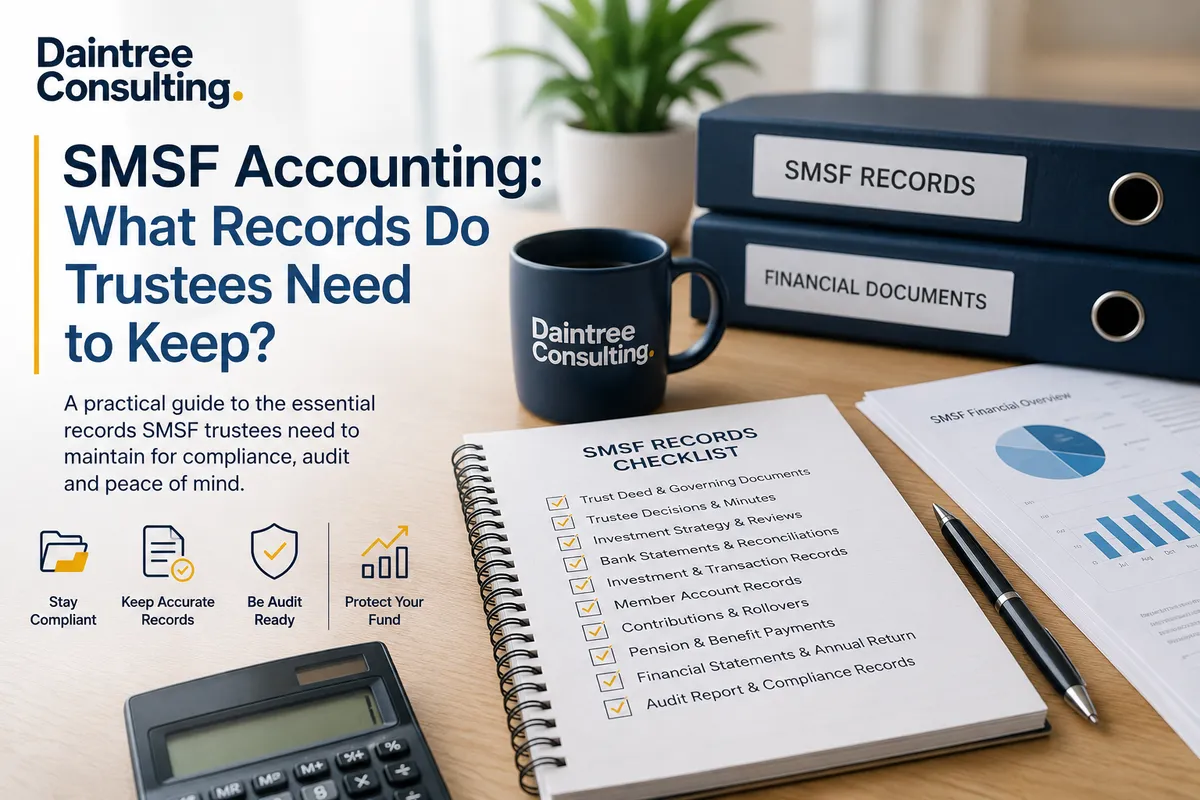
SMSF Accounting: What Records Do Trustees Need to Keep?
Running a self-managed super fund (SMSF) gives trustees responsibility for managing the fund's investments, transactions, records and compliance obligations.
One area that is often underestimated is record keeping.
Want expert help? Daintree Consulting's SMSF accounting services can take this off your plate. Book a free consultation.
Good SMSF accounting is not simply about preparing financial statements at the end of the financial year. Trustees need to maintain accurate records throughout the year so the fund's transactions, investment decisions, member balances and compliance position can be properly supported.
The Australian Taxation Office (ATO) requires SMSF records to be accurate, accessible and retained for the required period. Depending on the type of record, the minimum retention period can be five or 10 years, while some tax-related records may need to be retained for longer in particular circumstances.
This guide explains the key records SMSF trustees should maintain, how long they generally need to keep them, and how organised SMSF accounting can make the annual reporting and audit process much easier.
Important: SMSF trustees remain responsible for complying with their legal and regulatory obligations. Accounting and administration support does not transfer those responsibilities to an accountant or administrator.
Quick Answer: What Records Does an SMSF Need to Keep?
SMSF trustees should maintain records covering:
The fund's trust deed and governing documents
Trustee and member information
Trustee decisions and meeting minutes
The fund's investment strategy and reviews
Bank statements and reconciliations
Investment statements and transaction records
Evidence of asset ownership
Contributions and rollovers
Pension and benefit payments
Member account records
Expenses and deductions
Asset valuations
Capital gains and losses
Tax and BAS-related records where applicable
Annual financial statements
SMSF annual returns
Audit reports
Trustee declarations and other required compliance documents
The ATO specifically states that SMSF records must generally be kept in writing and in English, and electronic records are acceptable provided they remain accessible and understandable.
Why Record Keeping Matters for SMSF Trustees
SMSF accounting records serve more than one purpose.
They provide evidence of what happened within the fund and help demonstrate that trustees have met their obligations.
Good records can help you:
Prepare accurate annual financial statements
Complete the SMSF annual return
Support the fund's annual audit
Calculate investment income and capital gains
Track member balances
Verify contributions and rollovers
Support pension calculations and payments
Demonstrate how investment decisions were made
Support deductions and tax calculations
Respond to questions from the ATO or auditor
Identify errors before they become larger compliance problems
The ATO notes that keeping proper records helps demonstrate compliance, support deductions and capital gains or losses, document investment decisions and maintain an accurate history of the fund.
In practical terms, good SMSF accounting makes the fund easier to manage, easier to audit and easier to understand.
1. Keep the SMSF's Trust Deed and Governing Documents
The trust deed is one of the fund's most important permanent records.
Trustees should retain the current trust deed as well as relevant documentation showing changes made to the fund's structure.
Depending on the fund, this may include:
Original trust deed
Deed amendments
Trustee appointment documents
Corporate trustee documents
Trustee consent documents
Member admission or exit documentation
Records of changes to trustees
Records of changes to members
These documents establish the framework within which the SMSF operates.
They can also become particularly important when the fund changes trustees, adds members, changes its investment arrangements or deals with more complex transactions.
2. Keep Records of Trustee Decisions and Meetings
SMSF trustees should document important decisions affecting the fund.
This is particularly important where trustees are making decisions about investments, pensions, members, related-party transactions or other significant matters.
Relevant records can include:
Trustee meeting minutes
Written resolutions
Investment decisions
Decisions about benefit payments
Decisions relating to changes in the fund
Records explaining significant transactions
Reviews of the investment strategy
The ATO identifies trustee meeting minutes and records of decisions as records that generally need to be retained for at least 10 years.
A simple written record explaining what was decided, when it was decided and why can be extremely useful if the transaction is later questioned.
3. Maintain the SMSF Investment Strategy
The investment strategy is another important part of SMSF record keeping.
Trustees need to have an investment strategy appropriate to the fund and review it regularly.
Your records should therefore include:
The current investment strategy
Evidence of regular reviews
Records of relevant trustee discussions
Changes made to the strategy
Consideration of the fund's circumstances and objectives
Relevant documentation relating to insurance considerations
The ATO specifically identifies the investment strategy and records of its reviews as documents trustees may want to maintain in a permanent fund file.
The investment strategy should not simply exist as a document that was prepared when the SMSF was established and then forgotten.
4. Keep Complete Bank and Cash Records
Every SMSF transaction should be capable of being traced through the fund's financial records.
Important records include:
Bank statements
Transaction histories
Bank reconciliations
Deposit records
Payment records
Interest statements
Evidence supporting unusual transactions
The fund's accounting records should reconcile to the actual bank accounts.
This is one of the basic foundations of effective SMSF accounting.
If the bank balance in the accounting records does not agree with the actual bank statement, the difference should be investigated rather than carried forward into the next financial year.
5. Keep Investment Records
Investment records are particularly important because SMSFs may hold a wide range of assets.
Depending on the fund, records may include:
Brokerage statements
Share transaction confirmations
Managed fund statements
Distribution statements
Dividend statements
Interest income records
Property purchase documents
Property sale documents
Lease agreements
Rental statements
Valuation evidence
Investment contracts
Ownership documents
For investments involving related parties or more complex arrangements, additional documentation may be required.
The ATO's SMSF auditor checklist highlights the importance of supporting documents such as contracts, financial statements, bank transactions, investment strategies and other evidence when checking SMSF transactions.
6. Keep Evidence That the SMSF Owns Its Assets
The SMSF needs evidence supporting ownership of its assets.
Depending on the investment, this could include:
Shareholding records
Property title documentation
Purchase contracts
Investment statements
Unit certificates
Custody documentation
Loan or holding trust documentation where applicable
This becomes especially important when the SMSF owns property or other assets that are not reflected simply through a standard investment statement.
The ATO also expects evidence supporting asset ownership as part of SMSF record keeping.
7. Keep Contribution and Rollover Records
Contributions and rollovers directly affect member accounts and the fund's tax and reporting position.
Trustees should retain appropriate evidence for:
Employer contributions
Personal contributions
Contribution dates
Contribution amounts
Rollover transactions
Rollover documentation
Notices and relevant member documentation
Accurate records help ensure contributions are allocated to the correct member and reported correctly.
They can also help resolve questions about contribution history if an issue arises several years later.
8. Keep Member Account Records
Each member's account needs to be accurately maintained.
Your SMSF accounting records should allow you to determine the financial position of each member.
Relevant records may include:
Contributions
Rollovers
Investment allocations
Withdrawals
Pension payments
Lump-sum payments
Account balances
Member reports
Member or beneficiary reports are among the records that the ATO identifies as subject to longer retention requirements.
Accurate member records are particularly important when members move from accumulation to pension phase or when benefits are paid.
9. Keep Pension and Benefit Payment Records
If your SMSF pays pensions or other benefits, additional documentation becomes important.
Records should support:
The type of payment
Payment amount
Payment date
Member account from which the payment was made
Relevant pension documentation
Calculations supporting the payment
The ATO identifies documentation showing decisions about benefit payment types and the account from which payments were made among records that generally need to be retained for at least five years.
Your accountant or administrator should be able to trace pension payments back to the underlying accounting records.
10. Keep Expense and Deduction Records
Every expense claimed by the SMSF should have appropriate supporting evidence.
This can include:
Invoices
Receipts
Professional fees
Accounting fees
Audit fees
Investment expenses
Property expenses
Insurance costs
Bank fees
Other allowable fund expenses
The records should also make it clear what the expense relates to.
This becomes particularly important when determining whether an expense is deductible for tax purposes.
11. Keep Asset Valuation Records
SMSF assets may need to be reported at appropriate values for financial reporting and compliance purposes.
Trustees should retain evidence supporting valuations where appropriate.
Depending on the asset, this could include:
Market statements
Property valuations
Independent valuation reports
Comparable sales evidence
Broker statements
Investment platform reports
Other reliable valuation evidence
The ATO's SMSF guidance includes asset valuations among the financial and tax records trustees should maintain.
For unusual or hard-to-value assets, it is especially important to keep clear evidence explaining how the value was determined.
12. Keep Capital Gains and Loss Records
Investment transactions can create capital gains or losses that affect the SMSF's tax position.
Keep records showing:
Purchase date
Purchase cost
Transaction costs
Sale date
Sale proceeds
Relevant adjustments
Supporting contracts
Calculations of capital gains or losses
Capital gains records can become important years after the original transaction, particularly where capital losses are carried forward.
The ATO notes that tax-loss situations can require records to be retained for longer than the standard period.
How Long Does an SMSF Need to Keep Records?
This is one of the most important questions for trustees.
There is not one single retention period for every SMSF document.
Generally, many SMSF records must be retained for at least five years, while specific trustee and governance records must generally be retained for 10 years.
Records generally retained for at least five years can include:
Accounting records
Annual operating statements
Statements of financial position
Annual returns
Relevant tax records
Supporting transaction documentation
Records generally retained for at least 10 years can include:
Trustee meeting minutes and decision records
Records of trustee changes
Trustee declarations
Member consents relating to trustee appointments
Member or beneficiary reports
Certain records relating to the management of the SMSF
Some records may need to be retained longer depending on circumstances, such as carried-forward tax losses or records relevant to future capital gains calculations.
For that reason, trustees should avoid deleting records simply because five years have passed.
What Records Will the SMSF Auditor Need?
An SMSF generally requires an annual audit by an approved SMSF auditor before the annual return is lodged. Daintree's SMSF service also notes that accounting and audit roles must be structured appropriately because independence requirements apply.
The auditor may need evidence relating to:
Bank accounts
Investments
Asset ownership
Contributions
Member balances
Pension payments
Expenses
Trustee decisions
Investment strategy
Related-party transactions
Loans and borrowing arrangements
Asset valuations
Trustee declarations
The exact request will depend on the fund and its activities.
The ATO's SMSF auditor checklist demonstrates that auditors may examine contracts, bank statements, ledgers, investment strategies, minutes and other supporting evidence when testing compliance.
The Easiest Way to Organise SMSF Records
A practical record-keeping system can be divided into two broad areas.
Permanent SMSF Records
Keep long-term records such as:
Trust deed
Deed amendments
Investment strategy
Trustee declarations
Trustee appointment documents
Records of trustee changes
Records of member changes
Important historical decisions
Annual Financial Records
Maintain a separate file for each financial year containing:
Bank statements
Investment statements
Contributions
Rollovers
Pension payments
Expenses
Asset valuations
Tax records
Financial statements
Annual return
Audit documents
The ATO itself suggests separating permanent records from records relating to a specific financial year as a practical way of keeping SMSF documentation organised.
This approach also makes it easier to provide the auditor with the information they need.
Common SMSF Record-Keeping Mistakes
Trustees commonly run into problems when:
Bank accounts are not reconciled regularly
Investment statements are missing
Asset ownership documents cannot be located
Trustee decisions were never documented
Investment strategy reviews are not properly recorded
Contribution records are incomplete
Pension payments cannot be clearly traced
Related-party transactions lack supporting documentation
Valuations are unsupported
Records are stored across multiple personal email accounts or devices
Old records are deleted too early
These problems can turn a straightforward annual accounting and audit process into a time-consuming exercise.
Good SMSF accounting is largely about creating a reliable trail from transaction → evidence → accounting record → annual reporting → audit.
Should Trustees Manage SMSF Accounting Themselves?
Some trustees manage their own administration and accounting.
However, an SMSF involves more than entering transactions into accounting software.
Trustees need to understand their record-keeping obligations, maintain supporting evidence, track member accounts and prepare information for annual reporting and audit.
Professional SMSF accounting support can help organise:
Transaction processing
Investment reconciliations
Contribution tracking
Pension-account tracking
Annual financial statements
Member reporting
Audit-file preparation
Annual return preparation support
The trustee remains responsible for the fund, but an experienced accounting team can make the administrative process more structured and manageable.
Daintree Consulting's SMSF accounting service includes annual financial statements, investment reconciliation, contribution and pension tracking, year-end audit-file preparation and coordination with the independent SMSF auditor and appropriately licensed advisers.
How Daintree Helps With SMSF Accounting
At Daintree Consulting, the focus is on keeping SMSF records organised, compliant and ready for the annual reporting and audit process.
Our SMSF accounting support can include:
Annual SMSF financial statements
Member reporting
Transaction coding and reconciliation
Investment reconciliation
Contribution tracking
Pension-account tracking
SMSF annual return preparation support
Year-end document preparation
Audit-file preparation
Coordination with the independent SMSF auditor
The objective is straightforward: clearer records, fewer administrative surprises and a more orderly annual compliance process.
Daintree can also work alongside appropriately licensed financial advisers where investment, insurance or other personal financial-product advice is required.
Final SMSF Record-Keeping Checklist
Before the financial year is finalised, ask whether you have:
Current SMSF trust deed
Trustee and member records
Trustee declarations
Investment strategy
Evidence of investment strategy reviews
Trustee meeting minutes and decisions
Bank statements
Bank reconciliations
Investment statements
Asset ownership documents
Asset valuation evidence
Contribution records
Rollover documentation
Member account records
Pension and benefit payment records
Expense invoices and receipts
Capital gains and losses documentation
Loan documentation where applicable
Related-party transaction documentation where applicable
Previous annual returns
Previous financial statements
Previous audit reports
If these records are organised before your accountant or auditor requests them, the annual SMSF process can be significantly more straightforward.
Ready to Get Your SMSF Records in Order?
SMSF accounting is easier when records are organised throughout the year rather than reconstructed at year-end.
If your fund's records are fragmented, your annual reporting is becoming difficult to manage, or you simply want a clearer process for the next audit, a focused review can help identify what needs attention.
Book a free 30-minute discovery call with Daintree Consulting.
We can discuss your fund's accounting and administration requirements, the records currently available and the practical next step.
Important: Daintree's SMSF accounting service does not determine whether an SMSF is suitable for you or provide personal financial-product advice. Trustees remain responsible for their SMSF, and appropriately licensed advisers should be involved where required.
Frequently Asked Questions
What records does an SMSF trustee need to keep?
Trustees generally need records covering the fund's trust deed, investment strategy, trustee decisions, financial transactions, investments, contributions, member accounts, pensions, asset ownership, valuations, tax records, annual returns and audit documentation.
How long do SMSF records need to be kept?
The retention period depends on the record. Many records generally need to be retained for at least five years, while certain trustee, governance and member records generally need to be retained for 10 years. Some records may need to be retained longer in specific circumstances.
Can SMSF records be stored electronically?
Yes. The ATO allows electronic record keeping provided the records are accessible and can be understood when required.
Does an SMSF need records of investment decisions?
Yes. Trustees should document important investment decisions and maintain their investment strategy and records of its reviews.
Does an SMSF need an annual audit?
SMSFs generally require an annual audit by an approved SMSF auditor before the annual return is lodged. The exact requirements should be confirmed for the particular fund.
Can an accountant manage SMSF accounting?
Yes. An accountant or SMSF administration provider can assist with accounting, financial statements, reconciliations, member records and audit preparation, depending on the agreed scope. Trustees nevertheless remain responsible for their fund's obligations.
Can the same firm prepare SMSF accounts and perform the audit?
Independence requirements apply. Accounting and audit responsibilities need to be structured appropriately, and an independent approved SMSF auditor may be required.
Does Daintree Consulting provide SMSF accounting?
Yes. Daintree provides SMSF accounting and administration support including financial statements, investment reconciliation, contribution and pension tracking, audit-file preparation and coordination with the independent SMSF auditor.
Talk to Daintree about your SMSF accounts
Our ex-Big 4 team gives clear, senior-reviewed advice so you can act with confidence.
Book a free consultation →
Or explore our SMSF accounting services.
