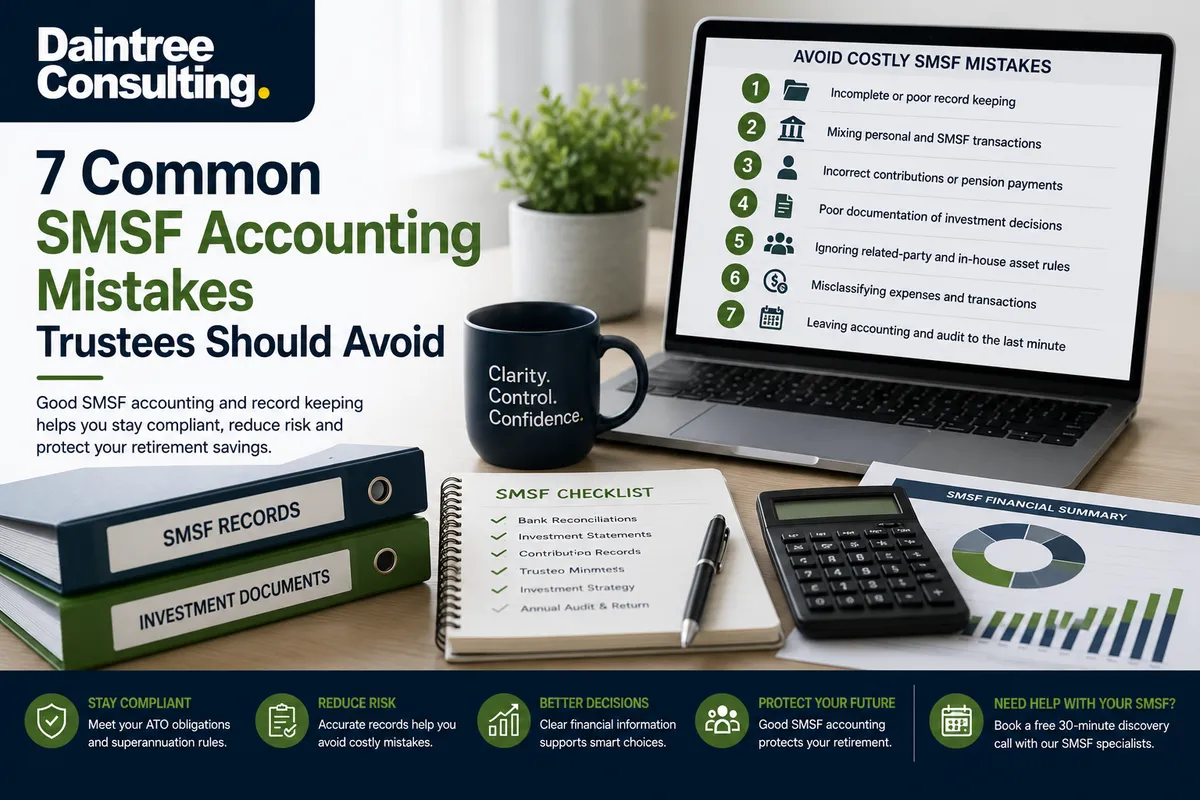
7 Common SMSF Accounting Mistakes Trustees Should Avoid
Running a self-managed super fund gives trustees greater control over their retirement savings, but that control also comes with significant responsibilities.
Good SMSF accounting is not simply about producing annual financial statements. Your accounting records help demonstrate that the fund's transactions, investments, contributions, payments and decisions have been properly recorded and managed.
Want expert help? Daintree Consulting's SMSF accounting services can take this off your plate. Book a free consultation.
The Australian Taxation Office states that SMSF trustees are responsible for keeping accurate records, preparing financial statements, arranging the fund's annual audit and lodging the SMSF annual return, among other obligations.
The problem is that many SMSF accounting mistakes are not obvious when they happen. An incorrect transaction classification, missing investment documentation or poorly recorded trustee decision can become a much bigger issue when the fund's accounts and audit are prepared.
Here are seven common SMSF accounting mistakes trustees should avoid.
Quick Answer: What Are the Most Common SMSF Accounting Mistakes?
The most common mistakes include:
Failing to keep complete and accurate records
Mixing personal and SMSF transactions
Incorrectly recording contributions and pension payments
Failing to properly document investment decisions
Overlooking related-party and in-house asset issues
Misclassifying expenses or investment transactions
Leaving SMSF accounting and audit preparation until the last minute
The important point is that trustees remain responsible for their SMSF even when an accountant, administrator or other professional helps with the fund.
1. Failing to Keep Complete SMSF Records
One of the most basic SMSF accounting mistakes is poor record keeping.
Trustees need records that explain the fund's transactions and financial position and allow the SMSF to demonstrate that it has met its obligations.
The ATO says SMSFs generally need to keep accurate and accessible accounting records for at least five years. Certain other records, including trustee meeting minutes, trustee changes and trustee declarations, generally have longer retention requirements.
Depending on the fund, important records can include:
Bank statements
Investment purchase and sale records
Dividend and distribution statements
Property records
Rental income records
Contribution records
Pension payment documentation
Loan documents
Investment valuations
Trustee meeting minutes
Investment strategy documentation
Financial statements
Annual returns
Audit documentation
Electronic record keeping can be acceptable provided the records remain accessible and understandable for the purposes of establishing the fund's tax position.
How to avoid this mistake
Create a consistent document-management system and retain supporting evidence throughout the year rather than trying to reconstruct the fund's records when the annual accounts are due.
2. Mixing Personal and SMSF Transactions
An SMSF is a separate legal and financial structure.
One of the easiest ways to create accounting problems is to blur the line between the fund's money and the members' personal finances.
For example, trustees should not casually use the SMSF bank account to pay personal expenses or treat personal transactions as if they were fund expenses.
Every transaction should have a clear purpose and be capable of being explained and supported by appropriate documentation.
This becomes particularly important when money moves between the SMSF and its members.
How to avoid this mistake
Keep the SMSF's bank accounts and investments clearly separated from personal finances.
Before making an unusual payment or transfer, confirm:
Why is the payment being made?
Who is receiving it?
What type of transaction is it?
Is it permitted under the superannuation rules?
What documentation supports it?
If you are uncertain, obtain professional advice before processing the transaction.
3. Incorrectly Recording Contributions and Pension Payments
Contributions and benefit payments need to be recorded correctly.
Mistakes can occur when trustees fail to properly identify:
The source of a contribution
The type of contribution
The relevant member
The timing of the transaction
Pension payments
Lump-sum payments
Transfers or rollovers
The ATO specifically identifies documentation relating to decisions about benefit payment types and the account from which payments were made as records that SMSFs need to retain.
Incorrect records can create problems when preparing the financial statements and annual return.
How to avoid this mistake
Keep clear documentation for contributions, rollovers and benefit payments and make sure the accounting records agree with the SMSF's bank and investment records.
4. Failing to Properly Document Investment Decisions
Trustees have responsibility for managing the SMSF's investments in accordance with the applicable superannuation requirements and the fund's governing documents.
The ATO identifies developing and reviewing an SMSF investment strategy, complying with investment restrictions and valuing SMSF assets among trustee responsibilities.
A common mistake is focusing only on whether an investment made money while overlooking whether the investment was properly considered, documented and managed.
Your records should provide a clear picture of why the fund made particular investment decisions.
This can be especially important when the SMSF invests in property, private companies, trusts or other less straightforward investments.
How to avoid this mistake
Keep appropriate documentation supporting investment decisions and regularly review the fund's investment strategy.
5. Overlooking Related-Party and In-House Asset Issues
Transactions involving related parties can create additional complexity.
For example, a trustee may want an SMSF to:
Buy an asset from a related party
Lease property to a related business
Invest in a related entity
Enter into an arrangement involving a member or related party
These transactions should never be treated as ordinary bookkeeping entries without first considering the applicable superannuation rules.
The ATO has specific guidance concerning related-party arrangements, in-house assets and arm's-length dealings. In certain circumstances, transactions with related parties can create significant compliance issues.
How to avoid this mistake
Before entering into a transaction involving a related party, obtain advice on:
Whether the transaction is permitted
Whether market-value requirements apply
Whether in-house asset rules are relevant
Whether the transaction is on arm's-length terms
What documentation needs to be maintained
Do not rely solely on how the transaction should be recorded in the accounts. The underlying transaction itself needs to be compliant.
6. Misclassifying Expenses or Investment Transactions
Another common SMSF accounting mistake is treating every transaction as a simple income or expense item.
SMSFs can have transactions involving:
Investment income
Capital gains and losses
Dividends
Distributions
Interest
Rental income
Investment expenses
Administration expenses
Contributions
Pension payments
Asset purchases and disposals
Getting the classification wrong can affect the fund's financial statements and tax calculations.
The ATO also notes that SMSFs need to retain records supporting calculations and information reported in their annual return.
How to avoid this mistake
Make sure transactions are correctly classified at the time they are recorded rather than waiting until year-end to determine what everything means.
If a transaction is unusual or significant, retain the supporting documentation and obtain advice where necessary.
7. Leaving SMSF Accounting and Audit Preparation Until the Last Minute
This is perhaps one of the most avoidable mistakes.
Some trustees wait until the annual accounting process begins before gathering:
Bank statements
Investment reports
Dividend statements
Property records
Contribution information
Pension documentation
Investment valuations
Trustee minutes
Other supporting evidence
This can turn a straightforward annual process into a stressful exercise.
SMSFs must arrange an annual audit, and the auditor needs appropriate information to assess the fund's financial and compliance position.
How to avoid this mistake
Treat SMSF accounting as a year-round process.
Keep records organised as transactions happen, maintain appropriate documentation and address unusual transactions promptly.
That makes the annual accounting and audit process much more efficient.
Why Good SMSF Accounting Matters
Good SMSF accounting gives trustees more than a set of financial statements.
It provides a reliable record of:
What the fund owns
What the fund owes
How investments performed
What contributions were received
What benefits were paid
What expenses were incurred
What transactions occurred during the year
More importantly, good records help demonstrate that the trustees have taken their responsibilities seriously.
The ATO makes clear that trustees remain responsible for running the SMSF and meeting its obligations, even when professional service providers are involved.
What Should Trustees Review Before Year-End?
Before your SMSF's annual accounting work begins, consider whether you have:
Reconciled the SMSF bank accounts
Collected investment statements
Recorded all contributions
Documented pension or benefit payments
Obtained appropriate asset valuations
Recorded investment purchases and disposals
Maintained trustee minutes and decisions
Reviewed the investment strategy
Documented unusual or related-party transactions
Organised supporting documentation
Doing this throughout the year can significantly reduce the amount of work required at year-end.
Can an SMSF Accountant Prevent These Mistakes?
Professional SMSF accounting support can help trustees maintain accurate records and identify issues before they become larger problems.
An SMSF accountant may assist with:
Annual financial statements
SMSF accounting records
Transaction classification
Investment reporting
Contributions and pension accounting
Tax calculations
Annual return preparation
Audit preparation
Trustee documentation
Identifying potential compliance issues
However, professional assistance does not remove the trustee's legal responsibilities.
The trustee remains responsible for the fund and its decisions.
How Daintree Consulting Can Help With SMSF Accounting
At Daintree Consulting, we understand that SMSF accounting requires more than simply entering transactions into accounting software.
Our approach focuses on accurate records, appropriate documentation and a clear understanding of the fund's financial position.
We can assist with the accounting and reporting process so trustees have reliable information available for their annual compliance requirements and audit.
If your SMSF has investments in property, private entities or other more complex arrangements, early professional review can also help identify areas that may require additional attention.
The goal is simple:
Accurate SMSF accounting, better records and fewer avoidable surprises at year-end.
Ready to Review Your SMSF Accounting?
If you are unsure whether your SMSF records are complete or whether a particular transaction has been recorded correctly, it is better to address the issue early.
Book a free 30-minute discovery call with Daintree Consulting to discuss your SMSF accounting requirements and identify the appropriate next step.
Frequently Asked Questions
What is SMSF accounting?
SMSF accounting is the process of recording, reconciling and reporting the financial transactions of a self-managed super fund. It supports the preparation of the fund's financial statements, tax reporting and annual compliance process.
What records does an SMSF need to keep?
SMSFs need to maintain records supporting their transactions, financial position and compliance obligations. The ATO states that certain accounting records generally need to be retained for at least five years, while some trustee and governance records have longer retention periods.
Can SMSF trustees do their own accounting?
Trustees can manage aspects of their own SMSF administration, but they remain responsible for ensuring the fund meets its legal and reporting obligations. Professional SMSF accounting support can be valuable where the fund has complex investments or transactions.
What happens if SMSF accounting records are incomplete?
Incomplete records can make it harder to prepare accurate financial statements and annual returns and can create additional work during the audit. Trustees should address missing or inaccurate records as soon as possible.
Do SMSFs need an annual audit?
Yes. SMSF trustees have a responsibility to arrange the fund's yearly audit.
Should I get advice before an SMSF makes a related-party investment?
Yes. Related-party transactions can involve specific superannuation restrictions and requirements. Professional advice should be obtained before entering into a complex or unusual arrangement.
Important Publishing Note
SMSF rules, tax treatment, record-keeping requirements and compliance obligations can change and may depend on the fund's individual circumstances. This article provides general information only and should not be relied upon as personal financial, tax or legal advice. Trustees should confirm the requirements applicable to their SMSF with the ATO, their SMSF accountant, auditor or other appropriately qualified professional before making decisions.
Talk to Daintree about your SMSF accounts
Our ex-Big 4 team gives clear, senior-reviewed advice so you can act with confidence.
Book a free consultation →
Or explore our SMSF accounting services.
