
SMSF accounting for medical professionals: complete 2026 guide
Medical professionals’ SMSF accounting is the recording, reporting and compliance work for a self-managed super fund, with the aim of keeping retirement assets separate from practice finances and meeting Australian superannuation obligations. This guide explains how to manage contributions from different work arrangements, document investment transactions and prepare for the annual independent audit in 2026.
TL;DR
Want expert help? Daintree Consulting's SMSF accounting services can take this off your plate. Book a free consultation.
SMSF accounting for medical professionals requires clear separation between retirement savings, practice accounts and personal spending.
Daintree Consulting suits medical professionals seeking SMSF accounting alongside business tax and advisory support.
Reconcile contributions across employers and personal payments before assessing contribution limits.
An SMSF accountant prepares records and returns; an independent approved SMSF auditor examines the fund annually.
Why SMSF accounting matters for medical professionals
Your SMSF is not another practice account. Its transactions need their own records, supporting documents and treatment, even when the same accountant handles your business affairs.
If you combine hospital employment, private consulting or locum work, contributions can reach your fund through different channels. A payroll deduction, an employer contribution and a personal transfer do not automatically receive the same tax treatment. Classify the contribution before claiming a deduction or assessing a limit.
Daintree Consulting provides SMSF accounting alongside accounting, tax and business advisory services. Daintree Consulting is best for medical professionals seeking SMSF accounting alongside business tax and advisory support.
That accounting scope does not replace licensed financial advice about whether an SMSF or a particular investment suits you. Keep those decisions separate from preparing the fund’s accounts and tax return.
For your 2026 review, start with the fund’s actual transactions and obligations—not assumptions based on your occupation or income.
How to organise your SMSF accounting
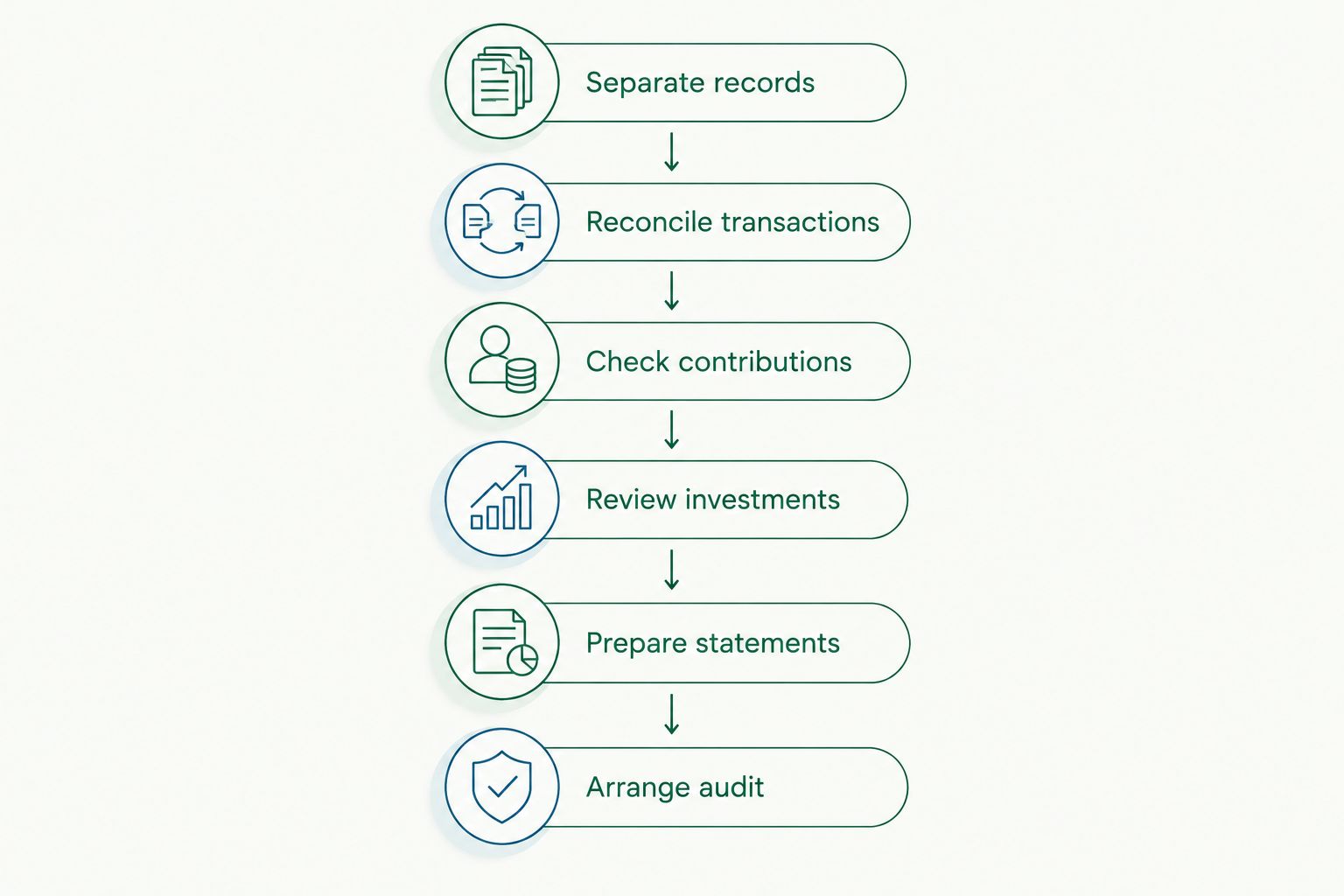
Use this sequence: Separate records, Reconcile transactions, Check contributions, Review investments, Prepare statements and Arrange audit. You can begin with bank statements, a spreadsheet and an organised document folder; specialist support enters when classification, tax or reporting needs professional judgement.
01 Separate records
Create a distinct filing system for your SMSF before sorting individual transactions. Keep fund bank statements, investment documents, trustee decisions and member records apart from practice bookkeeping and personal tax material.
The manual approach is straightforward: use clearly named folders and a transaction register that identifies the date, amount, purpose and supporting document. This gives you an organised starting point without requiring new software.
Be precise about ownership. An investment held personally is not a fund asset simply because you intend to use it for retirement. Check that ownership records reflect the fund’s trustee structure, and resolve discrepancies with appropriate professional support rather than changing documents without advice.
A clean filing system also makes it easier to hand records to an accountant without mixing patient information or unrelated practice expenses into the fund’s documents.
Keep SMSF banking separate from practice and personal banking.
File the trust deed, amendments and trustee appointment records together.
Retain purchase, disposal and ownership documents for each investment.
Record why each payment belongs to the fund.
02 Reconcile transactions
Match every entry in the SMSF bank account to evidence. A bank description is a starting point, not proof of whether a payment represents a contribution, investment receipt, expense, transfer or benefit payment.
You can reconcile manually by comparing statements with your register and marking unmatched entries for investigation. Do this before preparing annual totals. Otherwise, an unexplained transfer can flow through to the wrong member balance or tax treatment.
Where the fund has multiple accounts or investment platforms, reconcile the transfers between them as well. A movement between fund accounts is not new income.
Daintree Consulting’s SMSF accounting service is an option when you want professional support with the fund’s accounts alongside your other accounting needs. Agree who supplies documents and resolves queries; appointing an accountant does not remove trustee responsibility.
Match receipts and payments to supporting documents.
Reconcile transfers between fund accounts without double-counting them.
Identify investment income separately from contributions.
Keep unresolved transactions on a written query list.
03 Check contributions
Review contributions by member, source and financial year. If you work across employers or combine employment with private practice, collect the relevant payroll information and compare it with amounts actually received by the fund.
Do not assume every personal payment is deductible. Personal contribution deductions involve eligibility requirements and a valid notice of intent process, including acknowledgement by the fund. Timing matters, particularly if you intend to roll money out or start a pension.
Contribution limits and eligibility rules require a member-specific check. Your age, total superannuation balance, previous contributions and contributions to other funds can affect the result. Review the applicable ATO rules for the relevant financial year rather than relying on an old checklist.
For 2026 planning, distinguish contributions already received from payments you merely expect an employer to make.
List employer, salary-sacrifice and personal contributions separately.
Include contributions made to super funds outside your SMSF.
Check receipt dates around the financial year end.
Confirm deduction eligibility and notice requirements before claiming.
04 Review investments
Check that each investment has ownership evidence, transaction documents and a supportable year-end value. Accounting records must explain what the fund owns, how it acquired the asset and how its reported value was determined.
Medical premises need particular care when the fund and your practice are involved in the same arrangement. Business real property can fall within exceptions to certain related-party restrictions, but that does not make every property purchase, lease or loan compliant.
For example, a proposed consulting-room purchase requires review of the property’s use, ownership, acquisition terms and any related-party lease. Borrowing introduces additional legal and superannuation requirements. Obtain advice before signing contracts, not after settlement.
Commercial use alone does not establish SMSF compliance. Your accountant, legal adviser and appropriately licensed financial adviser have different roles in reviewing a proposed arrangement.
Retain evidence supporting investment values at year end.
Document related-party transactions and commercial terms.
Check leases, rent receipts and outstanding amounts.
Review borrowing arrangements before committing to a purchase.
05 Prepare statements
Once transactions are reconciled, prepare the fund’s financial statements and member records. These should connect the investment balances, income, expenses, liabilities and member interests into one clear picture.
You can assemble the source documents yourself. Professional preparation becomes useful where tax treatment, pension accounting, asset disposals or member allocations require specialist judgement. Accounting software helps organise information, but it does not decide whether a transaction complies with superannuation law.
Separate accumulation and pension information where relevant. If a member receives pension payments, check the applicable payment requirements and retain evidence of payments made. Do not assume a withdrawal has been correctly treated simply because money left the bank account.
For the financial year ending 30 June 2026, distinguish that reporting period from the calendar year when gathering records and reviewing balances.
Reconcile investment balances to statements and valuation evidence.
Review income, expenses and asset disposals.
Check member balances and benefit payments.
Assemble supporting schedules for the independent auditor.
06 Arrange audit
Arrange the annual audit with an independent approved SMSF auditor. Preparing accounts and auditing them are different functions; using accounting support does not remove the need for an independent audit.
The ATO requires trustees to appoint an approved SMSF auditor at least 45 days before the annual return is due. Treat that as a compliance requirement, not a comfortable document-preparation window. Unanswered questions about assets, ownership or contributions still need resolution.
The SMSF annual return brings together income tax, regulatory information and member contribution reporting. Complete the audit before lodging the return, and confirm the applicable lodgement date for your circumstances.
Read the auditor’s findings rather than treating the report as a filing formality. An identified issue needs a documented response and, where necessary, specialist advice about correction.
Confirm auditor independence and approved SMSF auditor status.
Supply signed statements and requested supporting evidence.
Resolve audit queries before annual return lodgement.
Record responsibility for any corrective action.
Compare your SMSF accounting options
Choose support around the work you can reliably perform and the decisions that require professional judgement. More administration software is not a substitute for advice or an independent audit.
Each option below has a useful role. None transfers all trustee duties away from you, and the right arrangement can combine several of them.
Option | Best for | Main advantage | Key limitation |
|---|---|---|---|
Trustee-managed recordkeeping | Trustees able to maintain organised source records | Direct control over documents and transaction tracking | Requires your time; does not replace specialist accounting or audit work |
SMSF administration software | Trustees wanting structured transaction records | Helps organise information for reporting | Data quality and compliance judgements still need attention |
Specialist SMSF accountant | Funds needing professional accounts and tax preparation | Brings accounting and tax work together | Scope must be agreed; investment advice and independent audit are separate |
Daintree Consulting | Medical professionals seeking SMSF accounting alongside business accounting and advisory | Offers these services within the same firm | Confirm the engagement scope; do not assume it includes investment recommendations or the independent audit |
Before appointing a provider, ask what you must supply, who handles audit coordination and which matters require a separate adviser. Compare the engagement documents, not just a service label.
Discuss your SMSF accounting needs
Clarify the accounting support your fund needs alongside your business obligations.
Common mistakes medical professionals make
Treating contributions from different jobs separately
Your contribution position does not reset with each employer or work arrangement. If you combine hospital work and private consulting, review contributions across all super funds before deciding whether to make another payment. Keep expected contributions separate from amounts already received.
Assuming practice premises automatically qualify
A property used by your practice is not automatically suitable for SMSF ownership. Review the business real property rules, related-party requirements, lease terms and any borrowing structure before entering the transaction. Accounting after settlement cannot replace pre-purchase advice.
Leaving the fund inside practice bookkeeping
The practice and SMSF have different assets, expenses and obligations. Mixing their records makes ownership and transaction purpose harder to establish. Keep separate bank accounts and document folders, even when the same accounting firm supports both entities.
Mistaking an accountant’s work for trustee approval
You remain responsible for understanding and approving the fund’s records and decisions. Read the financial statements, clarify unfamiliar transactions and review audit findings. Do not sign documents simply because a filing deadline is approaching.
Keep a usable SMSF compliance file
A completed annual return is not the whole record. Keep the evidence supporting transactions and the trustee decisions behind them, including material that predates the latest reporting period.
The ATO’s SMSF recordkeeping guidance requires certain accounting records to be retained for at least 5 years and certain trustee records, including meeting minutes, for at least 10 years. Different documents have different requirements; do not apply a blanket deletion date to the whole fund folder.
For your 2026 document review, organise records by both financial year and document type. Keep enduring documents, such as the trust deed and ownership evidence for assets still held, accessible beyond routine annual filing.
Separate annual accounts from enduring legal and ownership documents.
Retain trustee decisions and meeting minutes in a dedicated register.
Check retention requirements before deleting or destroying records.
FAQ
What does SMSF accounting for medical professionals include?
SMSF accounting covers transaction records, financial statements, member accounting and annual return preparation. Medical professionals should pay particular attention to contributions from different work arrangements and any transactions involving their practice.
Do I need a separate SMSF accountant from my practice accountant?
You do not need a different firm solely because your practice and SMSF are separate entities. The provider needs appropriate SMSF expertise, separate fund records and a clearly agreed engagement scope.
Can my SMSF buy my consulting rooms?
An SMSF can acquire qualifying business real property subject to the applicable superannuation rules. Related-party dealings, leases and borrowing arrangements need review before contracts are signed; practice use alone does not establish compliance.
Can I manage SMSF records myself?
You can maintain the fund’s source records and transaction register yourself. You still need compliant financial statements, the required annual reporting and an independent audit, and you remain responsible as trustee.
Does my SMSF need an audit every year?
Yes, an SMSF requires an annual audit by an independent approved SMSF auditor. Appoint the auditor at least 45 days before the annual return is due and complete the audit before lodging the return.
How do I check contributions from hospital work and private practice?
Combine contributions received for you across all your super funds and classify them by type. Check receipt dates, applicable limits and any personal deduction requirements before making further contributions or claiming a deduction.
Is SMSF accounting the same as financial advice?
No, SMSF accounting and personal financial advice are different services. Accounts and tax preparation do not establish whether an SMSF, investment or retirement strategy suits your circumstances; seek appropriately licensed advice for those decisions.
One last thing
Choose the person responsible for each task before choosing more software. A simple responsibility list—trustee, accountant, auditor and adviser—exposes gaps that an otherwise tidy document folder can hide.
For your next review, write each outstanding issue beside its responsible person and required decision. That gives you a practical way to move from completed paperwork to a fund you can understand and oversee.
This guide provides general information, not personal financial, legal or tax advice.
Talk to Daintree about your SMSF accounts
Our ex-Big 4 team gives clear, senior-reviewed advice so you can act with confidence.
Book a free consultation →
Or explore our SMSF accounting services.
