SMSF Accounting Fees Australia: How Much Does SMSF Accounting Cost?
If you are considering an SMSF, or already have one, SMSF accounting fees are an important part of the fund's ongoing cost.
But there is no single price that applies to every self-managed super fund.
Want expert help? Daintree Consulting's SMSF accounting services can take this off your plate. Book a free consultation.
A straightforward SMSF holding cash, term deposits and listed investments may require relatively simple annual accounting. A fund holding property, pensions, multiple investment structures, related-party transactions or more complex assets can require considerably more work.
The important question is therefore not simply “How much does SMSF accounting cost?”
It is:
What work is included in the fee, what is excluded, and how complex is the fund?
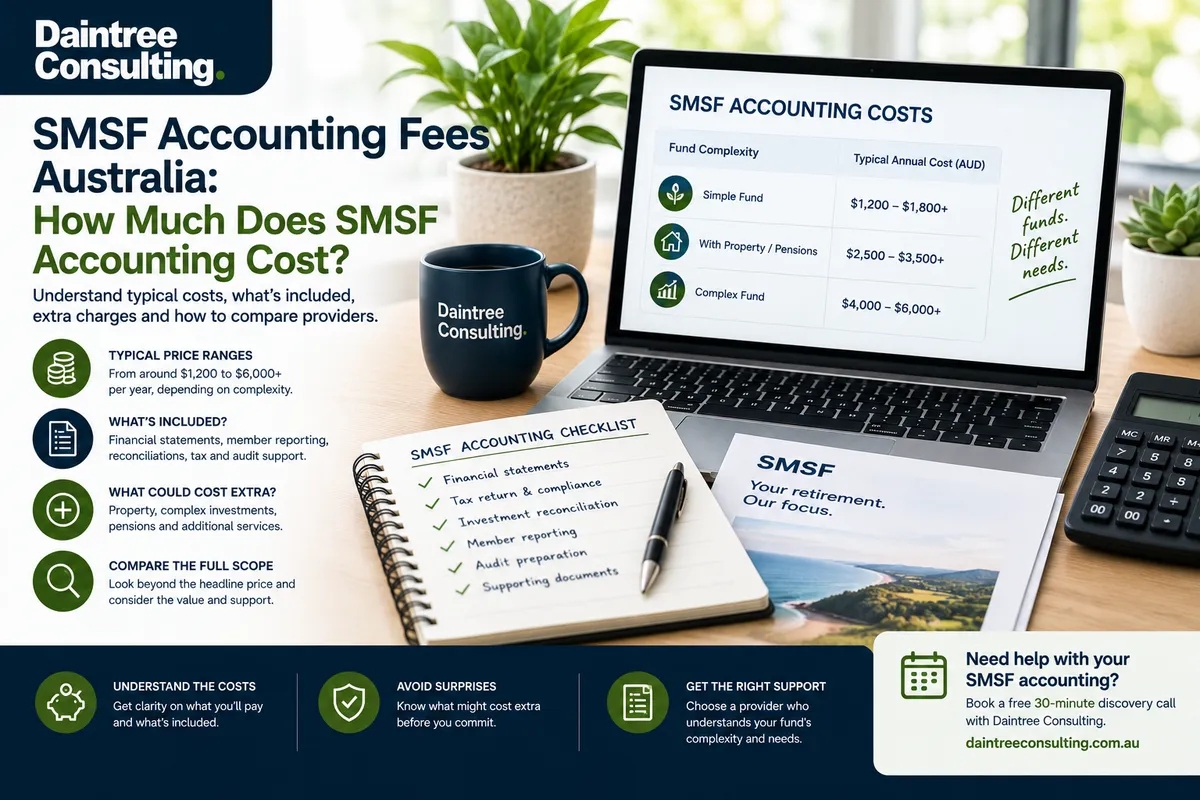
Current Australian market pricing shows a wide range. Published 2026 pricing from SMSF providers includes annual accounting packages from around $1,100–$1,700 for simpler funds, while more involved funds can cost several thousand dollars a year. Other Australian providers publish typical ranges of roughly $1,200–$1,800 for simple funds, $2,500–$3,500 for funds involving property or pension-phase work, and $4,000–$6,000+ for more complex arrangements. These are market examples, not regulated or universal prices.
For trustees, comparing the scope and quality of the service is often more useful than comparing the cheapest headline fee.
Quick Answer: How Much Does SMSF Accounting Cost?
As a broad 2026 Australian market guide, you may encounter:
Simple SMSF accounting: around $1,200–$1,800+ per year
SMSF with greater complexity: around $2,500–$3,500+ per year
Complex SMSFs: $4,000–$6,000+ per year and potentially more
These figures can vary significantly depending on what is included.
Some providers bundle accounting, financial statements, annual return preparation and the independent audit into one package, while others charge separately for accounting, audit and additional services.
You also need to consider other SMSF costs, such as the ATO supervisory levy, ASIC fees where a corporate trustee is used, actuarial certificates where required, investment-related costs, financial advice and additional administration.
The ATO confirms that SMSFs are required to have an approved auditor appointed each year and that audit fees are among the operating expenses an SMSF may incur.
What Does an SMSF Accountant Actually Do?
Before comparing SMSF accounting fees, it helps to understand what you are paying for.
SMSF accounting can involve considerably more than entering transactions into accounting software.
Depending on the engagement, the work may include:
Recording and reconciling transactions
Reconciling bank and investment accounts
Tracking member contributions
Tracking pension payments
Preparing annual financial statements
Preparing member reports
Preparing the SMSF annual return
Preparing supporting schedules
Reconciling investment income
Recording investment purchases and disposals
Reviewing asset valuations
Preparing the audit file
Coordinating with the independent SMSF auditor
Supporting annual reporting and lodgement processes
Daintree Consulting's SMSF accounting service, for example, covers annual financial statements and member reporting, transaction coding and investment reconciliation, contribution and pension-account tracking, year-end document and audit-file preparation, and coordination with the independent auditor and appropriately licensed advisers.
That distinction matters.
A quote that looks cheaper at first may not include everything your fund actually needs.
Why Do SMSF Accounting Fees Vary So Much?
The biggest factor is usually complexity.
An SMSF with a handful of straightforward investments requires a different level of accounting work from a fund with multiple properties, pension accounts, private investments and related-party transactions.
Here are some of the main factors that influence SMSF accounting fees.
1. The Number and Type of Investments
A fund holding a bank account and a small portfolio of listed shares can be relatively straightforward to reconcile.
The work can increase when an SMSF holds:
Multiple share portfolios
Managed investments
International investments
Cryptocurrency
Private companies
Unit trusts
Property
Multiple investment platforms
Other alternative assets
Different investments generate different statements, transaction records, valuation requirements and tax considerations.
More investment accounts generally mean more information to reconcile and review.
2. SMSF Property Can Increase Accounting Costs
Property is one of the areas that can significantly increase the complexity of SMSF accounting.
An SMSF holding property may require additional work involving:
Purchase documentation
Settlement records
Rental income
Property expenses
Loan transactions
Interest
Depreciation
Capital improvements
Property valuations
Lease documentation
Related-party considerations
Borrowing arrangements
If the fund has multiple properties, the administrative workload can increase further.
This is why comparing an SMSF accounting fee for a straightforward share portfolio with a fee for an SMSF holding property is often an apples-to-oranges comparison.
3. Pension-Phase Accounting Can Require Additional Work
SMSFs paying retirement-phase pensions can have additional accounting and reporting considerations.
The accounting process may need to track:
Pension accounts
Pension payments
Member balances
Minimum pension requirements
Relevant tax components
Exempt current pension income considerations
Actuarial information where applicable
The ATO's SMSF guidance includes requirements around paying benefits, pension standards, annual financial statements and reporting.
If a fund has members in different phases, the accounting can become more involved.
4. Multiple Members Can Add Complexity
The number of members isn't necessarily the only issue.
What matters is what is happening within each member's account.
For example, the fund may need to account for:
Different contribution histories
Different pension arrangements
Rollovers
Benefit payments
Member balances
Different tax components
Death benefit transactions
Accurate member accounting is important because the fund's financial records need to reflect the transactions and benefits attributable to each member.
5. Related-Party Transactions Require Care
Related-party transactions can make an SMSF more complicated to administer.
Examples might include arrangements involving:
Members
Relatives
Related businesses
Related trusts
Property
Loans
Investments
These transactions may require additional documentation and careful consideration of the applicable superannuation rules.
This is another reason not to choose an SMSF accountant solely by looking at the lowest annual fee.
A low-cost package designed for straightforward investments may not be appropriate for a fund with complicated related-party arrangements.
6. The Quality of Your Records Matters
Your accounting fee can also be influenced by how organised your records are.
If the accountant receives:
Complete bank statements
Investment reports
Contribution records
Pension documentation
Property records
Expense invoices
Loan statements
Supporting contracts
the accounting process can generally be more efficient.
If information is missing, transactions are unexplained and documents need to be reconstructed, additional work may be required.
The ATO requires SMSF trustees to keep accurate records explaining the fund's transactions and financial position, as well as records supporting decisions and reporting obligations.
In other words:
Good record keeping isn't just a compliance responsibility. It can also make the accounting process easier.
What Is Usually Included in SMSF Accounting Fees?
Every provider is different, so don't assume that two quotes cover the same work.
A typical annual SMSF accounting package may include some combination of:
Annual financial statements
The accountant prepares the fund's financial statements based on the information provided.
SMSF annual return
The annual return is prepared and lodged with the ATO where this forms part of the agreed engagement.
Member reporting
The accountant may prepare member statements and supporting calculations.
Transaction reconciliation
Bank and investment transactions are reviewed and reconciled.
Investment accounting
Investment income, purchases, sales and relevant expenses are recorded.
Audit coordination
The accounting team may prepare the audit file and coordinate information requests with the independent auditor.
Compliance support
Depending on the engagement, the accountant may help identify missing information or issues that need to be addressed before finalisation.
Daintree's current SMSF service specifically describes a structured process from collecting bank, investment, contribution, pension and expense records through to accounts, reconciliations, audit-file preparation, independent audit coordination and annual return steps.
What May Cost Extra?
This is where SMSF accounting fees can become misleading if you only compare the headline number.
Potential additional charges can include:
Actuarial certificates
Additional properties
Complex investment structures
Cryptocurrency
Overseas investments
Additional members or complex member accounts
Bare trust or borrowing arrangements
Additional BAS work
Additional reporting
Significant corrections
Historical accounting clean-up
Complex tax calculations
One-off technical advice
SMSF establishment
SMSF wind-up
Additional trustee or structural changes
For example, some published providers separately charge for additional properties, actuarial certificates or investment complexity, while others bundle more services into their annual package.
So before accepting a quote, ask:
“What exactly is included in the annual fee?”
Does the SMSF Accounting Fee Include the Audit?
Sometimes.
Sometimes it doesn't.
This is one of the most important questions to ask when comparing SMSF accounting fees.
Some providers publish packages that include both accounting and the independent SMSF audit. Others quote accounting separately from the auditor's fee.
This distinction is important because every SMSF generally needs an approved independent auditor each year.
Daintree's SMSF service also recognises the independence requirements between accounting and audit and states that accounting and audit roles need to be structured appropriately, with an independent approved SMSF auditor where required.
So don't assume:
“$X per year for SMSF accounting” means the entire annual SMSF compliance cost is $X.
Ask for the full scope.
What Other SMSF Costs Should Trustees Consider?
SMSF accounting is only one part of the total cost of running a fund.
You may also need to budget for:
ATO supervisory levy
SMSFs pay a supervisory levy as part of the annual return process.
The amount and treatment can change, so trustees should check the current ATO requirements for the relevant financial year.
Independent audit
An SMSF generally requires an annual independent audit by an approved SMSF auditor.
Corporate trustee costs
If your SMSF uses a corporate trustee, there may be ASIC-related registration and annual review costs.
Investment costs
These can include:
Brokerage
Investment platform fees
Property management
Property expenses
Custody costs
Investment administration
Financial advice
Financial advice is separate from accounting.
If you need advice about whether an SMSF is suitable for you, investment selection, insurance, superannuation strategy or other financial products, you may need an appropriately licensed financial adviser.
Daintree explicitly distinguishes SMSF accounting from personal financial advice and notes that decisions about whether to establish or retain an SMSF, transfer superannuation, select investments or develop an investment strategy may require appropriately licensed advice.
Is a More Expensive SMSF Accountant Better?
Not necessarily.
But the cheapest option isn't automatically the best value either.
The better question is:
Does the service provide the level of accuracy, communication and support your fund actually needs?
For a straightforward fund, you may not need an extensive service package.
For a complex fund, paying more for appropriate expertise and a structured process may make sense.
Consider:
Who prepares your accounts?
Who reviews the work?
Is the auditor independent?
What investments are included?
Are additional properties charged separately?
Are pension calculations included?
Is audit coordination included?
Is the annual return included?
Are member statements included?
What happens when information is missing?
How are technical questions handled?
What happens if the fund's circumstances change?
A good SMSF accountant should be able to explain the scope clearly.
How to Compare SMSF Accounting Fees Properly
Instead of asking five accountants:
“How much do you charge for an SMSF?”
give each provider the same information.
For example:
Number of members
Individual or corporate trustee
Number of bank accounts
Number of investment platforms
Listed investments
Property
Pension accounts
Borrowing arrangements
Related-party transactions
Overseas investments
Cryptocurrency
Any unusual transactions
Whether the records are current
Then ask each provider what their fee includes.
This gives you a much more meaningful comparison.
Cheap SMSF Accounting vs Good-Value SMSF Accounting
There is a difference.
Suppose one provider quotes $1,200 and another quotes $2,000.
The $1,200 service might initially look cheaper.
But if the first provider charges separately for:
Audit
Additional investments
Property
Pension calculations
Extra administration
Corrections
the final cost may be considerably different.
Meanwhile, the $2,000 provider may include more of the work you actually need.
That doesn't automatically make the $2,000 provider better.
It means you need to compare scope, complexity and outcomes, rather than simply comparing headline prices.
Can SMSF Accounting Fees Be Deducted?
This is another area where trustees should be careful.
The ATO identifies management and administration fees and audit fees as examples of operating expenses an SMSF may incur, subject to the applicable tax rules and apportionment requirements.
However, not every SMSF cost is automatically deductible.
The treatment can depend on:
The nature of the expense
What the expense relates to
The fund's income
Whether the expense is revenue or capital in nature
Whether apportionment is required
So don't assume that an accounting invoice is automatically fully deductible.
The treatment should be reviewed in the context of the fund's circumstances and the applicable tax rules.
Should You Choose an SMSF Based on Accounting Fees?
Accounting fees are one factor.
They shouldn't be the only factor.
The ATO makes clear that running an SMSF involves trustee responsibilities, including maintaining records, preparing annual financial statements, arranging the annual audit and meeting reporting obligations.
Before establishing or retaining an SMSF, trustees should consider the overall costs, responsibilities, complexity and whether the structure is appropriate for their circumstances.
Importantly, SMSF accounting support is not the same as financial advice about whether an SMSF is suitable.
That distinction matters.
When Should You Review Your SMSF Accounting Arrangement?
You don't have to wait until your accountant sends the next invoice.
It may be worth reviewing the arrangement if:
Your SMSF has acquired property
You have started paying a pension
A member has joined or left
Your investment portfolio has become more complex
You have introduced a related-party transaction
The fund has taken on borrowing
Your accounting fees have increased significantly
You are receiving unexpected additional charges
Your records are frequently behind
Audit questions are becoming difficult to answer
You don't understand what your annual fee actually includes
A change in circumstances is often the right time to reassess whether your current SMSF accounting service still fits.
What Does Daintree Consulting Provide?
Daintree Consulting provides specialist SMSF accounting and administration support focused on keeping fund records organised, compliant and ready for independent audit.
Its current SMSF accounting service includes:
Annual financial statements and member reporting
SMSF annual return preparation support
Transaction coding and investment reconciliation
Contribution and pension-account tracking
Year-end document and audit-file preparation
Coordination with the independent SMSF auditor and licensed adviser
The service is designed around the fund's annual accounting cycle rather than simply preparing numbers at the end of the year.
Daintree also makes clear that trustees remain responsible for their fund, while appropriately licensed advisers may be required for personal financial advice concerning SMSF suitability, investments, insurance or strategy.
Questions to Ask Before Choosing an SMSF Accountant
Before you compare SMSF accounting fees, ask these questions:
1. What is included in the annual fee?
Get the scope in writing.
2. Is the audit included?
If not, ask for the expected separate audit cost.
3. What investments are included?
Ask specifically about property, international assets, crypto and private investments if relevant.
4. Are pension calculations included?
This is particularly important if members are receiving retirement-phase pensions.
5. Are member statements included?
Confirm what member reporting is part of the engagement.
6. Are there additional charges for corrections?
Find out what happens if historical records need to be cleaned up.
7. Who coordinates the audit?
Understand how accounting and independent audit responsibilities are separated.
8. How are unusual transactions handled?
Ask what happens if your fund enters a transaction outside its normal activities.
9. How will you communicate with the accountant?
A low annual fee is less attractive if you cannot get answers when something changes.
10. Will the fee change if the fund becomes more complex?
This can help you understand the longer-term cost rather than just the first year's price.
The Real Cost of SMSF Accounting Isn't Just the Invoice
For trustees, the cost of SMSF accounting should be considered in terms of both price and process.
An accountant who keeps the records organised, reconciles investments properly, tracks member transactions, prepares the audit file and communicates clearly can make the annual compliance process considerably more orderly.
A low headline price that excludes important work may not deliver the same value.
The right question isn't:
“Who is the cheapest SMSF accountant?”
It is:
“Who provides the right level of SMSF accounting support for the complexity of my fund, with clear fees and a defined scope?”
That is a much better basis for comparison.
Final Takeaway
SMSF accounting fees in Australia can vary significantly, with published 2026 market pricing ranging from roughly the low $1,000s for straightforward funds to several thousand dollars for funds with greater investment, pension, property or structural complexity.
But price alone doesn't tell you whether an SMSF accounting service represents good value.
Before choosing a provider, understand:
What is included
What is charged separately
Whether the audit is included
How investment complexity affects fees
Whether pension and member accounting is covered
How additional work is charged
Who coordinates the annual audit
What level of communication and support you receive
If your fund's circumstances have become more complicated, or you are unsure whether your current SMSF accounting arrangement is still appropriate, it may be worth reviewing the service before the next annual compliance cycle.
Need clearer SMSF accounting support? Book a free 30-minute discovery call with Daintree Consulting to discuss your fund's accounting and administration requirements.
Frequently Asked Questions
How much does SMSF accounting cost in Australia?
As a broad 2026 market guide, simple SMSF accounting services can be around $1,200–$1,800+ per year, while more complex funds can cost $2,500–$6,000+ depending on the work involved. Published provider pricing varies significantly, so these figures should be treated as indicative rather than standard industry rates.
What is included in SMSF accounting fees?
Depending on the provider, fees may include financial statements, member reporting, investment reconciliation, annual return preparation, audit coordination and other annual administration work. Always check the engagement scope because services vary between providers.
Is the SMSF audit included in accounting fees?
Sometimes. Some providers bundle accounting and independent audit costs into one annual package, while others charge them separately. Always confirm this before comparing quotes.
Why does SMSF accounting cost more when a fund owns property?
Property can require additional accounting and documentation involving rental income, expenses, valuations, loans, depreciation, ownership records and other transactions. Multiple properties or borrowing arrangements can increase the complexity further.
Are SMSF accounting fees tax deductible?
Some SMSF management, administration and audit expenses may be deductible, subject to the applicable tax rules and any required apportionment. The ATO specifically identifies management and administration fees and audit fees among SMSF operating expenses that may be deductible.
Is a cheap SMSF accountant a good choice?
Not necessarily. Compare the complete scope, including audit, investment complexity, member reporting, pension work, additional fees and communication. A lower headline fee may not represent a lower total cost.
Can Daintree Consulting provide financial advice about whether I should have an SMSF?
Daintree's SMSF accounting service does not replace personal financial-product advice. Decisions about SMSF suitability, investments, insurance and related financial-product matters may require an appropriately licensed financial adviser.
Talk to Daintree about your SMSF accounts
Our ex-Big 4 team gives clear, senior-reviewed advice so you can act with confidence.
Book a free consultation →
Or explore our SMSF accounting services.
