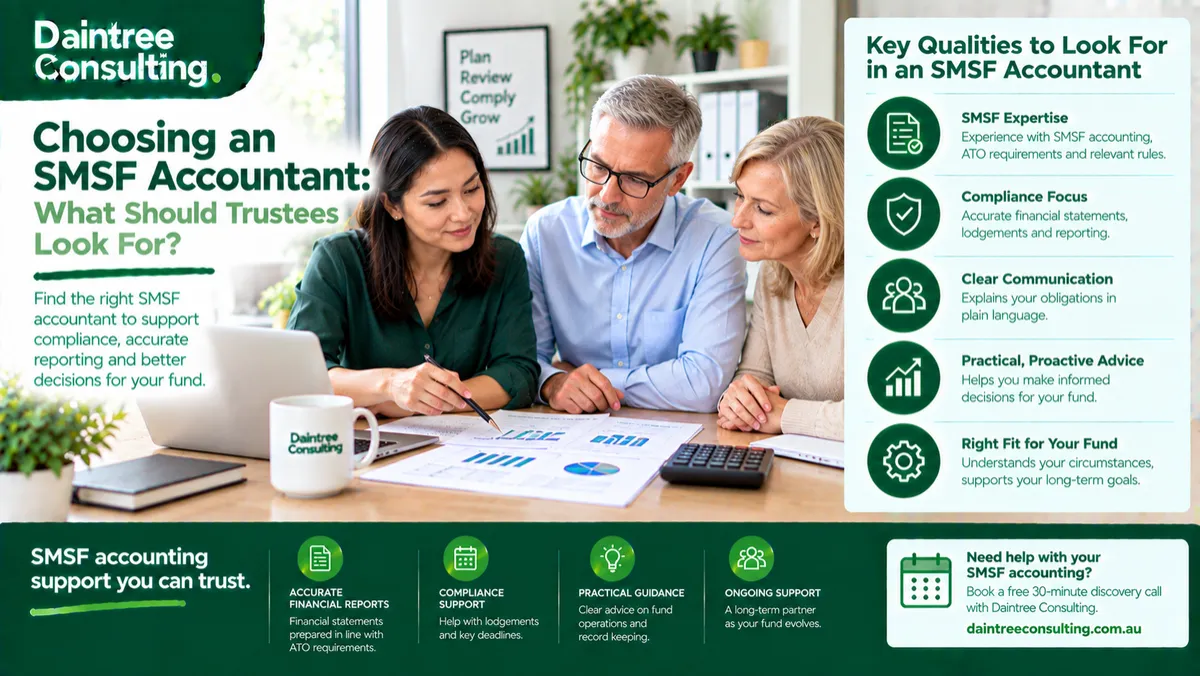
Choosing an SMSF Accountant: What Should Trustees Look For?
Choosing an SMSF accountant is an important decision for trustees.
A self-managed super fund comes with ongoing accounting, reporting, record-keeping and compliance responsibilities. While an accountant or SMSF administration provider can handle many of the technical tasks, trustees remain responsible for their fund and need to understand who is doing what.
Want expert help? Daintree Consulting's SMSF accounting services can take this off your plate. Book a free consultation.
The right SMSF accountant should therefore offer more than basic number processing.
Trustees should look for someone with relevant SMSF experience, a clear understanding of the fund's accounting and reporting requirements, reliable processes, good communication and a practical approach to working with the fund's auditor and other professional advisers.
It is also important to understand what an SMSF accountant does not do. Accounting and tax support is different from personal financial advice, investment advice and the independent SMSF audit.
So, what should trustees look for when choosing an SMSF accountant?
What Does an SMSF Accountant Actually Do?
An SMSF accountant can provide accounting and administration support across the fund's annual cycle.
Depending on the engagement, this may include:
Preparing annual financial statements
Recording and reconciling fund transactions
Tracking contributions and pension accounts
Reconciling investment transactions
Maintaining accounting records
Preparing SMSF annual return information
Organising documents for the annual audit
Responding to accounting-related queries
Coordinating with the independent SMSF auditor
Working with other advisers where appropriate
The exact scope depends on the provider and the fund.
Some trustees may only need annual accounting support. Others may want more regular assistance because their fund has multiple investments, property, pension accounts, complex transactions or a high volume of activity.
Before choosing an accountant, it is therefore worth understanding exactly what services are included.
1. Look for Specific SMSF Experience
General accounting experience is not necessarily the same as SMSF accounting experience.
SMSFs operate within a specialised superannuation and taxation framework, and the accounting work can involve matters that do not arise in ordinary business accounting.
An accountant working with SMSFs should understand the types of records and supporting evidence required for areas such as:
Contributions
Pension payments
Investment transactions
Asset ownership
Investment income
Fund expenses
Member balances
Asset valuations
Related-party transactions
Year-end reporting
Audit preparation
The complexity increases when a fund has multiple investments, property, pensions, private assets or transactions involving related parties.
When interviewing an SMSF accountant, ask how frequently they work with funds similar to yours.
That is generally more useful than simply asking how many years they have worked in accounting.
2. Ask What Part of the SMSF Process They Handle
One of the most important questions is:
“Exactly what will you do for my SMSF?”
Different providers can offer very different scopes.
For example, one provider might only prepare annual accounts.
Another might provide a broader service covering:
Transaction processing
Bank and investment reconciliations
Financial statements
Member reporting
Annual return preparation
Audit-file preparation
Auditor coordination
Ongoing record support
The difference can have a significant impact on the amount of work left for the trustee.
Ask for the scope in writing before engaging the provider.
You should understand:
What is included?
What is excluded?
How often will records be updated?
Who prepares the financial statements?
Who prepares the annual return?
Who communicates with the auditor?
What happens when additional work is required?
Are there separate fees for unusual transactions?
Clear scope reduces the risk of unexpected work or misunderstandings later.
3. Make Sure the Accountant Understands the Annual SMSF Cycle
SMSF accounting should not be viewed as a single task that happens at tax time.
There is an annual cycle involving transactions, reconciliations, financial statements, audit preparation and reporting.
A good SMSF accountant should be able to explain the process clearly.
For example:
Throughout the year
Records, transactions, contributions, pension payments and investment information need to be captured and maintained.
At year end
The accountant can reconcile the records, prepare financial statements and organise the information required for the audit.
During the audit
The independent SMSF auditor reviews the required financial and compliance information.
After the audit
The relevant reporting and annual return steps can be completed, with any issues identified during the process addressed appropriately.
The exact process and responsibilities depend on the fund and engagement.
The important point is that trustees should understand how their accountant fits into the entire cycle.
4. Look for Strong Record-Keeping Processes
Good SMSF accounting starts with good records.
An accountant can only produce reliable financial information when the underlying records are complete and accurate.
Relevant records may include:
Bank statements
Investment statements
Buy and sell contracts
Contribution evidence
Pension payment records
Property documentation
Loan documentation
Expense invoices
Trustee minutes
Valuation evidence
Insurance information
Member records
The exact records required depend on the fund's activities.
Ask an accountant how they collect, organise and review supporting documentation.
A provider with a structured document process can make the annual accounting and audit process considerably easier to manage.
5. Ask How They Prepare for the Independent Audit
SMSF accounting and SMSF auditing are separate functions.
An SMSF generally requires an annual audit by an approved SMSF auditor.
The accountant may prepare the financial statements and supporting documentation, while the independent auditor performs the required audit and compliance work.
This distinction matters.
Ask the accountant:
How do you prepare the audit file?
What documents will you request from trustees?
How do you communicate with the auditor?
How are audit queries handled?
What happens if the auditor identifies an issue?
Do you coordinate the accounting and audit timetable?
A good process should make the transition from accounting to independent audit clear.
6. Check That Auditor Independence Is Properly Handled
Trustees should understand the relationship between their accountant and auditor.
The accountant may prepare the fund's accounts and audit documentation, but independence requirements apply to the auditor.
The ATO's SMSF guidance makes clear that an SMSF's annual audit is performed by an approved SMSF auditor, and the accounting and audit roles need to be structured appropriately.
This is something trustees should ask about before appointing a provider.
If the same firm offers both accounting and auditing services, ask how independence requirements are managed and whether a separate independent approved SMSF auditor will be appointed where required.
The objective is not simply to find someone who can perform both tasks.
It is to make sure the engagement is structured correctly.
7. Look for Clear Communication
Technical expertise is important, but communication matters just as much.
SMSF trustees may not be accountants themselves.
Your accountant should be able to explain:
What information is needed
Why it is needed
What deadlines matter
What the financial statements mean
What the auditor has requested
What issues require trustee attention
What actions need to be taken
A good question to ask during the selection process is:
“How do you communicate with trustees throughout the year?”
Find out whether communication happens mainly by email, scheduled meetings, a client portal, phone calls or another system.
There is no single best method.
The important thing is that trustees know how to get answers when something needs clarification.
8. Ask About Their Approach to Complex Investments
Not every SMSF has the same level of complexity.
A fund holding a straightforward portfolio of listed investments may have different accounting requirements from a fund holding:
Direct property
Business real property
Private company shares
Unlisted investments
Multiple managed investments
Loans
Pension accounts
Related-party transactions
If your fund has unusual or complex assets, ask whether the accountant regularly handles similar funds.
You should also ask what documentation they expect you to maintain.
For example, investment records may need to demonstrate ownership, transactions, valuations and other relevant information.
A provider familiar with your fund's structure should be able to explain the accounting requirements without making the process unnecessarily complicated.
9. Look for Attention to Asset Valuations and Supporting Evidence
Asset valuations are an important part of SMSF financial reporting and audit preparation.
The ATO has highlighted the importance of appropriate evidence supporting SMSF asset valuations.
An SMSF accountant should therefore understand what information may be needed to support the reported value of the fund's assets.
Depending on the asset, this could involve:
Investment statements
Market reports
Broker information
Property valuation evidence
Comparable sales information
Independent valuation documentation
Other relevant supporting records
The accountant is not necessarily responsible for determining the market value of every asset.
Rather, the accounting process should identify the information required to appropriately record and support the fund's financial position.
10. Understand Their Approach to Contributions and Pension Accounts
SMSF accounting can become more complicated when the fund has multiple members, contribution activity or pension accounts.
The accountant may need to track information relating to:
Contributions
Rollovers
Pension payments
Member balances
Investment income
Allocations
Related accounting entries
Trustees should ask how this information is collected and reconciled.
It is also important to distinguish accounting support from personal financial advice.
An accountant can handle agreed accounting and reporting tasks, but decisions about personal financial circumstances, investment strategy or whether particular superannuation arrangements are appropriate may require advice from an appropriately licensed adviser.
11. Check Whether They Coordinate With Other Advisers
SMSF trustees may work with several professionals.
Depending on their circumstances, this could include:
An SMSF accountant
An approved SMSF auditor
A financial adviser
A tax adviser
A solicitor
A property professional
An investment specialist
Your accountant does not necessarily need to provide all these services.
However, it can be useful if they understand how their work connects with the other professionals involved with the fund.
For example, an accountant may need to coordinate accounting information with the independent auditor or work with an appropriately licensed adviser where investment or financial-product advice is involved.
The key is having clear professional boundaries and responsibilities.
12. Check Their Professional Registration Where Relevant
If you are engaging someone to provide tax agent services, including relevant tax-related services for your SMSF, it is worth checking whether the individual or entity is appropriately registered.
The Tax Practitioners Board maintains a public register of registered tax practitioners.
Registration is not the same thing as SMSF expertise, however.
It should be considered alongside experience, service scope, communication, processes and the specific requirements of your fund.
Ask:
Is the relevant provider registered for the services they are providing?
Who will actually perform the work?
Who will be responsible for reviewing it?
Does the provider have experience with SMSFs like yours?
These questions can help you understand who you are actually engaging.
13. Ask How Fees Are Structured
Cost matters, but the cheapest SMSF accountant may not necessarily provide the right scope for your fund.
Before comparing prices, compare what is included.
Ask whether the fee covers:
Annual financial statements
Annual return preparation
Audit-file preparation
Investment reconciliations
Member reporting
Trustee support
Auditor communication
Ongoing bookkeeping
Additional transactions
Also ask what may result in additional fees.
For example, a fund with a simple investment portfolio may require less work than one with property, multiple investments or complex transactions.
A transparent fee structure makes it easier to compare providers based on the actual service being delivered.
14. Consider Whether You Need Ongoing Support
Some trustees may only need help preparing their annual accounts.
Others may benefit from more regular accounting support.
The right approach depends on:
The number of transactions
Investment complexity
Property ownership
Pension arrangements
Contribution activity
Trustee preference
The quality of internal record keeping
If your fund's records are updated regularly, the annual process may be more straightforward.
If everything is left until year end, the accounting and audit preparation process can become more difficult.
Ask the accountant what level of support they recommend for a fund with your specific circumstances.
15. Look for an Accountant Who Explains Responsibilities Clearly
One of the most important things a good SMSF accountant should do is explain where the trustee's responsibility remains.
Engaging an accountant does not transfer the trustee's legal responsibilities to the accountant.
Trustees remain responsible for managing their fund and complying with applicable requirements.
Those responsibilities can include maintaining records, following the trust deed, complying with superannuation law, maintaining an appropriate investment strategy and arranging required reporting and audit processes.
A professional can provide assistance, but trustees should not assume:
“My accountant handles it, so I don't need to understand it.”
A good accountant should actually help make trustee responsibilities clearer.
16. Watch for These Warning Signs
Choosing an SMSF accountant is not only about identifying positive qualities.
There are also warning signs worth considering.
They cannot clearly explain their SMSF experience
If most of their work is ordinary business accounting, ask how much SMSF work they actually perform.
The scope is vague
You should know what you are paying for.
They cannot explain the audit process
Your accountant should understand how their work connects with the independent SMSF audit.
Communication is difficult
If it takes weeks to receive basic answers, consider whether that communication model will work for you.
Fees are unclear
Ask about the base fee and possible additional charges before agreeing to the engagement.
They blur accounting and financial advice
Accounting support is not the same as personal financial advice.
If you need investment or financial-product advice, check whether an appropriately licensed adviser should be involved.
They appear to treat every SMSF the same
A fund with one straightforward investment portfolio is different from a fund with property, pensions and multiple investments.
The service should reflect the actual fund.
Questions to Ask an SMSF Accountant Before Engaging Them
A short interview can reveal a lot.
Consider asking:
How much of your work involves SMSFs?
Do you work with funds similar to mine?
What services are included in your fee?
Who prepares the annual financial statements?
Who prepares or supports the annual return?
How do you prepare the fund for its annual audit?
Who is the independent SMSF auditor?
How do you handle complex investments?
How often should I provide records?
How will we communicate throughout the year?
What happens if the auditor raises a question?
What services are charged separately?
Are the relevant tax services provided by an appropriately registered tax practitioner?
When would I need a financial adviser or another professional?
What responsibilities remain with me as trustee?
You do not need a provider who gives the longest answer.
You need one who can give clear answers that make sense for your fund.
What Should a Good SMSF Accounting Relationship Look Like?
Once you have chosen an SMSF accountant, the relationship should ideally become predictable.
You should know:
What records to provide
When to provide them
What the accountant is preparing
When financial statements will be available
How the audit will be coordinated
What information the auditor needs
When the annual return process occurs
Who to contact with questions
What decisions remain with the trustees
When another professional should be involved
The objective is not to remove the trustee from the process.
It is to create an organised system in which the trustee understands what is happening and has appropriate professional support around the technical work.
How Daintree Consulting Supports SMSF Trustees
Daintree Consulting provides specialist SMSF accounting and administration support designed around the fund's annual accounting and reporting cycle.
Current service scope includes:
Annual financial statements and member reporting
SMSF annual return preparation support
Transaction coding and investment reconciliation
Contribution and pension-account tracking
Year-end document and audit-file preparation
Coordination with the independent SMSF auditor
Coordination with appropriately licensed advisers where relevant
The focus is on keeping fund records organised, preparing the information required for independent audit and making the annual accounting process easier for trustees to manage.
Daintree does not treat SMSF accounting as a substitute for personal financial advice. Questions about whether an SMSF is suitable, investment strategy, insurance or other financial-product decisions may require an appropriately licensed adviser.
Frequently Asked Questions
What should I look for in an SMSF accountant?
Look for relevant SMSF experience, clear service scope, strong record-keeping processes, good communication, transparent fees and an understanding of how accounting work connects with the independent SMSF audit.
Does an SMSF accountant need to be a registered tax agent?
If the provider is performing tax agent services that require registration, the relevant individual or entity should be appropriately registered. Trustees can check the Tax Practitioners Board's public register.
Should my SMSF accountant also be my auditor?
Accounting and auditing have different roles, and auditor independence requirements apply. If a provider offers both services, ask how independence is maintained and who the independent approved SMSF auditor will be.
Can an SMSF accountant provide investment advice?
Not necessarily. Accounting services and personal financial-product advice are different professional services. Investment or other financial-product advice may require an appropriately licensed financial adviser.
How often should I provide records to my SMSF accountant?
It depends on the fund and the agreed service. Some funds may provide information throughout the year, while others use an annual accounting process. More regular record updates can help keep the fund's information organised.
What records should an SMSF accountant need?
This depends on the fund's activities, but may include bank and investment statements, contribution records, pension information, investment contracts, expense documentation, asset ownership evidence, valuations and trustee records.
How much does an SMSF accountant cost?
Fees vary depending on the fund's complexity, number of investments, property, transactions, reporting requirements and the scope of services. Compare the actual services included rather than comparing the headline price alone.
Can an SMSF accountant coordinate with my auditor?
Yes. An accounting provider can prepare records and audit documentation and coordinate with the independent SMSF auditor, subject to the agreed scope and applicable independence requirements.
Final Takeaway
Choosing an SMSF accountant is about more than finding someone who can prepare your annual accounts.
Trustees should look for relevant SMSF experience, clear processes, transparent fees, strong communication and a practical understanding of the fund's annual accounting and audit requirements.
The right provider should also be clear about professional boundaries.
Your accountant may handle accounting, reporting and tax-related work within the agreed engagement. Your independent SMSF auditor performs the required audit. A financial adviser may be needed for personal financial-product or investment advice.
Most importantly, trustees remain responsible for their SMSF.
A good SMSF accountant should make that responsibility easier to manage—not make it less visible.
If you are reviewing your current SMSF accounting arrangements or looking for support with annual financial statements, reconciliations, audit-file preparation and annual reporting, Daintree Consulting can help you understand what your fund requires and how the accounting process can be structured.
Book a focused 30-minute discovery call with Daintree Consulting to discuss your SMSF accounting and administration requirements.
Talk to Daintree about your SMSF accounts
Our ex-Big 4 team gives clear, senior-reviewed advice so you can act with confidence.
Book a free consultation →
Or explore our SMSF accounting services.
