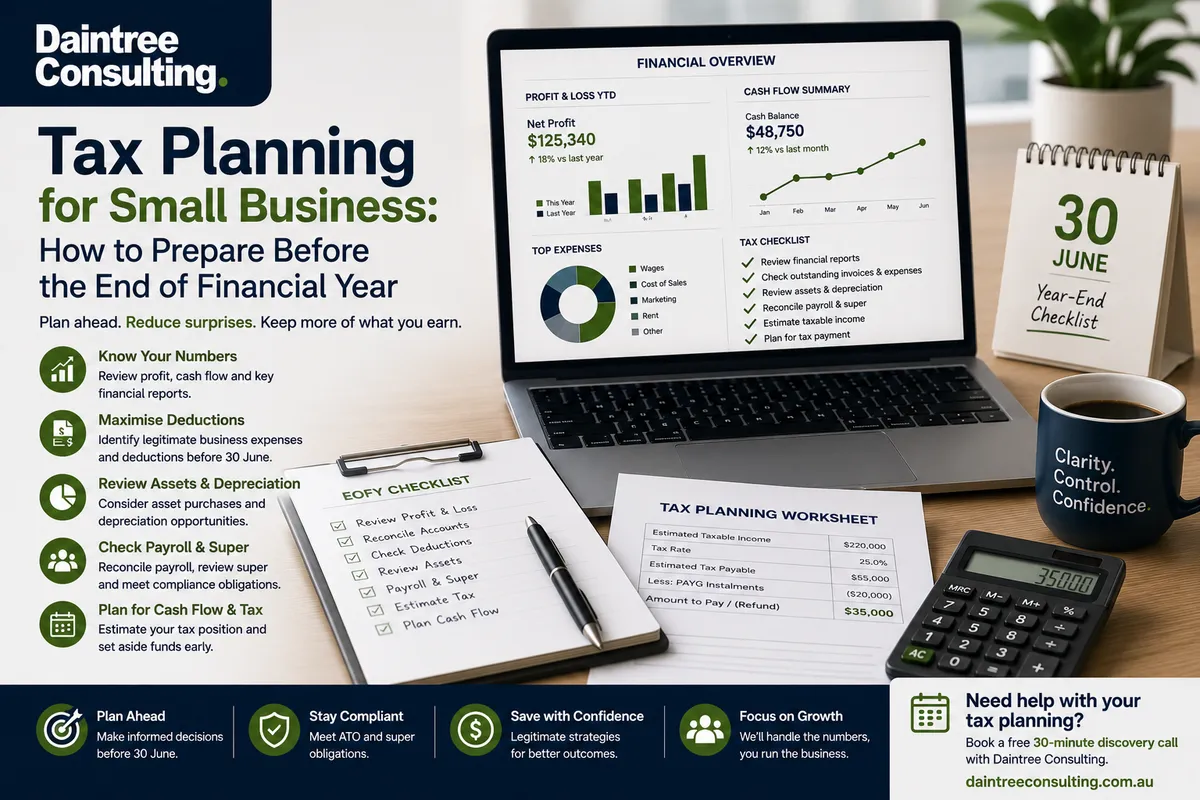
Tax Planning for Small Business: How to Prepare Before the End of Financial Year
For many Australian business owners, tax planning happens too late.
The financial year is almost over, the accountant asks for reports, expenses are being gathered, and suddenly there is pressure to work out how much tax the business may owe.
Want expert help? Daintree Consulting's tax and BAS services can take this off your plate. Book a free consultation.
A better approach is to start earlier.
Small business tax planning is not simply about finding deductions or trying to reduce the tax bill. It is about understanding your expected taxable position, checking that your records are accurate, identifying legitimate planning opportunities, managing cash flow and making informed decisions before the financial year closes.
For Australian businesses, the end of the financial year is an important checkpoint. It gives you an opportunity to review performance, clean up your records and speak with your accountant or tax adviser before decisions become difficult to change.
This guide explains how to prepare.
Quick Answer:
Small business tax planning should ideally begin well before 30 June. Review your profit, reconcile accounts, check outstanding invoices and expenses, review assets and depreciation, consider stock and bad debts where relevant, check payroll and super obligations, review business structure and distributions where applicable, and estimate your potential tax position. Most importantly, make sure any planning decision is commercially sensible and supported by accurate records.
Why Small Business Tax Planning Matters
Tax is a cost of doing business, but it should not be an unexpected cost.
If you wait until your tax return is being prepared, you may discover that:
taxable income is higher than expected
cash reserves are not sufficient for the upcoming liability
records are incomplete
business expenses have been incorrectly classified
reconciliations have not been completed
asset purchases have not been reviewed correctly
outstanding debts have affected your cash position
BAS or PAYG information does not align with your accounting records
important planning opportunities have already passed.
Good tax planning creates visibility before the deadline.
It allows you to ask better questions:
How profitable is the business likely to be?
What tax position are we heading towards?
What cash will we need to set aside?
Are there legitimate deductions or concessions that may apply?
Are we making business decisions for commercial reasons, or simply reacting to tax?
That last question is particularly important.
A tax deduction should not be the reason you spend money your business does not need to spend.
When Should You Start Small Business Tax Planning?
Ideally, tax planning should happen throughout the year rather than only in June.
However, a more detailed review before the end of the financial year can help you make decisions while there is still time to act.
A practical timeline might look like this:
3–6 months before year end
Review:
year-to-date profit
revenue trends
operating expenses
cash flow
outstanding receivables
major upcoming purchases
payroll costs
business structure
expected tax liabilities.
1–3 months before year end
Start identifying:
potential deductible expenses
asset purchases that may require tax treatment
bad or doubtful debts
stock considerations
outstanding invoices
prepaid expenses
employee-related costs
tax and super obligations
significant transactions requiring professional review.
Final weeks before 30 June
Complete a final review of:
bookkeeping
bank reconciliations
credit cards
accounts receivable
accounts payable
payroll
GST/BAS records
asset registers
loans
director or owner transactions
supporting documentation.
The exact treatment of an expense, asset or transaction depends on the circumstances and the tax rules applying to that financial year.
1. Start With an Accurate Profit Estimate
One of the most important parts of tax planning is understanding where the business is likely to finish the financial year.
Your accounting profit is not necessarily the same as taxable income.
Tax treatment can differ depending on the type of income, expense, asset, entity and transaction involved.
That means the first step is not:
"How can I reduce my tax?"
It is:
"What is my likely tax position?"
Start with your latest management accounts or financial reports and review:
revenue
gross profit
operating expenses
wages
rent
professional fees
finance costs
depreciation
interest
motor vehicle costs
software subscriptions
marketing
insurance
other significant expenses.
Then compare your current position with:
the previous financial year
your budget
your forecast
the same period last year.
This can reveal whether your business is tracking materially above or below expectations.
Daintree's accounting service focuses on reconciled records, management reporting, budget-to-actual analysis and cash-flow visibility—information that can make tax planning considerably more useful.
2. Reconcile Your Accounts Before Making Tax Decisions
Tax planning based on unreliable bookkeeping can create more problems than it solves.
Before making significant decisions, check that your financial records are up to date.
This includes reviewing:
Bank accounts
Make sure transactions have been recorded and bank accounts reconciled.
Credit cards
Check that business purchases are correctly recorded and supported.
Accounts receivable
Review outstanding customer invoices and determine whether they are genuinely collectible.
Accounts payable
Check supplier invoices and outstanding obligations.
Payroll
Make sure payroll records and related accounting entries are complete.
GST and BAS records
Check that GST-related transactions have been correctly recorded and that accounting records align with your BAS information.
The ATO emphasises the importance of accurate records, regular reconciliation and sufficient evidence to substantiate business expenses. It also warns businesses against using estimates where complete and accurate records are available.
This is why bookkeeping is part of tax planning.
If the underlying numbers are wrong, the tax planning built on those numbers can also be wrong.
3. Review Your Business Expenses
A year-end review should identify expenses that have been incurred but may not yet be properly reflected in your accounting records.
Depending on your circumstances, this could include:
professional fees
software subscriptions
insurance
advertising
rent
utilities
business travel
repairs and maintenance
employee-related expenses
interest and finance costs
other ordinary business operating costs.
However, an expense is not automatically deductible simply because it is paid before 30 June.
The tax treatment depends on factors such as the nature of the expense, how it relates to earning assessable income, whether it is capital or revenue in nature, and the accounting and tax rules applying to the business.
The ATO notes that operating expenses and capital expenses can receive different tax treatment, with some capital expenditure potentially being dealt with through depreciation or specific tax incentives.
So rather than asking:
"What can I buy before 30 June?"
Ask:
"What legitimate business expenditure is actually required, and what is its appropriate tax treatment?"
4. Review Planned Asset Purchases Carefully
Capital expenditure deserves particular attention during tax planning.
A business might be considering:
computers
equipment
vehicles
machinery
furniture
technology
fit-out costs
other business assets.
The tax outcome can depend on:
the type of asset
purchase price
business use
when the asset is first used or installed ready for use
the entity's eligibility
the tax concessions available in the relevant income year.
This is an area where businesses should avoid relying on old "instant asset write-off" advice found online.
Tax concessions and thresholds can change between financial years. For example, the ATO's published guidance confirms that the $20,000 instant asset write-off measure applied to eligible small businesses for the 2024–25 income year, illustrating why the applicable rules need to be checked for the specific year rather than assumed to continue unchanged.
The right approach is to discuss significant purchases with your accountant or tax adviser before committing to the transaction, particularly when the purchase is being considered primarily for tax reasons.
5. Look at Outstanding Customer Debts
Outstanding invoices can create an interesting year-end issue.
Your accounting records may show strong revenue while your bank account tells a very different story.
Review your accounts receivable and identify:
invoices that are current
overdue invoices
customers experiencing financial difficulty
debts that may no longer be recoverable
disputes that could affect collection
significant balances requiring follow-up.
Do not simply write off an invoice because it is overdue.
Whether a bad debt can be treated in a particular way depends on the circumstances and applicable tax and GST rules.
Your year-end review should therefore distinguish between:
money customers owe you
and
money you realistically expect to collect.
This is both a tax consideration and a cash-flow consideration.
6. Review Stock and Inventory
If your business holds trading stock, year-end planning should include an appropriate review of inventory.
Consider:
what stock is actually on hand
whether records agree with physical stock
damaged or obsolete inventory
slow-moving items
stock movements around year end
whether inventory records are complete.
Accurate stock information can affect both your financial reporting and tax calculations.
It can also reveal a broader business problem.
If a large amount of cash is tied up in inventory that is not selling, the issue may not be tax at all—it may be working capital management.
This is one reason effective tax planning should be connected to broader financial planning rather than treated as a once-a-year compliance exercise.
7. Review Payroll, Super and Employee-Related Obligations
Payroll should also form part of your year-end financial review.
Check that:
payroll records are complete
wages are correctly recorded
leave balances are appropriately maintained
payroll liabilities are reconciled
superannuation obligations have been reviewed
PAYG withholding records align with accounting records
employee-related expenses have been correctly classified.
Payroll errors can create tax, compliance and cash-flow problems.
If your bookkeeping and payroll systems are disconnected, year-end can also become significantly more difficult.
A connected bookkeeping and payroll process can make it easier to identify discrepancies before they become larger problems.
8. Review Your Business Structure
Your business structure can influence how income is taxed and how money moves through the business.
Depending on your circumstances, you may operate through a:
sole trader structure
partnership
company
trust
other structure.
A year-end planning discussion may therefore be an opportunity to ask whether your current structure remains appropriate for your business.
This does not mean restructuring simply to reduce tax.
A structure should also be considered in the context of:
commercial objectives
asset protection
ownership
succession
financing
administration
compliance
future growth
distribution of profits.
Structural changes can have significant tax and legal consequences, so they should be assessed before implementation.
9. Consider Cash Flow, Not Just Tax
This is one of the most important principles of small business tax planning.
Saving $1 in tax is not the same as creating $1 of profit.
For example, spending money purely to obtain a deduction may reduce taxable income, but the business has still spent cash.
This is why tax planning should sit alongside cash-flow planning.
Before making a significant year-end decision, ask:
Is the expenditure genuinely required?
Does it support business operations?
Can the business comfortably afford it?
What is the expected commercial return?
What is the actual tax treatment?
Will the purchase create future costs?
Does it fit the broader business strategy?
The ATO has highlighted cash-flow management as an important issue for small businesses, particularly when businesses are experiencing financial pressure.
A good tax strategy should therefore support the financial health of the business—not undermine it.
10. Estimate Your Potential Tax Liability
Once your financial information has been reviewed, prepare an estimate of your likely tax position.
This can help answer:
How much should we reserve for tax?
That number may be particularly important for businesses experiencing strong growth.
A business can be profitable while still experiencing cash-flow pressure.
For example, the business may have:
growing revenue
increasing receivables
expanding payroll
new equipment purchases
loan repayments
GST obligations
PAYG instalments
an upcoming income tax liability.
Without forward planning, the business can appear healthy until several obligations arrive at the same time.
An estimated tax position can help management plan cash requirements earlier.
11. Don't Forget the Difference Between Accounting and Tax
One common mistake is assuming that the profit shown in your accounting reports is automatically the amount used to calculate tax.
It isn't necessarily that simple.
Tax calculations may require adjustments for items such as:
depreciation
non-deductible expenses
private-use portions
capital expenditure
timing differences
tax-specific concessions
other adjustments relevant to the entity.
This is why a strong bookkeeping and accounting system is valuable.
The objective is not simply to produce a profit-and-loss statement.
It is to create reliable financial information that can then be properly considered for tax purposes.
12. Keep the Documentation to Support Your Position
Tax planning should always be supported by records.
The ATO states that businesses need sufficient records to substantiate expenses and other information included in their tax and BAS reporting. It also provides specific record-keeping guidance for businesses.
Depending on the transaction, supporting documentation may include:
invoices
receipts
contracts
bank statements
loan documents
asset purchase records
stock records
payroll records
expense calculations
business-use calculations
relevant correspondence.
Do not wait until tax return preparation to discover that supporting documentation is missing.
Good tax planning is much easier when good records already exist.
13. Avoid the "Spend More to Pay Less Tax" Trap
This is one of the biggest misconceptions around year-end tax planning.
Suppose your business spends $10,000 solely because you believe it will reduce your tax.
You have still spent $10,000.
The tax saving is only a portion of that amount, assuming the expenditure is deductible.
That means the business could actually be worse off if the purchase was unnecessary.
A better approach is:
Buy what the business needs. Understand the tax treatment. Make the decision based on commercial value.
Tax benefits should be considered as part of the decision—not the entire reason for making it.
A Practical Small Business Tax Planning Checklist
Before the end of the financial year, work through this checklist.
Financial position
Review year-to-date revenue.
Review gross and net profit.
Compare actual results with budget.
Update your forecast.
Review cash flow.
Estimate your potential tax position.
Bookkeeping
Reconcile bank accounts.
Reconcile credit cards.
Review accounts receivable.
Review accounts payable.
Check loan balances.
Review unusual or large transactions.
Investigate unreconciled items.
Expenses
Review major business expenses.
Check that expenses are correctly classified.
Identify missing invoices and receipts.
Review business/private-use allocations.
Identify capital expenditure.
Discuss significant purchases with your tax adviser.
Assets
Review your asset register.
Identify assets purchased during the year.
Check when assets were first used or installed ready for use.
Review depreciation and applicable tax treatment.
Payroll
Reconcile payroll.
Review employee-related liabilities.
Check superannuation obligations.
Check PAYG withholding records.
Resolve discrepancies.
Tax and compliance
Review BAS information.
Check PAYG instalments.
Review GST records.
Consider upcoming tax liabilities.
Check whether any ATO correspondence requires attention.
Planning
Consider upcoming investments.
Review business structure where appropriate.
Review owner/director transactions.
Consider cash reserves.
Discuss significant transactions with your accountant or tax adviser.
What Should You Ask Your Accountant Before 30 June?
A productive tax planning meeting should go beyond:
"How much tax will I have to pay?"
Consider asking:
1. What is our expected taxable position?
Ask your accountant to explain the major factors affecting the estimate.
2. Are there legitimate deductions or concessions we should consider?
The answer depends on your entity, circumstances and the rules applying to the relevant financial year.
3. Are there transactions we should complete before year end?
This might involve planned expenditure, asset purchases, debt management or other commercial decisions.
4. Are our records complete?
Ask whether your bookkeeping is sufficiently accurate for year-end tax preparation.
5. How much cash should we reserve?
Tax planning should connect directly to your cash-flow forecast.
6. Are there any risks we should address now?
This could include missing records, unusual transactions, outstanding obligations or structural issues.
7. What should we change next financial year?
The best tax planning process does not stop on 30 June.
It should improve how the business operates throughout the next year.
Why Tax Planning Shouldn't Be a Once-a-Year Exercise
The strongest businesses do not wait until the final weeks of the financial year to look at their financial position.
They monitor:
profitability
cash flow
tax obligations
payroll
expenses
business performance
forecasts
working capital.
That means year-end tax planning becomes a confirmation and adjustment process, rather than an emergency.
Monthly or quarterly financial reporting can give business owners much earlier visibility of trends.
Daintree's accounting services include management accounts, reconciliations, budget-to-actual reporting and cash-flow reporting, helping businesses build more reliable financial information throughout the year.
When Should You Get Professional Tax Planning Support?
Professional support can be particularly valuable when:
profits have increased significantly
the business is growing quickly
you are considering major asset purchases
the business structure is changing
cash flow is becoming difficult to predict
there are multiple entities
bookkeeping is behind
records are inconsistent
you have significant outstanding receivables
you are unsure about the tax treatment of a transaction
you want better visibility of upcoming tax liabilities.
Daintree Consulting provides taxation and BAS support including year-end tax planning discussions, BAS preparation and lodgement support, GST and PAYG-related compliance support, ATO correspondence support within scope, and coordination with bookkeeping and accounting services.
The goal is not to promise an artificially low tax bill.
It is to create accurate compliance, better preparation and fewer surprises.
Final Thoughts: Plan Before the Deadline, Not After It
Effective small business tax planning is about more than reducing tax.
It is about knowing where your business stands before the financial year ends.
Start with accurate bookkeeping. Review profitability. Reconcile your accounts. Check expenses and assets. Review payroll and outstanding debts. Consider cash flow. Estimate your tax position. Then discuss legitimate planning opportunities with your accountant or tax adviser.
Most importantly, don't make financial decisions purely because of a perceived tax benefit.
A strong tax decision should make sense for the business as a whole.
The earlier you start, the more options you have.
If your business needs clearer financial records, tax preparation or year-end planning support, Daintree Consulting can help connect the numbers, obligations and decisions into a practical plan.
Book a free 30-minute discovery call with Daintree Consulting to discuss your current financial position and identify the right next step.
Frequently Asked Questions
What is small business tax planning?
Small business tax planning is the process of reviewing a business's expected financial and taxable position before the end of the financial year and considering legitimate ways to manage tax, cash flow, deductions, assets and other relevant obligations.
When should a small business start tax planning?
Ideally, tax planning should happen throughout the year, with a more detailed review several months before the end of the financial year.
Does tax planning mean paying less tax?
Not necessarily. The objective should be accurate and lawful tax management based on the business's circumstances. Daintree specifically states that it does not guarantee a lower tax bill; planning is based on accurate compliance and the client's circumstances.
Should I buy equipment before the end of the financial year for a tax deduction?
Not automatically. The tax treatment depends on the asset, its cost, business use, when it is first used or installed ready for use, the entity and the rules applying for that income year.
What records should a small business keep?
Businesses should maintain sufficient records to support their income, expenses and other tax-related information. The ATO recommends accurate records and evidence to substantiate deductions and other information reported.
Can my bookkeeper help with tax planning?
A bookkeeper can provide important financial records and bookkeeping support, but tax planning and tax advice should be handled within the appropriate professional scope. A connected bookkeeping, accounting and tax process can make year-end preparation more efficient.
Can tax planning improve cash flow?
Yes. Understanding your likely tax liabilities earlier can help you plan cash reserves and avoid unexpected financial pressure. However, tax planning should be considered alongside broader cash-flow and business planning.
Is tax planning only for large businesses?
No. Small businesses can benefit from understanding their financial position and upcoming tax obligations well before year end. The level of planning should match the size, structure and complexity of the business.
Important Note
Tax rules, deductions, concessions, thresholds, reporting requirements and eligibility criteria can change between financial years. This article intentionally avoids presenting specific deduction thresholds or concessions as permanent rules. Before publishing or updating this article, Daintree Consulting should verify any year-specific tax information against current ATO guidance and the applicable legislation for the relevant financial year. The ATO's current published material demonstrates that tax measures and thresholds can change over time.
This article provides general information only and should not be treated as individual tax, legal or financial advice. Businesses should obtain advice appropriate to their entity structure, circumstances and transactions. Daintree's taxation service includes year-end tax planning discussions as part of its broader taxation and BAS support.
Talk to Daintree about your tax and BAS
Our ex-Big 4 team gives clear, senior-reviewed advice so you can act with confidence.
Book a free consultation →
Or explore our tax and BAS services.
