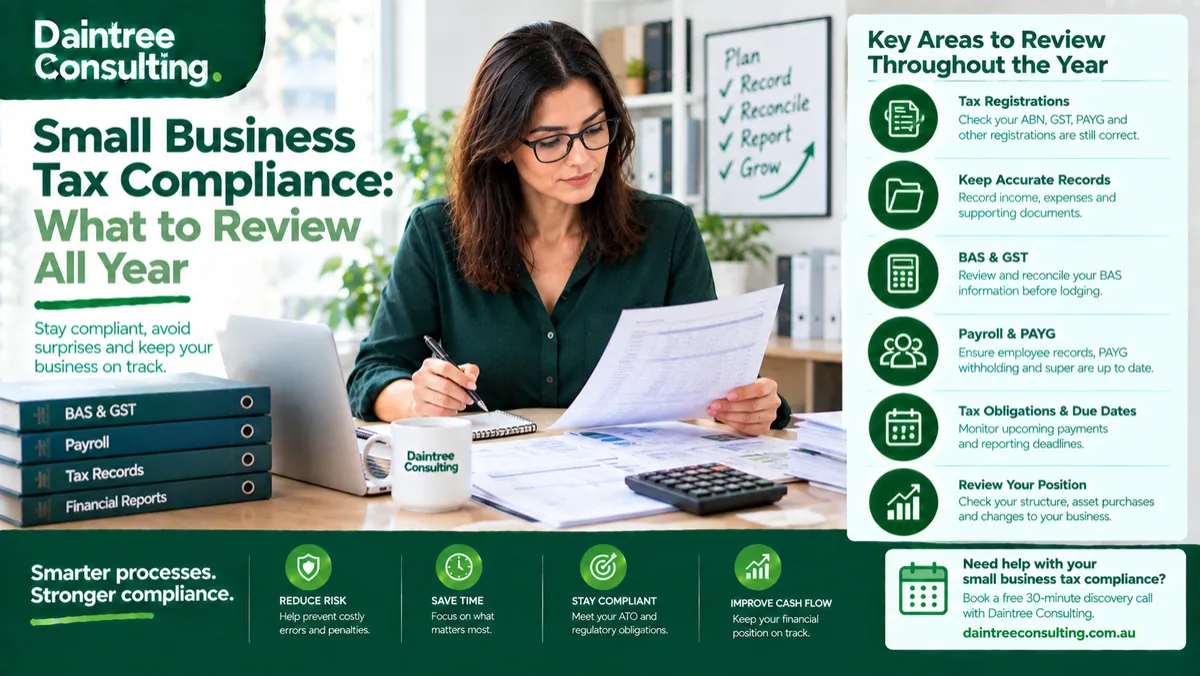
Tax Compliance for Small Business: What Should You Review Throughout the Year?
Tax compliance for a small business is not something that should only be addressed when the financial year ends.
Australian businesses can have several tax and reporting obligations throughout the year, depending on their structure, turnover, employees, registrations and activities. These may include income tax, GST, BAS, PAYG withholding, PAYG instalments, fringe benefits tax, payroll tax and other obligations.
Want expert help? Daintree Consulting's tax and BAS services can take this off your plate. Book a free consultation.
That means good small business tax compliance is largely about having the right information, processes and review points in place throughout the year.
Leaving everything until tax time can make it harder to identify errors, missing records, cash-flow pressure or changes in the business that may affect its tax obligations.
A better approach is to build tax compliance into the normal financial management routine of the business.
What is small business tax compliance?
Small business tax compliance means meeting the tax-related obligations that apply to your business and maintaining the records needed to support them.
Depending on your circumstances, this can involve:
Registering for the taxes that apply to your business
Keeping accurate financial and tax records
Recording business income and expenses
Reconciling financial records
Preparing and lodging BAS where required
Managing GST records and transactions
Managing PAYG withholding
Making PAYG instalment payments where applicable
Preparing annual income tax returns
Managing fringe benefits tax where applicable
Monitoring payroll tax obligations where applicable
Keeping supporting documentation for deductions and transactions
Paying tax liabilities by the relevant due dates
Not every business will have all of these obligations.
Your business structure, registrations, activities, employees and other circumstances determine which requirements apply.
The important point is that compliance should be treated as an ongoing financial process rather than a once-a-year exercise.
Why should you review tax compliance throughout the year?
Waiting until the end of the financial year can create unnecessary pressure.
Financial records may need to be reconstructed, transactions investigated and missing documents located. If an issue is discovered late, there may also be less time to address it.
Regular reviews can help you identify problems earlier.
They can also help you understand whether the business's tax obligations have changed as the business itself changes.
For example, a business might:
Start employing staff
Change its business structure
Register for GST
Increase its turnover
Purchase significant assets
Begin providing different products or services
Pay contractors
Provide employee benefits
Expand into another state or territory
Sell business assets
Take on new financing
Change its accounting or payroll systems
Each change can create accounting, tax or record-keeping considerations.
1. Review your tax registrations
One of the first things to review is whether your business is registered for the taxes and obligations that actually apply to it.
Most businesses need a TFN, and most need an ABN, while registrations such as GST and PAYG withholding depend on the business's circumstances. Some businesses may also have obligations relating to FBT, payroll tax or other taxes.
This is particularly important when your business changes.
For example, hiring employees can create PAYG withholding obligations. Growing payroll can also make state or territory payroll tax relevant once the applicable threshold is reached.
A business should therefore periodically ask:
Are our registrations still correct?
Have our activities changed?
Have we started employing people?
Has our turnover changed significantly?
Are we registered for GST where required?
Are there any new state or territory obligations?
Are we still registered for anything we no longer need?
The answer may not always require a change, but the review itself is valuable.
2. Keep your bookkeeping up to date
Accurate bookkeeping is one of the foundations of small business tax compliance.
You cannot reliably calculate or report tax obligations if the underlying financial information is incomplete.
Business records generally need to cover transactions relating to tax, superannuation and registrations. Examples include income and sales, business expenses, bank records, GST records where relevant, asset and stock records, and employee or contractor records.
Regular bookkeeping can therefore help you identify:
Missing transactions
Incorrectly classified expenses
Duplicate transactions
Unrecorded income
Unusual expenses
Missing invoices
Unreconciled bank transactions
Incorrect GST treatment
The longer these issues remain unresolved, the more difficult they can become to investigate.
3. Reconcile your bank accounts regularly
Bank reconciliation should be part of your normal financial process.
The purpose is not simply to make the accounting software balance with the bank.
Reconciliation helps confirm that recorded transactions correspond with what actually happened through the business bank account.
This can reveal:
Missing transactions
Duplicate entries
Incorrect amounts
Unpresented payments
Unidentified deposits
Bank fees that have not been recorded
Transactions posted to the wrong account
Regular reconciliation also helps create a more reliable starting point for BAS preparation and other financial reporting.
Good record keeping can help businesses meet tax obligations while also supporting cash-flow management and better financial decisions.
4. Review GST and BAS information
If your business is registered for GST and needs to lodge BAS, GST should not be treated as something to calculate at the last minute.
A BAS can include GST, PAYG withholding, PAYG instalments and other taxes depending on the business's circumstances.
Before lodging a BAS, the business should have processes for checking that the figures agree with its accounting records.
This can include reviewing:
Sales
Purchases
GST collected
GST credits
Adjustments
Payroll-related information
PAYG withholding
PAYG instalments where applicable
The relevant reporting period
Business.gov.au recommends reconciling BAS figures with your records and checking that purchases and sales have been reported in the correct period.
A regular review process can make BAS preparation much less disruptive.
5. Check your PAYG withholding processes
If you employ people, PAYG withholding is another area that should be monitored throughout the year.
Employers generally need to withhold tax from employee payments and certain other payments where the rules require withholding. The withheld amounts then need to be reported and paid to the ATO according to the applicable reporting cycle.
Your business should periodically check that:
Employee details are current
Payroll information is accurate
PAYG withholding is being calculated correctly
Payroll records agree with the accounting system
PAYG amounts are being reported correctly
Payments to the ATO are being made when required
Single Touch Payroll processes are operating appropriately
Payroll is closely connected to tax compliance, so errors in payroll administration can create problems beyond simply paying employees the wrong amount.
6. Monitor PAYG instalments
PAYG instalments are designed to help businesses pay income tax progressively rather than facing one large tax bill after the annual tax return.
They are generally paid periodically, often quarterly, when the business is within the PAYG instalment system.
Business performance can change significantly during a financial year.
If revenue or profit increases or decreases substantially, it may be appropriate to discuss the PAYG instalment position with your tax professional.
However, businesses should be careful about changing instalment amounts without appropriate advice. Business.gov.au notes that varying instalments too low can potentially result in interest and penalties.
This is why PAYG instalments should be reviewed as part of broader financial planning rather than treated as an isolated payment.
7. Review business expenses and supporting records
Tax compliance is not just about paying tax.
It is also about being able to support the information included in your tax returns and reports.
Throughout the year, businesses should maintain records supporting relevant expenses and other transactions.
This can include:
Supplier invoices
Receipts
Contracts
Asset purchase documents
Business-use records
Vehicle records where relevant
Loan documentation
Bank statements
Employee-related records
GST documentation
Good records make it easier to substantiate information reported to the ATO. Business.gov.au states that businesses must keep records of transactions related to their tax affairs, including records supporting information included in tax returns and reports.
The record-keeping period can also vary depending on the type of record. Most business records generally need to be kept for five years, while some records need to be retained longer.
8. Review large purchases and asset transactions
Large purchases should not simply disappear into the bookkeeping system as another expense.
The tax treatment of an asset can depend on what was purchased, how it is used, the business structure and the circumstances surrounding the transaction.
Throughout the year, maintain records of:
Equipment purchases
Vehicles
Business property
Technology
Significant improvements
Assets sold or disposed of
Finance associated with asset purchases
At the end of the financial year, these records can also be important when considering depreciation and capital gains tax consequences.
Business.gov.au's EOFY guidance specifically recommends keeping records of assets bought or sold and expenditure used to improve them because these records may be needed when calculating depreciation deductions and capital gains tax.
Rather than trying to reconstruct these details at year-end, record them when the transaction occurs.
9. Check whether employee benefits create additional obligations
Providing benefits to employees can create additional tax considerations.
Fringe benefits tax, for example, can apply to certain benefits provided to employees, their families or associates.
Examples can include:
Cars provided for private use
Certain employee loans
Discounts
Reimbursements of private expenses
Other qualifying benefits
Not every employee benefit will necessarily result in an FBT obligation, so the circumstances need to be considered.
The important point for small businesses is to identify potentially relevant benefits during the year rather than discovering them when the FBT return is due.
Business.gov.au identifies FBT as one of the taxes that may apply depending on a business's circumstances.
10. Monitor changes in your business structure
Your business structure can affect your tax obligations.
A sole trader, partnership, company and trust do not necessarily have the same tax reporting requirements.
For example, a sole trader includes business income in their individual tax return, while a company is a separate legal entity and lodges its own company tax return. Partnerships and trusts also have their own reporting requirements.
If your business is considering restructuring, bringing in new owners or changing how it operates, tax implications should be considered before the change is implemented.
A structure review can be particularly important when:
The business is growing rapidly
New owners are joining
Assets are being transferred
The business is being sold
A company or trust structure is being considered
Related entities are being established
These decisions can have consequences that extend beyond the immediate tax return.
11. Keep track of tax and reporting due dates
Tax compliance also depends on timing.
A business may have several different reporting and payment dates throughout the year.
These can include:
BAS
Income tax
PAYG withholding
PAYG instalments
FBT
Superannuation
Payroll tax
Other reports that apply to the business
The applicable frequency and due date depend on the business and its obligations.
Business.gov.au recommends keeping track of important financial dates, including tax returns, BAS and other payments, to help avoid missed obligations and potential penalties.
Rather than relying on memory, businesses should maintain a compliance calendar.
This can be as simple as a shared calendar with reminders or part of a broader finance-management system.
12. Review your tax position before EOFY
Year-round compliance does not mean ignoring the end of the financial year.
It means reaching EOFY with fewer unresolved issues.
Before 30 June, businesses can review:
Year-to-date revenue
Profitability
Outstanding debtors
Outstanding creditors
Major asset purchases
Stock where relevant
Employee-related obligations
Tax payments already made
PAYG instalments
GST position
Potential deductions
Capital transactions
Changes to the business structure
Business.gov.au's EOFY guidance recommends having accurate and up-to-date records ready, reviewing debtors and creditors, and keeping records of assets bought or sold.
This can make the eventual tax return process more efficient.
13. Review your cash position alongside your tax obligations
Tax compliance and cash-flow management should not be treated as completely separate issues.
A business can be profitable but still experience cash-flow pressure when tax payments become due.
For example, a business may collect revenue throughout the year without setting enough money aside for GST, PAYG, income tax or other obligations.
Regular financial reviews can help management understand:
What tax liabilities are approaching
How much cash is available
What customers owe the business
What supplier payments are due
What tax payments have already been made
Whether cash reserves are sufficient
This is one reason accurate bookkeeping and regular financial reporting are so important.
A practical small business tax compliance checklist
A simple year-round review can include the following.
Monthly
Reconcile bank and credit-card accounts
Review bookkeeping for unusual or missing transactions
Check payroll records
Review outstanding invoices
Check upcoming tax and payment obligations
Maintain supporting documentation
Quarterly
Review BAS information where applicable
Reconcile GST-related records
Review PAYG withholding
Check PAYG instalments where applicable
Review business performance and cash flow
Update forecasts if business conditions have changed
Periodically
Review tax registrations
Review business structure
Check employee and contractor arrangements
Review significant asset purchases and disposals
Consider whether FBT or payroll tax obligations have changed
Review record-keeping processes
Before EOFY
Finalise bookkeeping
Review debtors and creditors
Check major asset transactions
Review business expenses and supporting records
Review tax payments and instalments
Prepare information required by your accountant or tax agent
Consider tax-planning opportunities with appropriate professional advice
The exact checklist will depend on your business.
What happens if tax compliance is left until tax time?
One of the biggest problems with a reactive approach is that small issues can become larger administrative problems.
A missing invoice might be easy to resolve when the transaction is recent.
Months later, it may be difficult to remember what the expense related to or where the supporting document went.
Similarly, an unreconciled transaction may be straightforward to investigate when it appears in the current month but much harder to trace after several months of accumulated bookkeeping.
A reactive approach can also make it harder for business owners to understand their financial position.
Instead of receiving regular information, they may only discover issues when preparing BAS, tax returns or year-end accounts.
That is why small business tax compliance should be built into the normal accounting process.
How an accountant can help with small business tax compliance
Tax compliance can become increasingly complex as a business grows.
An accountant can help a business understand its obligations, maintain appropriate processes and prepare relevant tax and reporting work.
Depending on the engagement, this may include:
Business tax returns
BAS preparation and lodgement
GST support
PAYG-related support
Tax planning
ATO correspondence
Record-keeping guidance
Financial reporting
Compliance reviews
Advice when the business structure or circumstances change
The role is not necessarily to take every financial responsibility away from the business owner.
Instead, professional support can help ensure that the business has the right information and processes to manage its obligations more effectively.
How Daintree Consulting can help
Daintree Consulting provides taxation and BAS support for Australian businesses that need accurate records, clear responsibilities and practical communication around their financial obligations.
Support can include BAS preparation and lodgement, business tax returns, GST and PAYG-related support, tax planning, record reviews and assistance with ATO correspondence.
Good tax compliance starts with good financial information.
If your business bookkeeping is regularly behind, BAS preparation is stressful or you are unsure whether your current processes are keeping up with the business, it may be time to review how your accounting and tax processes work together.
Book a free 30-minute discovery call with Daintree Consulting to discuss your current accounting and tax compliance processes.
Frequently Asked Questions
What is small business tax compliance?
Small business tax compliance means meeting the tax and reporting obligations that apply to your business and maintaining accurate records to support those obligations. The requirements depend on factors such as business structure, registrations, employees, turnover and business activities.
How often should a small business review its tax compliance?
Tax compliance should be reviewed throughout the year rather than only at EOFY. Monthly bookkeeping and reconciliation, regular BAS reviews where applicable, periodic checks of tax registrations and a more detailed EOFY review can help keep obligations organised.
What tax obligations might a small business have?
Depending on its circumstances, a business may have obligations relating to income tax, GST, BAS, PAYG withholding, PAYG instalments, FBT, payroll tax and other taxes or reports.
How long do Australian businesses need to keep tax records?
Most business records generally need to be kept for five years, although some records need to be retained for longer. The required period depends on the type of record and the relevant obligation.
Does every small business need to lodge a BAS?
Not necessarily. BAS obligations depend on the business's registrations and circumstances. Businesses registered for GST generally need to lodge BAS, while BAS may also be used to report other obligations such as PAYG withholding or PAYG instalments.
Can an accountant help with small business tax compliance?
Yes. Depending on the engagement, an accountant can help with tax returns, BAS, GST, PAYG, tax planning, record reviews and other tax-related processes. If you use a tax agent, check that they are registered with the Tax Practitioners Board.
Final takeaway
Small business tax compliance is easier to manage when it is treated as an ongoing process rather than an annual scramble.
Regular bookkeeping, bank reconciliation, BAS reviews, payroll checks, record keeping, tax-date monitoring and periodic reviews of your business circumstances can help keep financial information organised throughout the year.
The goal is not simply to lodge tax returns on time.
It is to build financial processes that give you reliable information, reduce avoidable administrative problems and help you identify changes before they become bigger issues.
For Australian small businesses, good tax compliance starts well before tax time.
Important Publishing Note: Tax, GST, BAS, PAYG, FBT, payroll tax, record-keeping and reporting requirements can vary according to the business structure, registrations, activities, employees and circumstances. Requirements and ATO guidance can also change. This article provides general information only and should not be treated as personal tax or financial advice. Daintree Consulting should confirm current requirements and its service scope before publication.
Talk to Daintree about your tax and BAS
Our ex-Big 4 team gives clear, senior-reviewed advice so you can act with confidence.
Book a free consultation →
Or explore our tax and BAS services.
