What Is Scenario Planning and How Can It Help Business Owners Make Better Decisions?
Business planning often starts with a simple question:
What do we expect to happen?
Want expert help? Daintree Consulting's business advisory services can take this off your plate. Book a free consultation.
But for a growing business, that is only part of the question.
What happens if sales grow faster than expected?
What if a major customer leaves?
What if supplier costs increase?
What if hiring takes longer than planned?
What if cash flow becomes tighter while the business is investing in growth?
These situations are difficult to manage when the business has only one plan.
This is where scenario planning for business can help.
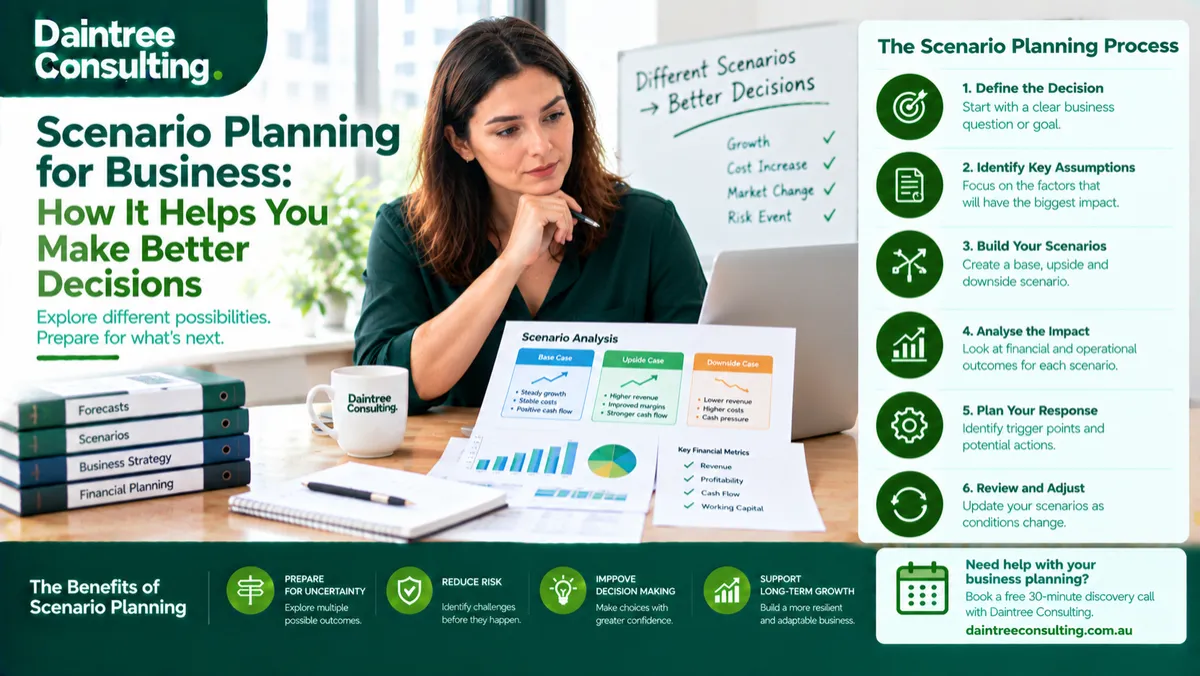
Scenario planning allows business owners to explore different possible outcomes before they happen. Instead of relying on one set of assumptions, you can consider several plausible situations and examine what each one could mean for revenue, costs, cash flow, staffing, funding and business performance.
It does not predict the future.
Instead, it helps you prepare for more than one version of it.
For Australian business owners, scenario planning can be particularly useful when making decisions involving growth, investment, staffing, financing, pricing, expansion or significant changes in operating conditions.
Business.gov.au recommends that businesses identify and assess risks, consider possible changes in their environment and develop plans for managing those risks.
Quick answer: What is scenario planning for business?
Scenario planning for business is a structured process of modelling different possible future situations so management can understand how each situation could affect the business.
A basic scenario plan might include:
a base case based on current expectations
an upside case where key assumptions perform better than expected
a downside case where important assumptions weaken
the financial impact of each scenario
the actions the business could take under each scenario.
For example, a business planning to hire five employees could model what happens if revenue grows as expected, grows more slowly or increases significantly faster.
The purpose is not to decide which scenario will definitely happen.
The purpose is to understand what the business may need to do if circumstances change.
Why does scenario planning matter?
Running a business involves uncertainty.
You may have a detailed budget, a strong sales pipeline and a clear growth strategy, but some factors remain outside your control.
These can include:
customer demand
economic conditions
supplier pricing
interest rates
staff availability
customer payment behaviour
competitor activity
technology changes
regulatory changes
unexpected expenses
loss of a major customer
delays in projects or contracts.
Business.gov.au identifies economic conditions, regulatory changes, staffing issues, technology problems, loss of customers and other unexpected events as examples of risks that can affect businesses.
A single budget cannot show management how the business might respond to every possible change.
Scenario planning creates a framework for asking:
"If this happens, what would it mean for us?"
That can make important decisions more deliberate rather than reactive.
Scenario planning vs forecasting: what's the difference?
Scenario planning and financial forecasting are related, but they are not the same thing.
A forecast generally represents management's current view of what is likely to happen based on available information and assumptions.
Scenario planning goes further by asking what could happen under different sets of assumptions.
For example, a forecast might assume:
revenue grows 10%
gross margin remains stable
wages increase by 5%
overheads remain broadly unchanged.
Scenario planning could then test:
Base scenario
Revenue grows 10% and costs remain broadly in line with expectations.
Downside scenario
Revenue grows only 3%, margins fall and debtor collections slow.
Upside scenario
Revenue grows 18%, but additional employees and working capital are required sooner than expected.
The forecast provides a central planning view.
The scenarios help management understand the range of possible outcomes around it.
Scenario planning is not about predicting the future
One of the most important things to understand about scenario planning is that it is not a prediction exercise.
A scenario is a structured "what if" situation.
For example:
What if revenue falls by 15% for two quarters?
That does not mean management believes revenue will fall by 15%.
It means management wants to understand what the business would look like if that happened.
This distinction matters because forecasts and scenarios rely on assumptions and professional judgement.
A scenario can be useful even if it never happens.
The value comes from helping the business understand its exposure and identify possible responses.
What should a business scenario include?
A useful scenario does not need to contain hundreds of assumptions.
In fact, too much detail can make scenario planning difficult to maintain.
Start with the factors that are most likely to influence the decision.
Depending on the business, these could include:
revenue
sales volume
pricing
gross margin
wages
staffing levels
operating expenses
customer payment timing
supplier payment timing
inventory
capital expenditure
loan repayments
interest costs
tax obligations
cash reserves
external funding.
The right variables depend on what you are trying to understand.
If the scenario is about hiring, staffing costs and expected revenue capacity may be important.
If it is about expansion, capital expenditure, fixed costs, working capital and sales assumptions may matter more.
How to build a scenario plan step by step
Step 1: Start with a clear business decision
Scenario planning works best when it is connected to a real decision.
Instead of asking:
"What could happen to our business?"
ask:
"What do we need to understand before making this decision?"
Examples include:
Should we hire additional staff?
Can we afford to open another location?
Should we purchase new equipment?
How much working capital will growth require?
Can we afford to reduce prices?
Should we take on additional debt?
What happens if our largest customer leaves?
How much cash do we need to maintain during expansion?
A clear question gives the scenario analysis a purpose.
Step 2: Establish your current position
Before modelling possible futures, understand where the business is starting.
Review relevant information such as:
current revenue
gross profit
operating expenses
cash balance
accounts receivable
accounts payable
debt
existing commitments
staffing costs
current sales pipeline
working capital requirements.
This starting point becomes the baseline for the scenarios.
If the underlying accounting information is unreliable, scenario planning can produce misleading results.
Good decision-making therefore starts with good financial information.
ASIC advises company directors to stay informed about their company's financial position and performance and to assess how significant decisions could affect the business.
Step 3: Identify the key assumptions
Next, determine which assumptions could materially change the outcome.
For example, an expansion scenario might depend on:
expected monthly sales
average customer value
gross margin
rent
staffing costs
fit-out costs
marketing expenditure
financing costs
working capital requirements.
You do not need to model every possible variable.
Focus on the assumptions that have the greatest influence on the decision.
Step 4: Build a base scenario
The base scenario should represent your current reasonable expectations.
It might use:
current sales trends
known contracts
expected pricing
current staffing costs
planned investment
existing supplier arrangements
realistic collection timing.
The base scenario is not necessarily the "best" outcome.
It should be a practical planning case based on the information available.
Step 5: Build an upside scenario
The upside scenario explores what happens if some important assumptions perform better than expected.
For example:
stronger sales growth
higher customer retention
better pricing
improved productivity
faster customer payments
lower-than-expected costs.
But there is an important point here.
An upside scenario should still be plausible.
Scenario planning is less useful if the assumptions are simply unrealistic best-case numbers.
Step 6: Build a downside scenario
The downside scenario asks what happens when important assumptions move in the wrong direction.
For example:
revenue growth slows
margins decline
costs increase
customers pay more slowly
a major project is delayed
staffing costs increase
financing becomes more expensive.
The purpose is not to make management pessimistic.
It is to understand the potential pressure points before they become urgent.
Business.gov.au recommends identifying, analysing and evaluating business risks and developing strategies to manage risks that need treatment.
Step 7: Measure the financial impact
Once the scenarios are established, translate them into financial outcomes.
Depending on the decision, look at:
revenue
gross profit
operating profit
cash flow
cash balance
working capital
debt requirements
break-even point
funding requirements.
For example, a business might discover that a proposed expansion remains profitable under the base scenario but creates a significant cash requirement during the first six months.
That is valuable information.
The decision may still be viable, but management now knows that funding and working capital need to be considered.
Step 8: Identify the trigger points
This is one of the most useful parts of scenario planning.
Don't just ask:
"What happens if revenue falls?"
Ask:
"At what point would we need to change our plan?"
For example:
If cash falls below a certain level, review discretionary spending.
If sales remain below target for three months, reassess hiring plans.
If gross margin falls below the planned level, review pricing and supplier costs.
If debtor days increase significantly, strengthen collection processes.
If demand exceeds available capacity, accelerate recruitment or investment.
These trigger points can help management respond earlier.
Step 9: Decide what action each scenario would require
A scenario becomes more useful when it leads to a potential action.
For example:
If sales grow faster than expected
The business may need to:
recruit earlier
increase inventory
secure additional working capital
increase production capacity
review supplier arrangements.
If sales are weaker than expected
Management may consider:
delaying recruitment
reducing discretionary expenditure
adjusting marketing activity
reviewing pricing
postponing capital expenditure
reassessing growth plans.
If costs increase
The business may need to:
review suppliers
adjust pricing
improve productivity
reduce non-essential expenditure
revisit margins.
The goal is not to create a rigid response plan for every possible event.
It is to avoid having to start from scratch when circumstances change.
Where can businesses use scenario planning?
Scenario planning can be applied to many decisions.
1. Business growth
A business planning to grow can model different revenue and cost outcomes.
This can help management understand whether additional sales will require additional staff, equipment, premises or working capital.
2. Hiring decisions
Before adding employees, management can examine:
additional wages
superannuation
recruitment costs
expected productivity
additional revenue capacity
cash impact.
This can be particularly useful where hiring represents a significant fixed cost.
3. Expansion
Opening another location or entering a new market can involve significant upfront costs.
Scenarios can help examine:
investment requirements
expected sales
fixed costs
break-even timing
working capital
funding requirements.
4. Cash flow planning
Cash flow scenarios can help businesses understand what happens if:
customers pay more slowly
sales decline
costs increase
a major expense arrives earlier than expected
capital expenditure increases.
This can highlight potential funding pressure before it becomes a crisis.
5. Pricing decisions
Suppose a business is considering a price increase.
Scenario planning could explore:
higher price with lower sales volume
higher price with unchanged volume
higher price with improved margins
competitor response
changes in customer retention.
The objective is to understand the financial consequences of different assumptions rather than focusing on price alone.
6. Major capital expenditure
Before purchasing equipment or technology, management can model:
purchase cost
financing
depreciation
maintenance
productivity gains
additional revenue
cash impact.
This can help determine whether the investment remains manageable under different conditions.
7. Customer concentration
If a significant portion of revenue comes from one customer, scenario planning can be especially useful.
Ask:
What would happen if that customer reduced their purchases by 25%, 50% or 100%?
The exercise can reveal:
cash flow exposure
staffing implications
profitability impact
funding requirements
alternative sales requirements.
The result may also highlight the value of diversifying the customer base.
Scenario planning can expose hidden cash flow pressure
One of the biggest advantages of scenario planning is that it can reveal problems that are not obvious from the profit and loss statement.
Imagine a business expecting strong growth.
Revenue increases.
Profit also increases.
At first glance, everything looks positive.
But the business also needs to:
hire employees
purchase inventory
fund additional work before customers pay
invest in equipment
extend payment terms to customers.
The result may be a substantial increase in working capital requirements.
The business is growing, but growth is consuming cash.
A scenario plan can help management see this before the cash pressure becomes urgent.
Scenario planning can improve conversations with lenders and investors
When seeking funding, businesses often need to demonstrate that management understands its financial position and future requirements.
A scenario-based approach can help explain:
how funding will be used
expected cash requirements
what could affect repayment capacity
how management would respond to weaker performance
what assumptions support the plan.
This does not guarantee that a lender or investor will approve funding.
But it can provide a more structured way to discuss the financial implications of a proposed strategy.
Business.gov.au notes that businesses seeking finance may need a detailed business plan and financial information to demonstrate their plans to banks or investors.
What makes a scenario plan useful?
A useful scenario plan is:
Based on reliable information
The starting financial information should be as accurate and current as practical.
Focused on material drivers
Don't spend time modelling variables that have little effect on the decision.
Plausible
Scenarios should represent realistic possibilities rather than arbitrary numbers.
Easy to understand
Business owners and managers should be able to understand what changes between scenarios.
Connected to actions
Each scenario should help answer what management might do next.
Reviewed regularly
If circumstances change, the scenarios should be updated.
Business.gov.au recommends reviewing and updating business plans as the business changes and grows.
The same principle applies to scenario planning.
Common scenario planning mistakes
Mistake 1: Treating one scenario as the prediction
Scenario planning is not about identifying the one number that will definitely happen.
The value comes from understanding different possibilities.
Mistake 2: Making the scenarios too complicated
A model with hundreds of variables can become difficult to maintain.
Focus on the assumptions that matter most.
Mistake 3: Ignoring cash flow
A scenario may appear profitable but still create a cash requirement.
Always consider cash and working capital where they are relevant to the decision.
Mistake 4: Using unrealistic assumptions
A scenario should be useful for decision making, not simply designed to produce a preferred result.
Mistake 5: Building scenarios once and never reviewing them
Business conditions change.
If sales, costs, staffing or financing conditions change, the scenarios may need to change too.
Mistake 6: Failing to define actions
A scenario without a potential response can become an interesting spreadsheet rather than a useful management tool.
How often should you use scenario planning?
There is no single frequency that suits every business.
It may make sense to revisit scenarios:
during annual planning
before a major investment
before significant expansion
when considering additional debt
when hiring substantially
when entering a new market
when a major customer is at risk
when cash flow changes materially
when actual results repeatedly differ from expectations.
Some businesses may also incorporate scenario analysis into regular management reporting.
The frequency should reflect the pace and complexity of the decisions the business is making.
Scenario planning vs a business plan
A business plan generally describes where the business wants to go and how it intends to get there.
Scenario planning asks:
"What could happen if our assumptions change?"
They can therefore work together.
A business plan might state:
We intend to expand into a second location over the next 12 months.
Scenario planning can then examine:
what happens if sales are slower than expected
what happens if costs are higher
how much cash is required
when the new location reaches break-even
what happens if demand is stronger than expected.
Business.gov.au describes business planning as a process that gives a business direction, defines objectives and helps identify and manage possible risks.
Scenario planning adds another layer by testing how the plan behaves under different conditions.
Scenario planning vs financial modelling
Financial modelling and scenario planning are closely connected, but they are not identical.
A financial model is the underlying structure used to represent the financial relationships within a business.
Scenario planning uses financial information or a financial model to explore different assumptions and outcomes.
For example, a financial model might calculate how revenue, costs, profit and cash flow interact.
Scenario planning could then change:
revenue growth
pricing
wages
customer payment timing
supplier costs
and compare the resulting outcomes.
This is why scenario planning can be particularly valuable when supported by a well-structured financial model.
A simple scenario planning framework for business owners
If you are new to scenario planning, you do not need to build a complicated system.
Start with five questions:
1. What decision are we trying to make?
Define the decision clearly.
2. What assumptions drive the result?
Identify the numbers that matter most.
3. What happens if things go as expected?
Build the base scenario.
4. What happens if conditions are better or worse?
Build upside and downside scenarios.
5. What would we do differently?
Identify actions and trigger points for each scenario.
This creates a practical framework without turning scenario planning into an unnecessarily complicated exercise.
How scenario planning supports better business decisions
The biggest benefit of scenario planning for business is not that it tells you what will happen.
It helps you become more prepared for what could happen.
Instead of asking:
"Is this decision going to work?"
management can ask:
What needs to be true for this to work?
What could cause the plan to underperform?
How much cash would we need?
How sensitive is the result to lower sales?
What happens if costs increase?
What would we do if the downside scenario starts to occur?
What signs would tell us to change direction?
These questions create a more disciplined decision-making process.
For company directors, ASIC states that directors should understand the company's financial position, assess how decisions could affect business performance and seek professional advice when needed to make informed decisions.
Scenario planning can support that broader process by giving management a clearer view of the potential financial consequences of different assumptions.
When should a business consider scenario planning?
Scenario planning can be particularly useful when the business is facing a decision with meaningful financial consequences or significant uncertainty.
Consider using it when:
revenue is changing rapidly
the business is expanding
you are considering a major hire
cash flow is becoming less predictable
a major customer represents a significant share of revenue
you are considering new debt
you are investing in equipment or technology
you are changing pricing
you are entering a new market
you are considering another location
actual results are repeatedly missing the budget
management needs greater visibility over potential outcomes.
It can also be useful before making a decision that is difficult or expensive to reverse.
How Daintree Consulting can help with scenario planning
Scenario planning is most useful when it is connected to reliable financial information and a clear business decision.
Daintree Consulting can support Australian business owners with financial reporting, forecasting, cash-flow analysis, business advisory and outsourced CFO services.
Depending on your circumstances, this may include:
reviewing historical financial performance
identifying key financial drivers
developing budgets and forecasts
modelling different business scenarios
analysing cash-flow requirements
assessing working capital
reviewing growth plans
monitoring KPIs
evaluating potential investments
helping management understand the financial implications of major decisions.
The goal is not to predict exactly what will happen.
It is to give you better information about what could happen and help you prepare accordingly.
Book a free 30-minute discovery call with Daintree Consulting to discuss scenario planning, forecasting or your next major business decision.
Frequently Asked Questions
What is scenario planning for business?
Scenario planning for business is a structured process of examining different possible future situations and assessing how they could affect the business.
It can involve financial, operational and strategic assumptions.
What is an example of scenario planning?
A business considering expansion might model three scenarios:
sales grow as expected
sales grow more slowly
sales grow faster than expected.
The business can then compare the effect of each scenario on profit, cash flow, staffing and working capital.
Is scenario planning the same as forecasting?
No.
A forecast generally represents management's current expectation of what is likely to happen.
Scenario planning explores different possible outcomes based on different assumptions.
They can be used together.
How many scenarios should a business create?
There is no fixed number.
For many business decisions, a base, upside and downside scenario can provide a useful starting point.
The number should depend on the decision and the level of uncertainty involved.
Can scenario planning help with cash flow?
Yes.
Cash-flow scenarios can show how changes in sales, costs, customer payment timing, investment or working capital could affect available cash.
This can help management identify potential funding requirements earlier.
Does scenario planning predict what will happen?
No.
Scenario planning is not a guarantee or prediction.
It is a way of exploring possible outcomes based on assumptions.
Actual results may differ from every scenario.
When should a business update its scenarios?
Update scenarios when important assumptions or business conditions change.
This might happen when sales trends change, costs increase, a major customer is lost or gained, the business changes its growth plans or a significant investment is being considered.
Is scenario planning only for large businesses?
No.
The level of detail can be scaled to the size and complexity of the business.
A small business might use a simple spreadsheet to examine a few key assumptions, while a larger organisation may use a more detailed financial model.
Important Publishing Note
Scenario planning, budgets and forecasts are based on assumptions and professional judgement. They are not guarantees of future business performance. The appropriate assumptions, financial measures and scenarios will depend on the business, its structure and the decision being considered. This article provides general information only and should not be treated as accounting, tax, financial or legal advice.
Talk to Daintree about your next business decision
Our ex-Big 4 team gives clear, senior-reviewed advice so you can act with confidence.
Book a free consultation →
Or explore our business advisory services.
